Initial research finds fast, dramatic benefits for a vulnerable population
By Jack Turban on July 18, 2017
Fourteen-year-old Nicole, whose name I changed for her privacy, told her mother every day for years that she wanted to end her own life. Between suicide attempts were more psychiatric hospital visits than she or her mother could count. She refused to get out of bed, shower, or go to school, missing sixty school days in a single year. In one visit with her therapist, she admitted to praying every night that she would not wake up the next morning. After countless psychiatrists and psychotherapists were unable to improve her depression, her mother converted a bathroom cabinet into a locked safe, containing all of the sharp objects and pills in the house. Her parents were certain it was only a matter of time until Nicole killed herself.
Today, a now seventeen-year-old Nicole greets me with a big smile. Her blonde hair is pulled back into a ponytail to reveal her bright blue eyes. She tells me she hasn’t missed a day of school and is preparing for college. Blushing, she lets me know that her first date is coming up, a prom date to be precise. For the first time in years, she is happy and wants to live.
What happened to cause this dramatic change? In December, Nicole started infusions of a psychedelic drug called ketamine. Though she had failed to respond to endless medication trials for her depression (selective serotonin reuptake inhibitors, mirtazapine, topiramate, antipsychotics, and lithium to name just a few), ketamine cleared her depression within hours. The effect lasts about two weeks before she needs a new infusion.
Ketamine is a drug with many identities. For anesthesiologists, it’s a sedative for painful procedures. For partiers, it’s a fun way to hallucinate and have an out-of-body experience. For critics, it’s a dangerous addictive drug that can cause memory problems, bladder disease, and psychosis when abused. In the past few years, it has taken on a new identity: miracle psychiatric drug that works within hours. Its use as a psychiatric medication is relatively new, and it’s possible that regular infusions could cause significant long-term side effects. We currently lack the long-term data to know. Still, the National Institute of Mental Health has called it “the most important breakthrough in antidepressant treatment in decades.”
The ketamine for mental health story goes back as far as the 1980s, when neuroscientists examined the brains of people who had committed suicide. They found that suicide victims had structural abnormalities in a protein called NMDAR, a neurotransmitter receptor that is sprinkled throughout the brain. It also happens to be the receptor to which ketamine binds. Though some animal models suggested that ketamine improved depression in mice, it wasn’t until 2000 that researchers tried giving the drug to adults with depression. Surprisingly, many patients’ depression completely resolved within hours. The quick and dramatic result was unprecedented for an anti-depressant medication.
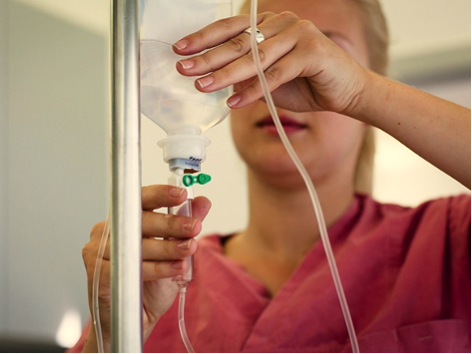
Since then, physicians have given the drug to thousands of depressed adults, including patients in eight successful clinical trials. But fewer have been willing to infuse the drug into the veins of minors. Yale School of Medicine is an exception, and I recently watched a few adolescents receive the infusions with Yale’s clinical trial team. It was less dramatic to watch than I expected, but the kids were definitely high. There was a lot of giggling involved, and they often said that they felt like time was changing and that their bodies felt ‘funny’ and sometimes numb. Nicole admitted, “I’m not gonna lie. I like the feeling of it.”
Perhaps more dramatic than the trips themselves, which happened in a carefully controlled procedure room with a psychiatrist and anesthesiologist ready to intervene if needed, were the interviews that came after. I could see the weight of depression lifted from these patients within hours. Adolescents who were previously ready to end their own lives became bright and hopeful. Psychiatry has never seen a drug intervention so powerful and fast acting. While most anti-depressants take weeks to work and offer modest improvement, ketamine offers dramatic improvement in less than a day.
Because of early success in adult patients, there has been explosion of ketamine clinical trails for adolescents. Frustrated by a lack of effective treatments for children experiencing severe, debilitating, psychiatric disease, doctors have new clinical trials underway for adolescents with depression, anxiety, obsessive-compulsive disorder, and even a rare autism-like condition called Rett’s syndrome. Dr. Gerard Sanacora at Yale School of Medicine explained it like this: “We know high blood pressure causes all kinds of things: heart attacks, strokes, vision problems, and kidney diseases. We treat all of those with blood pressure pills. Ketamine may be the blood pressure pill of psychiatry — altering basic physiology [of neuronal connections] and having a wide range of beneficial effects.”
But there is also reason to be concerned. Before now, ketamine has only been used as a one-time injection for anesthesia. The FDA approved the drug based on trials where the drug was given just once. For depression, however, it is given every few weeks with an unclear end point. Will repeated administration reveal new risks? Studies in adolescent mice show that ketamine can cause long-term cognitive problems. Ketamine-treated mice can also develop a schizophrenia-like illness, with a pattern of neuron loss in the brain that is similar to schizophrenia. However, it’s important to note that the majority of these studies use mice given ketamine doses equivalent to 10 times that which is given to patients.
Dr. Michael Bloch, Yale child psychiatrist and principal investigator of several controlled trials for ketamine for adolescents, points out that the drug is only used for select patients who have severe mental health problems that have not responded to other medications. The infusions are provided in a clinical trial setting, where doctors collect efficacy data and carefully watch for side effects. For each of his patients, the theoretical risks of ketamine are carefully weighed against the risk of suicide. For Nicole, who seemed likely to die from suicide, the calculus was not difficult.
But not all physicians are treading as cautiously as Dr. Bloch. Doctors of questionable ethics are giving patients large doses to inject themselves at home. Pharmacies are making child-friendly ketamine lollipops and nasal sprays. Will this revolutionary drug be the new thalidomide, creating a new generation of children who experience devastating side effects because doctors get too excited too quickly? Ketamine can be addictive, and its abuse can cause devastating memory problems and a bladder disease that can lead to removal of the bladder. Will we create child addicts, addicted to ketamine candy? Will some of these patients taking ketamine at home suffer from laryngospasm, a rare but potentially lethal complication of ketamine administration that makes it impossible to breathe through the vocal cords?
When I spoke to Dr. Jennifer Dwyer, another researcher on the Yale clinical trial team, her reaction to what is happening outside of academic medicine was strong: “the nightmare is happening already. Ketamine should only be given under careful physician supervision with appropriate monitoring.”
Though Dwyer and Bloch stress that doctors need to be careful, they are also quick to point out the potential promise of this research. Dr. Bloch explains, “Suicide is the second leading cause of death in adolescents. 40% of depressed adolescents don’t respond to first-line treatments. Another half of those don’t respond to multiple trials of medication paired with psychotherapy. Other than electroconvulsive therapy, which carries its own risk of memory problems, doctors have almost no other choice.” Suicidal patients are also at a high risk for suicide after leaving the hospital. Existing anti-depressants like Prozac take weeks to work, while ketamine can take effect in less than 24 hours. This could decrease deaths from suicide after patients leave the hospital.
For Nicole, one of those suicidal teens, everyone involved seems convinced that ketamine saved her life. According to her, her family, and her doctors, the theoretical risk of long-term side effects was less frightening than what might happen in the face of chronic hopelessness and suicidality.