Safety data analyzed from five NIH inpatient clinical trials.
National Institutes of Health researchers found that a single, low-dose ketamine infusion was relatively free of side effects for patients with treatment-resistant depression. Elia Acevedo-Diaz, M.D., Carlos Zarate, M.D., and colleagues at the NIH’s National Institute of Mental Health (NIMH) report their findings in the Journal of Affective Disorders.
Studies have shown that a single, subanesthetic-dose (a lower dose than would cause anesthesia) ketamine infusion can often rapidly relieve depressive symptoms within hours in people who have not responded to conventional antidepressants, which typically take weeks or months to work. However, widespread off-label use of intravenous subanesthetic-dose ketamine for treatment-resistant depression has raised concerns about side effects, especially given its history as a drug of abuse.
“The most common short-term side effect was feeling strange or loopy,” said Acevedo-Diaz, of the Section on the Neurobiology and Treatment of Mood Disorders, part of the NIMH Intramural Research Program (IRP) in Bethesda, Maryland. “Most side effects peaked within an hour of ketamine administration and were gone within two hours. We did not see any serious, drug-related adverse events or increased ketamine cravings with a single-administration.”
The researchers compiled data on side effects from 163 patients with major depressive disorder or bipolar disorder and 25 healthy controls who participated in one of five placebo-controlled clinical trials conducted at the NIH Clinical Center over 13 years. While past studies have been based mostly on passive monitoring, the NIMH IRP assessment involved active and structured surveillance of emerging side effects in an inpatient setting and used both a standard rating scale and clinician interviews. In addition to dissociative (disconnected, unreal) symptoms, the NIMH IRP assessment examined other potential side effects — including headaches, dizziness, and sleepiness. The study did not address the side effects associated with repeated infusions or long-term use.
Out of 120 possible side effects evaluated, 34 were found to be significantly associated with the treatment. Eight occurred in at least half of the participants: feeling strange, weird, or bizarre; feeling spacey; feeling woozy/loopy; dissociation; floating; visual distortions; difficulty speaking; and numbness. None persisted for more than four hours. No drug-related serious adverse events, cravings, propensity for recreational use, or significant cognitive or memory deficits were seen during a three-month follow-up.
To overcome the limitations associated with side effects and intravenous delivery, ongoing research efforts seek to develop a more practical rapid-acting antidepressant that works in the brain similarly to ketamine. These NIMH researchers, in collaboration with the National Institute on Aging, and the National Center for Advancing Translational Science, are planning a clinical trial of a ketamine metabolite that showed promise as a potentially more specific-acting treatment in pre-clinical studies. Meanwhile, the U.S. Food and Drug Administration earlier this year approved an intranasal form of ketamine called esketamine, which can be administered to adults with treatment-resistant depression in a certified doctor’s office or clinic.
About the National Institute of Mental Health (NIMH): The mission of the NIMH is to transform the understanding and treatment of mental illnesses through basic and clinical research, paving the way for prevention, recovery and cure. For more information, visit the NIMH website.
About the National Institutes of Health (NIH): NIH, the nation’s medical research agency, includes 27 Institutes and Centers and is a component of the U.S. Department of Health and Human Services. NIH is the primary federal agency conducting and supporting basic, clinical, and translational medical research, and is investigating the causes, treatments, and cures for both common and rare diseases. For more information about NIH and its programs, visit www.nih.gov.
NIH…Turning Discovery Into Health®
Reference
Comprehensive assessment of side effects associated with a single dose of ketamine in treatment-resistant depression. Acevedo-Diaz EE, Cavanaugh GW, Greenstein D, Kraus C, Kadriu B, Zarate CA Jr, Park LT. https://doi.org/10.1016/j.jad.2019.11.028, Nov. 10, 2019, Journal of Affective Disorders.
We’ve come so far in ketamine treatment for depression, and we still have so far to go.
KRIYA held the first conference on ketamine treatment for depression in 2015. Now, 5 years later, there are several medical conferences that support the exchange of information in this field. Raquel Bennett,the founder of KRIYA – The Ketamine Research Institute – says that ketamine is a flexible tool and should be used with freedom and skill. She urges clinicians to make the most of the flexibility of ketamine.
This is the last conference by KRIYA that will be held in this format, according to Dr. Bennett. She plans to possibly shift to an online format next year to accommodate the huge numbers of clinicians who wish to be included.
What’s more, KRIYA has supported, from the beginning, the use of ketamine by different routes and for varied conditions, and encourages participation from providers across the gamut of ketamine applications. So we’re a wonderfully diverse crew who come together for these conferences. As for me, I know that I’ve learned so many things and forged new friendships and collaborations from KRIYA conferences.
And…my own contributions have been so warmly received. As far as the educational gathering, there are psychiatrists, psychologists, therapists, ER physicians, pharmacists, anesthesiologists, neuroscientists, nurses, and experts in consciousness medicine.
Raquel Bennet, Psy.D. Stepped Up as a Leader in the Field of Ketamine for Depression
Dr. Bennett reminds us she has created a “tasting menu,” if you will… from
all corners of the field. At this conference, she opted for breadth vs depth to make us privy to all that’s happening in the field of working with ketamine. And she emphasizes that speakers are working from different paradigms. So, she urges us to listen for the paradigm they report from….and learn.
And she’s right when she says that ketamine is a flexible tool that contributes to a variety of needs. When a patient is too depressed to talk, ketamine lightens depression so they can participate in talk therapy. To help manage severe pain and the depression that goes with it. It can help the patient go deeper into therapy, and explore their traumatic experiences gently. It can treat acute suicidal thoughts and prevent hospitalization. And she says, it can induce mystical visions for existential exploration.
Raquel had much, much more to say, but I want to mention some of the other speakers.
Brent Turnipseed, MD and Lindsey Slater, LPC, from Austin, TX talked about their use of EMDR in ketamine-assisted therapy.
In PTSD, the body’s own reaction to a patient’s traumatic memories activates adrenaline , which prevents their ability to process their trauma. Ketamine can calm the body enough that they can process the trauma without the distraction of adrenaline. As a result, it can help relieve their fears.
EMDR works by helping the patient desensitize by brief exposures to the trauma, then by redirecting the patient’s attention, EMDR induces a relaxed neurological state similar to rapid eye movement (REM).
Elias Dakwar, M.D., psychiatrist and the addiction researcher we’ve often talked about before, gave a wonderful presentation.
He presented a thought -provoking talk on meditation and mindfulness as it relates to ketamine in treating addiction.
The field of ketamine for psychiatric disorders, including addiction treatment, continues to wrangle with how to take ketamine into psychiatry but that’s because our paradigms are problematic. Mainstream psychiatry has tried to cut ketamine down to size instead of using this extraordinary medicine as a DISRUPTOR.
Dr. Dakwar entered addiction research after a long time practice of meditation and with great compassion for the patients he sees.
He described his previous and current work in detail–look for it in the journals.
Ian Mitchell, M.D., Emergency Medicine in British Columbia,
spoke about the uses for ketamine in the emergency department. He spoke about its use for sedation during an emergency procedure, such as setting bones, repairing wounds, or the removal of foreign bodies, pediatric sedation for the same types of procedures, sub-dissociative dosing for pain management, especially for neuropathic pain, to prepare a patient for intubation, sedation for the out of control, prehospital pain relief, and to manage an overstimulated patient.
In British Columbia, ambulances are equipped with intranasal ketamine for prehospital pain management as a result of the PAIN-K trial. More of ketamine’s flexibility.
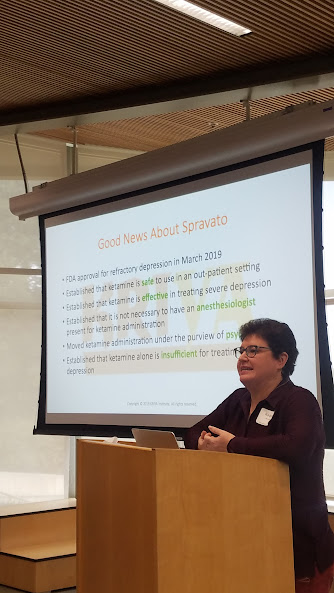
Wesley Ryan, M.D., psychiatrist from Marina del Ray, CA, Parria Zarrinnegar, M.D., psychiatrist in Portland, OR, and Daniel Barton, M.D., psychiatrist from Nashville, TN all presented riveting case reports.
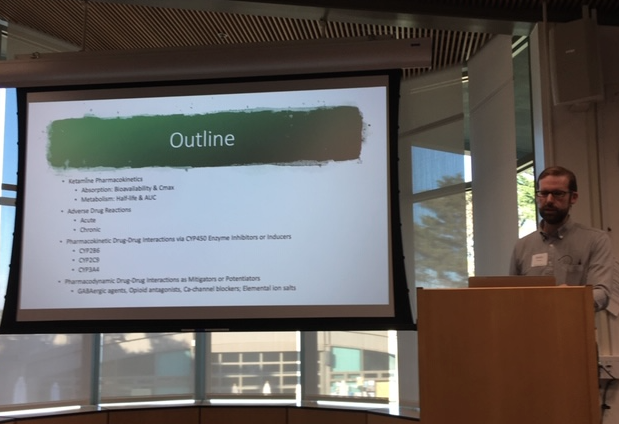
Kelan Thomas, Pharm.D,
spoke about adverse reactions and drug-to-drug interactions that have been documented with ketamine. So important and so well-done.
Annie Oak, a journalist from the Bay area, spoke on the use of ketamine outside the medical setting.
Gita Vaid, M.D., psychiatrist and psychoanalyst, spoke on using ketamine in psychoanalytic psychotherapy in very long session. She talked about how she has witnessed ketamine help patients relax and defenses soften so they can have freedom to talk. The psychotherapist builds relationship with the patient and it can be transformational.
Jason Wallach, Ph.D., is a pharmacologist and neuroscience researcher whose energy and depth of knowledge captivates us every time he speaks. He spoke about the neuroscience and pharmacology of ketamine. Gave an update on some of the other dissociative drugs he’s tested. (I think he’s tested them all!) He made the point that ketamine has been called a dirty drug because of the receptors it hits ex-vivo and in animal models — but that’s not true. It’s really one of the more selective drugs of this class at the doses used in people.
Jessica Katzman, Ph.D., and Harvey Schwartz, Ph.D., spoke about bumps in the road they’ve discovered with ketamine assisted psychotherapy and in the integration work that follows treatment… What is integration? It comes from a latin word that means “to make whole” or “to begin again.” Bring your clinical compass, but don’t forget your humanity. A beautiful duo talk with lots of clinical examples.
Eli Kolp, M.D., a pioneer in ketamine treatment, gave a beautiful talk on the phenomenology of ketamine-induced dissociative states.
There were so many other speakers and so much to absorb–my computer battery kept dying down, so between Surface notes, handwritten notes, and photos, I can’t do justice to the breadth of expertise in the room, and the excitement.
Greg Wells, Ph.D.Sylver Quevedo, M.D., Veronika Gold, M.F.T., Eric Sienknecht, Psy.D. presented as a panel on their model of coordination of care between prescriber and psychotherapist. Peter Koshland, Pharm.D. talked about how to work with a compounding pharmacy for varied compounded preparations of racemic ketamine. Nate Schmidt, A.R.N.P spoke about scheduling and billing logistics.
Sunday was a treasure with a very special presentation by Francoise Bourzat on the Use of Sacred Medicines in the Age of Technology and Medicalization. It was a delight to meet her. She captivated the audience, and her new book, Consciousness Medicine, is a wonderful synthesis of her life’s work.
Kelley O’Donnell, M.D. and Christian Yavorsky, Ph.D. are doing yeoman’s work with KRIYA and presented an excellent (and not dry!) talk on Measuring Clinical Outcomes: Scales and Assessment Tools. And in addition to the training for Ketamine Assisted Psychotherapy that Raquel Bennett presented and discussed earlier in the conference, Jennifer Dore, MD presented a model of training for Ketamine Assisted Psychotherapy developed by Phil Wolfson, MD and Julane Andrews, that they have used around the country.
IV Ketamine can STOP suicidal thoughts fast…Now that’s flexibility of ketamine!
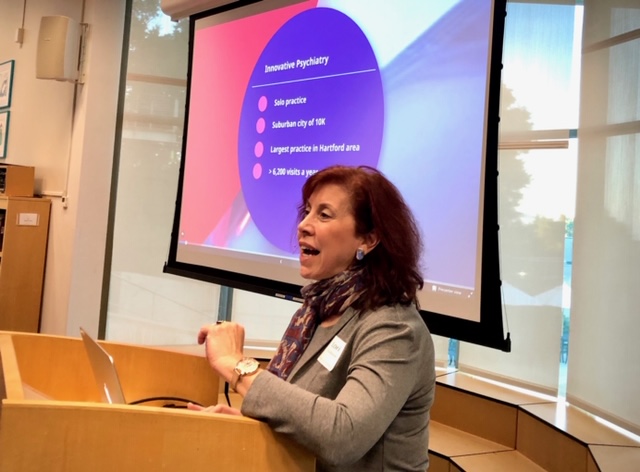
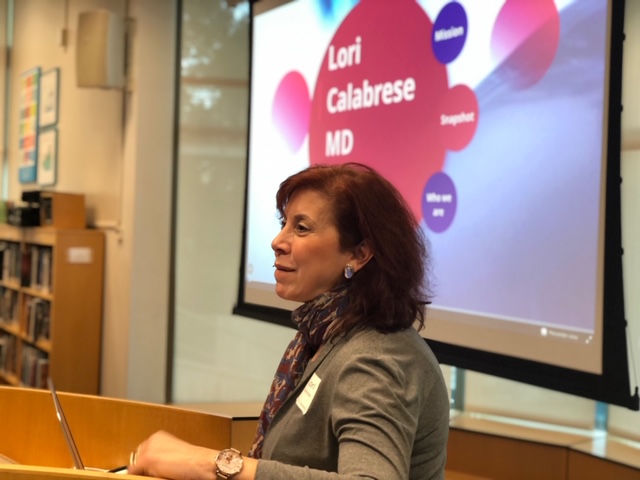
On the last day, and as the next to the last speaker, I took the podium to share my data in working with patients in my own practice, and showing how IV ketamine infusions can stop suicidal thinking, and save patients from having to go to the ER or be hospitalized.
With heartfelt gratitude. These are my people–the clinicians and many of the greats in the field (who were in the audience) who launched my interest, encouraged my work, supported my writing–and showed me how to apply for an IRB. It’s amazing how much can happen in a year. So I saved the newest data and my newest results (using a new protocol and a new rating scale) for my colleagues and my friends here at KRIYA. I wanted them to hear it first.
I wanted to give back to those who have sparked my imagination, nurtured my interests, given wind to my sails.
It gives me such joy to share how this remarkable medicine that can do so much, can also save a life in a short time. And to see clinicians in practice eager to take this information home.
And that’s the beauty of meeting together at KRIYA and swapping stories and describing outcomes and victories that have restored the lives of people we work with.
Looking Back…and Reaching Forward – Preserving the Flexibility of Ketamine
It’s been such a busy fall with travel and speaking engagements each month… along with treating patients. (I’m sure my colleagues are as tired as I am. We need a vacation. Seriously.) But it’s gratifying to look back and know all this information that’s been shared will improve the lives of people we each cross paths with after KRIYA and all the other conferences.
I know these reports “from the front” can seem science-y and vague, but I want you to see how hard clinicians, neuroscientists, and practitioners of all types are constantly working to learn the breadth and depth of what ketamine can do to help people live better, improved lives. That’s really what it’s about. Ketamine’s flexibility allows for treatment that can turn your life around.
And if you’ve been reading along, and wondering if there is help for you, call us. In spite of all the travel and bustle, we’re still in all this to help you get better, live better, and have the ability to build a truly fulfilling life.
You owe it to yourself to try, if you’ve not found a medicine that works for you. It’s not that ketamine is a cure-all for everyone, but it works in so many areas of your brain, that it can restore areas damaged by stress and trauma in most people who are treated with it.
As the holidays approach, give yourself the best chance you can to enjoy the time ahead and the new year that follows.
Welcome to November… this is the month each year we dedicate to thankfulness and gratitude.
I’m going to share with you some experiences I’ve had this week with gratitude, suicide research scientists, and the AFSP. No matter where you are in life, no matter your circumstances…if you think about it..look around you…there is most likely something you can be grateful for.
It may be something fundamental…like clean air or clean water…if your circumstances seem too dire to redeem. But start where you can. And acknowledge gratitude. Because when you do, something happens inside you. Something happens in your brain. It’s almost as though a barely perceptible fragrance emerges. Something that soothes your circuitry… and a partial drop of wellbeing falls into the pool of your spirit.
We’ll be talking more about this as the weeks go by. But think about it. Try to think of something…anything… each day that you can be grateful for.
I attended an inspiring conference last week. It was a gathering of over 400 scientific researchers from all over the world who gathered to exchange their findings and present their work on suicide research.
These are the highest level super scientists, who perform the purist research with the tightest controls and the most elegant statistics to reliably measure their results. And it’s their work that feeds the world’s understanding of suicidality. What is it? And what causes it? When does the risk spike? In whom? And what can we do to prevent it? Without these bright and dedicated men and women, we’d still be in the dark ages with our response as a society to suicidal thoughts and behaviors. Yes, I’m grateful.
And we’d also be in the dark ages about how to respond or help.
In terms of suicide research, these are the finest minds who’ve worked together and separately, tenaciously analyzing their data …and collaborating for decades.
Gratitude, suicide research scientists, and the AFSP have filled up my week and it has me spinning in it all.
An Invitation to Speak
Much to my surprise, I was invited to speak to this stunning gathering. It humbled me, and I felt so privileged that I could contribute to this body body of hard-won knowledge.
I presented my findings from my own retrospective chart review taken from the population of my own practice. Mine wasn’t a prospective randomized placebo-controlled trial. It was a gathering of data about IV ketamine’s impact on suicidal thoughts. Its ability to stop them. To prevent injury or death… or hospitalization — or trips to the ER.
It’s not my intent to make a name for myself as a research scientist… that ship sailed a couple decades ago. I just want to share my experiences treating my own patients in truth…honestly...inviting peer review.
This group received me well, as well as my presentation. I met some wonderful people. And it all got me thinking about what my place is in this universe of psychiatric treatment. Research. And ketamine administration for psychiatric disorders.
Where I Fit
I’m not a researcher. I don’t carefully tease apart large data sets, or curate a cohort to remove mitigating factors or symptoms that could taint the results.
Quite the opposite, actually. I’m a practitioner, caring for my patients, and always seeking ways to help each one get better so they might have access to a fulfilling life. My heart is in helping patients enjoy improved lives…and in healing.
From the earliest part of my training all those years ago, my heart was to find answers, methods, diets, nutrients, medicines… anything that could play a role in restoring these broken-hearted people, one patient at a time.
And that’s what motivates me still. To see sick people get well. To see suffering people get better. For those who can’t function to function again. With all their complicated, intricately confusing pieces to their personal puzzles… to see those pieces relax…integrate…and thrive together in a restored and hopeful person.
So this is all the more reason why I was so honored to be received by this exclusive group of scientists. I felt so privileged that my own work contributed to the body of knowledge on suicide prevention.
My Gratitude, Suicide Research Scientists, and the AFSP
I want to talk about the organization that fuels so much of this research with their funding. The American Foundation for Suicide Prevention (AFSP) was founded in 1987 by beloved actress Mariette Hartley because of her own personal and family struggle with suicide and suicidal thinking.
Her intent was to bring hope and intervention to those who suffer in silence and die alone.
Now, nearly 33 years later, AFSP has local chapters in all 50 states, and offices in NYC and Washington, DC.
They’re busy at work to create a culture that’s informed and prepared to “be smart” about mental health, and the potential for suicide. They teach society in general, and the family and friends of those at risk in particular, constructive methods for finding those with suicidal thinking, and helping them get treatment. To keep them safe.
Gratitude, Suicide Research Scientists, and the AFSP
AFSP maintains a presence in Washington, DC to influence policies geared to save lives, and educate people in all walks of life about suicide intervention and prevention.
International Survivors of Suicide Loss Day is an annual event when people who’ve been impacted by suicide and loss can come together at events around the world to find support, healing, understanding…and to give back.
Thanks to AFSP, when your loved one dies by suicide, you don’t have to bear the pain in withdrawn silence. And if you’re having suicidal thoughts, AFSP provides extensive resources to help you get better and live a healthier and happier life.
As I attended this conference, I realized how far reaching the funding AFSP provides is. How much research they fund. The resources they offer to survivors to help bring healing and restoration. Like the online memory quilt, where survivors can create a “quilting square” to remember and celebrate their loved one’s life, through photos, videos, prose, and poetry.
AFSB also created and supports the National Suicide Prevention Lifeline at 1(800)-800-273-TALK (8255) and the Crisis Text Line reached by texting TALK to 741741.
Carry It Forward this Holiday Season
As the holidays lie ahead over the next two months, be aware that this time of year is not only a difficult time for so many, but also a dangerous one. Let’s be tuned in to identify those around us who may be in need of a listening ear, support, or intervention. Research has shown that you won’t put someone at higher risk if you ask them directly whether they’ve considered hurting themselves or of wanting to die.
Being direct, it turns out, actually saves lives. People who are suffering need hope. And they need to feel included. And that they matter.
Because you DO matter. Your pain matters. You’re not invisible.
If you have thoughts of suicide, or the thought that you don’t want to live LIKE THIS anymore, reach out.
And if you’d like to see if IV ketamine infusions can help, call us.
IV ketamine treatment can erase those thoughts in an afternoon, and leave hopeful thoughts in their place. It can help you want to build your life. It can increase your energy so that you can.
You can feel amazed. Astounded at the change and new hope.
Does it do this for everyone? Well, no. Nothing does. But it does this for most people who have not been helped by medicines before. The more severe your symptoms, the more effectively it seems to work. It does it for far more than any other medicine has.
Just think about it. How far reaching is this one condition?
Sure people talk about being depressed with a casual tone. You get the feeling they feel crummy…but it seems to be their response to circumstances. And when circumstances change, they seem to forget they felt bad. But when you think about who’s affected by severe chronic depression, you think of people who don’t have the energy to get up in the morning. You think about people who are trapped in substance abuse and have grown to hate themselves. You think about people who are just tired. Of everything.
Let’s take a closer look at the people affected by severe chronic depression. Who are they?
Gary is one.
Gary worked hard his entire life. He worked tirelessly to help others improve their lives. He worked to inspire and comfort. But, when you’re in the business of helping people enjoy richer, more meaningful lives, there are always those few who spurn your efforts, and even come back to crush you, if they can. And sometimes it’s the one you believed in the most.
In Gary’s case, there were two of them. They robbed his house when he was away for the evening. Then, spread false stories attacking his integrity. And Gary was cut to the heart. After being robbed and betrayed, he was hurt, angry, disheartened. In fact he was shattered.
Even though he’d always been optimistic, and bounced back after disappointments, this time he utterly lost his footing. Shock and devastation swarmed around and within him. He lost his bearings…and withdrew into the quiet safety of his house.
He found himself acting strangely, behaving in ways he never had before.
Months went by. He ordered food from Amazon and avoided any human contact if at all possible. He didn’t answer the door, and friends gave up, one by one, and became absorbed with their own lives.
A relative helped him get in to see a doctor finally. He was diagnosed with Bipolar II Disorder. The doctor prescribed a medicine to help prevent the hypomanic episodes, but the depression and withdrawal didn’t improve much. Years went by and he settled into a routine of leaving the house maybe once a week. His warm, inviting personality became subdued and cautious.
Something needed to give. To help free him from the box he’d built around himself.
And thankfully something did …but we’ll get back to that in a moment.
And Who ELSE?
Dan is.
Dan had his first drink when he was 14, and was hanging out on a Saturday night with his brother’s friends. They were all 16 and 17, and after getting some six- and 12-packs of beer, they all went to the lake on a Saturday night and drank all they had. Some ended up vomiting, others passed out in the car. Dan did both. But he liked the way the beer made him feel, and he knew he’d be up for drinking more when he had the chance.
High school beer bashes led to frat party blow outs, and while he experimented with some other things when he had the chance, it was alcohol that became his “go-to” in good times and in bad.
At 42, he drank whenever he was free. He had managed to get through college with a degree and land a job that was steady, but nights and weekends were his time to reward himself — whether anyone was with him or not. He worked hard to earn the right to get smashed on Saturday night.
After marrying in his 20s…hoping for happily ever after… he found himself alone and single again in his 30s. So many fights about his drinking. She was just beautiful, and he was so proud to be seen out with her, but she was so critical.
Alcohol Addiction and Depression… A Dangerous Combination
Now in his 40s, Dan began to understand why. And he realized he was likely to spend his life alone and drunk, if something didn’t change. He’d actually tried to stop drinking but something always happened and he was back at it. He felt pretty defeated. It seemed to be bigger than he was.
Every day he dragged himself out of bed, and went to work. He was often hung over, but 25 years of this had helped him develop an armor that got him to work, helped him function well enough to not get fired, and then home again to repeat the habit of every other night of his life. He had come to hate his empty, dead-end life, and his empty, dead-end self.
Dan hadn’t enjoyed anything in his life in at least ten years. He endured, and barely existed. He had no purpose. No joy. He was the chair person for the Dan Hatred Club. It was hard to see any reason to keep living. He wondered how to stop without it hurting too much. He was convinced no one would notice if he was gone.
There’s more to Dan’s story.
And I want you to know what happened. A little later.
While it’s so true that many people are very ill, even disabled in some cases, with severe chronic depression, you can see that many have other illnesses that are complicated by depression.
Some people suffer with a complex combination of disorders, and diagnosis and treatment can be complicated, too. We talked about Gary and his traumatic experience, the depression and phobias that followed and led to his eventual confusing behaviors, and a Bipolar 2 diagnosis.
We talked about Dan, his early introduction to alcohol and the long term impact it had on his brain…and his life. How his drinking gave way to poor social function, and the inability to give his best to his marriage. Eventually he found himself in a self-destructive rut and didn’t know how to turn it around. Then the suicidal thoughts began.
So who else is devastated – and disrupted – by severe depression symptoms?
Cheryl is.
Cheryl is 26. She’d finished college and was working on her masters degree in forensic psychology when she found herself pregnant. She and her husband wanted children, but they weren’t sure when.
Still, she felt like she was carrying a miracle within her, and the couple set about learning all they could about pregnancy, their baby’s development, and child rearing. They wanted this to go perfectly. She would find a way to complete her masters degree. But she was determined to celebrate their child’s life.
Her pregnancy was hard at first, with morning sickness that seemed unrelenting. But around the 13th or 14th week she thought she might be feeling a bit better. She began to browse in baby stores, looking at the tiny clothes and trying to imagine her baby wearing them. Her clothes were also getting tighter, and she shopped to find some pants that were looser and more comfortable. It was all beginning to feel amazing, just thinking about this little person who was safely cradled and growing out of sight….but under her heart.
The weeks dragged by, and her excitement about her baby became almost too much at times. She and her husband began shopping for a bassinet, a crib…and a stroller. She learned about support meetings for breastfeeding mothers and attended as often as she could. There was so much to learn!
Weeks turned into months, and finally she was in her third trimester. Just 3 more months. Through her pregnancy her emotions were filled with excitement and joy. A sense of wonder seemed to give the whole world a glow.
Happy Times Preparing for Baby
She and her husband attended childbirth classes and toured the hospital. They practiced exercises and breathing patterns at home to try to truly equip themselves for the adventure of labor and delivery.
Then, when she was 41 weeks along, those Braxton-Hicks contractions everyone talked about began to get out of hand. Within a couple hours she was in the ER being checked out.
Finally, she was in labor.
Cheryl’s labor progressed normally the first 10 hours. Then, in spite of hard and nearly constant contractions she was no longer progressing. Her doctor confirmed his suspicions: the baby’s head was lodged at an angle in the pelvic region and couldn’t move forward. He called for a C-section.
Within 15 minutes she was wheeled into the operating room, and suddenly asleep. When she awoke, everything seemed strange. Then she remembered the labor, the baby, and oblivion.
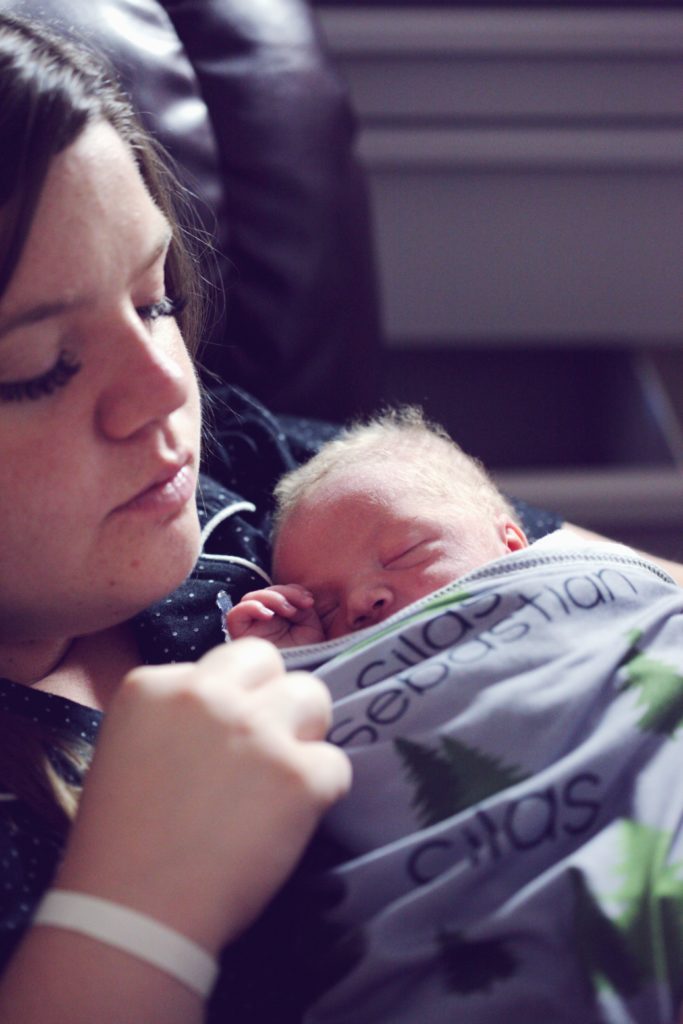
Her husband was smiling and told her they have a beautiful baby girl. She felt too groggy to understand what he was saying. She blinked hard to try to clear her head. Her husband handed her a little bundle. She laid it in her lap. What was it?
As the fog cleared her head, her memory of the labor returned. Her new baby slept in her bundled blanket. And Cheryl put the pieces together. She had had a baby. She was sleepy because of emergency surgery. The baby couldn’t get out… But where was that baby?
Traumatic Birth Can Interfere with Bonding Between Mother and Child
She asked her husband, and he told her their baby was in her lap. But the bundle in her lap didn’t look like anyone she knew. It just didn’t feel real…somehow…
She felt no connection to this tiny human, in spite of her husband’s reassurance… She felt sure she would have recognized her own baby, right?
Cheryl found herself detached, stunned, disconnected from feeling like a mother. Her strange behavior puzzled her husband. Why didn’t she cuddle their beautiful baby girl? The nurses tried to help her breastfeed, but the baby only cried. Almost as if this baby girl could sense her mom’s disconnect.
Cheryl and her husband took their new baby home and named her Phoebe Mae. She desperately wanted to feel something good toward the baby. But, she didn’t. She couldn’t. All that anticipation for 9 months, and this is it? Endless exhaustion and sleepless nights? Where was the joy..?
Her behavior worried (and angered) her husband. He just didn’t understand his wife’s coldness. Was this damaging Phoebe? What damaged Cheryl to cause this?
Months went by and Cheryl had long since taken up bottle feeding Phoebe formula. Besides, her husband could help more easily this way.
Then, Phoebe’s first smile was for her daddy. And her first laugh, too. Cheryl felt a bit jealous that she stayed with her daughter all day and fed her and took her on walks, but she really only responded to her daddy.
Who Else is Affected… or should I say, Overwhelmed ?
The family is.
Everyone who loves you. They worry, they try to help, they pitch in, they listen.
And try as they might, they’re helpless. And desperate for solutions. Your severe chronic depression breaks their hearts.
These few examples give only a glimpse of the complex symptom clusters any one person might suffer. There are so many more.
But IF, and only IF, you can safely and effectively reduce or even eliminate, the symptoms of depression, you may be able to see your life restored and functioning again.
Of course, traditional SRI and SNRI antidepressants play their role in helping people with depression feel better. Roughly a third to half of them…maybe a bit more. For those people, antidepressants are enough.
Remember, there is no medicine for depression that is as fast working as ketamine. No other medicine is as widespread in its antidepressant benefits in the brain. And no other medicine helps as many people recover, even achieve remission, and build restored, rewarding and fulfilling lives like IV ketamine treatment can.
Plus, it’s safe.
Ketamine doesn’t cause long lasting side effects. The notorious effects most antidepressants display, like sexual dysfunction and weight gain, don’t exist with IV ketamine. Ketamine doesn’t raise or lower the blood levels of other medicines you’re taking. It just goes to work. And, hopefully for you, it accomplishes the transformative restoration it’s so famous for.
The World Health Organization includes ketamine on its List of Essential Medicines. Respected around the world in ORs, ERs, disaster areas, and war zones, ketamine isn’t new.
Remission Often Replaces Severe Chronic Depression at Innovative Psychiatry
How did IV ketamine treatment impact Gary, Dan, and Cheryl? Did they recover from their own severe chronic depression symptoms?
IV Ketamine Treatment Does Its Best Work When Symptoms of Severe Chronic Depression Seem Untreatable
Remember Gary?
And his boxed-in anxiety-filled existence? The same friend who helped him go to the doctor, also helped him access IV ketamine treatment.
After 7 infusions, Gary bloomed. The warm, outgoing, generous man who had served people in need all his life re-emerged. Gary’s confidence returned along with his energy to participate in the lives of people who needed his help.
His life became rewarding again, filled with activity and relationships. You might say his best self was restored.
Then there was Dan.
Dan was suicidal when a friend told him about IV ketamine treatment. He learned that ketamine not only relieved depression, but could be effective in helping break addiction. And… that it could stop suicidal thoughts in a few hours. Dan wanted to see what it could do for him. He felt like this was his last ditch effort. He didn’t want to die, exactly. But he didn’t want to live like thisany more.
Well, he was not disappointed. The first half hour of the first infusion, those images of death and thoughts of dying disappeared. Almost like poof! gone. He emerged from the infusion smiling. That was a good start alright.
That night, he found he had no interest in a drink, so he skipped it. How about that, he thought to himself.
After the second infusion, he definitely felt less depressed. Improved. NOT great…but better. By the time he arrived for the 4th infusion he was feeling pretty good. Hopeful…motivated.
It’s been six months since his 6th infusion now, and Gary feels like he’s living. He’s stopped drinking completely, sees a few friends, met a terrific woman. His future looks bright.
And Cheryl…?
Well, Cheryl’s husband heard about ketamine for depression from a friend at work. He encouraged her to talk to her doctor about it. Her doctor said that effectively treating the depression could reverse her struggle with bonding.
When Phoebe was six months old, Cheryl received her first infusion. On the way home with her husband she could tell no difference. He encouraged her to keep an open mind. That he’d heard it could take awhile.
By the 4th infusion he noticed she was taking initiative in the kitchen, preparing a new recipe. She hadn’t done that since Phoebe was born. Then the next day she was sitting with Phoebe playing patty cake… and that night rocked her, kissing her on the forehead as she drifted off.
She was expressing joy more and more and laughing with Phoebe. By the end of the 6th infusion she didn’t feel perfect but she did feel happy. The doctor said it would get better and better.
Severe Stress Can Cause a Setback
Then Phoebe got sick. At 8 months she caught her first cold. Cheryl was up all night comforting her, sitting with her near the humidifier to help her breathe. This continued for 4 days until Phoebe started feeling better.
But the lack of sleep and strain took their toll. And Cheryl’s depression returned. Not as severe as it had been. But severe enough. A couple weeks later her husband asked her to call the doctor, who told her she may need another “booster” infusion. So she complied.
She felt much better again after the infusion, and Phoebe stayed well all summer. They had daily walks in the sunshine, and Cheryl and Phoebe both had rosy cheeks and and a tan.
The next time Phoebe got sick in the fall, the stress didn’t affect Cheryl adversely at all. She had the resilience to go without sleep as she cuddled her baby girl through the illness.
Before long, Phoebe turned a year old. Cheryl and her husband threw a big party for all their friends. It was a celebration of their little girl’s milestone, and for the joy Cheryl and her husband were enjoying again.
This Can Happen for You, Too
These stories all have happy endings. But low dose IV ketamine isn’t for everyone. Is there any medicine that is? Nope…not a one. But the response rate to ketamine treatment is remarkably high.
Still, that remarkably high response rate relies on skilled administration. Low dose IV ketamine treatment is not a one-size-fits-all treatment. It requires careful titration, identifying specific responses in the patient, and finding the sweet spot in dose and rate that yields the best outcome for each individual.
Unfortunately, many providers of ketamine don’t understand this, and give the same dose at the same rate to every patient, then schedule them to come in for regular maintenance infusions, indefinitely.
In other cases, they try a different dose with each successive infusion, because they don’t really understand how to achieve the therapeutic response.
Find Restoration from Severe Chronic Depression
Innovative Psychiatry is the premier provider of IV ketamine treatment in Connecticut for safe, effective treatment of depression and other psychiatric disorders. We offered the first ketamine treatment center of Connecticut for severe chronic depression and other disorders.
Innovative Psychiatry offers you a most extraordinary psychiatric treatment, IV ketamine. Some people require booster infusions now and then for awhile, and others achieve remission with the initial six infusions.
Every brain is different, just as every person is different.
We can’t predict what it will be like for you, but we can promise to provide the most effective administration of this remarkable treatment that can be found anywhere.
Can you relate to Gary, Dan, or Cheryl..? Or maybe to their loved ones? If you have similar symptoms or variations of your own, that have not responded to the treatments you’ve tried, call us.
Like the people we’ve talked about here, you can have restored joy, renewed initiative and motivation, the energy to pursue your dreams, and to rebuild relationships.
We’re here to help. Let’s work together to help you live a fulfilling and rewarding life.
Sam Chaney walked up to the quiet car in the dark.
It was a place by the lake frequented by teens for romantic interludes, or beer drinking. This car was dark. Silent. But running. He tapped on the window with a bit of anxiety. He’d just been reading about the teen suicide epidemic this morning.
“Hello – Metro police! Open the door please…”
Silence.
Tap tap tap…”Open up!”
Nothing.
Sam stepped back and looked at the car. Only then did he see the rags stuffed into the exhaust.
“Oh no….”
After trying to open the door, Sam used his baton to break the glass. The choking odor of exhaust wafted into his face. Carbon monoxide…
Inside the car he saw the lifeless bodies of four teenagers. One looked to be no older than 14.
Immediately he called for emergency personnel and then pulled each body out onto the ground in the fresh air.
One by one he checked their pulses. Nothing.
Instinctively, he did 15 chest compressions, then breathed twice into the mouth of each one. Then 15 more.
After the first one, he moved on to the next, then to the next. Their bodies were cold.
What is Causing the Teen Suicide Epidemic?
The suicide rate in teenagers has increased 56% since 2007. (Centers for Disease Control and Prevention) And even though the homicide rate in teens decreased 23% between 2007 and 2014, it increased again 18% between 2014 and 2017. Even so, the suicide rate has now surpassed the homicide rate in teenagers.
Suicide deaths in teens are also higher than accidental deaths such as transportation crashes or drug overdoses. These accidents represent the 3rd leading cause of death in people aged 10-24. But suicide has risen to the 2nd leading cause of death in teenagers.
Why??
We don’t really know. There are so many reasons. So many factors. Depression rates in children and teens have increased; in fact, they’ve increased across all age groups. Increased drug use has led to increased overdoses, too.
But a big factor seems to be embedded in the dramatic increase of social media use among this age group. This is a generation who has cut their teeth on facebook, instagram, and pinterest. Add to that Yelp, where they feel free to blast a restaurant with criticism every time they eat, just for the sport of it.
A Forum for Speaking One’s Mind – Uncensored and Unsupervised
In short, social media has allowed them to speak their mind, which isn’t necessarily bad. But to speak it without a filter aimed at diplomacy or compassion. We all know it’s easier to say something critical in writing than face to face. And during the teen years, insecurity is often considered hidden by cruelty to others.
Because of this un-squelched form of communication, privacy has taken a hit, too. A middle schooler catches someone in an awkward situation and sends the photo or video to his contact list. In seconds, a fragile, shy, insecure 13 year-old is publicly humiliated with nowhere to hide.
Darwin’s theory about the survival of the fittest is reduced to survival of the ones who dish out the most cruelty without falling prey to the same treatment.
For a child or teenager, the teen suicide epidemic seems daunting and intimidating. Her life experience or capacity to cope with such public shame is painfully limited, if not utterly lacking. And the under-developed prefrontal cortex in her brain prevents her ability to see such a crisis in the “big picture,” –that is, the idea that this too shall pass. Impulsivity can then win out …with a decision so permanent that all that’s left is the grieving.
Far too many of the children and teens who have taken their lives, had been reporting bullying. When circumstances didn’t change, they seemed to feel it was left up to them to stand against the assaults and onslaughts by themselves. And eventually, they may have become weary.
Chronic Stress Causes Pruning of Signaling Structures = Depression
We know what chronic stress does to the circuitry in the brain. Eventually, the synapses break down, dendrites become pruned…and depression ensues.
So a depressed person is more vulnerable to suicidal thoughts…images… and even action.
And there’s another factor.
Too often, as teens become depressed, they grow silent. They withdraw.
At Herriman High School in Utah, a total of 6 students ended their lives in a single year.
After each successive death occurred, the teachers, administrative staff, and parents became increasingly desperate to do something to prevent more.
The students, as well, experienced increased anxiety, overwhelm, and concern that students around them were suffering but no one knew who was at risk.
Parents Seek Answers for the Teen Suicide Epidemic
Parents spoke of the need to teach their children to talk about their feelings, and how things are going, from an early age. The mother of a boy who died said that she had no idea her son was struggling. She just thought he was being a normal teenager. She said, “We need to give them the ability to talk! And I think we’ve missed that along the way.”
As a result, both students and administration initiated programs to help everyone cope with their own anxiety and grief, and to also encourage everyone to reach out to anyone who seemed to be alone, isolated, or struggling.
QPR
In this atmosphere of tragedy, communication became a key focus. Since the parents of some who died recalled that their child had seemed withdrawn, spending long hours alone and talking very little, the students and staff learned to watch for withdrawal in any student. They developed a code: QPR. Similar to CPR, QPR is specific for saving the life of someone who’s suicidal.
Photo by Rachel Lynette French on Unsplash
Q stands for Question. They realized that people who are struggling may wish they could talk to someone, but maybe they don’t know what to say. In fact, they may not realize they’re struggling as much as feeling “off.” So the strategy they developed is to be bold enough to ask questions.
“Hi, would you like to sit with us?”
“How are you…?”
“You don’t seem to be feeling very well. Do you want to talk about it?”
“Are you at a point that you’re going to harm yourself?”
For teenagers, who struggle to talk at all, this initiative requires a brutal bravery, but as they weigh the awkwardness against the loss of life, they find they can push past the nervousness, and just ask.
P stands for Persuade. It means pushing through your own feelings to focus on the feelings of another. Then persuading that person to trust you enough to accept your invitation…answer your questions…consider solutions…
R stands for Refer. Part of the P in Persuade includes persuading the person to accept help and treatment: the solutions. It means including parents, the school counselor, and outside psychiatric help, as well.
Students refer to QPR as a useful tool for fighting the teen suicide epidemic and also for the helplessness they’ve felt as they’ve heard the announcement of each student who died. They feel armed with a way to help stop the deaths, and to know they’re doing something.
Joining Forces to Save Lives
Just as this high school pulled together to close the gap between hurting teens and everyone else, we can do the same.
To approach those who seem to struggle and dare to get your hands dirty. Dare to ask the questions. Then listen. Then work together with them to help them get treatment and to be safe.
Lots of Help is Available
But start with a comprehensive psychiatric — find the best doctor you can to do the best jobthey can to pull together all the pieces, all the stressors, all the symptoms. To diagnose and to offer treatment — rapidly.
And to present options and reasonable choices for treatment, the evidence for each, and the speed of response: medications, different talk therapies, TMS, and IV ketamine.
Speed is critical if you’re trying to save a life.
IV Ketamine Treatment works fast to Restore Brain Circuitry
So often, anguish is missed. Overlooked. Or it just doesn’t lift even with the first or second (or third) thing you’ve tried.
We see the end-results of anguish every day when everything breaks down: depression, anxiety, self-loathing, withdrawl. Loss of interest. Loss of eye contact. You don’t even smile anymore. (Or when you do, it’s phony.)
If you feel like this, or if someone you love feels like this, if treatment isn’t working, know that there is hope. You can feel better, you can repair and rebuild the circuitry that will allow that. And it can happen fast.
IV ketamine treatment specializes in rebuilding broken down dendrites and dendritic spines — it turns on mRNA to switch on DNA to turbo-boost Brain Derived Neurotrophic Factor (BDNF) and those dendrites and synapses just explode in new growth. Repairing and restoring the circuitry, and giving you joy, initiative, motivation, energy, … and hope.
Once repair gets underway, your brain can transmit signals along those repaired and restored pathways. Your brain lights up, and your eyes light up with it.
There are solutions.
And even if your insurance doesn’t cover this extraordinary treatment yet, there is financing to help you pay for it. And there are voices clamoring for it to be covered because it can stop suicidal thinking. It can turn around that trip to the ER and make it unnecessary. It can help avoid the need for hospitalization.
We’ll work with you, your doctor, your therapist, and your family, to help you feel better, function better, and really enjoy the details of your life again. If it’s been a really long time since you felt that way, you’re probably going to be astounded. Because the longer you’ve been ill without relief, and the more severe your symptoms are, the better IV ketamine treatment may work for you. It’s funny that way. It’s a bit of a show-off.
Let us help you find yourself, your creativity, and your heart again.
To the restoration of your best self,
Lori Calabrese, M.D.
We can all help prevent suicide. The National Suicide Prevention Lifeline provides 24/7, free and confidential support for people in distress, as well as prevention and crisis resources for you or your loved ones.
The National Suicide Prevention Lifeline 1-800-273-TALK (8255)
The Veterans Crisis Line and Military Crisis Line 1-800-273-8255 Press 1
We’re smack in the middle of a couple weeks focused on the quest for improved treatments for depression and anxiety.
This past Thursday was World Mental Health Day, dedicated to raising awareness for mental health …and this year’s efforts were focused on “40 seconds of action” to help reduce the risk of suicide. Because every 40 seconds, worldwide, we lose someone to suicide. And right on the heels of #WorldMentalHealthDay, we’re jumping into #OCDAwarenessWeek, which is promoted internationally each year by the International OCD Foundation during the second week of October. It’s an opportunity to LEARN about Obsessive-Compulsive Disorder and find ways to support those who live with it every day. And every discovery that researchers find lays the groundwork for improved wellbeing and fact-based treatment regimens. Like polyunsaturated fatty acids (PUFAs) in your brain. Let’s talk about how you can get your PUFAs straight and reduce the symptoms of depression.
BBRF Researchers Help You Get Your PUFAs Straight
The Brain and Behavior Research Foundation (BBRF) just released information about a new study that may explain why some people have more severe depression than others.
Led by M. Elizabeth Sublette, M.D., Ph.D., and J. John Mann, M.D., and published in the Journal of Affective Disorders, the study identified a relationship between polyunsaturated fatty acids (PUFAs), specialized proteins that transport serotonin (SERTs), and the severity of, as well as vulnerability to, depression.
This is a short excursion into only ONE aspect of the complexities of major depression and bipolar depression. But it’s important, and may give us something that we can do — actively, ourselves … every day — by modifying our diet. It’s back again–the importance of what we feed our brain. Not just diversifying our microbiome, ensuring we take in micronutrients, but choosing the best lipids to feed our brain health. Getting our fatty acids right.
See what you think of this…
BBRF Researchers Find New Discovery About Reducing Your Vulnerability to Depression
Using PET scans, researchers have found an intriguing relationship between certain types of polyunsaturated fatty acids (PUFAs) and the specialized protein transporters that move serotonin (SERT) to where it needs to be to do its job to reduce anxiety and improve your mood.
These are both ordinary, commonly seen components in the brain, but together, they seem to play a role in either causing depression… or at least causing you to be more vulnerable to it.
This study discovered a significant relationship tied to a certain PUFA known as arachidonic acid (AA). They identified a relationship between PUFAs and levels of that serotonin transporter, SERT, in the 6 most important areas of the brain. Plus, it showed how these two factors may influence the severityof depression.
The relationship is U-shaped, and inverted. It’s nonlinear. And that’s important.
Sounds complicated, I know. But here’s how they discovered this connection.
Study Subjects Stopped Their Medications for At Least 2 Weeks
The research team invited 21 adults, who were each in a full episode of major depression, to participate in the study. Each of these participants had refrained from any medication that affects serotonin levels or the biochemical system that produces arachidonic acid for at least 2 weeks.
A number of weeks before the PET scans, the team evaluated plasma levels of each participant for three specific PUFAs. DHA and EPA are both omega-3 fatty acids, and AA is an omega-6 fatty acid.
Measuring these three levels in six specific and key regions of the brain demonstrated their significance in depression.
Now get this:
In a healthy brain, SERTs are widely available in abundance throughout the brain so they can remove and recirculate those serotonin molecules from spaces where they can’t function.
For example, when they get stuck in spaces between the sending and receiving neurons after a signal has been sent. This is what happens: The SERTs take up the serotonin and return it to the sending cell. So it’s ready for the next message that needs to go out. Easy.
Now that’s what happens in a healthy brain.
However, a number of peer-reviewed studies have found that there’s a low availability of SERT in the brain of someone suffering from depression…or bipolar depression. The most commonly prescribed antidepressants, (SRIs), block the SERTs so the SERTs can’t move the serotonin out of those spaces where they’re stuck. This keeps serotonin available in the synapses between the neuron cells which promotes more signaling.
But In A Depressed Brain…Well, You Need to Get Your PUFAs Straight
However, this team of researchers discovered something about those three PUFA levels they analyzed before the scans. Only AA actually affected the availability of SERTs across those six brain regions they viewed with PET scans.
In fact, they found that the lower the AA level a person had when evaluated before the scans, the greater that person’s SERT transporter level they saw in the PET scan.
Reduced AA level = More Transporters; and Therefore Improved Mood…?
This is so revealing. We need to get our PUFAs straight.
Because depression and bipolar depression are complex and are each affected by so many factors. We’ve learned so much about depression through observing ketamine’s actions in the brain. And while we no longer believe the key to depression treatment is as simple as increasing level of serotonin (or any other neurotransmitter), we do know that serotonin binding plays a strong role in freedom from depression or conversely, a vulnerability to it.
Of course, our BBRF research team called for more studies to verify these findings. They asked that other researchers carry them a few steps farther. We need more information about the science behind polyunsaturated fatty acid supplements in depression. How do we work with complex, inverted, U-shaped relationships?
Hopefully, we’ll be hearing more about the effect AA has on depression and vulnerability to it.
This may sound like a little thing …a small finding from a ton of research. But it’s a breakthrough. And when you add up all the individual breakthroughs, together they can result in your changed and improved life.
Get Your PUFAs Straight and Bring Depression To Its Knees
At Innovative Psychiatry we rejoice with our patients whose symptoms lift after IV ketamine treatment. These patients didn’t responded to traditional medications. We continue to use a myriad of medicines, treatments, and regimens to relieve symptoms. And we bring the latest research findings to our practice. But for most patients, nothing compares to IV ketamine’s restoration of resilience, creativity, and initiative. The results bring fresh perspective, fresh hope, and renewed relationships as people rebuild their lives with enthusiasm and clarity.
Let’s keep spreading the word that remission of symptoms can happen. It’s no longer a pipe dream.
If you… or maybe someone you love… aches for relief from trauma or depressive symptoms, call us.
We know others who suffered from the same kind of pain, vacant-ness, and despondency you do. We can help.
Data Published from a Real World Psychiatry Practice Shows How Ketamine Infusions Can Avert ER Trips and Hospitalizations
SOUTH WINDSOR, Conn., Oct. 8, 2019 /PRNewswire/ — Lori Calabrese, M.D., Innovative Psychiatry (https://www.loricalabresemd.com). Local psychiatrist publishes data demonstrating that the use of a series of IV ketamine infusions, with dose adjustments, can stop suicidal thoughts and avert ER trips and hospitalizations. The research, published in the International Journal of Psychiatry Research, comprised a retrospective chart review of 231 patients with treatment resistant depression and co-occurring complex psychiatric illnesses treated in a large psychiatry office.
“This is the first report from a real-world psychiatry practice treating severely ill, suicidal patients with treatment resistant depression and complex psychiatric co-morbidities. It involved looking back at the treatment we provided to a large number of patients with treatment resistant depression who were suicidal. For them, serial, titrated ketamine infusions were life-saving. There were no suicide deaths or suicide attempts, no need for ER trips or psychiatric hospitalizations,” says Lori Calabrese, M.D., Medical Director of Innovative Psychiatry in South Windsor, CT. “This is the first report of IV ketamine used to treat suicidal thoughts in patients with treatment resistant depression in a real outpatient practice setting, the first report of the use of serial titrated infusions in comprehensive psychiatric practice, and the largest group of patients reported from one site in published studies of IV ketamine for treatment resistant depression and suicidality,” she says. “It’s a lot of firsts.”
Dr. Calabrese explains that this population of adolescents and adults is the most challenging to treat because their lives are at risk. Medicines that can rapidly treat suicidal ideation are few and far between, and desperately needed. “Remarkably, most of these patients had already tried at least 4 different antidepressants without improvement. The majority had made previous suicide attempts, had been hospitalized, and were currently being treated with complicated medication regimens without relief. Others had no relief from ECT or TMS (transcranial magnetic stimulation). Yet most of them responded dramatically to ketamine infusions,” she stated.
In many cases, a single ketamine infusion stopped suicidal thoughts completely, even if they’d persisted for months. If they didn’t stop, a short series of treatments significantly reduced suicidal thoughts in 79%, and completely stopped suicidal thoughts in 59%. “This is a dramatic result,” Calabrese states. “We’ve never had anything like this to offer patients.”
Of the 231 severely ill and high risk patients, there were no suicide deaths, no suicide attempts, no need for trips to the ER for suicidality, and no psychiatric hospitalizations during treatment and for an additional 4 weeks.
The lack of available treatment options, other than ECT, for people with treatment resistant depression who are suicidal, and often have several other psychiatric conditions associated with agitated states and increased suicidal risk, causes a critically high burden for these patients—financially, in quality of life, and in survival. “This treatment can offer these patient an extraordinary possibility,” Calabrese states. “The potential to avert suicide, preserve life, reduce patient and family suffering, and reduce healthcare costs is enormous.”
About Innovative Psychiatry (https://www.loricalabresemd.com) – Full service psychiatry practice offering patients innovative treatment including, but not limited to, IV ketamine infusions.