
Tag: Ketamine

  • Resilience: Adapting To Emerge as Your Best Self

    Resilience: Adapting To Emerge as Your Best Self

    A woman's hand reaching out for the possibilities that can come from her circumstances, and that's resilience.Do you know someone who can’t seem to go through difficulty without collapsing emotionally?  Whether the difficulty is a natural disaster, a broken relationship, or a financial loss…

    Some people can weather difficult storms with strength and resilience. Others become grief-stricken and shut down every time something disappointing happens.  Why is that?

    So what is resilience, anyway? 

    Resilience is the ability to absorb and then find a healthy way to adapt to what you’re faced with. 

    Attitude: Resilient or Victimized?

    A key to understanding and developing resilience, is attitude.  Or better said, perception. Those who look for ways to learn and grow in each difficulty presented to them, are the ones who are actively growing a bumper crop of resilience. It’s how you perceive the difficulty you face that makes the difference.

    Do you meet challenges on your own terms, believing the outcome is based on who you are and how you respond?

    Or…do you feel victimized by storms, fold up and lick your wounds when times are tough? Do you tend to see the glass half empty? If so, you may have a difficult time recovering from an adverse situation or experience.

    Resilience Takes Practice

    Anyone who goes through life with a proverbial halo over his head, never challenged, always rewarded, may or may not have the resilience he needs to draw from when times are tough.  Until you face hardship or difficulty, you never know how you’ll respond to it. 

    On the other hand, we also know we can train ourselves to be less resilient. if you’ve had challenges every step of the way, you have the best opportunity for displaying resilience, or else learning how to develop it. Because it’s in the presence of the storm that resilience is developed.

    Psychologists who conducted studies of children in extremely trying circumstances learned how they either succumbed to or surmounted their situation. Among the children, about 2/3 succumbed to their circumstances, losing their belief in themselves, and their hope for future achievements.

    But about 1/3 responded to their dire circumstances with determination and a belief that they were in control, that their outcome would be the result of their own decisions and actions.

    What they concluded is that the children who rose above their circumstances, who piloted their own journey through their personal storms, were those who did not view their difficulties as traumatic, but as just another difficulty to be overcome.  

    Trauma is How You Perceive It

    Only those who view difficulty as traumatic are, in fact, traumatized.

    What’s more, anyone can learn to view the difficulties they face in life in a resilient way. By learning to view an emotionally-charged experience as less emotional, and more factual, you can remove the traumatic association of it. Then, train your emotions to view it with less pain. By doing this, you can learn to regulate your emotions, and strengthen your resilience.

    On the other hand, we also know we can train ourselves to be less resilient. By exaggerating the emotional feelings tied to an experience, by thinking about it, talking about it, meditating on it, we can convince ourselves we’ve been traumatized. And that traumatized orientation will continue to follow us through life unless we set about to change it. We don’t even realize we’re doing this to ourselves.

    When you perceive a difficult situation as one that’s threatening, your own ability to face it and overcome it drains away. Conversely, view it as a challenge to be overcome, and your emotions remain strong and agile, adapting as you go and building inner strength along the way.

    This is what those resilient children discovered on their own.

    Some of them may have been fortunate to find a friend or relative who gave them support, as studies have shown that the most resilient of people are those who are closely connected to mentor or peer group support.

    David Brooks’ work on resilience in children has shown that the one thing that is found is children who develop resilience is the presence of a charismatic adult in the life of that child.

    Studies of military groups found those units with the strongest peer support and highest morale were the most adaptive in stress situations such as battle.

    Flexibility
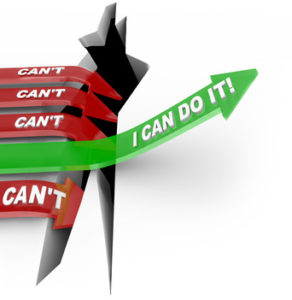
    Graphic image shows all the indicators that say you can't do it, but then one emerges that says, I CAN DO IT! This is resilience.

    Flexibility is a core value for resilience. The ability to adapt to circumstances as you navigate through them, gives you the power to emerge successful.

    In the award-winning movie, Pursuit of Happyness, Chris Gardner (played by Will Smith) faced ever-increasing obstacles and hardships that would have crushed many to despair, as he sought a better life for himself and his son. But his flexibility in the face of those hardships, and his stubborn tenacity in holding to his belief he would overcome them was the reason he did.

    In one scene, he locked himself and his son in a public restroom to sleep in safety, then woke the next morning to continue his quest to get the career that would change his and his son’s destiny.

    For some, that one experience alone would have been seen as traumatic. And hope would have drained away. But for Chris, it was a means to accomplish what he had to do to achieve what he wanted to achieve. It was a bump on the road to success.

    Resilience is Learned

    And, remember, you can learn to adapt, to change the way you see the challenges and stressors, every day. Take a moment to look at your circumstances. Are they as damaging as you tell yourself they are? Can you look at them with an objective view and see ways to adapt your attitude to move forward?  If you can, you’re building your own crop of resilience, and paving the road to your own success. There’s no shame in realizing you have invited a traumatized view of an experience. We’ve all done it. The key is to change to become a happier person.

    You really are the captain of your fate in this life, as you strengthen your skill to ride the ups and downs in life that surround you.

    Look for ways to develop resilience in your own life daily. The opportunities are all around you. And if you don’t see where to start, you may benefit from our innovative approach and  advanced psychiatric services, such as TMS or IV Ketamine treatment.

    Contact us and let’s discuss your options. You really can feel better and live a rewarding life.

    To the growth of your best self,

    Lori Calabrese, MD

    Lori Calabrese, MD offers innovative psychiatric treatment

  • When Depression Medications Don’t Help

    When Depression Medications Don’t Help

    Options for treatment-resistant depression are IV ketamine and TMSTreatment-resistant depression

    When you’re depressed and taking an antidepressant, it may seem like it takes forever for it to work. While therapy, in addition to medication, can help… it may not be enough if you’re experiencing treatment-resistant depression. Some people find after many months with a medication that there’s no relief. If that’s the case, we can offer options that can make a dramatic difference. In addition to traditional antidepressant medications, there are new treatment options available.

    1. Ketamine

    Ketamine is an innovative, off-label treatment of depression, which has created a wave of scientific interest and excitement in psychiatry and is administered intravenously. Unlike traditional antidepressant medication, ketamine acts quickly and has few side effects. Many patients find that ketamine is a much better option when traditional medications don’t work for them.

    Most patients find that their mood improves within hours of treatment instead of weeks or months. For those with major depressive disorder (MDD) or those contemplating suicide, fast treatment is crucial.

    2. TMS

    Transcranial magnetic stimulation (TMS) is another alternative to the treatment of depression. This is a non-invasive procedure that uses magnetic fields to stimulate the nerve cells in the brain and can lead to response and remission even when other treatments haven’t been effective.

    During treatment, magnetic pulses are delivered to the specific section of your brain in charge of controlling your mood. It may activate regions of your brain that have been inactive due to depression, which improve your depression symptoms and allows you feel better.

    Being depressed can take its toll on your life in many different ways. If you think you’re medication isn’t working, there is hope, and we are here to help you. IV ketamine and TMS may work even when other strategies don’t. To learn more, or to schedule an appointment, please contact our office at 860.648.9755.

    To getting you back to your best self,
    Lori Calabrese, MD
    calabrese-0510_g_crop

  • IV Ketamine Therapy for Postpartum Depression

    IV Ketamine Therapy for Postpartum Depression

    postpartum depression

    Postpartum depression affects 1 in 7 women and can last for months if not treated. The symptoms of pervasive depressed mood, feelings of inadequacy and being overwhelmed are often accompanied by anxiety, irritability, inability to sleep despite exhaustion, inconsistent appetite, and intense isolation and guilt about experiencing these symptoms during what should be a joyful time. Some women have thoughts of harming themselves or intrusive thoughts of intentionally or unintentionally harming the baby.

    Treatment for postpartum depression includes support for the mother and baby, omega 3 fatty acids, bright light therapy, and acupuncture. Data on the effectiveness of these is limited, but some women have found them helpful. Multiple studies have found that postpartum depression responds to psychotherapy and to traditional antidepressant medications. However, psychotherapy can take weeks or months to help ease symptoms; antidepressants often take weeks to work and are transmitted to the baby if the mom is breastfeeding.

    Breastfeeding mothers with postpartum depression often agonize about whether or not to use antidepressants to treat their symptoms because they often don’t want to expose the baby to medication and don’t want to stop nursing in order to take a daily medication.  Yet they need rapid and effective relief–for their own health and the health and development of their babies. Multiple studies show that untreated postpartum depression affects mother-baby interactions and are associated with lower cognitive functioning and adverse emotional development in the baby. In these instances, IV Ketamine Therapy for Postpartum Depression can help.

    Explore IV Ketamine Therapy for Postpartum Depression Safely and Affordably

    If you have postpartum depression or know someone who does, IV ketamine can treat it within hours without requiring that you stop breastfeeding.

    IV ketamine is an extremely rapid, effective treatment for depression and 75-80% of patients respond quickly and dramatically to very low dose IV infusions. Although more research needs to be done, this makes IV ketamine therapy an exciting treatment option for postpartum depression, where getting better quickly is what every mom hopes for, and where restoring the health of the mother positively impacts the whole family.  Mood, negativity, hopelessness, anxiety and distractibility can improve within hours, and hopelessness and suicidal thoughts can evaporate. A series of low dose infusions over about 2 weeks can result in dramatic and complete remission of symptoms.

    Most women experience a mild floating feeling during the 45 minute infusion and lightheadedness, which clears within about 10 minutes.  Although other side effects are possible, they are rare, and have not occurred in our postpartum patients. We are careful to discuss and review these in depth with our patients, as well as the breadth of research that supports the use of IV ketamine in the treatment of depression.

    We Prioritize IV Ketamine Therapy for Postpartum Depression with Flexible Scheduling

    We offer IV ketamine infusions, called IV Ketamine Therapy, for depression and for postpartum depression, and we make it a priority to see postpartum moms.  We offer flexible scheduling in the late afternoon and evenings so that a breastfeeding mom can come in for her treatment and resume breastfeeding when the medication has cleared from her system so that her baby is not exposed to it.  We carefully calculate the time that it takes for ketamine to clear and work with our patients to plan breastfeeding or pumping around their treatments.

    This is dramatic and life-changing for new moms and their families and can be easily added to support, non-pharmacologic approaches and psychotherapy for the most robust and sustained result.

    If you or a loved one would like to learn more about IV Ketamine Therapy for Postpartum Depression, please reach out to our office. We are here to help restore you back to your best self.

    To getting you back to your best self,
    Lori Calabrese, MD
    calabrese-0510_g_crop

  • Is IV Ketamine Therapy the Future of Depression Treatments?

    Is IV Ketamine Therapy the Future of Depression Treatments?

    Each year, millions of Americans are diagnosed with major depression. Not all of them will seek treatment, and roughly 40% of those who do will not respond to antidepressants.

    Fortunately, there’s an alternative to Treatment-Resistant Depression – IV Ketamine Therapy

    IV ketamine therapy relieves treatment-resistant depression.

    Ketamine is administered at a low dose by IV infusion, and it works quickly. Many patients feel the benefits within hours. Although it is not FDA approved for the treatment of depression, several studies have shown it to be safe and effective when used as an IV infusion in low doses.

    It’s not uncommon for doctors to go “off-label” in prescribing medications. That means they prescribe medications to treat conditions research has demonstrated the medication is effective for. The medication might not have been approved for that use, but the FDA often approves a given medication only once. Once it is approved for use, research and experience sometimes reveals other uses for the medication.

    Scientific studies have shown that even a low dose of ketamine administered IV can dramatically improve depressive symptoms. Symptoms like suicidal thoughts, loss of pleasure or interest in things, and decreased concentration tend to respond quickly. In fact, the rapid response to IV ketamine infusions can be life saving. Studies have shown that a single dose of IV ketamine often dramatically reduce suicidal thoughts.

    Patients with Depression Respond to IV Ketamine Therapy when Nothing Else Appears to be Working

    Low self-esteem, impaired sleep and appetite, overeating, decreased sexual desire, and other depressive symptoms also improve rapidly. With IV ketamine treatment, patients who’ve been unable to escape depression have a better chance. By putting lifestyle changes into place that help keep depression in remission, they can life more rewarding lives.

    It’s important to note that Ketamine is not a miracle drug. Although it’s effective for the majority of patients, it doesn’t always work for everyone. As we know, the treatment of depression is complex and the best outcomes occur when treatment is comprehensive and tailored to each patient individually.

    If you’ve been battling depression and feel as though traditional antidepressants aren’t working, it may be time to consider IV Ketamine infusions.

    For more information or to schedule an appointment, please contact my office today.

    To getting you back to your best self,
    Lori Calabrese, MD
    calabrese-0180_G

  • Ketamine Reduces OCD Symptoms

    Ketamine Reduces OCD Symptoms

    ketamineObsessive-compulsive disorder is a psychiatric disorder that causes repetitive behaviors, intrusive thoughts, and fear. The traditional treatment for OCD has been cognitive behavior therapy, drug therapy, or a combination. But Ketamine has shown promise in reducing OCD symptoms. The theory that ketamine reduces OCD has been studied and continues to be backed up by ongoing research.

    Ketamine Reduces OCD Quickly and Affordably

    A recent study was presented to the American Psychological Association (APA) during the annual meeting showing promising results of ketamine therapy to reduce OCD symptoms. This study included 10 unmedicated patients with OCD who were each given an infusion of 0.5mg of ketamine and 0.5mg of saline randomly.

    During the first week, half of the patients responded to treatment. The patients who received ketamine in the first infusion were evaluated two weeks later; 40% responded to treatment.

    Ketamine Reduces OCD in 40% of Patients who Were Studied

    The theory is that ketamine infusions work through the glutamate system to rapidly decrease the symptoms of OCD. More research is necessary to fully understand the sustained effect of ketamine in the treatment of OCD. However, this study has shown promising results for future OCD treatment.

    Call My Office to Hear More about How Ketamine Reduces OCD

    To getting you back to your best self,
    Lori Calabrese, MD
    calabrese-0180_G

error: Content is protected !!