Tag: resilience

  • BDNF and Microbiome: Your Paved Path to a Fulfilling Life

    BDNF and Microbiome: Your Paved Path to a Fulfilling Life

    BDNF and microbiome pave your path to fulfillment in life.

    Strengthen your microbiome, build up your BDNF: Live Better and Enrich Your Relationships

    Feel sluggish…like your brain is falling down on the job? “Why did I come into the kitchen?” “Where are my keys?” “I’m so overwhelmed…!” Wishing you had more physical and mental energy… and feel kind of foggy..?

    It’s not surprising if you do. It can happen to anyone, but there are things you can do about it.

    BDNF Grows Brain Cell Connections 

    We’ve talked before about BDNF (brain-derived-neurotrophic-factor) and how it works like a rich compost causing brain cells to branch prolifically creating a dense network of connections to move signals around and through the brain. 

    We talked about how the abundance of signals help you think more clearly and understand with more depth.  In turn, you have more neuroplasticity to change your perspective and your outlook to improve your enjoyment of life and the meaning you draw from it.

    BDNF and microbiome work together to help your life and relationships.

    Did you know there are things you can actually do to increase your BDNF, and in so doing, improve your sleep, your memory, cognition, and outlook?

    We’ve talked about the impact stress can have. How it prunes away signaling structures in the brain, wearing down and destroying synapses, and leaves you with a sparse number of connections between brain cells that slows down thinking, creativity, problem-solving, and hope.

    Brain Cell Connections Empower Life Connections

    Dr. Hannah Critchlow is a Cambridge neuroscientist whose work shows us how we form our own subjective views of the world. She weighed in on the effect of stress on your function as a leader in the workplace which also applies to your role in important relationships in your life, and basically your own well-being, as well.

    In a NYT article by David Donaldson April 4, 2018, she made the point that stress “seeps into the brain, and basically starts to damage the dendritic spines — the connections in the brain — so you get a much less connected brain and it becomes much more difficult to think flexibly and creatively.”

    She points out that research has shown that working out at the gym or going for a jog can help reduce the effects of stress on the body, and mental and physical activity can reduce the effects of stress on the brain’s functioning.

    And…since BDNF is such a huge boost for building synapses — those connections between brain cells — and improves resistance against stress – doing things that increase BDNF is the ticket. 

    BDNF and microbiome pave your path to fulfillment and leadership.

    Dr Critchlow says that some people have high levels of BDNF naturally. This certainly helps them with productivity when they’re under stress.  But for those who don’t, regular exercise can actually boost their own BDNF levels.  

    But there’s more.

    BDNF and Microbiome: There’s More To It than Exercise

    She emphasizes that beyond exercise, engaging in meaningful socialization and getting a full night’s sleep also boost BDNF.  Things like going to new places, exploring new environments, exchanging new ideas — both listening and expressing — also give more synapses a jump start.

    But here’s the rub. It’s tough to discipline yourself to regular exercise, go to new places, stretch your boundaries, and have stimulating conversations when you’re depressed and lack the energy to do anything. Even if you’re just feeling a bit blue.

    So Dr. Critchlow recommends developing an attitude of positivity, to keep those synapses growing.

    Her own hack is to maintain a gratitude journal…and she writes down 3 things at the end of every day she’s grateful for. Doing that helps her keep her mind focused to help herself think with more positivity as well as think about how she might pay it forward and help others have more positive days ahead.

    It’s also helpful to listen to your own emotions, and use them to try to pick up on key alerts within you… and try to make sense of them. It’s not always easy, but it helps to learn to let them inform our decisions, rather than pulling us down into a dark pit. 

    Sometimes the alert is about something or someone in our environment, and other times it’s about our own “slightly flawed view of reality.” Either way, it gives us something to work on or make new decisions about how to live better and help others, too.

    What Makes BDNF Increase?

    BDNF and microbiome can give you a path to fulfillment.

    So…since you and I want to live better lives, and enjoy richer relationships by deeply engaging in stimulating conversations… and reaching out to show interest in others, how can we increase our BDNF to help us have the energy to want to?  

    Harvard neuropsychiatrist John Ratey is the author of, Spark, The Revolutionary New Science of Exercise and the Brain. He stresses the importance of exercise for release of BDNF. From his point of view, exercise is more for the brain than the body. (Think about this and how important this might to you!) He says that it turns the power switch in the brain to ON. 

    But, if exercise isn’t the only way to cultivate the release of BDNF, what else can you do? 

    Well, one suggestion is to reduce your intake of sugar. Because it so happens that high glucose decreases BDNF release, the neuroplasticity fuel in your brain that helps you learn and change, and stimulates the very ability to learn itself. 

    Most of us are either trying to lose weight or avoid gaining it. (So we already have a guilt trip in place about our waist size.)

    Try this instead of self-reproach:

    Reach for a clearer mind, success in your work, and fulfillment in your relationships….  Make your diet decisions in light of your desire to enjoy your friends, your spouse, and your children. And to find work meaningful, to work more effectively with your coworkers, and to enjoy the success that goes with better team building.

    No guilt here. Just rewards.

    Give Your Pancreas a Break!

    Another method is to use short periods of fasting now and again. You can work it into your schedule daily like some do, or just plan it for once a week. For example, if you stop eating at 8pm, then go to bed and sleep from 10pm-6am and put off breakfast til 8am, you’ve given yourself a 12-hour fast and hardly notice it.

    BDNF and microbiome can help you bask in contentment like this woman.

    A 12-16 hour reprieve like this gives your pancreas some off-duty time and boosts BDNF. 

    This can increase the resistance to dysfunction and degeneration of those brain cells we talk about so often. The healthier and more resilient your brain cells are, the more resilient you are.

    There have been a number of studies focused on what happens to BDNF following intense exercise. One example involved a 3 minute sprint, followed by 2 minutes of rest, then another 3 minute sprint.

    Participants enjoyed a 20% increase in their learning ability immediately afterwards.

    You can, too. 

    Rich Socialization = Higher BDNF

    Did you know that children who grow up in a highly stimulating and engaging social environment display less anxiety and higher levels of BDNF? In addition, they develop better social behavior in adulthood as a result.  

    You can probably think of someone this describes. 

    Children involved in team sports with social activities that occur around their team are an example that comes to mind. The exercise, the sense of accomplishment, and the great times with their friends increases their BDNF — and their synapses — and their sense of well-being.

    BDNF and microbiome improve when you spend time with friends.

    But, this need for rich social interactions — and their benefits! — applies to all of us, even the introverts.  Rich socialization is about the quality, more than the quantity, of your relationships. And as long as there is quality engagement with people you enjoy stimulating your emotions and your mental performance, BDNF increases.

    The Benefit of Supplements

    Supplements can boost BDNF, too, and including them in your diet or supplement regimen can play an important role in your sense of well-being, emotional balance, and bright outlook.

    Krill oil, for instance, increases the omega-3 levels in your body, and one of the omega-3 fatty acids can help increase BDNF.

    Resveratrol is found in dark grapes and red wine. It can also help increase  BDNF, as can components found in green tea.

    And, curcumin can increase BDNF, so it’s not surprising that it’s being studied for its antidepressant as well as anti-inflammatory benefits. We’re learning that it may help prevent cognitive decline as you age. 

    BDNF and the Microbiome

    Add to those nutrients a regular dose of broad-spectrum multi-strain probiotics to strengthen your microbiome and your gut-brain axis, and you have the set-up to greatly improve your brain’s ability to produce and release BDNF, your sense of wellbeing, and your fulfillment in important relationships. 

    When diet is not enough…

    But what if you do all these things — really do them –and still don’t feel well?  In that case, you may need treatment to gain enough function so you can improve your outlook. 

    And if you’ve suffered with depressive symptoms for months or years and no doctor has been able to help you feel better, you may need a different type of treatment than pills.

    Some people need something novel…more advanced than pills.

    Consider ketamine.

    BDNF and microbiome may not be enough, so ketamine treatments can  can bring you to joy like this man.

    Ketamine treatment is a series of IV infusions that can turbo boost your BDNF to stimulate dense branching and new connections between the neurons in your brain. Its actions are so rapid, so robust, that you can begin to feel improvement within a couple of hours. 

    At Innovative Psychiatry, we’re witness to the transformation people experience with this extraordinary and effective medicine. Daily.  

    If you suffer with little to no improvement and need a real solution that can help you enjoy a rewarding life and fulfilling relationships, call us.

    We can help you find the you that seems lost and forgotten. The you that has ached for a chance to live … and love. 

    Reach out and give yourself the chance to enjoy. To love. And to be productive. 

    We’re in your corner. And we want to help you live the life you long for.                                            

    Lori Calabrese, MD offers innovative psychiatric treatment like IV Ketamine

    To the igniting of your very best self,

    Lori Calabrese, M.D.

  • Fuel Hope With Gratefulness All Year Round

    Fuel Hope With Gratefulness All Year Round

    Fuel hope with gratefulness this season.

    Surprising Results Can Follow Counterintuitive Choices

    Thank you.

    Such sweet words.

    Here in the US, we’re just ending a four-day celebration we call Thanksgiving weekend. True, the official day for Thanksgiving is the fourth Thursday of November each year — but it’s also true that most families spend the entire four day weekend continuing to celebrate, spend time together, and enjoy this holiday set aside for gratefulness.

    Plus, you probably know that “the holidays,” starting with Thanksgiving and lasting through New Year’s Day, is a difficult time for some people. Yet many others actually enjoy all the festivities, sharing, eating, and laughing that goes with good times together.

    Whether you’re a celebrator or an abstainer from these gatherings, there are some things we can talk about to improve these days for the grievers, and improve sensitivity for the revelers.

    Thanksgiving was first conceived by the Pilgrims after their original successful harvest in the New World. 

    That doesn’t mean it was their first harvest, but rather the first time it was successful and there was food to eat. There’s nothing like starvation to inspire gratitude for food.

    They called it their harvest festival. 

    George Washington made a proclamation that Thanksgiving should be celebrated in 1789, and it was sporadically celebrated. However, Thomas Jefferson chose not to celebrate the observance, so the day of gratefulness tended to be hit and miss until 1863. 

    In the midst of the Civil war, Abraham Lincoln declared Thanksgiving be observed as a federal holiday on the fourth Thursday of November … and that has continued to this day.

    Fuel hope with gratefulness for family.

    It might strike you as odd that President Lincoln started a federal holiday observation when the country was at war with itself, when families were torn apart by sons, fathers, and grandfathers marching off to to battle…

    Homes and farms were burned. Families were seeing more funerals than birthdays. 

    Does that sound like a time to be thankful…?

    Can you imagine the uproar? 

    “Have you heard what he’s done now???  He’s declared thankfulness as a national holiday, of all things!!”

    “I’m not surprised…after all, seeing as how we do have SO MUCH to be thankful for right now… I’m so sick of  this war and this administration!  I’ve lost my farm!  How will I feed my family?!!

    …and on and on it might have gone.

    Doesn’t sound all that different from what we hear today, does it?

    Counterintuitive Declaration in the Middle of the Chaos

    Is it possible he had a higher purpose than just creating confusion in the midst of the terrible war?

    We do know that he had an abiding faith. He seemed to understand that choosing thankfulness can inspire better decisions and better outcomes. Thinking of others inspires generosity…and his nation needed generous hearts from top to bottom if it were to heal.

    Some of the most liberating principles of life have been around for hundreds of years and dozens of generations. And sometimes they’re hard to grasp because they’re locked in counterintuitive thinking.

    Oprah Winfrey put it this way:

    “Be thankful for what you have; you’ll end up having more. If you concentrate on what you don’t have, you will never, ever have enough.” — Oprah Winfrey

    And therein lies the secret. The secret of justice and unity that President Lincoln reached for, the secret of poverty vs. abundance that Oprah warned about, the benefit that we all receive when we take the time to focus on everything and everyone in our life that’s good.

    The Secret of Gratefulness.

    “At times our own light goes out and is rekindled by a spark from another person. Each of us has cause to think with deep gratitude of those who have lighted the flame within us.” –Albert Schweitzer

    Albert Schweitzer may not be a familiar name to anyone under the age of 50. But, he won a Nobel Peace Prize in 1952 for his extensive work in Africa in an area now known as Gabon, near the Republic of the Congo.

    He had studied extensively in theology and medicine, and as a newlywed set out with his bride to live in this place where sickness and suffering were crushing the people. Over the course of his life he built an enormous hospital complex to treat the thousands who came to him for help.

    He wasn’t perfect — and even embraced perspectives that would offend us now in our modern culture — but he gave what he had from who he was and helped make life better for thousands. 

    It’s no mystery why he might have felt his “light go out” from time to time. His work was demanding and unrelenting in a place where hardships abounded.

    But he understood gratitude.

    Do you ever feel as though your light is going out…and you need it rekindled? Me, too. In fact, most of us can say that words of encouragement spoken at the right time can help to turn us around.

    Beloved 20th Century Actress Doris Day has seen it all.  She knows the value in that counterintuitive assertion of gratefulness. In her own words:

    “Gratitude is riches. Complaint is poverty.”

    Fuel hope with gratefulness.

    On her way to becoming a dance star, her car collided with a train. Her injuries took a serious toll that permanently ended her dancing career. But, rather than give up, she turned to singing under the training of a voice coach. She soon made movies that were wildly popular in the mid 1900’s … and her fans assumed her life was perfect.

    But behind the sweetheart-girl-next-door image she presented to the public… was a victim  of domestic abuse, a history of 4 marriages, the widow of the only man she loved, loss of her fortune, and complete exhaustion.

    But she, too, understands gratitude in the face of adversity.

    As humans we may envy what another has that we don’t. Wealth, charm, health, fame…but focusing on what we don’t have does nothing to improve our situation.

    Turning a laser beam of attention on our envy of another person only fuels a raging fire of jealousy inside us. And we grow more bitter and focused inward. It isolates us and doesn’t improve anything.

    On the other hand, being grateful for the gifts, the benefits, the talents we do have, empowers us to make those gift, talents, and benefits bigger, brighter, and more abundant.

    Helen Keller said that she cried that she had no shoes, until she met a man who had no feet.

    Helen Keller, if you’re not familiar with her, was blind, deaf, and mute… so you can see her metaphor about the lack of shoes…

    “Necessity is the mother of invention,” they say. So her gratitude for having feet led her to find ways to serve mankind, and especially others who were blind, deaf, or mute… or all three.

    Miss Keller knew there was no place in her life for self pity.

    She came to understand gratitude at a young age.

    During World War II, as able-bodied men went to war, and women and children were left behind, women who’d never considered such a thing went to work for wages.  It was a time of hardship. But, rather than complain, these women put on their work shoes and headed for the factories. 

    Many of us had grandmothers and great grandmothers who worked in the factories to make bombs, aircraft, trucks, and other tools needed to fight the war.

    Fuel hope with gratefulness.

    Is it any wonder that gratefulness and the can-do attitude that was required to rise above those difficulties led to a song in the last year of the war that strengthened that frame of mind? :

    You have to accentuate the positive, 

    Eliminate the negative, 

    And latch on to the affirmative, 

    But don’t mess with Mr. In-Between.

    Comical?  Maybe so…but you get the message.

    Like we saw with the man with no shoes, there is always something to be grateful for. And gratitude has a way of propelling you above the circumstances you wish would change, so you can see the bigger picture. 

    Gratefulness transforms your perspective.

    And when that happens, you’re no longer a victim, but rather on top of your circumstances. The circumstance may not change the way you want it to, but your improved outlook can give you power over it.

    No one is without flaws, and no one’s life is perfect. But each of us can contribute to the lives of others in some way, and in the process gain the freedom to overcome our own struggles on some level.

    Psychiatric disorders can render you emotionally paralyzed… trapped inside inertia, fatigue, and despair. And as you know, there are other types of paralysis. If you’ve experienced this, you may be able to relate to Jon Morrow.

    Jon Morrow is a wildly successful blogger whose body is paralyzed by Spinal Muscular Dystrophy.  He can move nothing except his eyes and lips. Helpless?  Well, he was for awhile. But he has pushed through from a point of inertia and despair to doing what he could do…until he learned to drive traffic to his blogs and has achieved the status of the most widely read blogger in the world.

    He has generated more than 200 million views of his blogs and earned $50 million as a result.  

    A spoiled rich kid?  Not in the least. This guy was facing the end of his life because of his need for healthcare, and no money to pay for it.  His story is hugely inspiring. If he can accomplish his dreams…anyone can.

    And Jon understands gratefulness.

    Look for his blog Unstoppable.me. It will give you a shot in the arm to choose and express gratefulness and overcome adversity.

    Gratefulness is liberating, empowering, and humbling… all at the same time. 

    Fuel hope with gratefulness

    So now that the Thanksgiving 2018 holiday weekend is behind us…let’s not lose sight of the lessons we’ve learned together as we venture through the rest of the winter holiday season and into the new fledgling year 2019.

    With gratefulness you can turn on the light in someone in your world, and illuminate your own heart at the same time.

    Still, if you’re suffering under the weight of a psychiatric disorder that hasn’t yielded to any medicine you and your doctor have tried, there is something more you can do as you focus on gratitude in your life.

    Ketamine treatment is a series of IV infusions that have demonstrated in thousands of cases an extraordinary capacity for relieving depression and anxiety in the vast majority of those who have not been helped by anything else.

    From severe treatment-resistant depression, bipolar depression, and suicidal thinking, to social anxiety, PTSD, OCD, and addictions, ketamine has the remarkable ability to rebuild signaling structures and systems along with regulating a wide variety of puzzle pieces in the brain that make up the sense of wellbeing, joy, motivation, and initiative you long for.

    Fuel hope with gratefulness.

    At Innovative Psychiatry, we’re big believers in joy. Happiness. And gratitude. We offer help and we offer hope — with new treatments that can turn things around for you.

    Call us. We want you to experience relief and the ability to build a rewarding life you enjoy… and to revive and renew the relationships in your life that are important to you.

    With gratitude for the opportunity to share my thoughts with you this year, I want to wish you a warm and heartfelt joyous season of holidays. 

    To the renewal of your best self,

    Lori Calabrese, M.D.
    Lori Calabrese, MD offers innovative psychiatric treatment like IV Ketamine
  • The Science of Happiness: What You Can Do to Achieve It

    The Science of Happiness: What You Can Do to Achieve It

    Photo of family catching snowflakes who have found happiness in their relationshipsThe science of happiness is rather new as a science, but the pursuit of happiness is something we’re all familiar with. Everybody searches for happiness all through life. In fact, it’s ranked right up there with food and water since the days of cave men. As long as man has lived on earth, he’s sought ways to be happy. Even the founding fathers, while framing US democracy, highlighted their core principle as the fundamental human desire for life, liberty, and the pursuit of happiness.



    In recent years, psychologists, neuroscientists, and economists have been exploring the science of happiness.  What is happiness? What causes it? Does something prevent it? Can it be created or is it dependent on circumstances? The science of happiness is a young science, but is helping us learn how to acquire this important element of life for ourselves.

    Researchers who combine their data learn more than ever before about the answers to these questions. For instance, they’ve learned without question that wealth isn’t the source of happiness, any more than health, or fame, or power. But they’ve learned even more than that…

    Science of Happiness researchers also learned there’s a long list of resources that do help us actually cultivate our own happiness, and contribute to it in the lives of others.

    The idea that the fulfillment of our dreams will create happiness has already been discredited through documented studies. Landmark events like winning the lottery, or finishing college, or getting married–which most people think would bring happiness–have been shown to only bring it for a short time… as little as an average of three months!!

    Surprisingly, heartbreaking experiences have a similar impact. People who experience job loss, romantic breakup, death of a loved one, or even blindness suffer the worst of it at first — and within three months are beginning to find reasons for happiness in their new readjusted life. They learn about new things to enjoy in their lives they wouldn’t have known existed without this jarring change.

    In fact, research has established that most people are more resilient than they think they are. They begin looking for the silver linings in life no matter what happens. And they’re surprised to find that they do.

    Whether good or bad, happy or sad, experiences from outside ourselves have a temporary impact…but lasting happiness seems to come from within.

    So, is it possible to create happiness for yourself, or are you limited to waiting for happiness or hoping you’ll feel it or find it?

    The studies conducted by “happiness scientists” and “positive psychologists” have demonstrated that you have within yourself the ability to create your own happiness. To actually “synthesize” it. And the happiness you gain from happy circumstances is only one of the types of happiness available to you.

    You might ask whether the happiness you synthesize even counts, or if it’s a false form of something that must be genuine to be of value. The  collective answer is a resounding NO, it’s not false, but actually very real. If you feel it, it IS real and it’s yours. And knowing how to create it for yourself means that you’re not a slave to circumstances. But you’re definitely independent to enjoy your life your way and overcome whatever difficulties come along.

    So How?? How Can You Make Your Own Happiness?

    The answers may surprise you. Some may seem obvious, like exercise and getting plenty of rest. But others may seem counter-intuitive, like giving away rather than getting what you want. See what you think as you read through the answers below:

    1. Build Relationships

    Build strong and healthy relationships – Relationships  play a huge role in your access to happiness. The ones where you openly and honestly express your heart are the most powerful single element in anyone’s level of happiness. A friend with whom you can share your fears, successes, losses, and hopes and know you’re accepted provides a nourishment nothing else can rival.

    Of course, for that relationship to be fully functional, your friend or partner needs to feel the same safety and support with you. Relationships where you both express genuine interest in each other’s life and concerns, providing encouragement and support, are enriching and create positive feelings…like happiness.

    2. Show Kindness

    Random acts of kindness toward others you know and those you don’t know, bring an overall sense of fulfillment and peace. Volunteering or caring for loved ones consistently brings joy, happiness, and reduces depression.

    3. Get Regular Exercise

    Exercise and physical movement improves emotional well-being and lowers the occurrence of depression.

    The Cochrane Review, that highly prominent medical review with huge influence in the global medical community, published a landmark review and analysis of over 20 studies on the link between exercise and depression. It drew a major conclusion:  exercise has a “large clinical impact” on depression.

    Game-changing discoveries like the gut-brain axis and the link between large sugar consumption and depression also shows the impact of physical well-being and health on emotions.

    4. Embrace Your FlowPhoto of happy, mature woman who enjoys the flow in her life as she pursues her passion and is fulfilled.

    Finding Your “Flow”  comes through being deeply involved in working to reach a certain goal, or engaging in a challenging activity that’s stretching but well-matched to your skills. It’s a joyful state, even exhilarating at times, and creates its own internal motivation that cycles with the rewards and joy it produces.

    5.  Nurture Spiritual Engagement and Deeper Meaning

    Nurturing spiritual engagement and deeper meaning in life was found to be closely connected to happiness. People who are part of a spiritual community and regularly participate in spiritual activities have a higher level of happiness than those who aren’t. Through spiritual development, deeper levels of meaning and fulfillment can be discovered and assimilated.

    6. Develop Your Strengths and Virtues

    Identify, develop, and gain confidence in your strengths and virtues.  An expert in the field of Positive Psychology, Martin Seligman, conducted studies that confirmed that the happiest people are the ones who know their strengths and virtues, and use them to further goals greater than themselves.

    Strengths can be things like persistence, tenacity, and analytical thinking. Virtues can be qualities like compassion, integrity, and tolerance. Using your best traits to help others is a great generator of happiness.

    7. Cultivate Optimism and Gratitude

    Optimism and gratitude are two mindset choices that draw happy feelings like a magnet. People with a grateful mindset have been the focus of numerous studies that found these people have a higher sense of belonging, higher sense of optimism, happy positive thoughts, and lower occurrence of depression, anxiety, and stress than those who don’t. 

    Choose an “attitude of gratitude”  in the various moments of the day. Watch for the silver lining. Find someone to whom you offer a helping hand or some kindness as you follow your routine. These will form the foundation for an underlying joy that makes life worth living.

    The Happiness Scientists learn more all the time about the key to happiness. It centers on many small moments of joy and reward throughout the day that accumulate to create the happiness we all seek. Surprising as it may be, it’s not what you get…it’s what you give… It’s not the big victories or bright spots that make a life happy…but the hundreds of little ones that form the fabric of happiness in your life.

    Start Today and Build a Year of Happiness

    Learning to recognize these opportunities and snatch them at a moment’s notice is a skill we train ourselves to use with keen attention and alertness. The best approach is to just start today to build an arsenal of happiness moments so that by this time next year you’re outlook on life has dramatically improved. Be your own Science of Happiness researcher.

    If you feel too listless to follow these guidelines, we might need to talk about alternative therapies. Therapies that can empower you to take steps like the ones we talk about here.  Schedule an appointment for a thorough evaluation, and we’ll take it one step at a time.

    To your emerging best self,

    Lori Calabrese, MD

    Lori Calabrese, MD offers innovative psychiatric treatment

  • Resilience: Adapting To Emerge as Your Best Self

    Resilience: Adapting To Emerge as Your Best Self

    A woman's hand reaching out for the possibilities that can come from her circumstances, and that's resilience.Do you know someone who can’t seem to go through difficulty without collapsing emotionally?  Whether the difficulty is a natural disaster, a broken relationship, or a financial loss…

    Some people can weather difficult storms with strength and resilience. Others become grief-stricken and shut down every time something disappointing happens.  Why is that?

    So what is resilience, anyway? 

    Resilience is the ability to absorb and then find a healthy way to adapt to what you’re faced with. 

    Attitude: Resilient or Victimized?

    A key to understanding and developing resilience, is attitude.  Or better said, perception. Those who look for ways to learn and grow in each difficulty presented to them, are the ones who are actively growing a bumper crop of resilience. It’s how you perceive the difficulty you face that makes the difference.

    Do you meet challenges on your own terms, believing the outcome is based on who you are and how you respond?

    Or…do you feel victimized by storms, fold up and lick your wounds when times are tough? Do you tend to see the glass half empty? If so, you may have a difficult time recovering from an adverse situation or experience.

    Resilience Takes Practice

    Anyone who goes through life with a proverbial halo over his head, never challenged, always rewarded, may or may not have the resilience he needs to draw from when times are tough.  Until you face hardship or difficulty, you never know how you’ll respond to it. 

    On the other hand, we also know we can train ourselves to be less resilient. if you’ve had challenges every step of the way, you have the best opportunity for displaying resilience, or else learning how to develop it. Because it’s in the presence of the storm that resilience is developed.

    Psychologists who conducted studies of children in extremely trying circumstances learned how they either succumbed to or surmounted their situation. Among the children, about 2/3 succumbed to their circumstances, losing their belief in themselves, and their hope for future achievements.

    But about 1/3 responded to their dire circumstances with determination and a belief that they were in control, that their outcome would be the result of their own decisions and actions.

    What they concluded is that the children who rose above their circumstances, who piloted their own journey through their personal storms, were those who did not view their difficulties as traumatic, but as just another difficulty to be overcome.  

    Trauma is How You Perceive It

    Only those who view difficulty as traumatic are, in fact, traumatized.

    What’s more, anyone can learn to view the difficulties they face in life in a resilient way. By learning to view an emotionally-charged experience as less emotional, and more factual, you can remove the traumatic association of it. Then, train your emotions to view it with less pain. By doing this, you can learn to regulate your emotions, and strengthen your resilience.

    On the other hand, we also know we can train ourselves to be less resilient. By exaggerating the emotional feelings tied to an experience, by thinking about it, talking about it, meditating on it, we can convince ourselves we’ve been traumatized. And that traumatized orientation will continue to follow us through life unless we set about to change it. We don’t even realize we’re doing this to ourselves.

    When you perceive a difficult situation as one that’s threatening, your own ability to face it and overcome it drains away. Conversely, view it as a challenge to be overcome, and your emotions remain strong and agile, adapting as you go and building inner strength along the way.

    This is what those resilient children discovered on their own.

    Some of them may have been fortunate to find a friend or relative who gave them support, as studies have shown that the most resilient of people are those who are closely connected to mentor or peer group support.

    David Brooks’ work on resilience in children has shown that the one thing that is found is children who develop resilience is the presence of a charismatic adult in the life of that child.

    Studies of military groups found those units with the strongest peer support and highest morale were the most adaptive in stress situations such as battle.

    Flexibility

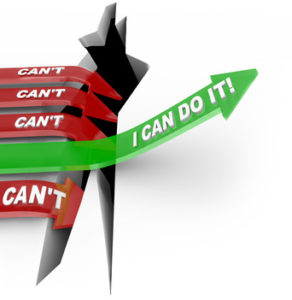
    Graphic image shows all the indicators that say you can't do it, but then one emerges that says, I CAN DO IT! This is resilience.

    Flexibility is a core value for resilience. The ability to adapt to circumstances as you navigate through them, gives you the power to emerge successful.

    In the award-winning movie, Pursuit of Happyness, Chris Gardner (played by Will Smith) faced ever-increasing obstacles and hardships that would have crushed many to despair, as he sought a better life for himself and his son. But his flexibility in the face of those hardships, and his stubborn tenacity in holding to his belief he would overcome them was the reason he did.

    In one scene, he locked himself and his son in a public restroom to sleep in safety, then woke the next morning to continue his quest to get the career that would change his and his son’s destiny.

    For some, that one experience alone would have been seen as traumatic. And hope would have drained away. But for Chris, it was a means to accomplish what he had to do to achieve what he wanted to achieve. It was a bump on the road to success.

    Resilience is Learned

    And, remember, you can learn to adapt, to change the way you see the challenges and stressors, every day. Take a moment to look at your circumstances. Are they as damaging as you tell yourself they are? Can you look at them with an objective view and see ways to adapt your attitude to move forward?  If you can, you’re building your own crop of resilience, and paving the road to your own success. There’s no shame in realizing you have invited a traumatized view of an experience. We’ve all done it. The key is to change to become a happier person.

    You really are the captain of your fate in this life, as you strengthen your skill to ride the ups and downs in life that surround you.

    Look for ways to develop resilience in your own life daily. The opportunities are all around you. And if you don’t see where to start, you may benefit from our innovative approach and  advanced psychiatric services, such as TMS or IV Ketamine treatment.

    Contact us and let’s discuss your options. You really can feel better and live a rewarding life.

    To the growth of your best self,

    Lori Calabrese, MD

    Lori Calabrese, MD offers innovative psychiatric treatment

error: Content is protected !!