
Tag: Trauma

  • Why Some People Get PTSD…and Others Don’t

    Why Some People Get PTSD…and Others Don’t

    In the throes of PTSD, this man feels lost and terrorized. Why do some people get PTSD, and others don't?Ever notice how some people seem to collapse under an onslaught of traumatic experiences, and others almost seem to rise above them? Almost as if demonstrating their resilience? Why some people get PTSD and others don’t..that’s the question.

    People tend to say the latter type is “strong”…  and the former type is weak…unable to withstand or overcome much. More stigma that we have to fight.  But is that what’s going on..?

    Strong or Weak…?  Really…??

    What is it that increases the risk that trauma can traumatize you?  We’re talking about big T Traumas and little t traumas.  Is it about how much or how little?  About how much stress you’ve had.  How many put downs.  Or how much yelling you’ve endured.  And how much fear.  Too much neglect.  Or too little attention.  About too little protection… and too few resources.  How little money.

     How much struggle.

    Traumatic experiences can etch themselves into you–into your memories, into your emotions, and into your biology.  And what we’ve learned is that what puts us at risk for that–besides the horrible events themselves–is something that is already etched into us.  A gene.

     A gene?

    Genetic Widget

    There’s a serotonin transporter gene called SLC6A4. This little genetic widget has two arms–and in the best of all possible worlds, the arms are both long arms.  But if you were born with one or two short arms instead of two long ones, you are more likely to develop major depression or PTSD in response to a traumatic life event.PTSD triggered by fireworks explosions is relieved by IV ketamine, which is why some people get PTSD and others don't

    It’s almost as if those little short “arms” can’t carry quite the emotional load as the longer arms of the corresponding gene in those who aren’t so impacted.

    Or…maybe the longer arms shield their owner from the emotional pain that accompanies heartbreak or trauma in some way.

    Of course this is all  just a way to bring science to life, but the fact is, having a short arm on that gene increases the risk that you will suffer deeply and longer from life events such as verbal or physical attacks, traumatic events, and long term debilitating difficulty.

    And there’s more.

    Genetic Test Predicts Outcomes

    There’s also a genetic test we can use to determine if you might be someone who would respond well to ketamine treatment.

    What?

    For decades, psychiatric medicine has relied on trial and error from one medication to another to find the one that is most effective for a given patient.

    But now…there is actually a test to help predict your outcome in advance and whether you’re likely to respond quickly and robustly to a treatment for severe depression and PTSD that is as innovative as a ketamine infusion.

    Neuroscience is advancing quickly, and treatment options for people who suffer with major depression, bipolar disorder, PTSD, and other psychiatric disorders are becoming more reliable and predictable. These discoveries were unheard of less than 10 years ago…even five.

    More on the Horizon

    And there’s yet another breakthrough on the horizon. And that’s the possibility that we might be able to use science to potentially prevent psychiatric disorders from developing–for example, to protect first responders and military from the risks of trauma before they enter a crisis situation.

    First responders can be protected from potential trauma by ketamine treatment in advance, an example of why some people get PTSD and some don't.So imagine… if firefighters, paramedics, SWAT team members, and military personnel facing potentially traumatic experiences could feasibly be treated with IV ketamine to prevent the event from becoming a debilitating traumatic experience. Or—think about this—imagine if someone who is genetically vulnerable to developing depression or PTSD in response to a traumatic life event could be buffered from the risk of developing it.

    One of the exceedingly bright researchers studying ketamine, and interested in “repurposing it,”  talks about the exceptional potential of this drug for potentially preventing psychiatric disorders. Working with lab animals, her work with ketamine has opened up a treasure chest of new possibilities.

    If you haven’t seen it before, it’s worth your time to watch the TED talk about this by Rebecca Brachman.

    She expounds on the sparkling new hope surrounding psychiatric use of ketamine treatment. It has already offered healing to so many who suffer, and in the future, may potentially protect others from the risk of such suffering.

    Don’t put psychiatry in a box.

    Don’t put people who suffer with psychiatric disorders in a box.

    The possibilities are endless.

    Rapid and effective treatments are emerging.

    And hope for your life to be the best it can be is billowing.

    Please call for an appointment if you’re concerned about the emotions and reactions you’re experiencing in response to what life has thrown at you. Let’s work together to find the right innovative solution for you.

    To your best self,

    Lori Calabrese, MD

    Lori Calabrese, MD offers innovative psychiatric treatment like IV Ketamine

  • Resilience: Adapting To Emerge as Your Best Self

    Resilience: Adapting To Emerge as Your Best Self

    A woman's hand reaching out for the possibilities that can come from her circumstances, and that's resilience.Do you know someone who can’t seem to go through difficulty without collapsing emotionally?  Whether the difficulty is a natural disaster, a broken relationship, or a financial loss…

    Some people can weather difficult storms with strength and resilience. Others become grief-stricken and shut down every time something disappointing happens.  Why is that?

    So what is resilience, anyway? 

    Resilience is the ability to absorb and then find a healthy way to adapt to what you’re faced with. 

    Attitude: Resilient or Victimized?

    A key to understanding and developing resilience, is attitude.  Or better said, perception. Those who look for ways to learn and grow in each difficulty presented to them, are the ones who are actively growing a bumper crop of resilience. It’s how you perceive the difficulty you face that makes the difference.

    Do you meet challenges on your own terms, believing the outcome is based on who you are and how you respond?

    Or…do you feel victimized by storms, fold up and lick your wounds when times are tough? Do you tend to see the glass half empty? If so, you may have a difficult time recovering from an adverse situation or experience.

    Resilience Takes Practice

    Anyone who goes through life with a proverbial halo over his head, never challenged, always rewarded, may or may not have the resilience he needs to draw from when times are tough.  Until you face hardship or difficulty, you never know how you’ll respond to it. 

    On the other hand, we also know we can train ourselves to be less resilient. if you’ve had challenges every step of the way, you have the best opportunity for displaying resilience, or else learning how to develop it. Because it’s in the presence of the storm that resilience is developed.

    Psychologists who conducted studies of children in extremely trying circumstances learned how they either succumbed to or surmounted their situation. Among the children, about 2/3 succumbed to their circumstances, losing their belief in themselves, and their hope for future achievements.

    But about 1/3 responded to their dire circumstances with determination and a belief that they were in control, that their outcome would be the result of their own decisions and actions.

    What they concluded is that the children who rose above their circumstances, who piloted their own journey through their personal storms, were those who did not view their difficulties as traumatic, but as just another difficulty to be overcome.  

    Trauma is How You Perceive It

    Only those who view difficulty as traumatic are, in fact, traumatized.

    What’s more, anyone can learn to view the difficulties they face in life in a resilient way. By learning to view an emotionally-charged experience as less emotional, and more factual, you can remove the traumatic association of it. Then, train your emotions to view it with less pain. By doing this, you can learn to regulate your emotions, and strengthen your resilience.

    On the other hand, we also know we can train ourselves to be less resilient. By exaggerating the emotional feelings tied to an experience, by thinking about it, talking about it, meditating on it, we can convince ourselves we’ve been traumatized. And that traumatized orientation will continue to follow us through life unless we set about to change it. We don’t even realize we’re doing this to ourselves.

    When you perceive a difficult situation as one that’s threatening, your own ability to face it and overcome it drains away. Conversely, view it as a challenge to be overcome, and your emotions remain strong and agile, adapting as you go and building inner strength along the way.

    This is what those resilient children discovered on their own.

    Some of them may have been fortunate to find a friend or relative who gave them support, as studies have shown that the most resilient of people are those who are closely connected to mentor or peer group support.

    David Brooks’ work on resilience in children has shown that the one thing that is found is children who develop resilience is the presence of a charismatic adult in the life of that child.

    Studies of military groups found those units with the strongest peer support and highest morale were the most adaptive in stress situations such as battle.

    Flexibility

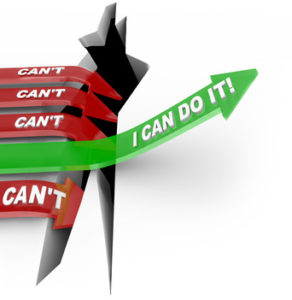
    Graphic image shows all the indicators that say you can't do it, but then one emerges that says, I CAN DO IT! This is resilience.

    Flexibility is a core value for resilience. The ability to adapt to circumstances as you navigate through them, gives you the power to emerge successful.

    In the award-winning movie, Pursuit of Happyness, Chris Gardner (played by Will Smith) faced ever-increasing obstacles and hardships that would have crushed many to despair, as he sought a better life for himself and his son. But his flexibility in the face of those hardships, and his stubborn tenacity in holding to his belief he would overcome them was the reason he did.

    In one scene, he locked himself and his son in a public restroom to sleep in safety, then woke the next morning to continue his quest to get the career that would change his and his son’s destiny.

    For some, that one experience alone would have been seen as traumatic. And hope would have drained away. But for Chris, it was a means to accomplish what he had to do to achieve what he wanted to achieve. It was a bump on the road to success.

    Resilience is Learned

    And, remember, you can learn to adapt, to change the way you see the challenges and stressors, every day. Take a moment to look at your circumstances. Are they as damaging as you tell yourself they are? Can you look at them with an objective view and see ways to adapt your attitude to move forward?  If you can, you’re building your own crop of resilience, and paving the road to your own success. There’s no shame in realizing you have invited a traumatized view of an experience. We’ve all done it. The key is to change to become a happier person.

    You really are the captain of your fate in this life, as you strengthen your skill to ride the ups and downs in life that surround you.

    Look for ways to develop resilience in your own life daily. The opportunities are all around you. And if you don’t see where to start, you may benefit from our innovative approach and  advanced psychiatric services, such as TMS or IV Ketamine treatment.

    Contact us and let’s discuss your options. You really can feel better and live a rewarding life.

    To the growth of your best self,

    Lori Calabrese, MD

    Lori Calabrese, MD offers innovative psychiatric treatment

error: Content is protected !!