Tag: IV Ketamine for Depression

  • Is Self Harm Tormenting Your Teen? Ketamine Can Help!

    Is Self Harm Tormenting Your Teen? Ketamine Can Help!

    Is self harm tormenting your child? Check in often on your teen's wellbeing.

    Kinsey recoiled when her mom screamed, “If you don’t cooperate I’m going to kill myself! Do you want that on your conscience??” The security she had felt when she was younger, with both parents making her world safe, seemed to be disintegrating. She felt guilty, confused, and terrified. She trusted her parents, but her mom was saying more and more shocking things, and Kinsey didn’t know what to think or feel. When her dad came home, they ate dinner, then from her room later she heard her parents shouting at each other. Kinsey sat in the corner in her room and pulled up her pants leg and slowly applied her Swiss army knife to the skin on her ankle…slowly but surely breaking the skin and making a tiny line of blood alongside the scars left from other times like this. Somehow as her skin stung from the cut, she began to feel some relief from the anguish. Self harm tormented Kinsey in the chaos of her family crisis.

    Strangely, Cutting Helped

    After awhile, she felt calmer. The angry sounds in the house became quiet.  She leaned her head against the wall and let out a breath. Pulling her sock up and smoothing her pants leg down over her ankle, she got up and crept downstairs. She found her mom in the kitchen.

    “Your father has become impossible to live with. I’m moving out tomorrow.”

    “Oh mom, NO!!!”

    “Yes, I can’t live with his self-righteous attitude another day. I need to be free to live my life.”

    If self harm torments your child, she may need IV ketamine for depression.

    Kinsey’s dad didn’t seem self-righteous to her… he just seemed tired. But she trusted her mom and if she said her dad was self-righteous then maybe he was. And if he was, then maybe it was his fault that her family was falling apart. Thoughts of self harm tormented and pulled at her.

    Her Parents Separate

    The next morning, while she ate her breakfast, her dad sat down with her and told how sorry he was that this was happening. He assured her he didn’t want her to feel she was choosing between her parents, but this was her home, her neighborhood, and if she preferred to stay here while her mom tried to figure out what she wanted, that was her prerogative. 

    He told her he loved her no matter where she was and would do all he could to support her through this.

    Tears filled her eyes. 

    When she got off the bus that afternoon and unlocked the door of her house, she discovered much of the furniture was missing.

    Kinsey was stunned.

    She didn’t even know where her mom had gone.
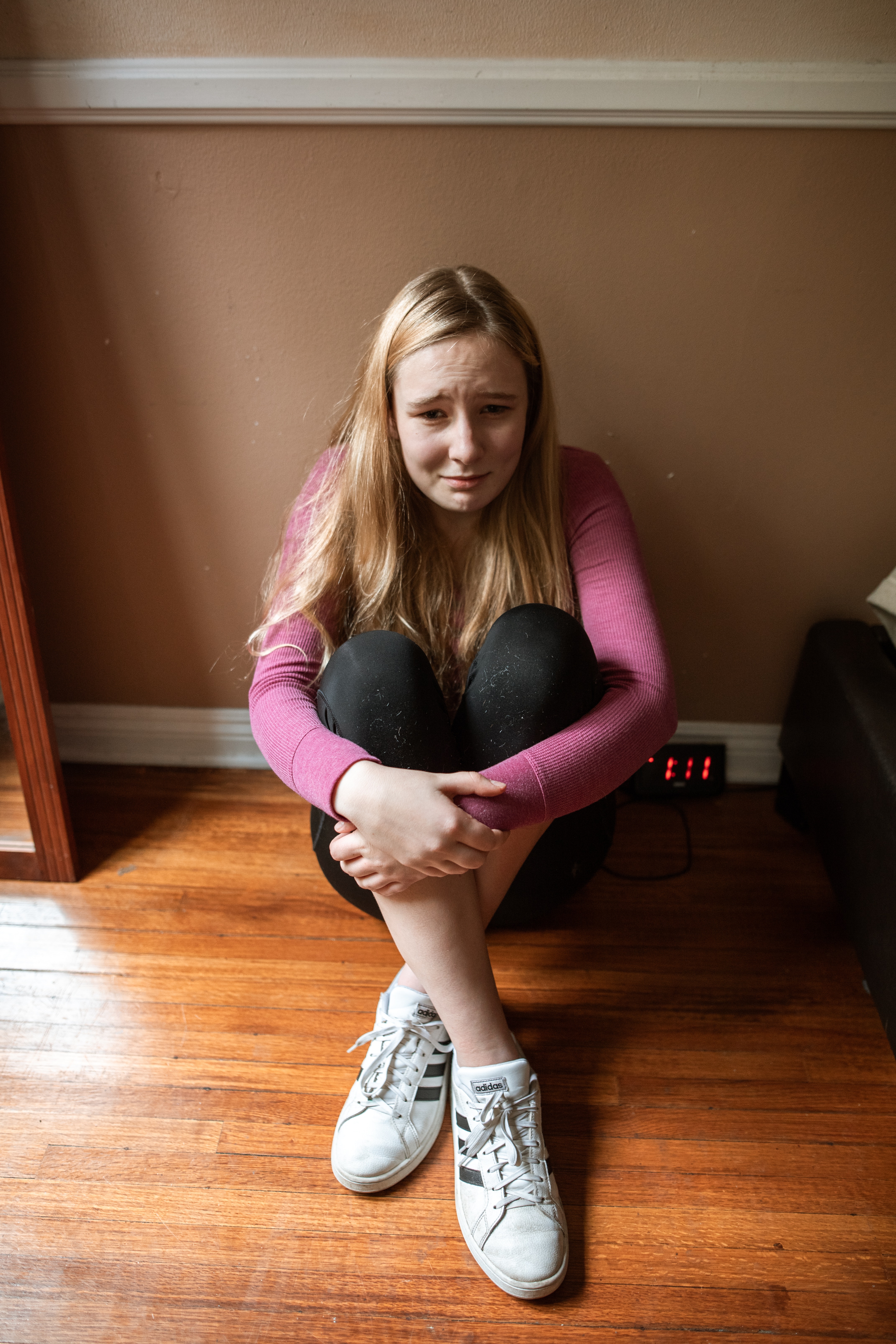
    Kinsey was shocked to discover turniture gone from her home. Self harm tormented her.

    She perched on a chair in the living room and wondered what to do with herself. Then, she began to cry. She felt afraid for her mom who seemed so lost. And angry at her dad for not preventing this.

    As was her habit at times like this, she pulled out her Swiss army knife and went to work on her ankle. There were now rows of scars from the cutting, and as she drew her finger across them, she felt a little better. Self harm tormented her as she drowned in anguish.

    Moving In With Mom

    A week later, her mom came by after school, told her where she had moved, and suggested they pack her belongings so she could move with her. Kinsey felt conflicted. She had grown up in this house, had friends in the neighborhood she’d known all her life. To move somewhere else sounded lonely.

    But, being without her mom seemed lonely too.

    Kinsey's mom had been nurturing throughout her life, in spite of her problems.

    Her dad was only home in the evening, and he was always tired. But he was the person who seemed to provide stability in their family. Even so, her mom had always nurtured her, in spite of her problems. And the thought of being without that left her feeling bereft and isolated…something like a life boat floating alone in the ocean. Thoughts of self harm tormented and nagged at her.

    So she filled her suitcase with clothes and her favorite items, along with her toothbrush, and loaded it into her mom’s car.

    Her anger toward her dad grew for letting this happen. And her need to stay near her mom to protect her became more intense.

    That night her dad called. He reminded her that he loved her, and missed her already. But he wanted her to do what she felt she needed to do. And invited her to come home for dinner on Friday night.

    She felt so alone as her mom withdrew from life.

    As the week dragged by she noticed her mom wasn’t doing well.

    Mom would be asleep when she got home from school, and didn’t wake up till dinner time. She told Kinsey there was bread and cheese in the fridge and to feel free to make herself a grilled cheese sandwich.

    What??

    Her mom not only moved out of their home, but was also no longer cooking for her? It was like Kinsey was living in an apartment by herself, taking care of herself. To add to that, her mom was barely functioning. Urges of self harm tormented her.

    At dinner on Friday she was afraid to tell her dad what was going on. The worse things got, the angrier toward him she felt.

    Weeks went by like this, and Kinsey felt herself sinking into a darker and darker place. Her life seemed so absurd, and her motivation to do well in her 8th grade classes began to fade. She clashed often with her mom, confronting her about her own responsibility, and her mom lashed back…often threatening suicide if Kinsey didn’t support her.

    Confrontations with her mom's threat of suicide led to self harm tormenting her.

    After these confrontations and her mom’s responses, Kinsey felt like she would explode. Sometimes she would slap herself and beat her fists against her head, unable to cope with the anguish she felt.  And there was just nowhere to turn for help. Self harm tormented her to find her knife.

    No one knew.

    Kinsey Withdraws

    Over the next few months, Kinsey and her dad went out for dinner once a week, and he’d try to encourage her to talk about her life, her school, her friends. She said very little, aside from frequent jabs at him for letting their family fall apart. 

    He tried to help her see that he hated all this, but did not have the power to control her mom’s behavior. He hinted that her mom had a disorder but was not willing to get treatment. So far…

    That just made Kinsey angrier.

    Finally, six months after her parents’ separation, he invited Kinsey to a long weekend trip at the beach. Kinsey loved the beach, the ocean waves, and the seafood.  But she didn’t want to be alone with her dad. Even so, she grudgingly agreed.

    They played in the waves, soaked up the sun, and enjoyed delicious seafood meals at the specialty restaurants along the boardwalk.

    After about 24 hours there, Kinsey began to relax.

    Is self harm tormenting your teen? IV ketamine can help.

    Dad Helps Kinsey Explore What’s Happened

    For the first time, her dad noticed that there were small parallel scars on Kinsey’s ankles. He was alarmed, but tried to not show it. As they sat in the shade, sipping lemonade freezes, her dad gently asked about the scars.

    She instinctively covered her ankles with her towel, because she didn’t want Dad to see how self harm tormented her. She didn’t understand it herself.

    “I don’t want to talk about it.”

    “I respect that, honey. Just know that I love you. No matter how awful all this is, nothing can change that…. The truth is, I’m hurting, too. I keep hoping we can put our family back together, and I don’t know how to do that. But meanwhile, you need to know how important you are to me, and that you’re not facing this alone.”

    “Mom’s not doing well.”

    “I can imagine that’s true. But do you feel safe at home?”

    “I feel like I have to take care of myself and mom. I’m tired. And I have no friends. I wish life was like it used to be. Sometimes I don’t want to live anymore.”

    Teens withdraw when they feel depressed and when self harm torments them.

    “Kinsey, it isn’t your job to take care of Mom. You’re 14 years old — geez! —and have your hands full with school and life. You need to have the freedom to spend time with friends and have fun. The truth is, you don’t have the power to change your mom’s choices. She has to do that for herself.

    “I’d like to ask you to at least think about coming back home and living with me, getting back with your friends, and letting your mom work out her own situation. It’s true that I can’t be there till dinner time, but maybe we could get help from your friends’ families for you to have company in the afternoons. 

    “Or maybe I could hire someone to be at the house when you come home from school, and cook dinner. We’ll figure something out so you aren’t alone. No pressure…just think about it. You deserve to be a kid.”

    Kinsey looked at her hands, and nodded.

    She thought about how many times when she was cutting her ankles, she thought how easy it would be to cut her wrists and escape all this.

    But she’d never done it. Not yet.

    They finished their lunch, then walked down the boardwalk and browsed in the shops. Kinsey bought a t-shirt and a tote bag to carry her towel and phone. She was relieved to not feel self harm tormenting her.

    Shopping can give a depressed teen a lift.

    She felt relief at being able to do these simple things in the sunshine after all these months in a dark apartment.

    Dad Offers Hope

    The next morning, over breakfast, Kinsey’s dad broached the subject again. 

    “Honey, I did some exploring on my laptop and learned some things I didn’t know before. I learned that sometimes teens cut or hit themselves when the anguish they feel is too much to bear.

    “That’s oversimplifying things, I know, but I wanted to suggest that we talk about what can be done to help you feel better.

    “Honey, it wouldn’t be surprising if your life has been harder to live the last couple years due to problems at home, and mom’s symptoms getting worse, and then your mom’s and my separation.

    “I can imagine it has all caused you a great deal of conflict, as well as feeling helpless. And it’s also possible that it has resulted in you becoming depressed. If that’s the case, then it’s treatable.  And you can feel better. Would you be willing to see a doctor to find out if there is something that would help?”

    “Dad, the idea that something can be done to help me feel more like living than wishing I could die sounds hopeful, in a way… But who knows? I have no idea.”

    Kinsey felt so much better after IV ketamine treatment.

    “Ok, I learned there’s a treatment that can do amazing things for depression. It’s called IV ketamine treatment. If it’s ok with you, I’d like to take you to the doctor to see what she says…”

    Ketamine Treatment for Depression

    The following Wednesday, Kinsey’s dad picked her up at school and took her to the appointment he’d made with a psychiatrist he’d found who offered ketamine treatment.

    After taking a thorough history, she agreed that Kinsey suffered from major depressive disorder, and that her self-harming behaviors were linked to it. She was very hopeful that IV ketamine treatment could make a real difference.

    So her dad left work early to pick her up at school twice a week, to receive these infusions.

    By the third infusion, she could feel herself relaxing. She told her dad she’d like to come back to live with him, she was just worried about her mom being ok.

    The idea of dying, or escaping through death, had faded away and she wasn’t thinking like that anymore.

    By the fifth infusion, she began to feel hope, and a sort of brightness. In all, she received 8 infusions, and continued to feel more and more upbeat for weeks after the last one.

    A teen girl needs friends outside her family to develop socially.

    She embraced her school work again, and laughed with her friends. When she woke up, she sang in the shower in the morning, and walked to the bus with a spring in her step.

    She finally realized she hadn’t cut herself in weeks, which was a relief when she realized it. Self harm tormented her no longer.

    Kinsey also had the resilience to call her mom and talk to her, no matter how her mom reacted, and to hang up knowing her mom’s problems weren’t her fault. That’s not to say her mom’s confusion didn’t cause Kinsey to cry at times, but it was because she was sad for her, and loved her, but not because she thought it was her responsibility to save her.

    In the safety of her home, with her dad’s support, Kinsey began to thrive again

    How About Your Teen?

    Your teen can recover from the torment of self harm and depression with IV ketamine treatment.

    More and more, we see teens whose life circumstances or psychiatric symptoms are so difficult, that they use self-harm to cope. It’s easy for parents to miss, because whatever harm they inflict on themselves is carefully hidden.

    Parents can gently and respectfully approach their teens, check on their wellbeing, and hopefully verify whether they’ve harmed themselves through hitting, cutting, burning themselves or even breaking bones repeatedly, so they can offer hope through treatment.

    If your teen can relate to Kinsey’s symptoms or circumstances, call us.

    Since teens don’t have the development to cope with severe circumstances that they may have in adulthood, it’s imperative to help relieve them of emerging behaviors like self harming.

    When self harm torments long enough, it can become compulsive. So early treatment is important. Ketamine treatment can be effective in stopping self-harm.

    Together, let’s help them thrive again and grow into a bright future.

    If you or your teen suffers from suicidal thoughts, Help is Available. Call the Suicide and Crisis Hotline 988 now.

    Lori Calabrese, M.D. is on the front end of the race to stop PTSD in its tracks using IV ketamine treatment.

    To the restoration of your best self,
    Let us help you help them.

  • When Trauma Sabotages Your Life – You Can Overcome It!

    When Trauma Sabotages Your Life – You Can Overcome It!

    When trauma sabotages your life, overcome it with ketamine.

    Stephanie was a happily married thirty-something woman with 3 young children. She adored her husband and after 12 years of marriage, she still felt a thrill every time they held hands or caught each other’s eye. She fully expected the spark between them would see them through good times and bad, and they worked at actively communicating through every challenge. Of course, they had minor conflicts and bumps in the road from time to time, like any marriage does. But they built a life and family together, and Stephanie felt lucky and fulfilled. Then, everything changed. One evening right before Christmas, Stephanie’s husband told her he’d never loved her, and wanted a divorce. Stephanie was floored. She felt punched in the gut. Devastated. Shocked. Stunned. All she believed about their marriage seemed to have been fiction..?  Her friend told her when trauma sabotages your life, it can be overcome. But how?

    Her love and warmth and deep affection for her husband was not returned. Why?

    Infidelity Shatters Trust in a Committed Relationship

    It came out that he’d been seeing a “family friend.” He didn’t go home the next night, and the night after that. Then began coming home only in the morning to shower before work.

    Stephanie saw him in the bathroom and flew out of bed in a rage. “How could you???”

    He silently dressed and left for work…and Stephanie collapsed on the bed, crying in pain and betrayal. This man who had been so beautiful to her for the 15 years she’d known him, had turned into a stranger and a monster in a moment.

    Cold. Without compassion or mercy. Brutal. Cruel.

    Trauma sabotages your life and strips your joy.

    What a fool she must have been. She felt ashamed. Humiliated. How could she think she was in a happy marriage? How could she have enjoyed him so much, when his loyalty was to someone else? The betrayal of her deep trust and love disintegrated her core. Trauma sabotaged her life, from wall to wall.

    Painful thoughts of hurt, humiliation, betrayal, and loss swirled around and around in her head. 

    “So this is what it feels like when your heart is breaking,” she thought…For weeks, then months. Then years. She worked hard to build a new life, support her children, weave fun moments into their lives. If it wasn’t for her children, she thought she’d go to bed and stay there. Forever. But she didn’t. She kept putting one foot in front of the other.

    Dinner Out is Ruined, Groceries Abandoned

    Two years later she still felt like she would implode at the mention of his name. If she entered a restaurant, and saw him and “her” seated, she would walk out to keep from having a panic attack. If she saw them in the grocery store, her hands would start shaking, her palms would grow moist, and perspiration would break out on her forehead. She’d quickly leave, abandoning her groceries.

    She wondered how others got over divorce. She didn’t think she was making any progress. How do you let go of the rage? How do you heal from the terrible hurt? What do you do to stop trauma from sabotaging her life? She felt like she was defined by her ex-husband’s rejection. Stephanie worried about her children and what her prolonged grief was doing to them.

    The heartbreak of betrayal and trauma leave you heartbroken.

    As more time went by, the strain of her ex-husband’s betrayal wore her down. It ground away at her resources— including mental, emotional, financial, and physical. She had not experienced joy since he told her he was leaving nearly three years ago. Stephanie endured. She existed. She kept hanging on.

    Maybe There’s More To It than Grief

    Stephanie decided to see a therapist. On the recommendation of a friend, she made an appointment. After talking awhile, the therapist pointed out that she may have PTSD from the way it all happened. Considering her panic attacks, her severe reactions to having contact with her ex. Her increased heart rate and respirations at the thought of him.

    The stress of living her altered life, worry about her children, fear of contact with her ex-husband, fear of reminders of the trauma … all hinted at her post traumatic stress and need for treatment.

    There were long sessions with her therapist every week for months, but while she learned some things about herself, the panic continued.

    Then, she read an article about PTSD and how IV ketamine treatment could be effective in treating it. She wanted her life back. Her self back. She wanted to be her best self for her children.

    IV Ketamine Treatment Emerges as Her Solution

    Trauma sabotages your life but ketamine can help you rise above it.

    Stephanie googled “IV ketamine treatment” and learned it showed dramatic results in treating depression, social anxiety, PTSD, and suicidal thoughts. She also found blog posts and articles describing personal experiences about relief and remission following the treatment.

    Stephanie felt hope in ketamine’s potential. Could it help her feel better?  Could it help her reach freedom from the prolonged grief and pain of her divorce? Was it possible she could actually live again?

    A search for psychiatrists who offered IV ketamine, and a scrutiny of those she found, led her to choose a practice in a nearby town. She began infusions the following week.

    A Supplement that Can Enhance Outcomes

    The doctor encouraged her to begin taking magnesium glycinate daily to help her glutamate receptors and neurons work more effectively with the ketamine.

    By the third infusion, Stephanie felt a lightening of the weight that had hung over her for 3 years. It was subtle, but definitely there. She noticed other changes in her motivation, her ability to laugh, and her plans.  Something was getting better inside her.

    Trauma sabotages your whole life, but ketamine can help you overcome.

    It May Take More Than 6 Infusions

    All in all, 9 infusions were required, but it was worth the perseverance. A sense of resilience replaced the defeat and trauma. Her feeling of self respect seemed to fall into place, along with confidence to reach out and assert her desires. Stephanie realized that though trauma might sabotage her life, with ketamine it could be overcome.

    A happy mom leads to happy children, and hers were no exception. Her life, and theirs, had changed — and there had been losses. But she came to accept that change is a part of life, and she could move forward and make her new life meaningful and rewarding.

    And she did.

    If you have had a life altering blow that seemed to dismantle your life, there is hope. And if the blow was so traumatic that you’ve been unable to move forward, but want to, we may be able to help.

    So, if you’ve had trauma, betrayal, hurt…that’s led to depression or PTSD, and nothing has helped, call us.

    It just could be that IV ketamine treatment can restore your peace, your resilience, your hope, and your freedom to live as your best self.

    Lori Calabrese, M.D. is on the front end of the race to stop PTSD in its tracks using IV ketamine treatment.

    To the restoration of your best self,

  • When Abuse Leads to Overwhelming Stress at Work

    When Abuse Leads to Overwhelming Stress at Work

    A boss who uses abuse can lead to overwhelming stress.

    Garrett is a 38-year old computer programmer who works in the IT department of a nationwide mortgage company. After ten years in the same department, the stress of the job seems to just pile upon itself. The short length of time allotted for projects to be completed, the abrasive attitudes of co-workers who are all under terrible pressure, the long hours into the night when something breaks down, the strain on everyone when a key member of the team leaves for a new job… Garrett is worn out and work down by the ongoing pressure and stress of his job…and doesn’t know how much longer he can endure. The stressful conditions of the job itself are abusive. And abuse leads to overwhelming stress.

    Why Can’t People Just Be Kind?

    By far, however, the worst stressor in his life ...is his boss. Daily chiding, screaming profanity, and humiliating Garett and his co-workers has destroyed the morale of the team. Garrett’s early annoyance with his boss’s bad attitude has evolved into a white hot fury he keeps under a lid. He does what he’s told but he feels himself losing his tolerance.

    Day after day after week after month, the toxic atmosphere is so distracting and keeps Garrett on edge. He feels his creativity wane, his outlook darken. Until his mind has grown dull, and his bitterness toward his abusive boss grows hotter.

    A constant source of abuse leads to overwhelming stress, like your boss.

    Finally, the last straw. It’s on a Monday morning. His boss gives a young, newer employee a promotion and a raise, and places him in a supervisory role over Garrett. He demotes Garrett to a position with less authority than he currently has. And he announces it to everyone. He makes Garrett an example of failure before his entire team.

    Garrett is devastated. His boss is such a jerk.

    From where Garrett’s sitting, his boss seems to derive actual pleasure from humiliating Garrett. The hurt and frustration fills him. Humiliation crushes him. From this point, he avoids making eye contact with his co-workers. He feels frozen, hopeless, and unable to do his job acceptably.

    Weeks go by as he struggles to muscle through his job responsibilities.  It’s just so hard to think. Before his boss took his position in Garrett’s department, Garrett had been a bright, promising employee, full of good ideas and creative solutions. Now he can’t seem to produce anything worthwhile. It’s like the lights have been turned out.

    Weekend Getaway To Explore Options

    Finally, Garrett and his wife take a weekend trip and talk. Garrett pours out to her his frustration, wounded pride, feelings of betrayal by his boss, and disillusionment. She says he needs to get out of that job, but he says he’s lost his edge and wouldn’t be able to find further employment. The strain of abuse leads to overwhelming stress.

    So they talked about why he’s having so much difficulty on the job. Is the boss’s cruel treatment traumatizing him? Is he getting depressed from all the stress? All he knows is that he used to be exceptional and now he feels dull and stunted.

    Resilient businessman can rise above the stress with ketamine.

    Lucy, his wife, had been reading some books lately. One of them, Ketamine for Depression by Stephen J Hyde, had been remarkably enlightening. She wondered if this treatment that had helped so many, would help Garrett. She described some of the personal stories in the book and Garrett was intrigued.

    It sounded like this treatment could help trauma, depression, cognition, and social anxiety. It seemed possible it might help him.

    A Special Treatment Restores Resilience

    He googled “IV ketamine treatment” in his area and found a psychiatry practice that offered it. What a relief that he could go in after work. Finally, someone was getting it—that when you’re already under fire, you can’t afford to call out or take PTO. He scheduled a consult and was excited he could schedule infusions on Tuesdays and Fridays after work. That meant no one needed to know.

    Whew.

    Garrett didn’t feel any change after the first 3 infusions…. his wife encouraged him, pushed him to continue, read that this was not unusual. Then felt some lightening in his outlook after the fourth. He felt less depressed and took some initiative after the fifth.  Then felt somewhat better again after the sixth. The seventh opened a door that brought in light…and hope. He found in the following weeks he had a spring in his step, and energy for people’s idiosyncrasies.

    Ketamine can relieve stress that abuse causes and give you the power to enjoy life.

    Within two weeks of his 7th infusion, he was becoming more and more creative, and his work became easier and easier for him.  He felt like he was getting better and better now.

    And he was resilient, so the boss’s comments just rolled off him. Garrett was so thankful, and relieved. He could live his life again. He and his wife could have dinner with friends. So much opened up.

    He was ready to keep it going.

    As we often say, ketamine treatment isn’t for everyone. And we continue to study it to learn why.

    But for most people it’s transformative.

    Here at Innovative Psychiatry, we’re focused on bringing this extraordinary treatment to you. We do all we can to help you get the most benefit from your ketamine treatment. That why, first and foremost, we offer IV ketamine infusions.

    It’s what works. It’s where the most data is. And it’s the safest and fastest route out of misery.

    Thanksgiving is a time for love and sharing

    Do you live or work in a situation where abuse leads to overwhelming stress? Is that stress leaving you worn down and worn out? If you experience the symptoms of depression like Garrett did and nothing has helped, call us.

    We want to help you feel great again, back to your best self, and able to enjoy the rewards your life can bring.

    With Thanksgiving upon us, we wish you and your loved ones a wonderful holiday, and that you have the resilience to enjoy this season and make memories you’ll treasure.

    Happy Thanksgiving From Us to You!!

    Lori Calabrese, M.D. is on the front end of the race to stop PTSD in its tracks using IV ketamine treatment.

    To the restoration of your best self,

  • Does Your Teen Get SAD This Time of Year? Try IV Ketamine.

    Does Your Teen Get SAD This Time of Year? Try IV Ketamine.

    Does your teen get sad this time of year?

    It’s November, and Daylight Savings Time has ended. The sun goes down earlier, and when you get home from school or work, the night covers you and the traffic in a blanket of darkness. Homework has to be done by artificial light, and the healing dose of vitamin D that has nourished you all year is gone. Add to that the nourishing sunlight is only prevalent while you’re indoors at school. Seasonal Affective Disorder, or SAD, can interfere in your teen’s social development and education. Does your teen get SAD this time of year?

    Psychiatric Disorders Tend to Run in Families

    Cherie and Tom are brother and sister, and they both suffer from seasonal affective disorder. It started in their early teens, and you know how psychiatric difficulties can run in families. They have a 9 year old little sister who doesn’t seem to be affected by the emotional lows in fall and winter that Cherie and Tom do. At least, not yet.

    Their family is active, and in the summer they’re busy with tennis, golf, swimming and water skiing, and they feel great. But by November, both of them slow down, feel too sluggish to participate in sports at school, and do only what’s required.

    Seasonal affective disorder makes school work hard or impossible to accomplish.

    Studying is harder than it is in September and early October, or April and May. They both feel withdrawn, less interested in social interaction, and  more overwhelmed with school demands. Cherie is 15 and in 10th grade, and Tom is 17 in 11th grade. 

    Without Resilience It’s Hard to Move Forward

    Tom dreads going to college because he’ll be away from home and wonders how he’ll survive during fall and winter. What can he do to save his grade point?

    As for Cherie, she just wants to give up. She thinks a lot about dropping out of high school because it seems futile to keep going through this every year, when classes get harder and harder with each passing grade.

    Finally, Cherie feels she’s drowning in the futility and begins to think about making her life stop. Ending it. Trouble is, she doesn’t talk to anyone about it. She just carries it inside her…thinking about it more and more.

    In a family of five, a quiet teen can easily be overlooked. The signs can be missed.

    Meanwhile, Tom is trying to prepare for the SAT, which is no small feat in his frame of mind. His parents are taking him around to a variety of college campuses to help him narrow down his choices. And on top of that their younger sister, Izzie, is trying to prepare for the Science Fair.

    Tom held on with white knuckles, trying to study and prepare for his upcoming SAT, getting his parents to drill him. To say the least, the family was stretched in too many directions.

    No one noticed that Cherie was spending most of her time in her room.

    Does your teen get SAD this time of year?

    Bottom line, the depression of seasonal affective disorder made Tom and Cherie feel like they were sludging through hip-deep mud day after day.

    Then came the day of Tom’s SAT test. He honestly prayed through it. Hoping for some sort of miracle that the answers would come to him and he’d do well.

    Cherie stayed at home that day, and after everyone else left, she found a bottle of pills her mom took to help her sleep. She sat on her bed for hours contemplating those pills. Finally, Cherie went to the kitchen to get a glass of water then sat on her bed working up the courage to start systematically swallowing the pills. When your teen gets SAD at this time of year, it can be dangerous.

    She started swallowing the pills two at a time.

    After she had gagged while swallowing the second handful, she thought she heard a clattering downstairs. She closed her eyes and tried to swallow down the nausea. Then swallowed two more.

    Her mom tapped on the door then walked in. There Cherie sat with a pile of pills in her lap, and water in her hand, looking guilty.

    IF your teen gets SAD this time of year, IV ketamine can help her get back on track.

    Thinking fast, her mother called 911, then asked Cherie how many she’d taken. In a panic, Cherie said, “I’m not sure.”  But she knew she felt a bit fuzzy.

    At the Emergency Department, the doctor induced vomiting, then inserted an NG tube into her stomach to keep her stomach empty. It was a miserable experience for Cherie. Then she was admitted to the Psychiatry unit for observation.

    Afterwards, Tom and Cherie’s parents drove home to talk to Tom.

    “Have you had any thoughts about hurting yourself, Tom? We know you’ve been struggling since the first part of November,” his parents asked gently.

    “I don’t think so,” Tom replied quietly.

    “I’ll admit I’ve felt desperate at times, but not that desperate. I wondered how I would survive in life without college because it all overwhelms me and I’m afraid to go. I don’t know what to do.”

    Both Tom and Cherie had been taking a variety of antidepressants but neither seemed to have gotten relief from the medicine.

    Tom’s parents looked at each other and said, “There must be something that will help.”

    Tom went to bed, and his parents got on the computer. They googled, “Treatment for depression when medicine doesn’t help.”

    A Novel Depression Treatment May Hold Hope

    IV ketamine can give your depressed teen a new lease on life.

    To their surprise, all sorts of things came up, that all seemed to point to novel forms of treatment, especially IV ketamine treatment. They got to thinking about how their teens get sad, and realized they’d been rather blind to their children’s wellbeing.

    They read all they could find on it, and learned that ketamine has been used for 50 years safely in anesthesia, and that in the last ten years it’s been used more and more widely to treat depression, bipolar depression, social anxiety, PTSD, and suicidal thoughts

    The more they read, the more hope they had for both of their teens. They learned that ketamine turbo boosts the connections between brain cells which offers clearer cognition, a brighter outlook, and more creativity. It brings hope and resilience.

    Tom and Cherie both received IV ketamine treatment for depression and social anxiety the following week, along with their mom. who also battled with seasonal affective disorder but hadn’t realized it.

    Does your teen get SAD this time of year? Is he sluggish, listless, with little interest in school work or time with the family? If he’s hopeless, sad, and withdrawn, and medications haven’t helped, call us.

    At Innovative Psychiatry we can help you get the ketamine treatment you need to restore your joy and hope.

    Make this a productive and rewarding winter.

    We’re here for you.

    Lori Calabrese, M.D. is on the front end of the race to stop PTSD in its tracks using IV ketamine treatment.

    To the restoration of your best self,

  • Straight Talk: Let’s Be Honest About  Excessive Social Media Engagement

    Straight Talk: Let’s Be Honest About Excessive Social Media Engagement

    Extensive social media engagement can hinder a students success.

    Zach is 15 year-old high school sophomore. Some say that 14-15 can be the hardest teen years. Insecurities about identity, body image, personality, and a need for acceptance without the freedom of driving can add seemingly insurmountable pressures for a young person. But those miseries and uncertainties can be compounded by the hostile input that occurs through excessive social media engagement.

    Zach was a more serious student who tried to do well in school. He had a few friends who were academically focused like him. They kept to themselves to avoid bullying  by those who had nothing better to do. Occasionally, Zach or one of his friends, was the target of attacks on social media, and it was so cruel because of the public humiliation he felt. 

    Extensive social media engagement can cause isolation and shame.

    The more often it happened, the more he withdrew into himself. It seemed like life was about keeping his head down and enduring.

    He was ashamed that he’d been singled out and rejected by the crowd, and he wondered if he’d ever overcome all this, or if he would fail at life because of his shame. Zach and his friends talked about all the heartache excessive social media engagement caused, and how it affected them. The most resilient of their friends, Noah, reminded them that by studying hard in high school, they’ll be better equipped in college, and one day the cruel kids will end up working for Zach, Noah, and their friends. He encouraged them to focus on the long game.

    Pep talks like that helped. A little.

    After his homework one night, Zach googled what he thought were his symptoms. He had begun to wonder if his social withdrawal was a psychiatric problem, or whether there was something wrong about him the bullies could see that he couldn’t.

    Teens can be so cruel, sometimes due to their own pain, which can be traumatic to their targeted victim.

    In his search results, up came link after link to articles about major depressive disorder, anxiety disorders, and personality disorders like antisocial disorder.  He found online tests and videos he watched to help him diagnose himself.

    Then he researched the medications often found effective in treating his “symptoms.”

    Trouble was, Zach’s “symptoms” weren’t actually symptoms at all. They were a natural part of surviving adolescence. Zach’s limited perspective as a 15 year old who was experiencing bullying online didn’t take into consideration his overall coping skills and challenges he was facing. 

    But he didn’t know that.

    He decided to talk to his parents about his concerns and what he had learned on social media. YouTube videos had convinced him he had the classic symptoms of antisocial personality and general anxiety disorder. He asked his parents to help him see a psychiatrist.

    His parents loved him and wanted him to feel their support. They agreed with Zach that excessive social media use among his high school students was destructive. They called around to get a recommendation for a psychiatrist, then called for an appointment. 

    When Zach and his mom arrived for his appointment, she told the doctor that Zach had researched his symptoms and discovered he had antisocial personality disorder. She asked if the doctor could prescribe medication for him.

    Extensive social media engagement can seem harmless but it can do great harm through bullying.

    The doctor raised his eyebrows.

    “Antisocial, huh? Let’s take a breath and talk about this.”

    The doctor proceeded to ask Zach some questions, listen to his answers, and then ask more. Before long, Zach was engaged in the conversation that included his childhood, his home life, the bullying at school, and his experiences with social media. They talked about his friends, and his relationship with his parents, and his performance in his classes.

    Finally, the doctor sat back and smiled.

    “Zach, first of all, you don’t have antisocial personality disorder, so I want to set you at ease about that. I think the bullying you’ve experienced face to face and on social media has triggered some anxiety for you. You seem to have healthy relationships with your friends, as well as your family, and you’re investing considerable effort to do well in your studies. These are signs of a healthy 15 year old guy who’s taken it on the chin several times due to thoughtless, ill-adjusted teenagers.

    Extensive social media engagement can lead to bullying, but counseling and IV ketamine can help.

    “I’d like to see you get some counseling to help you let go of the opinions of others, and I’m giving you a list of some counselors you can call.  I’m also prescribing 6 months without social media, to give you relief from the cruelty you find there. Hopefully that time will give you the space you need to sever the influence that cruel, idle peers have tried to hold over you. Hopefully, you’ll find this excessive social media engagement is something you can live without.

    “Here’s a prescription for a very low dose of anxiety medicine — No, it’s not a benzodiazepine — to help reduce your worrying while you work on these changes.”

    “I’d like to see you in a couple weeks to check on how things are going and how the medicine is doing. Do you think you can work with this plan?”

    “Yes,” Zach said. “I’m going to try.  I’m sorta overwhelmed with the counseling, but I’ll try.”

    And he did.

    Six months later, Zach was feeling more like himself, had learned to ignore the irrelevant voices of “haters,” and had gained confidence in who he was through group counseling with other peers.

    He was feeling more comfortable in his own skin, and worried less about what others said about him. 

    Teen friends spend time together.

    Meanwhile, across town, his friend Noah had been talking with Jeb about his sullen outlook, hopeless demeanor, and bitter attitude. Noah explained to Jeb what he himself had been through after his dad died. Noah told him he was already depressed, but medication wasn’t helping…then his dad died and he just gave up. He described to Jeb what that felt like, and how his grades dropped and he didn’t want to be around anyone.

    Then, someone in his math class told Noah about IV ketamine treatment. He called the doctor the classmate told him about, went in for a long appointment (with a million questions) and started ketamine infusions. Already after the first one, he felt better and by the end, he felt like himself again. He had the strength to grieve his dad’s death, while still functioning at school and with friends. Noah said that sometimes you need help just to work on your life.

    Jeb told him that he would talk to his parents about it.

    Turns out, Jeb’s dad had heard the story from a friend at work how IV ketamine treatment had transformed the man’s daughter… that it was like a miracle after years of depression. He was immediately on board about Jeb’s interest in getting treated.

    A couple months into the summer, Zach ran into Jeb, and he was his old self. He was back at his best self. They talked and laughed and caught up, and agreed to go to a movie on Saturday. Noah and Ethan joined them and the four had a great time. They talked openly about what an amazing year it had been, as though they had passed from dark to light. 

    IV ketamine can help bring joy to your teen's life.

    IV ketamine treatment isn’t for everyone. There is a small percentage of people who don’t seem to benefit from it, at least so far. Others benefit more from changes in their lives…their infrastructure…to support their healthy frame of mind. They also may need changes in their environment — like friends they choose or excessive social media, for sure. But for those who need treatment to restore their brain structures and their resilience, ketamine treatment offers a rapid and robust antidepressant transformation in most people. Chances are, it can change your outlook and your life can be rewarding again.

    If you suffer from depression, general or social anxiety, PTSD, or suicidal thoughts, and nothing has helped, call us.

    We get up early and stay up late, studying, conferring, and seeking the latest research, finding ways to help you get better. Let us hear from you.

    Lori Calabrese, M.D. is on the front end of the race to stop PTSD in its tracks using IV ketamine treatment.

    To the restoration of your best self,

  • How Ketamine Can Put Your College Student Out Front Again

    How Ketamine Can Put Your College Student Out Front Again

    Start your college student out front with treatment for depression with IV ketamine.

    Ethan was in his second semester of his first year in college. The new had worn off, and the classes were getting harder. He hadn’t had to work that hard to do well in high school and being challenged felt more like being overwhelmed. He studied hard for chemistry, but he really struggled to get a handle on it. Instead of A’s he was making B’s and C’s in that class and was feeling stupid for the first time in his life. He had never worked at a job before now, but had to work 20 hours a week doing something he hated…making cold calls to alumni to raise funds. It was part of his financial aid. To make things worse, his social anxiety was kicking up with all the stress, making those calls torture. Ethan wasn’t starting as a college student out front, unfortunately.

    Help your college student out front again with ketamine for depression.

    His friendships were few, because forming connections took so much energy and he felt more and more depleted. HIs roommate was a nightmare…clearly someone who needed some sort of treatment. 

    The guy would hide behind the door and jump out screaming at him when he walked in the room. Bizarre was an understatement. Rather than a place of rest and refuge, his dorm room was a torture chamber except when his roommate went home for the weekend. Relief was hard to find, and the stress just kept building.

    As time passed, Ethan’s anxiety kept rising. Test anxiety, social anxiety, and worry grew and billowed, choking his ability to function. Worse and worse. He had expected to do well, but his stressors were preventing him from being a college student out front of the crowd.

    When he reached the breaking point, he would stay in bed and skip classes as well as work. A day in bed in a dark room seemed to give him the courage to face another day…until it didn’t.

    His grades began to decline.

    The worse his grades, the more guilty he felt. He didn’t want to face his parents with what had happened this semester. He began drinking to relieve the guilt. It wasn’t partying because he had too much anxiety to face a crowd. He had never used alcohol before, because he’d always had his mind on performing well in school. But that wasn’t happening anymore. He didn’t know what to do.

    A student feels lost when they aren't ahead in class.

    Realizing he was going to fail the semester if he didn’t take action, Ethan went to the campus counseling center and talked to a therapist. He told him the trouble he was having with everything. He asked what could be done about his record when he was too anxious and depressed to function, much less improve his grades.

    The therapist recommended a leave of absence to give him time for treatment and therapy so he could function again and improve his grades.

    She also gave him a card for a therapist, and another one for a psychiatric practice that offers ketamine treatment.  And she encouraged him to spend some time with his parents to talk through all that had happened, and determine the best steps to take.

    Anxiety disorder is the most common disorder in college students, and generalized anxiety disorder is often diagnosed during college. It exhibits itself often as worry that won’t stop, and can often be accompanied by social anxiety or panic attacks. Add to that the prevalence of depression which often accompanies untreated anxiety, and you can see the very real risk to college students for things to fall apart caused by the new stressors they face. 

    You can set your college student out front when you treat depression with IV ketamine.

    Suicidal thinking, planning, and attempts threaten college students — and suicide is the third leading cause of death for young adults.

    Eating disorders are also high on the list of disorders threatening college students. ADHD and autism often get identified for the first time are also prevalent. Sometimes psychotic symptoms begin.

    All these challenges face a growing number of young adults between ages 17 and 25. Since college students aren’t known for seeking help, many end up being placed on suspension without effective treatment. In addition, the prevalence of disorders sometimes clogs the healthcare system in universities. 

    But when parents and students identify symptoms of depression, anxiety, PTSD, and suicidal thinking, they can receive IV ketamine treatment and in most cases find relief and even remission.

    By treating mood disorders you can set your college student out front.

    IV ketamine doesn’t resolve everything, but for these conditions it can give you your life back. Initiative, motivation, clarity of thinking, hope… freedom from feeling overwhelmed and confidence can set your college students on firm ground for embracing challenges. If you have social anxiety it can be transformative for you.

    It doesn’t work for everyone, but IV ketamine can be transformative for many.

    The key to understanding why college students may be overcome with anxiety, depression, PTSD, and suicidal thoughts is stress. Their increased stressors wear down the synaptic connections between brain cells that are the pathways for signals throughout the brain. When those pathways wear down, signals can’t be sent, and thoughts become less prolific…dull…dark.   

    IV ketamine treatment turns on mRNA which switches DNA to ON to turbo boost  brain-derived-neurotrophic-factor. BDNF restores and proliferates those synapses creating strong and broad pathways for messages, filling your mind with problem solving, creativity, and hope.

    Put your college student out front with IV ketamine for depression.

    If your student is struggling with anxiety, depression, PTSD, or suicidal thinking, call us.

    We offer IV ketamine treatment so he can experience freedom from fear, lifting of depression, relief from PTSD, and the end of suicidal thinking. If he’s had difficulty with academic demands, ketamine can put your college student out front again.

    Let us help your student excel like he used to.

    Lori Calabrese, M.D. is on the front end of the race to stop PTSD in its tracks using IV ketamine treatment.

    To the restoration of your best self,

  • Promote Optimism and Slash Depression with IV Ketamine

    Promote Optimism and Slash Depression with IV Ketamine

    Ketamine can promote optimism and slash depression for you.

    Jayne believed in being realistic. She didn’t notice that her “realistic” outlook leaned toward pessimism. When someone said, “Don’t be such a pessimist!” she would respond, “My realistic outlook has served me well.” She didn’t want her head in the clouds. When something bad happened, she thought about how it was punishment of her for her failures. The more she thought about it, the more hopeless and worthless she felt. Eventually, she felt like she was drowning in her own worthlessness …and that there was no hope of improvement. This wasn’t realism, it was pessimism and hopelessness. Self flogging. Despair. Jayne had no idea she could actually promote optimism and slash depression with the help of IV ketamine.

    When things were difficult, Jayne would spiral in her thoughts about her own failures. She felt she would never be able to create solutions because of her own worthlessness. Surely her family would be much better off if she were gone. She felt like a dead weight they had to carry. She could see no value in herself. Her focus on her failures —rather than understanding the wonderful value she had to those who loved her — blinded her.

    Ben saw that IV ketamine would promote optimism and slash depression for his wife.

    Her husband, Ben, read about IV ketamine treatment in a magazine. He decided to research it more deeply on his laptop. He learned it could dispel hopelessness and replace it with hope and a bright outlook.

    Ben talked to Jayne about it at length, and she agreed to meet with a doctor who could give her IV ketamine treatment. She understood there would be at least 6 infusions, maybe more.

    Her thoughts of suicide dissipated after the first treatment. That was a relief. After the second treatment, she began to feel initiative. She got things done. It made her feel better about herself. After the third, hope began to seep in. By the time she had her 7th infusion, she felt joy and pleasure…and began to believe in herself. Her outlook was surprisingly optimistic, after years of pessimism. 

    Jayne was so grateful to her husband for seeking answers and finding a treatment she didn’t realize she needed. She felt transformed.

    Worthlessness, hopelessness, and pessimism are negative beliefs that characterize major depressive disorder and the depression that is part of bipolar disorder. These beliefs and feelings color the outlook and perception, and influence the way you interpret experiences and events in your life.

    IV ketamine can promote optimism and slash depression.

    They cause a negative view of yourself, everyone around you, and your future. Healthy people tend to have a stubbornly optimistic view of life. There is a stark contrast between the two.

    Beliefs about the likelihood of future outcomes are regularly “updated” after new and interesting experiences. This most often happens after a positive experience in healthy people, and most often occurs after a negative experience in depressed people.

    These updating experiences change the way they expect a new situation will turn out.  If he’s healthy, he’s most likely to expect good things to follow. But if he’s depressed, he’s likely to ignore positive updating experiences and overfocus on negative ones. He’s likely to derive a pessimistic view and just expect that bad things that continue to happen.  

    This way of looking at life tends to maintain depressive symptoms, just as a healthy outlook serves to maintain optimism.

    IV ketamine has demonstrated a rapid antidepressant effect that peaks in 24 hours. It promotes optimism and slashes depression.

    We know that ketamine alters the belief updating process. It alters the mechanism you use to update your beliefs when exposed to new experiences and information. This is what happens in healthy people.

    But if you have treatment resistant depression, it hasn’t been so clear when and how ketamine can impact your belief updating, and it’s important that we understand that.

    So a team led by Hugo Bottamanne, M.D. conducted an incredibly elegant study recently to show how IV ketamine affects belief-updating. Because if ketamine can shift belief-updating to be more positive than negative in patients with treatment resistant depression, it can prolong a healthy outlook. Published in JAMA Psychiatry September 2022, the study worked with 26 patients with treatment resistant depression, and 30 who were healthy, who served as the control group.

    The participants received three ketamine infusions and during this treatment period, they were asked to make educated guesses as to the likelihood they’d experience certain adverse events. The details of it all are quite complex.

    On an ordinary day, IV ketamine can promote optimism and slash depression for you.

    If they expected it was likely that a catastrophe would happen to them, they had a pessimistic outlook. (Of course, right?) If they expected it was unlilkely a catastrophe would happen to them, they had a more optimistic outlook. (At baseline, they expected the worst.)

    Belief Updating Goes Positive

    But even after just one ketamine infusion, the depressed participants showed a strong shift in their thinking from pessimistic to optimistic. Their natural depression-related bias (leaning more towards the negative) actually shifted towards imagining positive outcomes in a significant and measurable way. One treatment. This accounts, in part, for why they started to feel better within just 4 hours of their infusion.

    It just happened. Without trying too hard. Without having to work at reframing anything.

    Just like it happens in our own patients.

    It’s so exciting to see this studied in such a careful way, because it underscores and begins to explain how it is you can actually feel your depression lift. It’s because, in part, your thinking automatically changes and you lean in more towards the positive.

    Ketamine promotes optimistic thinking…and hope. The mechanisms that promote pessimistic, depressed, and hopeless thinking can be reversed by ketamine.

    Don’t just take my word for it (although I say it all the time). This latest research now shows it. We are all about bringing you innovative treatments, and helping you understand the brain science, the mechanisms, and the evidence base that underlies them. So that you can change your mind.

    For the better.

    The way you think has a strong impact on your outlook and state of mind. Ketamine can instill hope and a positive outlook for the future.

    If you feel your realistic thinking (or, let’s just say, your pessimistic thinking) is contributing to depression, and if nothing has helped, call us.

    IV ketamine can promote optimism and slash depression, giving you hope and joy for the future.

    We want to help you experience how bright your life can be.

    Lori Calabrese, M.D. is on the front end of the race to stop PTSD in its tracks using IV ketamine treatment.

    To the restoration of your best self,

  • Did You Know Alcohol & Substance Misuse Increase Suicide Risk?

    Did You Know Alcohol & Substance Misuse Increase Suicide Risk?

    Alcohol and substance misuse increase risk of suicide.

    Tom woke up, his head pounding, and he ached all over. The dark cloud that followed him everywhere was back. The partying last night gave him a brief reprieve, but it was over. He slowly dragged himself out of bed and thought about how disappointing it was that he woke up. He didn’t realize he was playing with fire, or that alcohol and substance misuse increase suicide risk.

    He just wanted relief.

    The nagging wish to stop living like this wrapped itself around him and through him to his core. It wasn’t the booze and pills that he wanted to be free of. It was the darkness, the pit, the vacant emptiness, the ache.

    A lifetyle of over indulging increases risk of suicide.

    His lifestyle of repeatedly over indulging, getting high, and oblivion was the one thing that gave him minutes of relief. 

    Minutes when he felt good for a change.

    Tom drank a couple mugs of coffee to try to clear his head, took a shower, and headed to his job. He had a degree in business management, but since the depression and anxiety had gotten so much worse, it flattened his ambition. He was just hanging on. Trying to get through the day. In fact, he held on to get through the hour…the slow, dragging minutes.

    By lunchtime he didn’t know if he could get through the day, but he needed this paycheck. So he had to endure…and thought about what he would do after work to feel better. He started planning in his head to occupy his mind. That was a whole lot better than just slogging through work.

    That night, Tom met up with friends he sometimes partied with. He contributed a bottle of bourbon, malt whiskey, and a case of beer he put on ice. The other two friends brought more of the same, plus some pills. 

    Alcohol and substance misuse increase risk of suicide.

    Tom hated the morning after. He always did. But the whole purpose was to construct relief. Respite from his misery. And this time was no different. He wanted to drown his pain. So he popped pills, guzzled beer and slammed shots with abandon.

    However, this time he didn’t wake up with his head pounding. The “blackout” that followed all that he swallowed pulled him into a coma. One of his friends woke up from his own stupor and couldn’t wake Tom or his other friend. He called 911.

    Their friend was pronounced dead at the scene, and Tom was rushed to the hospital where emergency personnel fought for his life. 

    After 2 weeks in the ICU, Tom began to gain consciousness. They told him his alcohol poisoning was nearly fatal, which was really hard for him to grasp. But it was even worse realizing his friend William had died that night.

    Were they trying to end their lives? Had they tried to die before and — since it hadn’t happened — did they think they were indestructible? Was it really “partying” or was it flirting with death, in hopes of escaping their misery..?

    These are questions that surround the growing numbers of people who misuse alcohol and substances… and die as a result.  Do they realize that alcohol and substance misuse increase suicide risk?

    Is an overdose suicide or an accident?

    Self medicating depression symptoms increases risk of suicide.

    September is National Suicide Prevention Month. Research has illuminated the complicated relationship between alcohol use disorder, substance use disorder…and suicidal thinking, suicide attempts, and suicide deaths. The purpose of National Suicidal Prevention Month is to inform society and equip you to recognize risk factors among your own friends, family, and coworkers.

    For a long time we’ve recognized that alcohol and substance use disorders are associated with suicide risk. And when substance use is combined with alcohol use, there is a much higher risk of fatalities by suicide.

    When you consider that alcohol and substances are widely used to self medicate symptoms that may not have been addressed and treated, it makes sense to treat the symptoms and talk openly about suicidal thoughts that can be stopped by IV ketamine.

    Alcohol and substance misuse are not the only risk factors for suicidal thinking or fatalities —but they can increase risk of suicide a hundred fold.

    A hundred fold greater risk. That’s staggering.

    When you identify these risk factors in the life of someone you care about, you can save a life by opening up conversation about suicidal behaviors and thoughts.

    IV ketamine can give you remission from depression and suicidal throughts.

    Talk about the symptoms that lead to self medication — because there is hope through treatment of those symptoms.

    And IV ketamine can stop suicidal thoughts in a few hours. And allow you time to seek the treatment that will make your life better.

    If you’re experiencing suicidal thoughts or plans, call 988, the National Suicide Hotline. 

    Someone who understands what you’re feeling is waiting to talk with you.

    If you’re plagued by thoughts of suicide and want to seek IV ketamine treatment to stop those thoughts, call us.

    IV ketamine can stop those thoughts in an afternoon, and buy you time to seek treatment and counseling for a more rewarding life.

    We’re here to help.

    Lori Calabrese, M.D. is on the front end of the race to stop PTSD in its tracks using IV ketamine treatment.

    To the restoration of your best self,

  • Smashing Anorexia with a Therapeutic Ketogenic Diet Plus IV Ketamine

    Smashing Anorexia with a Therapeutic Ketogenic Diet Plus IV Ketamine

    Halley put on her makeup and looked in the mirror. She abhorred her round face and the fat on her chest and arms. She quietly resolved that she’d swim more laps tomorrow, because the 30 laps she swam daily just wasn’t improving her appearance. It was hard, so hard, to go out in public because she knew in her gut that she would be secretly criticized for her excess weight. She saw an article about treating anorexia with a ketogenic diet plus IV ketamine, but she didn’t read it. She tossed it aside. Halley didn’t believe in anyone’s solution. She wanted nothing to do with it.

    Maybe it was denial. Or maybe it was some sort of cosmic nagging and shaming. She didn’t know. But she didn’t want to hear it. She fought guilt and shame every day.

    Halley had been avoiding family meals for a year or more, because she just  couldn’t load up on all that heavy food. It was easier to go to the gym during dinner time, and privately eat 4 peanuts, drink powerade, and chew a stick of gum. When she ate with the family, it always seemed to descend into a conflict over what she ate. Too exhausting.

    One day, Halley’s mom walked into her room and found her crying in front of the mirror.  

    “What is it, honey?” She put her arm around her painfully thin daughter and gently squeezed her. 

    Halley’s tears rolled down her cheeks.

    “I’m so fat! I try and try to diet and exercise but I stay so heavy. I hate myself.”

    Her mom embraced her. “Halley, you’re not fat! You’re really thin…”.  Then, her mom realized they might slip into a conflict, so she added, “Honey, you’re beautiful, inside and out.”

    Halley rushed out of the room. She felt like a total failure. 

    As her weight dropped more, her mom became more and more worried. Halley’s face went from slender to gaunt, and her arms lost shape, as her muscle mass diminished. 

    But Halley kept working out, running now and swimming laps, eating little to nothing. And feeling like she was heavily overweight. She felt appalled at her appearance, but it was a distorted perception. To observers, she looked rail thin, but when she looked in the mirror she thought she looked massive.

    At some point, Halley realized she hadn’t had a period in months. She’d been so busy with working out she hadn’t noticed. This scared her because she thought she wanted to have children some day. Her hair was brittle and falling out. It collected on her brush like a haystack.

    Finally, her mom convinced her to get a check up so the doctor could evaluate why her hair was falling out and her periods had stopped. 

    The doctor spent time evaluating her, asking questions, doing lab work, and listening. Then diagnosed anorexia nervosa. Her doctor referred her to a dietitian and a psychiatrist.

    But there was a problem.

    Even though the doctor recommended group therapy for Halley, the inner drive to restrict her eating and push through excessive exercise continued. There was a voice in her head that drove her. It shamed her for eating, it shamed her when she looked in the mirror, it degraded her and made her feel deeply unworthy.

    So she tired of the group therapy eventually. The reason? That anorexic voice still drove her.

    She was angry about the anorexia diagnosis. Didn’t believe anything was wrong with her. Not really.

    But she felt bad… sad…pretty hopeless. And empty. She felt ashamed to be around friends, and just didn’t feel very connected anymore. To anyone.

    Halley also felt light-headed more and more often. Sometimes dizzy, and somewhat weak.

    One day she collapsed.

    Her mom ran to her room when she heard the crash and found Halley on the floor unconscious. Mom dialed 911 and paramedics arrived in 7 minutes. They told her mom her blood pressure was low, and her pale color could be anemia. They transported Halley to the hospital and admitted her to ICU.

    Halley remained semiconscious for 3 days, while she received IVs of electrolytes, TPN (total parenteral nutrition), fluids, and iron. Lab work revealed her electrolytes were out of balance, and her liver and kidney function were out of whack, too. And she was very anemic. Thankfully, her heart wasn’t damaged — but it could have been.

    As her body’s electrolytes, fluids, and glucose balanced, Halley did a lot of thinking. She had to face that something was very wrong with her life … and potentially damaging. Even though she was glad she had survived this, she knew she needed to do something. She decided she needed to open herself to help, treatment, and changes in her life.

    The day before she was discharged from the hospital, a nurse came to talk to her. She told her that her own daughter had suffered from anorexia for years and but had recently turned it around using a special program developed by a team of specialists. Medical doctors, a registered dietitian specializing in medical ketogenic nutrition, peer counselling, and a psychiatrist.

    The approach included education, peer support counselling, a specially designed therapeutic ketogenic diet plus IV ketamine treatment.

    And it is new. We first wrote about it here 2 years ago, in a blog about Caroline, the first patient we treated with this sequence. And then published a case report about her remission from chronic anorexia.

    Another Study To Replicate Results

    Recently we conducted a pilot study with 5 women who had struggled with chronic anorexia for at least 10 years. This was our next step to replicate our outcomes from the first case study. We’ve just recently published that data in Eating and Weight Disorders: Studies on Anorexia, Bulimia and Obesity.

    Our team included an internist, a registered dietitian specializing in medical ketogenic nutrition, a psychiatrist, peer support counselling.

    Similar to the initial case study with Caroline in 2020, the subjects in our pilot study were thin—but partially weight restored—and medically stable enough to participate. (This was key.) But they were still plagued by the shaming anorexia inner voice, distorted perceptions of their shape and weight, and seriously low self esteem.
    They began a specially designed therapeutic ketogenic diet — aimed at nurtritional ketosis, not weight loss — and maintained it for several weeks.

    There is no psychiatric medication that targets specific residual symptoms of the compulsions, self-starvation, and the anorexic voice — and so they often continue even after weight has been restored to normal. And all too often, relapse occurs. Because the anorexic voice just hangs on and torments.

    To effectively treat anorexia, the compulsions and that shaming voice must be targeted and quieted.

    This is what this two-part protocol was aimed to address and where IV ketamine infusions come in.

    After at least 4 weeks of maintaining the therapeutic ketogenic diet, each participant received a series of IV ketamine infusions (modeled after the success of the first patient we treated with this approach.)

    And the voice quieted. In fact, it disappeared.

    We followed the participants closely, presented our preliminary results in Oxford, UK and published our results at six months follow-up. Four women showed significant improvements across the measures we used to assess recovery and remission; one relapsed and was admitted to a residential program.

    This approach of using a therapeutic ketogenic diet (an approach that induces safe, nourishing nutritional ketosis — not weight loss or starvation ketosis) may seem counterintuitive, but it’s based on science, and evidence supports it.

    This isn’t keto from YouTube.

    Our approach offers a potentially life-altering and lifesaving two-part treatment for a deadly disorder.

    More research is needed to understand the mechanisms in the brain that result in quieting these compulsions and the anorexic voice, and in studying this treatment sequence in anorexia. A lot more research. But we’re excited to discover and report something truly new and hopeful for so many who have suffered so long: a very careful therapeutic ketogenic nutritional approach followed by IV ketamine.

    If you’ve struggled with symptoms of chronic anorexia for a long time … if you think you might want to work with us … if you’re interested in the program we’re developing, please contact us.

    Tell us a little about yourself and your story.

    Let’s talk. Let’s start something new.

    Lori Calabrese, M.D. is on the front end of the race to stop PTSD in its tracks using IV ketamine treatment.

    To the restoration of your best self,

  • Does Your Teen’s “Selective Hearing” Drive You Batty? There’s More To It…

    Does Your Teen’s “Selective Hearing” Drive You Batty? There’s More To It…

    Your teen's selective hearing turns to peers and away from parents to support independence.

    “Riley?  Riley… RILEYYYY!!”  “MOM, why are you YELLING?”  “Because you aren’t ANSWERING ME!!” Sound familiar? Does it seem like your teen has her ears stuffed with cotton?  What about when it’s her friends talking to her? They have her undivided attention, right? Your teen’s selective hearing can drive you bonkers…

    What is this?  Is it just rebellion? A breakdown of respect?

    It turns out there’s a neurobiological change that happens in your teen’s brain that results in their “selective” hearing. Before puberty, they’re hardwired to recognize their mother’s voice amidst other voices. They associated that voice with nourishment, as well as social and language learning. The sound of that familiar and important voice lights up multiple parts of the child’s brain.

    But all that changes at puberty.

    Your teen's selective hearing may make you feel ignored.

    Get this: A study conducted at Stanford University delved into this phenomenon to better understand it. Led by Daniel A. Abrams, Ph.D., and Vinod Menon, Ph.D., they set out to learn more. After discovering in previous years that children 12 years old and younger can recognize mom’s voice with a 97% accuracy, they wondered: what about older kids? They also saw that mom’s voice set in motion multiple brain areas. Functional brain imaging scans allowed researchers to visualize them.

    Brain regions like the reward centers, emotion processing areas, and the auditory cortex were activated. (The job of the auditory cortex is simply to process sound.) Of particular import were brain networks that give a person the ability to differentiate when information introduced is particularly worthy of attention. That’s the key.

    For an infant, the mother’s voice signals nourishment, comfort, language and social learning.

    These researchers set out to build on this previously discovered information. If an infant needs to focus primarily on mother’s voice for survival and development, what happens when a child reaches adolescence?

    Needs change. Survival depends on other needs being filled.

    In the new study, they compared responses to auditory tests of children under 13, to those 13-16. The latter group is in an age of transition, when a dependent child grows toward adulthood. To achieve that independence, his prowess at reaching out to others outside his family must be developed.

    Selective hearing develops around age 12-13.

    Because of that, he experiences a shift in who he’s drawn to focus on. (And he’s not even aware of it. Nature just flips the switch.) Researchers discovered that the process of becoming independent is initiated by a subconscious biological signal. This turns on a teen’s ability to connect socially outside his family. He becomes more and more attracted to the unfamiliar voices of potential friends and companions. He wants to be in their company and spend time together. As a result, he becomes socially skilled outside his family.

    As disrespectful as this “selective hearing” may seem, it’s actually a vital and normal part of teen growth and development, when everything else is normal.

    However, sometimes there are other circumstances that complicate the teen’s “selective” type of hearing. Adolescent depression is an example. When a teen is depressed, he may not feel much like responding, especially to someone in his family. That’s a symptom all its own and can complicate the neurobiological shift in focus a teen experiences toward those outside his family.

    The first step in communicating with your teen comes in recognizing that as much as he needs you until he’s ready to make his own home and take care of himself, he also needs to safely transition to that independence.

    That can be a painful process for both parent and teen. But if you, as parent, can recognize that his instincts to pull away are biologically based, you can better guide him patiently to take those steps toward independence, safely. Allowing his maturity to catch up with each new stride.

    The second step is to be informed and familiar with symptoms of psychiatric disorders that can seriously complicate the process. And if those symptoms emerge, you’ll be there to help him find the treatment that can make all the difference for him.

    For disorders like treatment resistant depression, bipolar depression, PTSD, social anxiety, panic attacks, and symptoms like suicidal thinking, IV ketamine treatment can restore, renew, and give him hope. It can stop suicidal thoughts in an afternoon. It can help your teen move forward with building his life, engaging with friends, and performing in school.

    These symptoms can interrupt your teen’s development, but ketamine can set him back on solid ground.

    If your teen exhibits symptoms beyond just selective hearing, or if you struggle with symptoms of your own, call us.

    Get the help your teen and your family need to enjoy resilience and balance.

    And you can get back to the “simple job” of patient, loving support and guidance as he grows into the future ahead for him.

    Lori Calabrese, M.D. is on the front end of the race to stop PTSD in its tracks using IV ketamine treatment.

    To the restoration of your best self,

error: Content is protected !!