Tag: IV Ketamine for PTSD

  • Ketamine for Teenage Depression: How To Set Your Teen on Solid Ground

    Ketamine for Teenage Depression: How To Set Your Teen on Solid Ground

    Set your teen on solid ground with IV ketamine treatment.

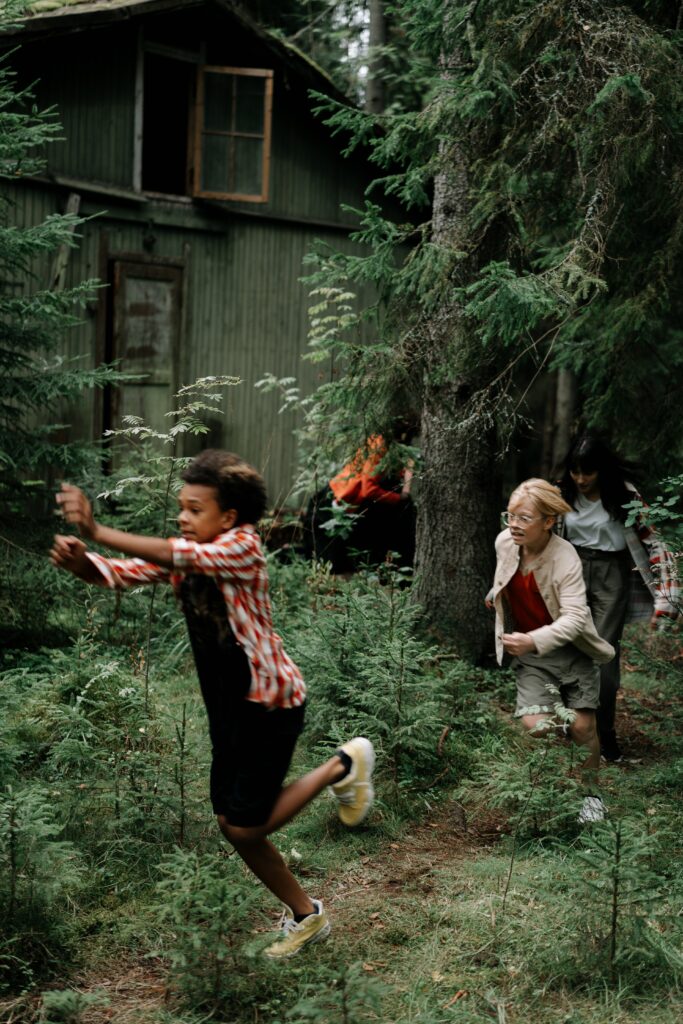
    Brittney dressed for school and left for the bus. She waited 20 minutes then slipped back into the house and slid under the bed. And she waited. She couldn’t face school…. all the kids who she felt judged her. The sleepiness that made it impossible to pay attention in class. The expectations from teachers she couldn’t meet. What can set a teen on solid ground? Brittney didn’t know about ketamine for teenage depression, so she had no hope that anything would change.

    She wasn’t intending to do anything dishonest, she was just trying to survive. School was a problem she didn’t know how to solve. She had no energy or drive for homework, for the tension of being around people all day she had no rapport with. Every day, every day, every day…it never stopped. 

    She felt she would be trapped in this misery forever. So she found a safe place to avoid it.

    Under her bed there was no pressure. No tension from unfulfilled expectations. No students asking her intrusive questions. 

    “Are you on something? You always sleep in class… What do you do at night?”

    “No.”

    “Why do you always sleep?”

    “I don’t know.”

    She just couldn’t stay awake. And she didn’t want to, anyway. 

    When it was time to be arriving home from school, she slipped out of the house… And when the bus stopped she walked into her home by the front door, went upstairs and watched TV. Teen depression can drive them to do desperate things.

    Her mom came in. “Hi Brittney, how was your day?” “Fine.” 

    “Do you have homework?”

    “I finished it at school.”

    “Well, that’s good.”

    Her mother never suspected she was not going to school until the teacher’s conference. And it came out that she … a former “A” student… was failing from missed homework, absence from class, and missed tests.
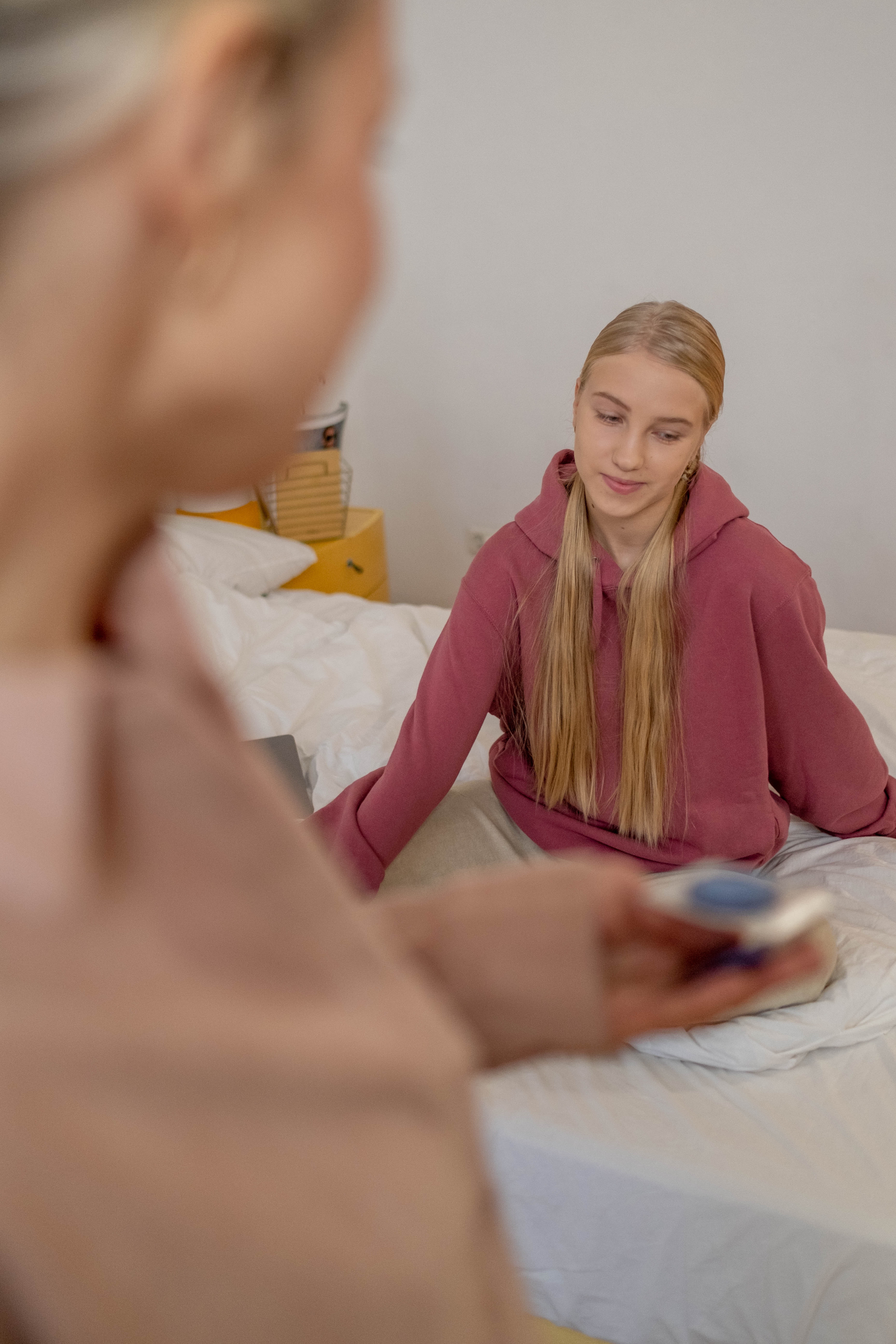
    Talking with your child often can help set your teen on higher ground.

    After a long talk, and lots of tears, Brittney’s mom realized her daughter needed help. And that was the beginning of a long, painful road. Brittney wasn’t thumbing her nose at the system, she was trying to survive. Her mom racked her mind to find solutions, but didn’t know about ketamine for teenage depression.

    For years, we’ve been fighting a crisis of adolescent depression, bipolar depression, anhedonia, PTSD, social anxiety, substance and alcohol misuse, addiction, and suicide. As teens like Brittney drop out of adolescent society to withdraw into a seemingly safe, though dark place, they need someone to reach out and help.

    Someone who recognizes their misery and is willing to help them discover how to find freedom and joy. Because these symptoms aren’t a natural part of adolescence. Misery isn’t a required rite of passage … so if your teen is exhibiting a sullen withdrawal, they may very well need treatment rather than punishment.

    Because here’s the thing.

    Adolescence is a challenging time with hormone fluctuations, changes in self image, reduced energy associated with fast growth and less sleep, and the problems that arise from being suspended between childhood and adulthood.

    It’s no walk in the park to be a teenager, or the parent of one.

    But it’s not an illness. When you see symptoms of illness, that’s the time to seek help.

    And when it comes to illness… i.e., a psychiatric disorder…finding people who can help and a treatment that works can be easier said than done.

    Some teens want to see a therapist and some refuse. Some respond to oral medication and some don’t. If your teen can take a pill and feel better, function better, and get better, wonderful. But if he or she doesn’t respond, something else needs to be done. These are formative years when your teen is forming ideas about who he is and what he wants his future to hold.

    To let time go by without helping them feel their best is blocking that development. But it’s possible to help set your teen on solid ground.

    And for that, stop and consider IV ketamine treatment.

    Set your teen on higher ground with IV ketamine treatment for depression.

    Effective with a broad percentage of people, and responsible for helping so many more achieve remission, IV ketamine is a novel and advanced treatment that can be used for teens be used who suffer with psychiatric disorders like the ones we’ve talked about.

    There has never been a medication that helps everyone, but no medication we use has ever helped so many as quickly as IV ketamine has. It doesn’t help everyone — but in our practice, it does help most of those who need it. And when it helps, it can transform.

    If your teen struggles with anxiety about school, or social anxiety, or depression that hasn’t gotten better, or PTSD, IV ketamine treatment may be just the thing to relieve those symptoms and give him or her the chance to start the year on solid ground in high school or college

    It’s normal to be a little nervous about a new experience, but if your teen is depressed rather than excited about going to school, meeting new people, living in a dorm, and tackling harder classes, he or she may need the boost that IV ketamine for teenage depression can give.
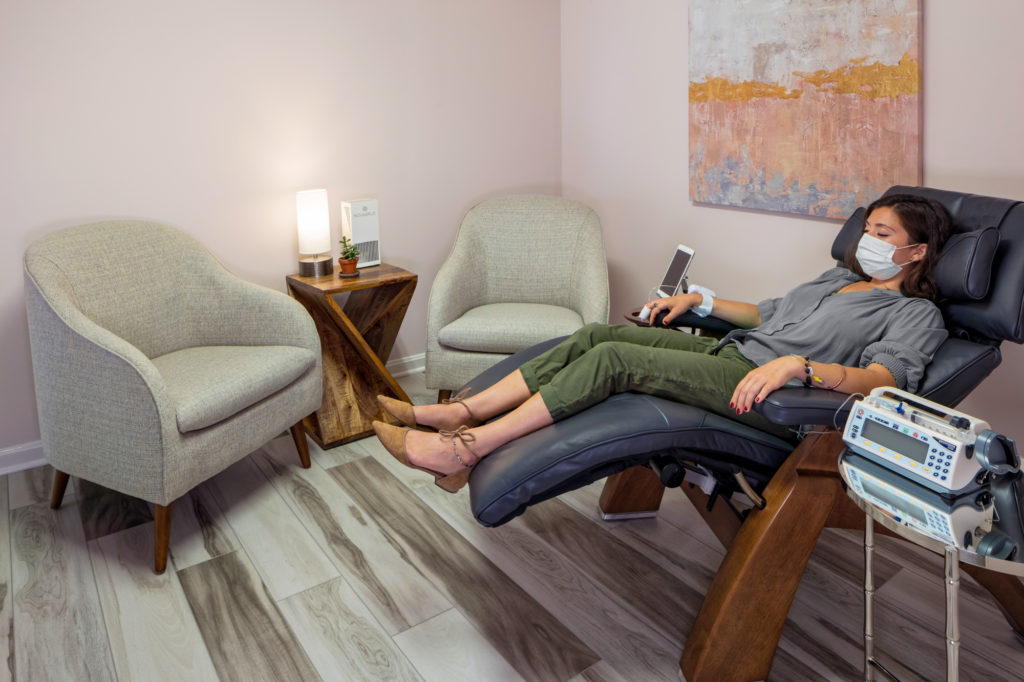
    Receive your ketamine treatment in a comfy recliner to erase memory triggers of alcohol use.

    If you start now, you have time to benefit from a series of infusions before school starts.

    Back-to-school treatment to restore resilience and hope is far more important than back-to-school clothes shopping. Take advantage of 21st century neuroscience so that your teen (or you, if you’re a teen) can reap the benefits of IV ketamine treatment.

    Let us help you prepare your child for the challenges ahead. Call us now.

    Set your teen on solid ground and equip her to meet the demands.

    Sometimes it takes a village.
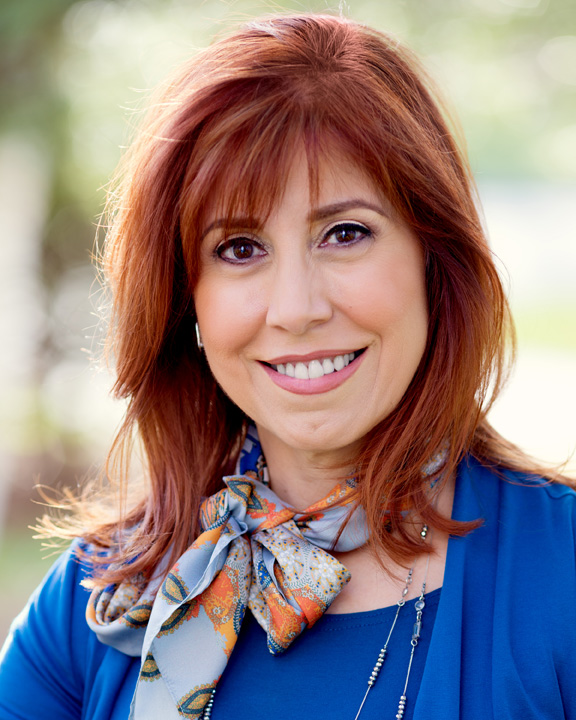
    Lori Calabrese, M.D. is on the front end of the race to stop PTSD in its tracks using IV ketamine treatment.

    To the restoration of your best self,
  • When You Need Resilience, IV Ketamine’s Got Your Back

    When You Need Resilience, IV Ketamine’s Got Your Back

    Chronic Illness Creates Physical Stress

    Janie has a chronic illness that causes her to be admitted to the hospital — often the ICU — relatively frequently. Her condition becomes urgent, throwing her electrolyte balance, her pH balance, and her other systems into disarray. Each time she’s admitted, she suffers dreadfully with overwhelming nausea, vomiting…. and her awareness dims. Janie needs resilience to get her through these times.

    When this happens, she’s under extreme physical stress.

    At the same time, Janie fights depression related to feelings of inadequacy because the hospitalizations that occur so often have interrupted the normal development of her life. Being sick has put her life on pause. She blames herself for not building a career, and considers herself “worthless” because of her lack of success in the business world.

    So Janie suffers from physical and emotional stress. Unbelievable stress. And expanding shame.

    Work Pressure Creates Mental Stress

    Brandon has a severely stressful job. As a manager in a fast-paced, intense environment, he is constantly bombarded with problems that need to be resolved. Things his team members are not in a position to solve themselves. The mental stress of this constant bombardment prevents him from having even a few minutes to recover. Brandon works from 8am to 10pm… and often through the weekend. Sometimes the bombardment continues far into the night. 

    He has very little time with his family, and wonders how long he can hold up under this prolonged onslaught of demands. The mental strain he experiences threatens to break him.

    Janie and Brandon need a heaping dose of resilience. We can think of resilience as the power to quickly bounce back and recover from extreme stress.

    Stress can be emotional, mental, or physical. All three types of stress can prune and wear down the synapses, or connections, between brain cells in the prefrontal cortex, the hippocampus, and the amygdala. According to research, the prefrontal cortex has heavy connections to the emotion-linked areas of the brain in people with a lot of resilience. 

    You NEED those connections.

    Resilience Can Diminish if Not Supported

    While it’s true that the prefrontal cortex is heavily connected to the emotions in a resilient person, non-stop stressors can still wear down those connections and resilience can wane. When your resilience is high, you have incredible flexibility of thought. But as your resilience diminishes, so does that flexibility. So does the synaptic plasticity that creates it.

    There is a plethora of neurotransmitters that play a part in resilience: norepinephrine, neuropeptide Y, galanin, corticotropin releasing hormone, dehydroepiandrosterone (DHEA), dehydroepiandrosterone sulfate (DHEA-S), dopamine, serotonin, abrineurin (BDNF), and allopregnanolone (ALLO). These neurotransmitters and proteins are an integral part of the networks that help create resilience.

    And here’s an important point: not only is your gut involved in your response to stress, but large parts of your brain are involved in your response to stressful stimuli. Are you resilient in your response to the stress you face? Resilient people use higher levels of brain power — as in 3 times the number of genes — than those who have less resilience.

    Think about that.

    Developing Resilience

    And how you develop resilience is influenced by your personality, your temperament, physical fitness, and your social support network. Do you see stress as a challenge or a threat….? It’s unclear how much of a role genetics play in developing resilience, but you can improve your ability to recover from stress by choosing an optimistic solution to problems, by honing a problem-solving outlook, by investing yourself in seeking what’s important to you in life and what brings meaning to it for you, by surrounding yourself with people who support and believe in you

    Pushing Yourself to Stretch Beyond Your Comfort Zone

    You can also develop your own confidence by pushing the envelope, and see how much you can accomplish under duress… without disrupting your peace of mind. And you can support and help others with their challenges…which helps them and puts your own life challenges into perspective. And, by the way, this keeps your brain engaged in life, projects, work, and pleasure.

    Can Janie or Brandon stretch? Can you?

    When Janie’s in the ICU, and barely conscious from her severe condition, she’s not in a position to apply these lessons to improve her resilience. But when she recovers—each time she recovers—it’s a good time to think about her outlook, her problem solving, and her optimism.

    The science of resilience helps you overcome difficulties .

    And when Brandon’s in the throes of one thing going wrong after another at work, he may not be able to think of anything but the pressures that pound him. But when he’s off, he can work on his outlook, his physical fitness, his purpose, and he can choose to surround himself with people who support him and believe in him.

    Sounds good, right?
    Except when it doesn’t work.

    When the onslaughts of stress are severe, they can wear down those connections between brain cells and reduce the neurotransmitters… and it may be just too overwhelming to build resilience.

    You may need help with that.

    IV Ketamine Can Restore Resilience

    IV ketamine can restore resilience. It can build up the connections between brain cells in the prefrontal cortex. It can give you the benefit of turbo charged BDNF to create dendritic growth and spark those connections. The more connections, or synapses, the more you can reach out and the world can reach in. The better you feel.

    Then you have the freedom to build your own inner thought life to support the resilience you’ve gained as a result of treatment. It’s a sort of “leg up” to better living and recovery ability.

    Do you have stressors that overwhelm you? Have you tried treatments or medications that haven’t helped?

    Call us

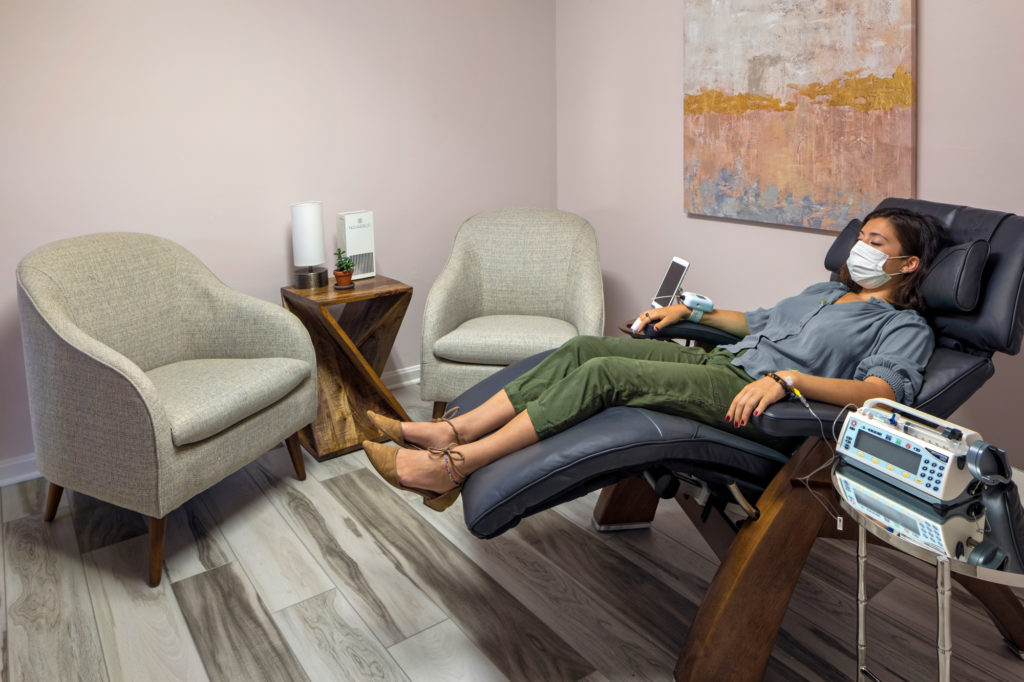
    When you come for ketamine treatment, you'll have a comfortable, quiet room to get the most from your treatment.

    IV ketamine treatment can set you on higher ground, so you can not only develop resilience but you can maintain it. So you can face difficulty with confidence.

    Let’s work together to equip you to thrive — not just cope — with the challenges you face.

    You have just one life. Make it a joyful one filled with hope and confidence.

    We’re here to help

    Lori Calabrese, M.D. is on the front end of the race to stop PTSD in its tracks using IV ketamine treatment.

    To the restoration of your best self,

  • PTSD Permeates Our World with a State of Post Traumatic Stress

    PTSD Permeates Our World with a State of Post Traumatic Stress

    Since the Uvalde, Texas shooting at Robb Elementary on May 24 where 22 people were killed and 18 wounded, 40 more mass shootings have occurred in this country. As we spoke about in our post Shooters are Terrorizing Us, people who hear or read about these terrible events struggle to make sense of them, and in many cases feel the rise of PTSD. Traumatic events like this are all around us. PTSD permeates our world.

    This is National PTSD Awareness Month, and you can help those with PTSD with your awareness and by understanding their pain.

    PTSD isn’t limited to soldiers who’ve survived active combat. It’s also a risk for people in domestic violence situations and those who’ve been assaulted. It can also develop in people who’ve survived transportation accidents, those who have survived a vicious divorce, horrible bullying, and so many other terrible and damaging experiences.

    Some say the whole world is living in a post-traumatic era.

    I say we’re living in an era that’s currently traumatic. There is so much that threatens to fill our lives with trauma. From the deaths and severe illnesses of people we knew and loved related to the COVID pandemic —which is still happening! — to the wildfires, natural disasters, wars and shaken refugees pouring into any country where they can be safe… to the cruel murders carried out by marginalized people who have a hate crime or score to settle.

    We’re seeing it all.

    Hypervigilance creates a prison of trauma

    PTSD permeates our world. Why is that? Maybe because our world is increasingly permeated by experiences that lead to post traumatic stress …. changes within our bodies and our minds characterized by hypervigilance, fear, and hopelessness.

    When we speak of hypervigilance, what are we describing? It’s that exaggerated condition of constantly looking around you for potential threats…something or someone who might hurt you. If you experience trauma, the impact of it can stay with you, always threatening to rear its ugly head again.

    This state can prevent you from relaxing, enjoying the circumstances you’re in, because of the danger of missing a threat. Your subconscious is constantly scanning for danger. Because it feels like it can be anywhere.

    It can make you feel on edge, tense, fearful, and overwhelmed. Post traumatic stress can keep you frozen in fear.

    The stress of PTSD that permeates our world wears down and prunes the nerve connections (synapses) in your brain, making it difficult to think of other things, or focus on the people you love. It’s as though you’re on high alert and ready to jump to defend yourself at the smallest surprise or noise.

    IV ketamine treatment has proven especially effective with PTSD. It causes those synapses to rebuild and reconnect to give you the ability to relax and enjoy the moments in your life with loved ones and friends.

    How does ketamine work?

    By triggering RNA to turn DNA “ON,” and to produce BDNF, a growth factor for brain cells that works like fertilizer to get those synapses growing, flourishing, and connecting…. filling your brain with new, robust connections. It’s as though the lights turn on as the signals in your brain transmit feelings of calm, relaxed enjoyment… and you can feel lighter and infused with hope. Resilience returns (or begins) for you and patience becomes part of you as you find new ways of enjoying your life.

    Imagine waking up in the morning with a song going through your mind, or even waking up singing…! (I know, right? when was the last time?) Imagine not reacting when someone playfully slaps you on the back. That you can go about your business without scanning the crowd for some threat…

    You can live free of those restraints and painful symptoms, and actually focus on your child’s birthday party, or conversation with your partner at dinner.

    At Innovative Psychiatry, it’s a joy to see people freed from PTSD symptoms after ketamine treatment every week. (Makes working so late into the evening doing infusions so worth it!) The robust impact ketamine wields on PTSD is a marvel to witness and can be — hands down — life changing. Whether the trauma is from exposure to tragic events, or verbal or physical assault, or injuries from accidents, or a catastrophic disease.

    Even though PTSD permeates our world — and maybe permeates yours — know that there is hope.

    If you suffer from symptoms we’ve described here and nothing has helped, call us.

    We’re here to help you receive your ketamine infusions in the best possible healing environment. You’ll have a beautiful treatment room where you can relax in a zero-gravity heated recliner while we monitor your heart rate and blood pressure. Your infusion of ketamine will be by a precise infusion pump that measures your dose to the tenth of a milliliter. We don’t hang a bag on a hook, cross our fingers, and let gravity take over, or run a bag in fast because we have to leave. (You wouldn’t believe the stories!) Your recovery is too important for that so we do our absolute best for you.

    And while you undergo your infusion, you’ll be safe from infection from the COVID virus, as well as bacteria and molds. Because 99.99% of all viruses, bacteria, and molds in our air are destroyed by the plasma cell technology we’ve installed in our offices. This is that system we’ve talked about before that was developed by NASA and the Department of Defense for the International Space Station. While our technology works to protect you, you’ll be free to focus on your treatment and getting better.

    We know that there are lots of ways to administer ketamine — lots of ways to administer IV ketamine… and most practices just don’t do what we do. Your journey starts with me—and with an incredibly thorough diagnostic evaluation—not a checklist, not a quick referral form, or a phone call where someone (medical? not medical? a closer?) just sets up an appointment. We don’t run a clinic with one size fits all…we do the very best we can possibly do to foster your recovery and remission.

    Get in touch with us and let’s talk it through.

    We want to see you enjoying your life — and you want that, too.

    So let’s do this! You have nothing to lose and a bright future to gain.

    Lori Calabrese, M.D. is on the front end of the race to stop PTSD in its tracks using IV ketamine treatment.

    To the restoration of your best self,

  • Shooters Are Terrorizing Us

    Shooters Are Terrorizing Us

    Shooters are Killing People

    We have a tradition in this country of excusing and explaining away the actions of a terrorizing shooter by declaring him mentally ill. We’re talking about shooters—the ones who open fire in a crowded public space and gun down the innocent. I hesitate to enter this dialogue but I feel compelled to today. The reason? Because those who truly suffer from conditions I specialize in treating — like trauma, PTSD, depression, bipolar disorder, obsessive thinking, and so many other conditions I specialize in treating are gentle, peaceful, empathic …. and would never become a shooter. The kind of rhetoric in the news these days (and dripping from loud-mouths) that “explains away” terrorizing shooters fuels fear surrounding psychiatric disorders. Shooters are terrorizing us, that’s for sure, they’re terrorizing our sense of security, curtailing our freedom, robbing us of peace. They are stealing our futures.

    So let me be clear and speak loudly: we desperately need to get away from “explaining away.” Because the simplistic way of thinking “they must be mentally ill” (a phrase I loathe) also feeds the stigma that can surface when someone admits he or she is depressed, or has bipolar disorder, or PTSD, or autism or an addiction.

    An Attack on a School or Church Requires Cognition and Strategy

    The person who would plot and plan to enter a public place and shoot as many people as he can is a murderer. Full stop. His cognition is working well enough that he can plan clearly, strategize his actions, and craft his response to resistance. No wonder shooters are terrorizing us.

    It’s not a game.

    They kill without conscience.

    Think about what that means for a minute.

    Are We “Making Excuses” for Shooters by Calling Them Mentally Ill?

    It’s difficult to imagine in a civilized world that anyone would purposely hurt defenseless children, or worshippers, or a family gathered at a barbecue. We can’t conceive of someone with a balanced mind setting out purposely, deliberately, and carefully to make sure that the mass killing is actually a mass killing. Unreal, right? So some people explain it with something else they don’t understand, such as mental illness. (“It must be….”) But it’s most likely that the tipping point for shooters who carry out their despicable acts happens because they’ve been radicalized by their associations, what and whom they listen to…. and eventually decide to act on it.

    This is terrorism…not mental illness.

    Shooters are terrorizing us and killing the innocent. That’s not to say that some of these shooters don’t have a psychiatric disorder. They might and they often do. But that’s not what motivates them. It’s who they listen to in many cases. Voices in their friendship circles, podcasts, or online … the ones they wake up to, fall asleep with, and dial into all day long. The ones who draw them into a marginalized way of thinking related to ideologies, race, hatred, and other dangerous concepts.

    Trauma Caused for Thousands by These Events when Shooters Are Terrorizing Us

    These events are upsetting and heartbreaking for all of us. Far more people suffer beyond the grieving families, friends, first responders and communities affected directly by the deaths that have been exploding around us. Everyone who reads about these incidents, or hears about them on the radio…or on TV or online…suffers with the horrors.

    As a nation, we shudder. And we cry.

    The trauma of these events causes damage not easily repaired.

    But here’s the thing.

    When these incidents draw attention, we’re flooded by footage, news clips, firsthand accounts. Just hearing about and seeing these events—and the shooters who perpetrate mass killings—results in trauma.

    Big T and little t trauma depending on how close you are to it, and what it reactivates.

    What can be done about these wounds to people like you?

    Let’s focus on that.

    Brain Cell Damage from the Trauma People Suffer Over Such Events

    Most of us start out in life with brain cells that are flourishing and abundant, resembling well developed oak trees. Happy Trees!! Then a stressful, traumatic event comes along and creates pruning. It’s as if shears are cutting away the branches from the brain cell, limiting what it can do drastically.

    What had been a great oak among the brain cells, dwindles to a twig with very little function. Then, suicidal thinking often enters, cognition deteriorates, mood tanks, and joy (what’s that?) is reduced to anhedonia…or the inability to feel pleasure.

    IV Ketamine Restores Signals Between Cells and You Feel Better

    shooters are killing people, but to recover from the trauma they causes, IV ketamine can heal the scars of PTSD.

    But when you receive IV ketamine treatment, it creates a cascade which turns on the production of BDNF to act like fertilizer so your brain cells can flourish again. Branches — we call them dendritic branches — grow and reach out and multiply until that pruned back twig is like the mighty oak again, remodelling synapses, setting up new connections, allowing new possibilities, removing suicidal thoughtseven in teens — improving mood dramatically, doing away with anhedonia, and sharpening cognition ….and you feel good again.


    Just imagine for a moment feeling good again after years of feeling bad…or if that’s hard to imagine, read about it in real people who tell their stories.

    But IV ketamine isn’t perfect.

    It doesn’t ALWAYS do all these things — no treatment works 100% of the time for everyone — but it’s so effective and revolutionary in psychiatry because in the right hands, it can operate like this nearly all the time, transforming people like you so you can function at your best. To help you be your best self.

    We can say this because we live it and see it every day. We think deep and long, have the guts and the courage (and the circles under our eyes!) to write up our findings and publish them, travel to teach our colleagues nationally and internationally. It’s why people drive in or fly in from far away to see us.

    At Innovative Psychiatry, we love to see people like you rise above painful symptoms and flourish. Seeing your resilience restored, your hope and energy renewed, your courage and ability to adapt strengthened, makes everything we do worthwhile. (Even the dark circles!)

    Our Treatment Setting is Calm and Relaxing

    When you come for ketamine treatment, you'll have a comfortable, quiet room to get the most from your treatment.

    When you come in, you’ll find a comfortable, gorgeous, private room to create a wonderful setting for healing. The environment is kept pure and clean using Plasma Cell Technology we’ve installed in each space—actually designed and installed for the square footage of your treatment room. (Tell me: who else does that?) Developed by the Department of Defense and NASA, our technology was first created for the International Space Station and removes 99.99% of all viruses, bacteria, and mold from every square foot of the environment by instantly destroying its DNA and RNA. (We’re not talking about a filter here.) It’s the best technology available and it’s kept us —and you — safe since 2020. So you can focus on your treatment and get better.

    Just know that this is your place to get better. To receive infusions of ketamine, integrate them with therapy, work on your infrastructure and your mindset… and achieve remission. We’ll talk about that more soon.

    We’re here to help you on your path to healing, so call us and come in.

    Better days are waiting for you.

    Lori Calabrese, M.D. is on the front end of the race to stop PTSD in its tracks using IV ketamine treatment.

    To the restoration of your best self,

  • Your Family Can Help You or Hinder You in Being Your Best Self

    Your Family Can Help You or Hinder You in Being Your Best Self

    When we think about family, what does your mind conjure?  A mother, a father, and a few children?  Or maybe a mother and children. Or a father and his brood. How you achieve being your best self is largely influenced by your family.

    Maybe your experience with family is having two moms, or two dads. You might have a foster family with a mom and several children of various races with different backgrounds.

    Or you just might have developed a family of your own by gathering people in need you’ve met, who need the support of family. Maybe you needed the presence of others who needed you, and found you needed them too.

    Family can come in lots of shapes and sizes.  A mother and a grandmother leading the brood, or a father and grandfather, like we see on the TV show, Blue Bloods. Fact is, it’s not about whether family members are related or not, it’s about people who feel a connection to each other, who may live together or not, but feel some sort of bond and mutual support that keeps them tied together. That bond can play an important part in your being your best self.

    For those who have good family relationships, thoughts of family likely bring a sense of togetherness, laughter, and warmth.  These are the people you can talk to about your problems and disappointments, and trust you’ll be heard without judgment.

    They’re also the ones who will share your joys and triumphs.

    Fundamentally, family has your back. Or at least it’s supposed to.

    But, if you can’t relate to the warmth, laughter, and togetherness, you may have a family who doesn’t know how to function with support and lack of judgment. And if that’s the case, you may be suffering from wounds and scars from your family. And those can be hard to overcome and heal.

    Family members in families like this are often scarred from being hurt by damaged people. It’s easy to see that in cases like this, your family might not be a strong influence in being your best self.

    Family members who were treated harshly, or even abused, and who in turn, repeat those same behaviors with their loved ones. Because of their own scars, they may not be fully aware that their behavior toward people they love could be causing deep seated damage.

    But for right now we’re focusing on you.

    Mistreatment during your formative years can result in excessive anxiety, depression, PTSD, and suicidal thoughts, as well as substance use disorders.

    What about you? Is your family life full of joy, laughter, sharing, loving, and support..?   Or is it a place you feel alienated and alone, defensive and afraid..? Or if you’re grown now, what are your memories like?  Positive or hurtful?  Maybe you feel anger and don’t know why.  

    It’s possible it started when you were too young to remember, or that you do remember the pain and you can’t figure out how to get over it.

    Here’s the thing. It can be a lot of work to get the therapy you need to come to peace with your past traumas, but ketamine treatment can help resolve the symptoms and the fall-out. It can help you feel better, and by feeling better you can understand your feelings and even change them. If your family has hindered you in being your best self, ketamine can help.

    How? Well, ketamine has the unique and mighty power of neuroplasticity. It helps the neurons in your brain to change, which helps you to change the way you see things. It’s effective in treating PTSD, treatment resistant depression and bipolar depression, and social anxiety, substance and alcohol use disorders, and suicidal thinking.

    At Innovative Psychiatry we help people every week — who suffer from disorders like these — achieve remission with ketamine treatment. Your relationships with your family can be wonderful, or they can be extremely difficult. Sometimes, they’re a combination of both. But if you’ve been wounded, and scarred, ketamine treatment is something you can do to help you heal.

    When you come for ketamine treatment, you'll have a comfortable, quiet room to get the most from your treatment.

    And when you come for treatment, we’ll take you to a private treatment room with a soothing atmosphere, so you can relax. We also have installed plasma cell technology to destroy all the bacteria, viruses, and mold in the room. You can rest assured that you’re safe from infection and can focus on your treatment…and getting better.

    When you’ve lived with these painful symptoms for so long, you can’t imagine you can be free of them, it’s hard to imagine how some infusions can resolve your misery, but they often can.

    We’ve been doing this for years, and we know that ketamine treatment isn’t for everyone. For some people It doesn’t work. For others, it doesn’t seem to work initially, then weeks later, remission sneaks up and takes over. In still other cases, symptoms dissipate after the first or second infusion. Ketamine response is different in different people, just as everyone is different, and everyone’s brain is unique.

    But the bottom line is that you are likely to transformed by ketamine treatment.

    If you suffer from symptoms that interfere with your life, call us.

    We want you to get better. That’s what we’re about.

    Lori Calabrese, M.D. is on the front end of the race to stop PTSD in its tracks using IV ketamine treatment.

    To the restoration of your best self,

  • Mothers of Babies, Teens, and Mothers of Senior Citizens… We Honor You!

    Mothers of Babies, Teens, and Mothers of Senior Citizens… We Honor You!

    Whether you’re expecting your first child or your kids are senior citizens themselves, your heart has been on your sleeve for the duration. Is there anything like being a mother? Whether you’re a. mother of a baby, a teen, or a mother of senior citizens, the worry never dissipates. They’re always on your mind.

    Here in the US, we celebrated Mother’s Day last weekend. But everyday is a celebration of this most wonderful – and sometimes not so wonderful – relationship. The rearing and loving of a human, who pops out of the womb with his own ideas, plans, intents, and decisions compares with nothing else in this world.

    But on the other end of mothering, when children are grown, is when the tables turn in a long, slow process as grown children come to face their mother is a human being, rather than the self sacrificing superhero she’s always been. And that’s a rich opportunity to really learn to know her. Some mothers live long enough to nurture as mothers of senior citizens… and sometimes their senior citizen children are focused on caring for their elderly mother. Turn about is fair play when it comes to your mom.

    Adam is 40…and says his mom really WAS a super hero. The things she accomplished, the things she did for him as a child. No one could ever keep up. But when she was diagnosed with cancer, she became weak and frail. Then she didn’t recognize him at one point, and he says her mortality confronted him like a fist to his midsection. And that’s no joke.

    Marcie Anne talks about how she herself was a realist.  Always was. So her mom’s romantic and poetic views of life seemed to hit her cross ways from the time she was very young…as in three. Now in her mid thirties, her realistic mind set is even stronger. She says if she had to name a time when she was really seeing her mother as she was, it was when Marcie Anne was between 20 and 22…during her mom’s painful divorce.

    She made the point that there’s nothing like watching a parent torn to their core during a crisis like that. 

    What about you?  Do you remember when you realized your mother wasn’t just someone in your life to serve you, but rather a feeling, vulnerable human being in her own right and that there are needs of hers you can meet?

    Perhaps your mother wasn’t healthy enough to be there for you, but rather caused you to suffer by imposing her needs and desires upon you. There are some mothers like that, and if yours is I’m sorry.

    That said, there are no mothers who are perfect, right? None who are never selfish, or who never make mistakes or disappoint you.

    If you’re a mother, you know the deep exhaustion and creativity that life requires of you…and at the same time the reward of watching these young humans grow is beyond description.

    If you, like me, have children by natural birth, adoption, fostering, or just serendipity, you know that the greatest rewards come when we give the most. And few occupations…or rather callings…can require the investment mothering does, or brings the returns.

    But we all know that sometimes mothers become ill and can’t give to their children as they wish to. It can be a catastrophic illness like cancer… or a psychiatric one like severe treatment resistant depression, PTSD, bipolar depression, substance use disorder, or suicidal thoughts that won’t stop.

    In situations like that, the best Mother’s Day gift just might be ketamine treatment. As much as you love and appreciate your mom, she may love and appreciate you even more. To help her get back her heart, her clear mind, her cognition, and to help her get the treatment that restores her hope, and relieves the symptoms of the disorder, lets her live and love again like her heart aches to do.

    At Innovative Psychiatry, we’re set up and equipped to help you receive the treatment you need to function well without depression, social anxiety, or alcohol misuse.

    So you’re free to enjoy your family and your life, and you have the energy to invest yourself in things that matter to you. Your life is to be lived, and ketamine treatment can help you live it.

    To Mothers Everywhere, Happy Mother’s Day–every day!

    Lori Calabrese, M.D. is on the front end of the race to stop PTSD in its tracks using IV ketamine treatment.

    To the restoration of your best self,

  • Feel Like Giving Up?  That’s When You Need Resilience

    Feel Like Giving Up? That’s When You Need Resilience

    Find out how to get it fast.

    Feel like giving up lately? Not just giving up what you’re doing, but giving up on life…?  You’re not alone, you know. Still, just because you feel something a lot of other people feel, you don’t have to act on it. This is why you need resilience. Resilience can give you the power to overcome hopelessness and try again.

    Take Kevin. He has a good job, but he hates it. He doesn’t get along with his boss, and his marriage is not going well.  Kevin feels like he’s always the target of someone’s criticism and ridicule.  (Maybe it’s his imagination, but it sure feels legitimate.)

    At New Years, he went to Las Vegas and played blackjack. He had a great time. Maybe he drank too much to maintain good judgment — didn’t have a clue at the time, of course — and he ended up losing his retirement savings. (You heard that right.) He didn’t realize how bad it was till he was sober, and by then it was too late. It would be different if he’d just lost fun money. But it was his retirement… at least the portion he had access to.

    Kevin felt like such a total fool.

    Of course his wife was horrified. And he knew it was a foolish thing to do.  He thought he could recover it, until he realized it was really gone and there was nothing left to wager.

    Dead end. Empty pockets.

    The shame that engulfed him threatened to drown him. He was humiliated and afraid. So afraid. It felt like there was no hope of recovering. It felt like he was against a brick wall.

    Sometimes being suicidal is a symptom of a severe psychiatric condition, like depression or bipolar disorder, and sometimes it comes on more suddenly in response to complex circumstances.

    Like the men who jumped from office buildings during the stock market crash of 1929. That’s not to say psychiatric conditions weren’t involved. It’s safe to say those people lacked resilience.

    When you need resilience ketamine treatment will life you above the difficulties.

    But sometimes, circumstances become so extreme, leaving you to think you can’t face what the next day will bring…and sometimes giving up the fight seems the only viable option…at least from where you’re standing in the storm.

    A child is ridiculed at school, and her parents find her hanging by the neck in her closet.  Or those people who lost everything in the stock market crash and impulsively jumped to avoid the horrors they faced with no money. Or someone like Kevin, who feels the world is against him, and his self respect is destroyed… so he thinks if he ends his life he would be free of the ridicule.

    For someone in that position, a desperate craving to escape is often one factor in the decision, but there are usually many more. And without confidence and resilience to know he’ll bounce back, he’s left with hopelessness.

    It’s hard, really hard, to live without hope.

    To lift you. above your circumstances ...that's why you need resilience.

    People call it a selfish decision, or a coward’s decision, and I hate to hear that. The duress that someone has endured to reach the point of ending his life is hard — if not impossible — for us to grasp. We all have stress, and stressors, and it may be tempting to compare your own struggles and resilience to his decisions and outcome. But you can’t do that with someone who’s suffering. 

    That person leaves behind loved ones who are grief-stricken but it doesn’t mean it was done thoughtlessly. Often, he has convinced himself that his loved ones will be better off without him.

    So then, it can seem like there is a pathway to suicide that appears on the surface to be fueled by circumstances, and a pathway paved by illness. (And oh it is so much more complicated than that!) But in both cases, resilience can offer hope and strength to move forward.

    What is resilience?

    It’s the capacity to recover quickly from difficulties, to spring back with energy to overcome when circumstances knock you down. When you feel like giving up, resilience is what you need to stand up and overcome. So what do you do if you don’t have resilience?

    Big question. If you’re in a hurry, if you don’t have time to fool around, if things are down to the wire…

    One thing you can do is reach out for IV ketamine treatment to restore your resilience, your joy, and your hope. And…the emotional energy to face what life throws your way..

    When that internal pressure to give up becomes more and more daunting, resilience helps you to resist that defeating pressure and keep trying. Keep overcoming.

    When you come for ketamine treatment, you'll have a comfortable, quiet room to get the most from your treatment.

    At Innovative Psychiatry, applying ketamine treatment to suicidal thinking is one of our most important responsibilities. Ketamine has a unique ability to STOP suicidal thoughts that’s even apart from and before it helps severe depression, bipolar depression, PTSD, social anxiety, alcohol use disorder, and substance use disorder.

    Sometimes in an afternoon. It can save you a trip to the ER. It could save your life. Or someone you love.

    Give yourself the opportunity to overcome defeat and shame, and to stop suicidal thoughts. Reach out for resilience and hope.

    We’re here to help.

    Lori Calabrese, M.D. is on the front end of the race to stop PTSD in its tracks using IV ketamine treatment.

    To the restoration of your best self,
  • Ketamine2022: Ketamine and Related Compounds at Oxford, UK is over. …Unforgettable!!

    Ketamine2022: Ketamine and Related Compounds at Oxford, UK is over. …Unforgettable!!

    Thrilling?  Yes.  EYE opening?  Yes!  Opportunities?? YES!!

    Ketamine and related compounds conference  for treating depression.

    This week saw the best conference of the ketamine-for-depression specialization.  A gathering of neuroscience researchers, psychiatrists, chemists, and more came to share their work with ketamine and related compounds. Researchers hailed from all over the world — the Netherlands, Israel, Sweden, Greece, Ireland, Scotland, France, Australia, Italy, Canada and the US presented their work and poured out the bounty of their findings. Clinical trial sites spanned Eurasia to Australia to North America. Ketamine2022 at Oxford, UK.

    Ketamine and related compounds is such a dynamic topic that a yearly conference is held at Oxford, UK.

    There is nothing like coming together with like-minded professionals to learn and exchange ideas about this medicine we’ve seen do so much. And instinctively, our gut says it will do so much more.

    Ketamine, initially developed as an anesthesia medicine. But surprised us all when we found it could treat depression extraordinarily well—depression that had not responded to other medications. From there, ketamine has gone on to be studied and used clinically to treat PTSD, bipolar depression, and it had been shown to stop suicidal thoughts, and to reduce craving and relapse in alcohol and cocaine use disorders.

    Biopharma companies presented their data on the compounds they’re developing: Axsome, Clexio Biosciences, Janssen, Bexson Biomedical, Relmada Therapeutics, Perception Neurosciences.  

    (These are exciting times and it’s thrilling to see what’s gone on behind the scenes during the pandemic.)

    Ketamine and related compounds presented and discussed at Oxford, UK.

    There were SO MANY, far too many to describe here. But know that the field of ketamine and related compounds in psychiatric treatment is growing all the time.

    We sat at the feet of long-time respected ketamine researchers and a crowd of the best and brightest in the field.

    Rupert McShane of Oxford drew together an extraordinary group.

    Carlos Zarate, Jeff Becker, Jason Wallach, Roger McIntyre, Gerald Sanacora. These are household names in the world of ketamine for psychiatric treatment.

    Carl Zarate is an undisputed leader in ketamine research for psychiatric disorders. He spoke on glutamatergic modulators and next-generation antidepressants. The hope is growing that even those who aren’t helped by ketamine treatment will find relief through another fast acting solution.

    Roger McIntyre talked about the real world evidence that supports long term treatment with ketamine. He also participated in a debate about whether there is enough data to support widespread therapeutic use of ketamine in psychiatry for treatment resistant depression.

    Jeff Becker and Jason Wallach spoke about their new system for subcutaneous delivery of ketamine for acute post-operative pain.

    Jason Wallach spoke again about dissociatives–NMDA receptor antagonism and structure/activity relationships. (He is always so passionate, so brilliant, and so compelling!)

    There were so many wonderful speakers, wonderful insightful topics … evidence that treatment for psychiatric disorders is full of hope on the horizon.

    Ketamine and related compounds conference at Oxford UK

    So more about the conference. Overall, the presentations ranged from esketamine use longterm to new oral meds which were NMDA receptor agonists for major depression. Also about subcutaneous delivery of ketamine, and IV ketamine to prevent postpartum depression after a planned C-section, and data comparing ketamine to ECT. The topics were varied, extensive, important, and innovative.  

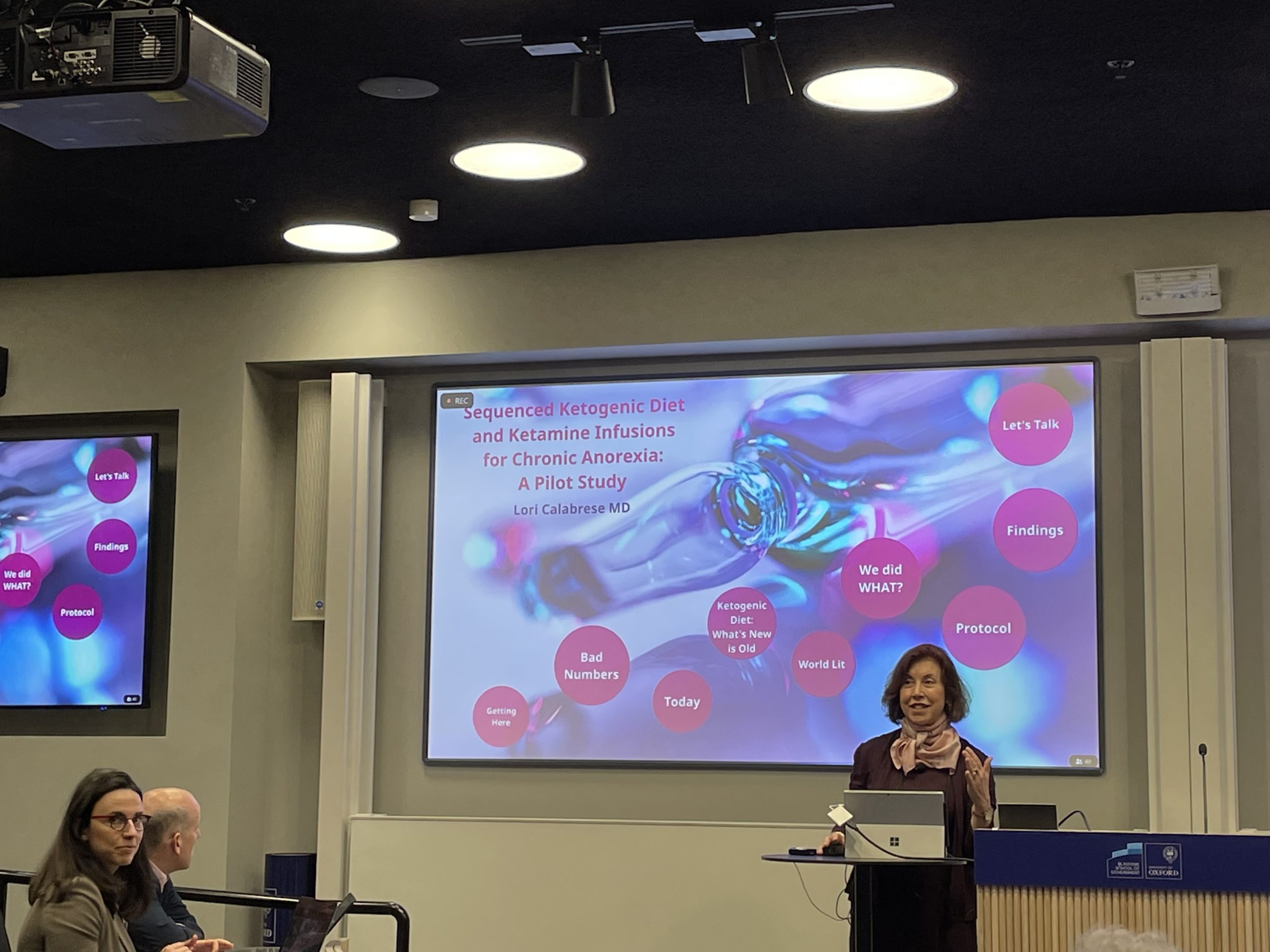
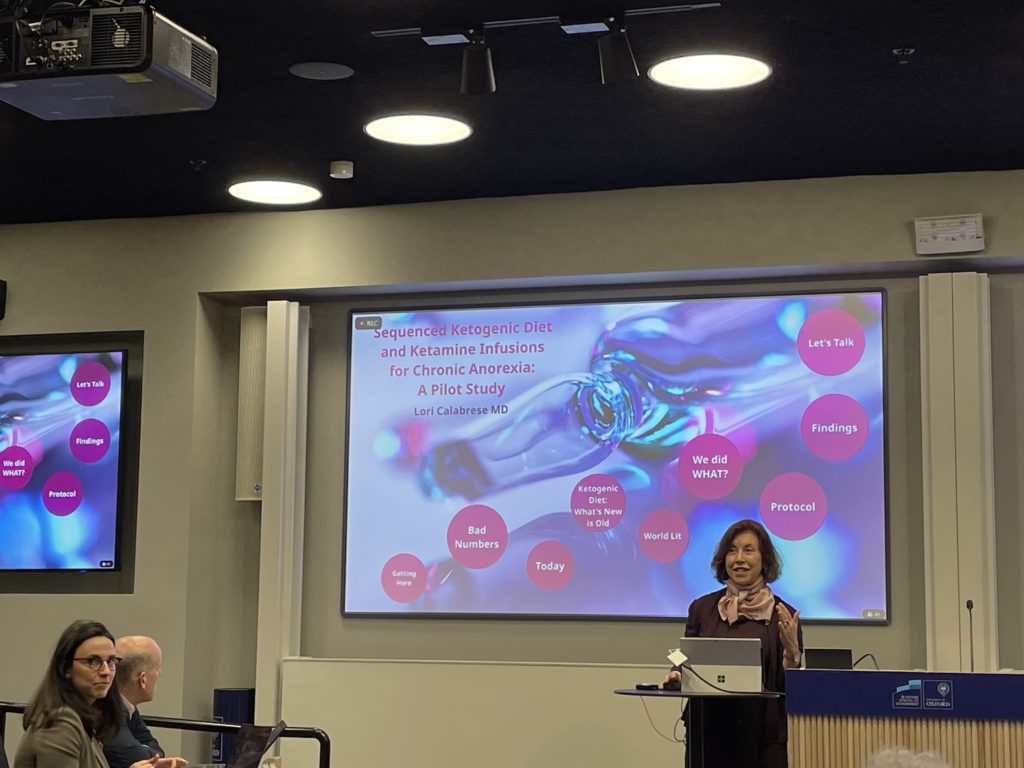
    I spoke on results from a small pilot trial my team and I are conducting using ketamine in the treatment of chronic anorexia — with a therapeutic ketogenic diet (yep! in chronic anorexia) followed by a series of ketamine infusions.

    (The publication is under review, so this was the first sneak peak at the data.)

    Ketamine and related compounds presented in the most lovely setting.

    Going forward, we’ll be talking about some of these topics connected to ketamine and related compounds as they develop… and change the face of therapeutic ketamine in depression and other psychiatric disorders and pain conditions.

    Here at Innovative Psychiatry, people who’ve suffered from major depression and other related conditions come to us every week seeking treatment because what they’re doing isn’t working. Often they leave with hope, joy, confidence, and a spring in their step. It’s important to understand that ketamine isn’t effective for everyone. No medicine is. But it’s transformative for many who need it. And we administer ketamine using the most effective methods available.

    If you suffer from major depression, PTSD, bipolar depression, social anxiety, alcohol use and substance use disorders, and/or suicidal thoughtscall us.

    When you come for ketamine treatment, you'll have a comfortable, quiet room to get the most from your treatment.

    Like the speakers at this conference, we’ve dedicated our days to help you find resilience, restoration, and hope — through IV ketamine treatment.

    When you come for treatment, you can relax in a beautiful, private treatment room to receive your infusions—knowing we use state of the art air disinfection. Using a system designed by the Department of Defense and NASA, each of our rooms is protected by plasma cell technology that destroys viruses, bacteria, and molds in the air. (Even though a new variant of Omicron is in the US now, we have extraordinary technology in our clinic to protect you from it.)

    You can relax and focus on just getting better.

    Call and let’s determine together if you’re a candidate for this lauded treatment. You deserve to enjoy a rewarding life. 

    Lori Calabrese, M.D. is on the front end of the race to stop PTSD in its tracks using IV ketamine treatment.

    To the restoration of your best self,
  • Building Confidence in Your Capabilities: Put First Things First

    Building Confidence in Your Capabilities: Put First Things First

    Twenty-year-old Jake felt listless, really somewhat lost, truthfully. He had led a confusing life of trying to take classes his counselors and parents told him to take, joining organizations that were recommended to him. But never being able to sink his teeth into anything. Nothing seemed like it mattered. Whether it was classes or sports or charity groups. Jake needed to build confidence in his capabilities, but it wasn’t happening.

    How could he get out of his slump and find some meaning?  Build his life toward something worthwhile?  How could he make his LIFE worthwhile?

    He’d taken two years of college, sludging along, getting by without real commitment or passion. Some of his fellow students were halfway through pre-med or pre-law, and he felt like he had nothing to show for his first two years. Jake wanted his life to count for something. He wanted real meaning. He knew his whole life was ahead of him, but how could he make it count…? Did he just need to build confidence in his capabilities or was there more to it?

    One day, after swim practice, he talked to his coach about it. The coach had asked him what he wanted in life. His answer? “Meaning. I want to make some sort of difference in people’s lives. I don’t know whose, or how, but that’s what I want.”

    The coach said, “You know Jake, the students who take swimming for a semester won’t go to the Olympics. A few will continue in swim because they’ve been training for competition all their lives. Of those, one or two might eventually compete. But for the rest, this class is for health benefits and college credit. This class will push you to excel, and you’ll succeed, but then what?  What you want starts with an attitude of excellence. Deciding in advance that you’ll excel at each course you take. Even something as simple as swimming. Then as time goes by you’ll develop more and more expertise in more subjects. Every class you take is building your expertise… and your confidence in your capabilities.”

    Jake wondered what value swimming would have in his life…what purpose…?  Then he thought of other courses he was taking that seemed equally irrelevant. There was a literature course, an art history course, and a basic biology class. He couldn’t see the point. 

    His coach answered. “It’s less about how you’ll use those courses to change the world, and more about how those courses will lead to others, that will be instrumental in your future.

    And meanwhile you’re building yourself…who you are.  That literature course may lead you to try out law courses, art history may give way to archeology, or that intro biology course may usher you into medical research. Because it’s the doing that builds your capabilities, and giving your very best to every course disciplines your mind to seek understanding and answers — no matter how daunting the questions. Giving your best develops excellence… and hope.”

    All this was eye opening. “I guess I’ve just been waiting for the passion for something to assault me in an alley….”

    His coach laughed. “ You may find it more effective to assault passion first with a strategy to develop expertise. What do you think?”

    … Confidence is that knowing, with sureness, that you can trust in your ability and your judgment. It’s feeling sure of your abilities and principles…your capabilities to accomplish what you want to accomplish. 

    It’s one thing to just sludge through life, and another to reach for things that seem beyond your grasp. But the thing is: you need to stretch to keep reaching higher, right?  And to stretch requires some confidence, along with some determination to achieve what you’re reaching for. The confidence you crave is at your fingertips once you build competence.

    It helps to have some guide posts to help you get there.

    To build Confidence, build Competence first. Stand on those things you can do well, and build on them. Maybe you’re really good at baking cookies, or mowing and trimming the lawn. Keep doing those things you can do well, and get better and better at them. Then excel at something else. Maybe swimming..or chemistry. And work and work at it until you’ve mastered it. Then, choose something else. Each time you master something, you create an island to stand on.  Little by little the islands grow more numerous until they grow together and — voilà!!—you’re standing on a continent. Competence is something you build and multiply. Competence gives you confidence. Build confidence in your capabilities.

    Don’t compare yourself and your achievements to others. Maybe someone you know is smarter or better looking than you are. Who cares?  You can do what’s in your heart to do, no matter what someone else can do. Those others, with different looks, different personalities, different assets and talents are not relevant to you with your personality, your appearance, and your assets and talents. Build confidence in your own accomplishments.

    Make them your own.

    Hang out with positive people who believe in you and will help you believe in yourself. Invest your support in those people and accept their support of you. People who believe in each other build strong bonds and collaborate well to solve problems. Choose your friends, your coaches, your colleagues from this group. You can’t afford people who defeat themselves daily with their attitude in your life.

    Take care of your body. Take inventory on your diet. Remove empty sugar foods from your diet and build it on a variety of flavonoids, heathy fats, good proteins, plenty of pure, clean water, and a low percentage of carbohydrates.  

    Lean meats like chicken and fish.

    Flavonoids like avocados, onions, berries, kale, red cabbage, tea, red wine, dark chocolate

    Healthy fats like extra virgin olive oil, coconut oil, avocado, eggs, salmon, mackerel, trout, raw macadamias, almonds, cashews and walnuts.

    Get exercise at least 3 times a week. Walking for 30 minutes, jogging, swimming, or playing a sport you love.

    The best foods and exercise will help you build your confidence in your capabilities.

    Be kind to yourself – Are you someone who beats yourself up after a mistake?

    You may know it well: “I’m so stupid! How could I be such a fool?! What an idiot I am! I’ll never succeed.”

    Cut out that trash talk. You made a mistake. You’re human…it happens to everyone.  

    Learn to treat yourself with the same kindness you treat others. You’ll reach success faster if you’re your own best friend. Never tear yourself down. Accept mistakes and determine to learn how to avoid them. How to replace them with successes. You are your own coach, and there is no place for trash talk with a good coach. Get up and try again — as many times as it takes.

    Practice good sleep hygiene and learn ways to get your mind and body to relax and rest while you sleep at night — good sleep is essential to overall good health as well as preparing yourself to succeed every day. If you sabotage your wellbeing at night, then try to compensate during the day, it won’t work. Use your nights to prepare you for successful days. Using exercise at the optimal time for your own inner clock so it releases tensions, while not overstimulating your body for sleep is ideal.

    Face Your Fears-This may be one of the most prominent elements of building confidence. Facing fears head-on is essential. The opposite — avoiding your fears — sabotages the building of confidence. To recognize you are afraid of something, and then to systematically and purposely try to avoid it, continually rips the rug out from under you. Facing fear takes courage, but then it strengthens your confidence in your own ability to do what you want to do. And when you’ve built competence along the way, fears are less daunting. The confidence you gain from facing fear head-on is something no one can take from you.

    There are some things in life that don’t offer a quick fix. Sometimes what’s needed is our investment of effort. The effort may be long term. But the more effort we invest, the more reward we can enjoy throughout our lives.

    Lack of confidence isn’t always a psychiatric condition — in fact it usually isn’t. But if you suffer from social anxiety, ketogenic psychiatry can give you the freedom to function around people you don’t know so that you can feel comfortable in your skin and build confidence— in your career, as well as your life.

    If you need the extra help Metabolic Psychiatry can provide, call us.

    We’re dedicated to helping you enjoy a more rewarding life.

    Lori Calabrese, M.D. is on the front end of the race to stop PTSD in its tracks using IV ketamine treatment.

    To the restoration of your best self,
  • Inflammation in the Brain with Mood Disorders and COVID

    Inflammation in the Brain with Mood Disorders and COVID

    Eric woke up agitated, fighting the darkness that flooded his thoughts. He plodded to the kitchen and tried to keep the defeat and deep irritability at bay. On his good days, Eric could be a somewhat upbeat guy, and his family enjoyed his clever quips. On darker days, he tried to be upbeat but it came across pretty sinister and critical. Eric was diagnosed with bipolar I disorder a few years ago. The parade of medications his doctor prescribed didn’t help him like they seemed to help others. His brain was miserable. It actually stung and itched at times…at least it felt that way. Was it possible to have inflammation in his brain…?

    Frankly, Eric was “white knuckling it”… basically doing the best he could.

    Because when medicine doesn’t work, you have to use all your strength and your will to hold yourself in control.

    His muscles were stiff and clenching, almost involuntarily. At least, he couldn’t tell that he was flexing them. He didn’t know how to describe it, but he sometimes felt his mind and body had called a meeting without inviting him to attend.

    As hard as he tried to control himself, sometimes he just couldn’t.  His self respect was shot from the life he’d lived, the mistakes he’d made, and the scenes he’d made when his symptoms overwhelmed him. Inflammation in the brain, combined with other bipolar symptoms make it really difficult to live without shame. Especially when medications don’t work.

    To make matters worse, the inflammation led to motivational anhedonia — and it was just too hard to care about things he needed to do, or to find energy to exert on those things.

    Anhedonia is when your ability to experience pleasure or interest in previously rewarding activities falls away — often dramatically. It’s common for people with psychiatric disorders to experience their motivation drop off. Pleasure and motivation are vital components in living to fulfill goals, and without those, you lack the reward that comes with fulfilling goals…which results in dysfunction.

    Was he a monster? No, of course not. The myth of people with bipolar disorder acting like “monsters” is just that. A myth perpetrated by unthinking and uninformed people, devoid of understanding. Eric knew he was soft-hearted, kind to children and pets. Those who knew him best knew his kind heart. And they offered their best support when symptoms loomed too heavy and overwhelming to control. He had friends who said he was the best friend they’d ever had. That was probably because he understood their struggles.

    But…why did the medicines not help him when they helped others?  Eric and his family didn’t know. But they never gave up hope that a medicine or treatment would be found to make his life endurable.

    As the hours droned on, his agitation seemed to be getting worse. It was so hard to remember that his feelings of agitation were symptoms, and not a natural reaction to frustration. Those symptoms felt like real life experiences.

    Because they were his real life.

    Honestly? It was hard to hold a job because these feelings would invade as he waited tables, and as hard as he tried to cope with the frustration in his job, he’d finally melt down and walk out. Or just as bad, the motivational anhedonia would blanket him and he’d be too shut down to go to work at all.

    And then, sometimes his face felt like it was on fire.

    On a bad day, he would squeeze his eyes shut, and hold his head in his hands, groaning, “I have fire ants on my brain.”  Inflammation in the brain is misery. Of course, this was his own personal metaphor. There were no insects. It was a sensation that occurred. This miserable symptom occurred periodically and was a sign his family recognized as an alert he was about to escalate. When Eric escalated, that might mean he would shout a string of expletives, or roar as he hurled his Coke at the wall.  

    He didn’t know why this happened, but it was one of a variety of symptoms that made his condition so hard to live with. His family saw it…upfront and personal. (They knew they’d never experienced what he described.) And they respected him for what he endured. It was awful.

    When people heard he had bipolar disorder, they would say things like, ”Oh, you have mood swings.” They had no idea what that was like. Unpredictable misery. It had little to do with the “swing” and so much to do with the inflamed misery.

    Roger McIntyre, MD, FRCPC, of the University of Toronto and the University Health Network spoke on inflammation in people with mood disorders at a conference last November. 

    In addition, Dr. McIntyre will be speaking at Ketamine2022 the Ketamine and Related Compounds Conference in Oxford, U.K. on April 4-6.

    He pointed out that there is a high prevalence of inflammation in individuals with mood disorders, like depression and bipolar disorder.

    He said that 25-30% of people with major depressive disorder or bipolar disorder have a CRP (C-reactive protein) level higher than 3mg/l. 

    That means they’re at risk for cardiovascular disease, for example, because of inflammation.

    Dr. McIntyre made the point that individuals with bipolar disorder or major depressive disorder are at higher risk to contract, be hospitalized, and even die from COVID-19.

    Plus, one third of outpatients with COVID-19 (and half of inpatients with COVID-19) develop a neurologic or psychiatric disorder.

    Think about that for a moment. One out of three people you know who’ve had COVID will develop a psychiatric or neurologic disorder.

    We’ve got a big crisis looming.

    He found that some causes of inflammation in mood disorders include genetics and environmental factors like poverty, cigarette smoke, diet, sleep disturbance, obesity, trauma, and …loneliness.

    Yes, even loneliness.

    You may have noticed how isolating mood disorders can be. And all that isolation can produce loneliness, which sets you up for inflammation.

    Dr. McIntyre recommends ways of treating inflammation like a Mediterranean diet (lots of flavonoids there!), exercise, stronger social ties, and more restful sleep.

    Because of the connections between COVID-19 and mood disorders, it’s important to take good care of yourself and the people you love, to avoid more serious complications.

    Another issue is obesity. Obesity is more common in people with psychiatric disorders than in other groups.

    Obesity and mood disorders are a dangerous  combination, especially when combined with COVID-19.

    There’s something to be said for throwing out our old view of psychiatric illness, and looking at it through a new pair of lenses.

    At Innovative Psychiatry, we have deep and broad expertise in treating bipolar depression and major depressive disorder. And we know the complications COVID and obesity contribute.

    We encourage you to take advantage of our ketamine treatment program. Ketamine isn’t magic (and it doesn’t work for everyone), but in our practice, it has been transformative for so many.

    Receive your ketamine treatment in a comfy recliner to erase memory triggers of alcohol use.

    When you come for treatment, you’ll be led to a private infusion room where you’ll be carefully monitored. We’re meticulous about keeping our air free of bacteria, viruses (like COVID-19), and molds using plasma cell technology developed by NASA the Department of Defense—we were the first ketamine infusion center in the US to offer this.

    When you come to us for treatment, you can rest knowing you’re safe from infection here (no matter what’s going on out there) and you can focus on just getting better.

    We’re here to help you, with infusions of a remarkable medicine we use effectively for major depressive disorder, bipolar depression, PTSD, social anxiety, substance and alcohol use disorder, and suicidal thinking.

    Treat the mood disorder to reduce the inflammation in the brain.

    You’re not isolated and facing your symptoms alone. We’re here to help.

    Give yourself the opportunity to get better.

    Lori Calabrese, M.D. is on the front end of the race to stop PTSD in its tracks using IV ketamine treatment.

    To the restoration of your best self,

error: Content is protected !!