Tag: IV Ketamine for Depression

  • Grieving Loss as the COVID Saga Drags On…

    Grieving Loss as the COVID Saga Drags On…

    If you’ve known someone who’s had COVID-19, you may have also known someone who died from this coronavirus. Hundreds of thousands have died since January 2020, but your loved one was not just “part of the crowd.” Death of your cherished love one is life changing for you. What do you do with the grief?

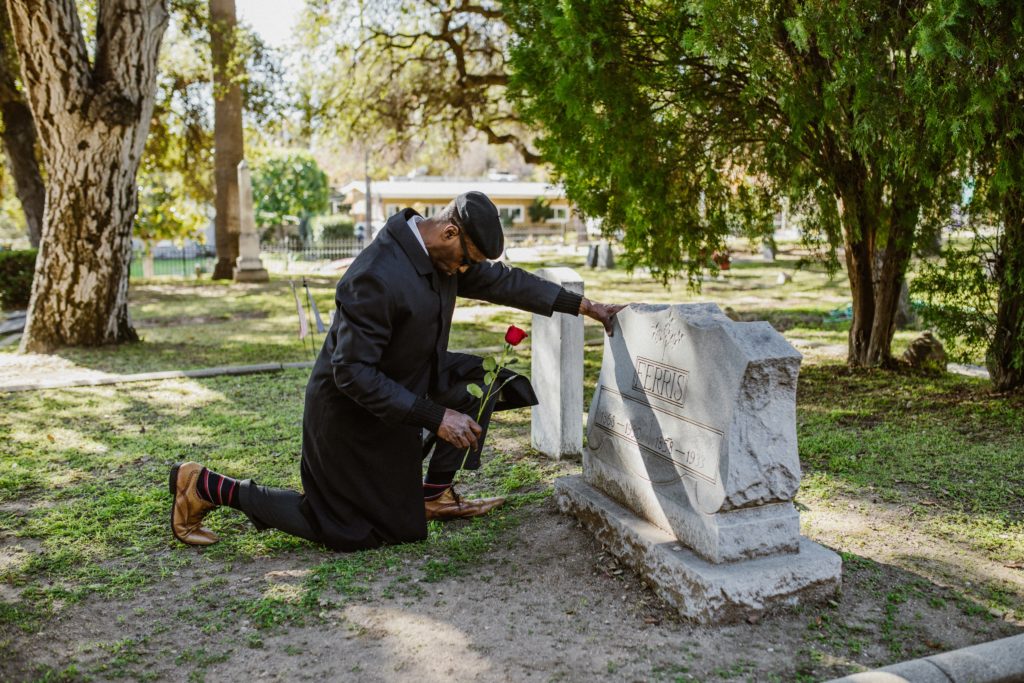
    Since nearly 750K people have died in the US alone from COVID, most of us have known someone who died. Some of us know several people who’ve died. And beyond COVID-19, many have died from heart disease, cancer, accidents, suicide, and scores of other causes. Starting in January 2020, few people are left who’ve been untouched by the loss of a loved one. The death of someone significant in your life leaves you empty, bereaved, even angry. And you’re left to do something with belongings, and find a way to move forward. Let’s talk about the grieving… grieving loss as the COVID saga drags on. Since death is part of life, grieving those we’ve lost is a very real part of living…

    Stephanie walked along the walkway, mask firmly in place. She was armed with hand sanitizer in her purse, and a spare mask. She and her family had complied with the protocols for protection from COVID-19 all along.  So much time alone in the house — so she’d learned to play music all the time so she wouldn’t feel so alone.  

    Text messages and phone calls filled in spaces through the day that would have otherwise felt like isolation, and overall, she was doing pretty well.

    Her husband, Dan, had worked from home, but his company had been transitioning workers back at a rate of a handful a week. Today was his first day back in the building. 

    But, he came home feeling bad… aching and exhausted. Fever was 102.3. Now that was alarming. 

    She got him settled in bed, gave him some Tylenol, and started thinking. This was his first day. The coronavirus would not have already shown symptoms if he got it at work that day.

    So where else had he been in the last week?

    Nowhere. He’d been home. Who was he exposed to?

    Oh wait. He’d gone across the street to borrow gas for the lawnmower. That took about 10 minutes. Surely not.  

    The more she thought about it, the more she realized she was right. He’d been at the neighbor’s house ten minutes. She decided to call over there to ask if anyone in the house is sick.

    So she did, and wouldn’t you know… their son had gotten COVID at school. She felt sick. He wore his mask, used hand sanitizer, but still got the virus from someone at school. So… he brought it home. And in a quick ten minute visit, Dan was exposed.

    Within 5 days, Dan’s breathing was alarmingly labored. Stephanie called 911 and Dan was rushed to the hospital. In ICU, he was quickly placed on a ventilator and IV medications were started. 

    For reasons that baffled Stephanie, her husband’s condition worsened fast. 

    Dan died 3 days after his admission.

    Stephanie and her son, Jacob, felt lost. In shock. Surely she would wake up and this would be a terrible dream.

    Shock and denial engulfed her.

    They went through the motions of moving Dan to the funeral home and making preparations. They arranged a memorial service over Zoom and let all Dan’s friends know when to tune in.

    She didn’t want to see anyone, but knew she was grieving the loss as the COVID saga drags on. She had to pull herself together to respond — to her son, to their family, to their friends.

    The tragedy was senseless. Heartbreaking. For a week or two, she felt like she was in a fog. She kept expecting Dan to walk through the door and tell her it was all a mistake. That he was fine.

    But he didn’t walk through the door. And Stephanie was angry.

    Eventually, as the reality sank in, Stephanie felt angry. Angry that Dan was gone, angry that he’d left her, angry she had to rear their son by herself. She found she was short tempered, irritable, quick to retaliate with clerks, the checkout person at the grocery store, her son, and her parents.

    The longer that went on, the more she blamed herself for making life hard for her son, and others. She loathed herself for being unpleasant with everyone. But she was just so mad.

    She felt guilty for snapping at those around her, and for Dan’s death. If only she’d been more helpful that day when he was mowing and ran out of gasoline.

    She found herself bargaining.

    How much better it would have been if she had taken the gas can in the car to the gas station and brought him home some gasoline. Then he would not have gone to the neighbor’s house. Maybe it would have saved his life…and they never would have even known he might have died. Their life would still be stable and good.

    Why didn’t she? If only she had!!!!!!

    She knew she was just grieving…grieving loss as the COVID saga continued…still it felt real. But so futile.

    Was she being lazy..?  What WAS she doing that day when Dan needed that gas?? If only she could bring him back. If only he was still alive….and life was normal.

    If only…

    Depression began to take hold

    Stephanie found she lost interest in being with her friends. She just wanted to nap. She took her son to school, then went home and went to sleep. Life had lost its luster. The appeal was gone.

    She had lived her life for Dan and Jacob. They were everything to her. All the things she used to enjoy — like watercolors, hiking, school board meetings…it was all so empty now. In fact, it was miserable. Anything that involved people made her feel like she was on display… the single mom, the woman whose husband died. She couldn’t bear being in that atmosphere so she didn’t go. 

    The days and weeks wore on. She tried to be cheerful for Jacob. She tried to talk to him and listen to him about his feelings of loss. But she didn’t feel she was very good at it because she felt so broken inside.

    So she called in pizza, or Uber Eats — she didn’t have the energy to face cooking — and they ate and talked some, or she put on a movie they could watch together.

    Grieving loss as the COVID pandemic continues… well, it takes its own path. Grief has a life of its own…

    After a couple months of this, Stephanie began to see her situation in a new light.

    Acceptance rises ….

    Her thinking became more realistic when she thought about Dan’s death…more logical.  And the more she looked at it all realistically, the better she felt. As if a lead blanket was lifting off her.

    She heard someone say that the answer to “Why me?” is Why not me? That life is made up of good times and hard times. And this pandemic has made millions of people sick. Not just Dan. 

    That hundreds of thousands of people have died in this country as a result. Including Dan. And just like her, hundreds of thousands of families are shattered because of loss. Not just Stephanie and Jacob. Of course, this was months after Dan died. It seemed that grief just had to take its course, but she felt she was beginning to see light between the clouds…

    She could see there was no shame in grief. But she could also see she must not stay tied up in grief forever. She could see she needed to rise up, shower, dress, and take Jacob somewhere up lifting.  

    As the days and weeks passed by, and Stephanie dove into all the tasks she needed to tend to, she found she could feel the sunshine again. She felt hope beginning to bubble up inside her.

    At times, a wave of grief would over take her and she had to excuse herself and sob over how much she missed Dan. But then it would subside, and she could function again, to some degree. 

    Have you lost a loved one during the pandemic? Do you find yourself in a swirl of confused emotion, and feeling guilty to boot?

    Since depression can creep in and take over during grief, how long should you let the depression continue without seeking treatment?

    You’ve probably guessed the answer… “It depends.”

    Grieving loss as the COVID pandemic continues takes courage. But it’s not permanent.

    If you find yourself stuck in grief that turns into depression for an extended period of time, say several months…and it’s not getting better… maybe you should consider IV ketamine treatment.

    At Innovative Psychiatry, there is no magic cure for grieving a loved one. It’s something we each go through after a terrible loss from death or divorce, for example. And while there there is no official time stamp that determines when your grief should be complete, it is possible for you to get stuck in anger…or depression…and feel helpless to continue moving forward.
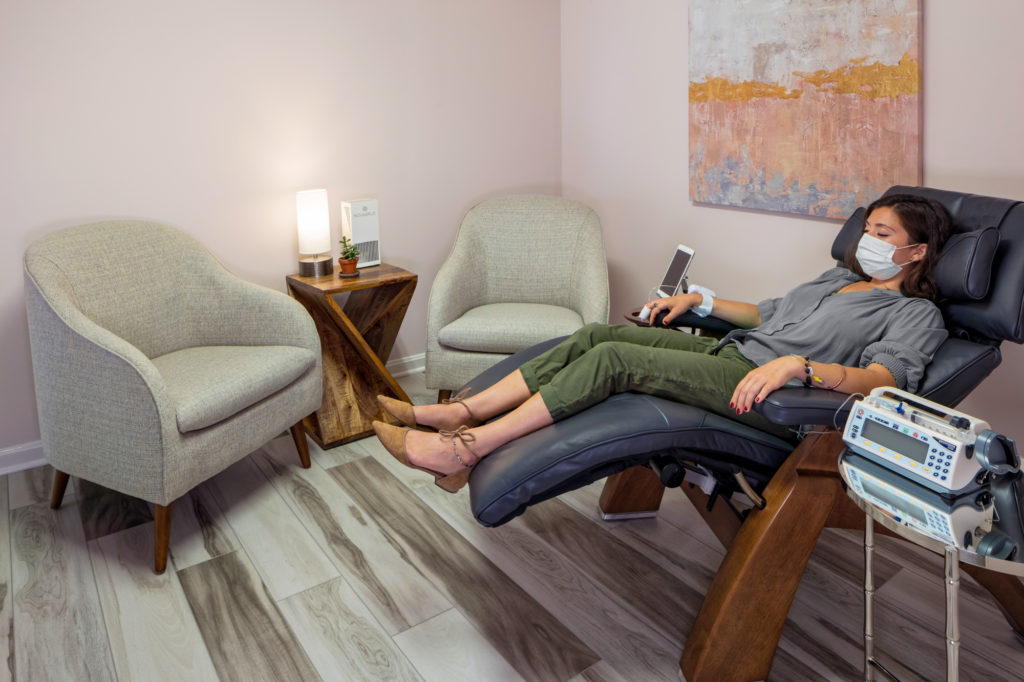
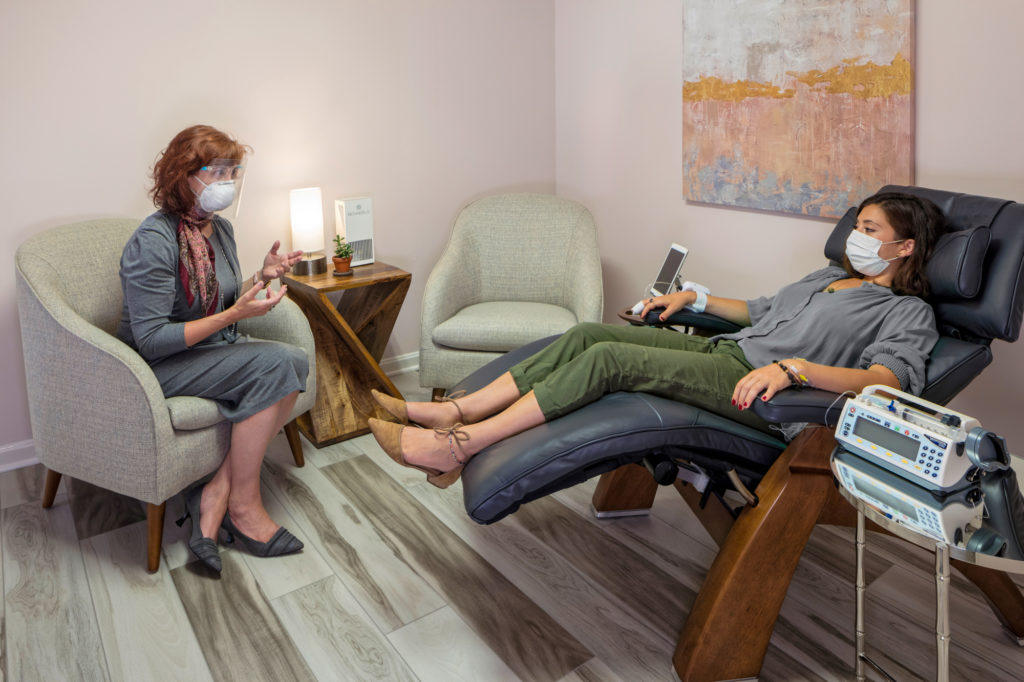
    Receive your ketamine treatment in a comfy recliner to erase memory triggers of alcohol use.

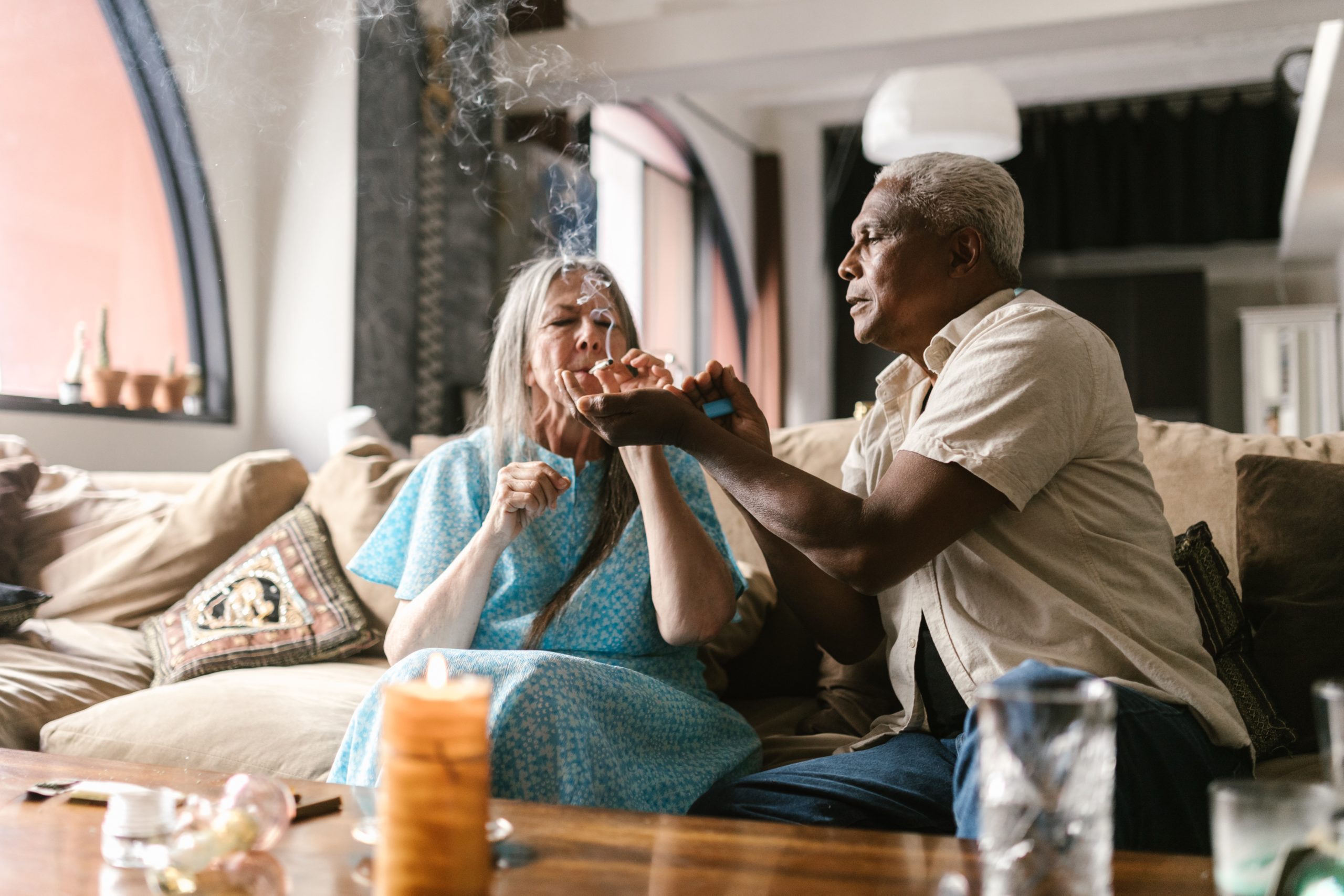
    In addition, depression can become complicated with other problems like substance and alcohol misuse. IV ketamine can be a great help with those, and make it less difficult to move forward and reach the point of acceptance and peace with this loss.

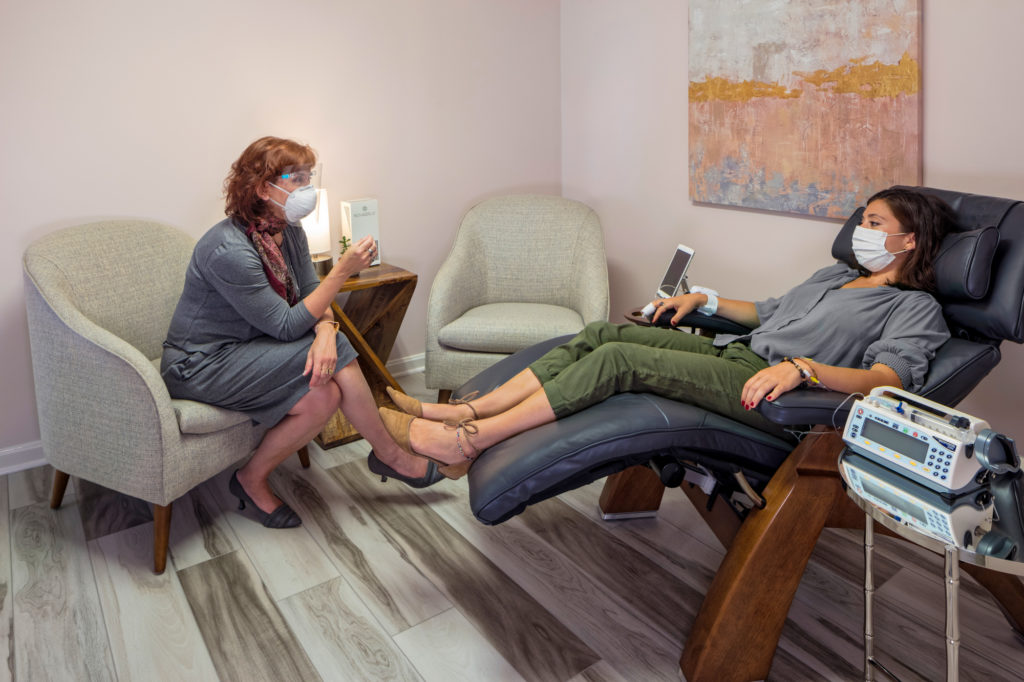
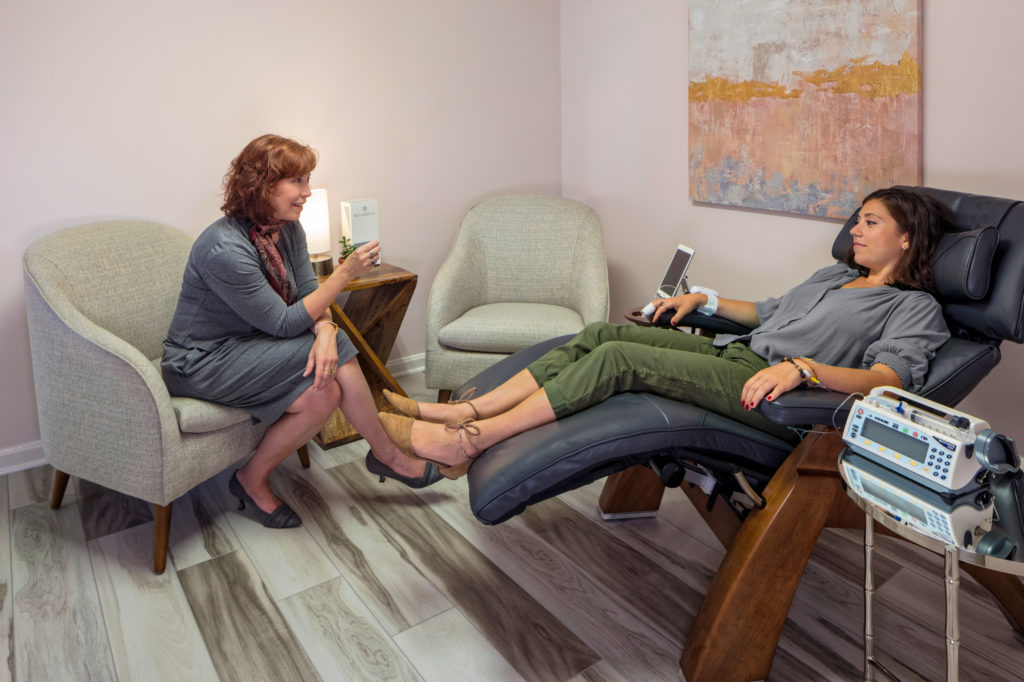
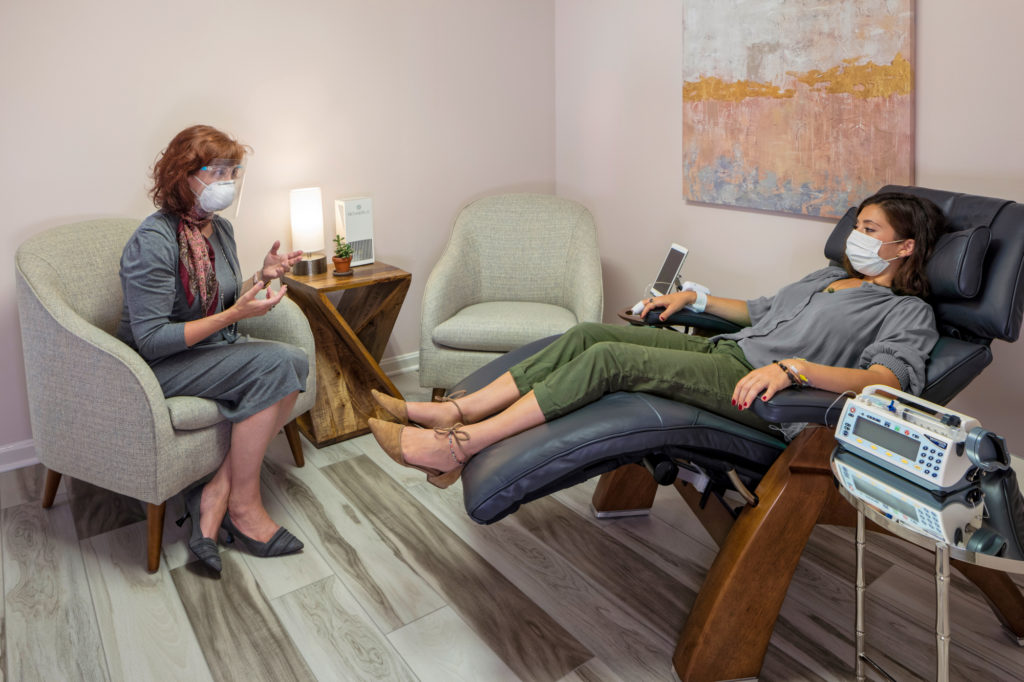
    We offer IV ketamine treatment for those who are candidates and would like to give themselves the best opportunity to get better. When you come for treatment, we’ll meet you at the door and take you straight to your private beautiful room where you can get comfy in your zero gravity recliner. You’ll be monitored with state-of-the-art equipment to so we can ensure you’re at your best during the infusion.

    Feel free to bring a playlist (without words) that can run for about an hour and earbuds or headphones.

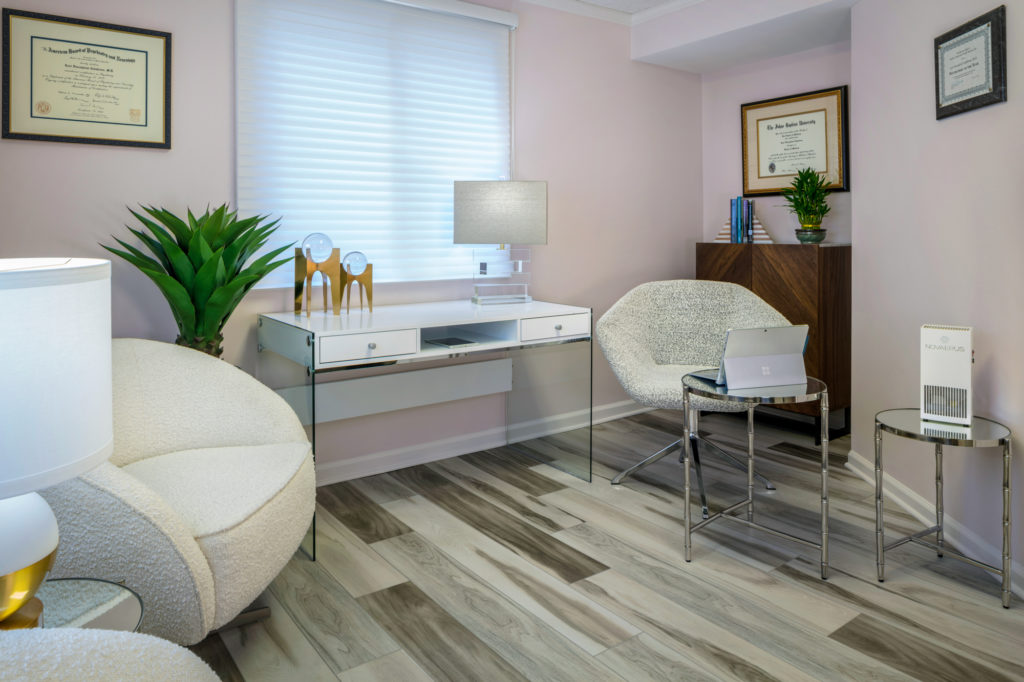
    You’ll notice an elegant white box labeled Novaerus on the table. This unassuming box is quite a hero in our offices. Developed by NASA and the Department of Defense, this plasma cell technology is busy working 24/7 to destroy and remove from the air all the viruses, bacteria, and mold. So the air you breathe is fresh and cleaned continuously, and your lungs are not exposed to pathogens that cause disease. (All COVID variants included.) You can feel safe from infection when you come for treatment, and you can focus on getting the most from your infusion.

    Grieving loss as the COVID saga drags on is challenging, but you will survive it.

    Grief can be complicated. In addition to the loss of your loved one, the loss may include major changes to your life that also must be managed. Isolation. Loneliness. Perhaps reduced income. To manage difficulties you were unprepared to face, it helps to have the benefit of remission giving you a clear mind to address all you need to.

    The loss of someone you care about can be devastating, but as you proceed with support through the stages of grief, and get treatment if you need it, you can recover, rise again, and move forward in your life.
    Lori Calabrese, M.D. is on the front end of the race to stop PTSD in its tracks using IV ketamine treatment.

    To the restoration of your best self,
  • Anxiety vs. an Anxiety Disorder: What’s the Difference?

    Anxiety vs. an Anxiety Disorder: What’s the Difference?

    Anxiety is a part of all our lives. Feeling nervous before a test, or before a meeting with the boss. But for some, anxiety continues to get worse until it is a disorder…and needs an intervention because it’s interfering in your life. How can you know the difference?

    For example, a time of life when anxiety is so thick in the air you can cut it with a knife… is middle school.  And it’s true that most middle schoolers struggle with some amount of anxiety on a regular basis. Does he like me? Am I ugly? Did she talk to me because I’m a charity case, or does she think I’m worthwhile..? It goes on and on. Self doubt and insecurity is part of the backdrop at that time of life. But there is a difference between anxiety vs. an anxiety disorder.

    Britney and Analise were both 13, and cute boys filled their thoughts. The dreams they carried in their hearts of being swept off their feet by their fellow 12- and 13- year old classmates were just that — dreams. But their hearts swooned when they thought about certain boys in their class. 

    As the girls walked home from school, they talked about the upcoming 8th grade graduation dance. “Has anyone asked you to go to the dance?” Analise asked. 

    Britney said, “No…, you?”

    Analise looked at her feet…”No…. I sort of doubt anyone will. So if no one asks you, will you go anyway?”

    Britney lit up. “Yes I think I will. I mean really, Analise, we could ask some boys to go, you know?  We don’t have to wait for them!”

    “Would you do that? I know people do that…but I just don’t think I could… Just getting my nerve up to call would be so hard…I don’t think I could do it. Look at my hands…they’re shaking just thinking about it.”

    “Analise, lots of girls will ask boys to the dance. You wouldn’t draw attention to yourself if you did, too. It’s scary to ask someone, knowing you can be turned down. But honestly, it’s what boys go through all the time. Even though it scares me to ask somebody too, I still think girls should carry some of the load.”

    (Britney had some anxiety vs. an anxiety disorder…? Not so much of a disorder.)

    Tears filled Analise’s eyes. “Thank you for the vote of confidence, but there’s just no way. I’d rather not go at all…”

    Twenty Years passes….

    Britney walks into the City Library, and stops at the head librarian’s desk. “Ahem… I’m looking for the librarian. Is she here today?”  

    Her eyes met with the woman at the desk. “Britney!!” Analise was elated. “I haven’t seen you in years!! What have you been doing???”

    “Analise, I would have known you anywhere!!!  I’m in town for a conference for women lawyers. I have to speak, which I don’t mind. But I just had to make time to come see you!  How long have you worked here?”

    “I was hired straight out of college and have been here ever since. A few promotions and I’m head librarian. I love my job.”

    “Ana, this is perfect for you. Remember when we talked about asking boys to the 8th grade dance??  You didn’t go, and I did. I realize now that I shouldn’t have pushed you. It just wasn’t your thing.”

    (Anxiety vs. an anxiety disorder: the difference is that Britney was motivated by hers…and Analise was blocked by hers.)

    “Honestly, Britney. It turns out I have an anxiety disorder and I take medication that helps but it doesn’t wipe it away. I felt so much shame as a teenager. But it’s been a revelation to understand that I have a disorder, that it’s not that I’m a coward. Gosh, life is hard for kids. Have you experienced any difficulty with anxiety since then?” Analise looked at Britney intently.

    “Sure, I’ve had anxiety, but nothing hard to deal with. I’ve been nervous about one thing or another along the way. Asking a boy to that dance was really tough. I felt humiliated and my hands were shaking. But he went with me, and we had a pretty good time. I think that through the years, I’ve been able to just go ahead and do things that were hard, and most of the time it helped me gain confidence. 

    “Which is a good thing because I’m in the public eye so much now for my job. It’s just the path my life took.” Britney scratched her forearm thoughtfully.  

    “Brit, I’m really glad for you. So glad that you have been able to keep pushing through in what you wanted to do. Glad you’re enjoying the life you have. Glad for you that you’ve been promoted along the way. Your job sounds perfect for you. I can clearly see that the anxiety you’ve experienced has been part of your growth rather than a disorder requiring treatment. And I’m also so glad that a job like this one was available for me to enjoy and follow my own path. We’re both “following our bliss” as they say.”

    Britney smiled her winning smile, and looked at her watch. “I wish I didn’t have to rush off, but I need to get to the conference. It’s wonderful to see you again, Analise, and to see how well your life is going.”

    Ana and Brit discuss the difference between anxiety vs. an anxiety disorder.

    “I’m thrilled I got to see you too, Britney. And by the way, I’m getting married this summer. You’ll get an invitation. He’s a chemical engineer and my best friend. If you can make it to the wedding, I’d love it. Now hurry and run! You mustn’t be late! “

    The two women hugged, kissed cheeks, and Britney took off.

    Analise sat back down at her desk and thought about their conversation. She smiled to herself when she thought of how far she’d really come.

    Both Analise and Britney felt anxiety in 8th grade.  The anxiety seemed to motivate Britney to overcome it and make the call to a boy. But it stopped Anallise in her tracks.

    Anxiety is a part of life for everyone. Many experience it in small manageable doses like Britney did. Over her life, she came to see the anxiousness she felt before a challenge as an opportunity to overcome. So she just kept stepping up to overcome it.

    Britney saw anxiety as a motivator.

    In Britney’s life, anxiety built a fire under her to accomplish more, overcome more.

    Analise, on the other hand, felt blocked by the anxiety she felt about that dance. Her anxiety was too intense for her to move forward. It didn’t motivate her, it made her feel crippled. Frozen. Incapable of meeting the challenge. As Ana’s life continued, she never felt motivated by anxiety, but had to get it under control just so she could function at all. 

    She had headaches, GI upsets, and aches and pains she couldn’t explain. She’d be invited on dates, and spend the date in the restroom of the restaurant, unable to enjoy the opportunity. And it was so embarrassing. She felt out of control of her life.

    Anxiety vs. an anxiety disorder… Britney managed the former well, and Analise found treatment for the latter. And they’re both doing well now.

    So in her late teens she sought psychiatric care and took medication. With the help of the medication, she could push forward in her education.  

    However, after college, it became clear that Analise’s main anxiety issue was social. It prevented her having fun at the 8th grade dance, it made it hard to date in high school and college.  But she learned about IV ketamine treatment and what it could potentially do for social anxiety.

    So after college, once she was working at the City Library, she saw a psychiatrist who offered IV ketamine treatment, and it changed everything for her.

    She became comfortable attending librarian meetings, or talking at length to scholars who came to the library for research. And she began to date again because her fear was gone.

    She was so thrilled to share with Britney her upcoming marriage. Oh sure, the wedding would be fun, but it was the aspects of marriage that require deep communication that excited her the most.

    At Innovative Psychiatry, we see people with anxiety disorders all the time. We get to enjoy the pleasure of watching people receive IV ketamine treatment and lose their fear of social situations. With the anxiety gone, they’re able to let their true personality emerge in a variety of situations. No longer do they stare at their feet.

    Ketamine treatment has demonstrated great results for social anxiety, treatment resistant depression, PTSD, substance and alcohol use disorders, and suicidal thoughts.

    If you suffer from symptoms of disorders like these, call us.

    When you come for ketamine treatment, you'll have a comfortable, quiet room to get the most from your treatment.

    When you come for treatment, we’ll will meet you at the door and lead you to your private treatment room where you’ll find a comfy recliner. The room is in a constant state of disinfection from a plasma cell technology developed by The Department of Defense and NASA to destroy viruses (including COVID-19 related forms like the delta variant and the lambda and mu variants), bacteria, and mold in the air and on surfaces. Designed for the Space Station, this technology is powerful and wipes out these invaders. So you’re safe from infection when you’re with us. That leaves you free to focus on getting the most from your treatment.

    Remember, most people struggle with some anxiety now and then, but if you suffer with symptoms that are persistent and that interfere with your life, causing you to miss important opportunities, you may benefit from treatment. It can make all the difference for you.

    Lori Calabrese, M.D. is on the front end of the race to stop PTSD in its tracks using IV ketamine treatment.

    To the restoration of your best self,
  • How Neglect in Early Childhood Changes Girls’ Brains for Surviving

    How Neglect in Early Childhood Changes Girls’ Brains for Surviving

    We talked last week about how childhood abuse alters girls’ brain development, slowing down the maturing of emotional circuits in key areas. But what about neglect?  Does the neglect of a little girl do the same thing?

    The light grew darker as the sun had set and Bryanna shivered. She didn’t like the dark. She scooted her stool to the light switch and turned on the light to chase the monsters away, then did the same in the hall, kitchen, and family room. Bryanna knew her parents had to work so they’d have food, but she so wished she had her family at home. This was the third night in a row that no one was home when she had to turn on lights. (Neglect in early childhood puts a little girl at risk.)

    Her tummy growled and she realized she was hungry, so she opened the fridge and found some lunchmeat and mustard. Then she found bread in the pantry and put it on the table. She reached up and opened the silverware drawer and felt around above her eye level. She felt the long table knives and wrapped her fingers around one and pulled.

    Back at the table, she worked and worked to open the mustard, and finally snapped it open. Then squeezed the plastic bottle upside down until some clear juice and some mustard came out on her bread. She frowned at the clear stuff. That’s not mustard, she murmured to herself. 

    But she just stirred her knife in the clear stuff, then spread it all on her bread. Next, she freed a piece of lunchmeat from the package and carefully put it on the bread and covered it with more bread.

    Taking a bite out of her sandwich, she walked with it to the family room and turned on the TV. A big blob of mustard plopped from her sandwich onto the carpet. Bryanna frowned and scrubbed it with a napkin.

    Switching channels to her favorite Disney show, she settled on the sofa to eat.

    Bryanna felt her aloneness, and wished someone would come over or even call. She knew Grandma wouldn’t because she lived 8 hours away. She didn’t want Uncle Jason to come because he wasn’t very nice. So, she picked up her teddy bear and hugged him tight so she’d feel better.

    Finally, as the night grew later, she leaned over on a sofa pillow in front of the TV and went to sleep.

    When she woke up, the house was filled with morning light.

    So, dragging her bear by the arm, Bryanna went to the kitchen to find her cereal. But first, she looked in the driveway.

    Empty.

    No one came home. Siggghhhhhh.

    Does Bryanna know she’s neglected? Probably not. At least, not yet. Once she’s in school and hears about the kids whose moms are home waiting for them, she’ll begin to make the comparison. And eventually, it’s likely she’ll become increasingly unhappy about it.

    At this point, however, she just knows she’s tired of being lonely, and wishes they would return, because neglect in early childhood is hard for little persons who ache to be nurtured.

    Bryanna decided to get a pen off the table, and she put a mark at the top of an old newspaper. That was for yesterday. Then she put a mark next to it. That’s for today, she whispered.

    How many days would they be gone before they came home..?

    Bryanna is 4. Her ability to care for her own needs seems mature, considering her age. But Bryanna has been left alone many times in her life. She gets lonesome, sometimes scared, but she solves problems, feeds herself with what she can find, and entertains herself very well for a 4 year-old.

    She loves her teddy bear like any 4 year-old. And using her stool, she can turn the lights on when the dark becomes frightening. She knows how to make her own sandwich, eat cereal, entertain herself to help the time pass, and keep track of how long her parents are gone this time.

    Like any young child, she might wish to be surrounded by family, and conversation, and laughter. But that is not her life. Waiting is her life. And when you think of a four year old that you know, you probably don’t see such self sufficiency.

    What’s the difference?

    We spoke last week about a paper published in the American Journal of Psychiatry where a group of 234 girls aged 8-18 were given MRIs, then scanned again 5 years later.

    They studied the impact abuse in early childhood had on girls. They found that while abuse alters their brains specifically in the emotion processing areas, causing delayed maturing of emotion processing in very specific brain areas, neglect actually accelerates brain development of the entire brain.

    Think about that. 

    If a child has no one to care for her, her brain hurries and advances quickly so she can take care of herself. So she can survive. There are actual changes in the cells of her brain that race to mature ahead of when they should.

    Maybe that improves her ability to survive.

    You can see an example of that in Bryanna, above. It’s just a fact that neglect in early childhood poses too great a burden on a young child and results in markedly increased risks of depression, anxiety, and other disorders.

    (This scenario doesn’t only happen in third world children, or somewhere else far away — it happens right here in the US, in all kinds of families, including homes with parents who have jobs and could choose to parent differently.)

    As a result, you see that little girl’s BrainAGE accelerated beyond her chronological age.

    Parents may think if they leave their 4 year old with cereal and peanut butter and the TV on, she’ll be fine for awhile. They may even think they can leave a four year old to care for her younger siblings. But to survive, and to help her siblings survive, her brain ends up advancing in maturing… so she can manage the responsibility. 

    We now have MRI proof of that.

    This is abuse by neglect. It doesn’t mean you have a really smart child…though you do. It means you’re abusing your children and putting all of them at risk.

    (That tidbit was tossed out free to any parent who makes this mistake.)

    Neglect is no joke. No parent should pat themselves on the back, proud of how their little girl is “so grown up.”
    The more severe the neglect, the more advanced and matured the whole brain of the child becomes. A little girl living on the streets, without parents, is likely to advance in whole brain maturity even more dramatically, in order to dodge authorities and keep her siblings together, find daily shelter for them, and food.

    This is in contrast to the abuse we talked about last week, where yelling, berating, and hitting abuse led to delayed development in the emotion-processing circuits in the brains of those girls who experienced that kind of abuse.

    So, to recap: little girls who are neglected experience advanced maturing across their whole brain, but those who are physically, sexually and emotionally abused experience changes in specific circuits that process emotion, and those changes specifically delay their emotional development.

    Both are bad.

    Neglect in early childhood causes whole-brain advanced maturing.

    So how does this affect the little girl? These MRI findings are exciting — but preliminary. They add to the body of research that shows that childhood abuse and/or neglect are associated with increased risks of developing depression, anxiety, PTSD, and substance misuse (alcohol, cannabis….the gamut) throughout her life.

    Depression and anxiety that seems to come out of nowhere? It may well be the direct fall-out of the stress of the neglect or abuse in childhood. That type of stress causes hypervigilance … and it can prune dendritic branches and wear down the synapses between your brain cells.

    And you know what happens? When they get pruned, you get pruned. We live like our biology. You lose energy, interests, enthusiasm, focus, friends, resilience. Words can’t reach you. Therapy feels useless.

    At Innovative Psychiatry, we often work with women who were abused or neglected as children. Now they suffer from disorders that disrupt their lives. Severe stress does that. But we find that even though we can’t rewrite their history, we can treat some of the disorders that have resulted from their past abuse or neglect…or both.

    We’ve seen it do such wonderful work in people with depression and other disorders. And many times the result of trauma and neglect is depression, substance or alcohol use disorders, social anxiety, or PTSD. Sometimes it’s hopelessness that seeps in as thoughts of death as a relief or frank suicidal thinking. So often, treating the symptoms of these disorders, and making suicidal thoughts go away, holds the key to a fulfilling and radiant life.

    IV ketamine treatment has a fifty year history of safe, effective use in children, adolescents and adults of all ages.

    If you suffered neglect in early childhood, you’ve probably experienced recurring problems through the years. Anxiety? Depression? PTSD?
    Ketamine isn’t for everyone, but it helps so many that it’s reasonable to hope it can do wonderful things for you.

    When you come for ketamine treatment, you'll have a comfortable, quiet room to get the most from your treatment.

    When you come for treatment, bring a sweater and wear a mask. We’ll meet you at the door and take you to your treatment room where you can nestle into a welcoming recliner. You’ll note a snazzy white box on the table with the label Novaerus. That’s the plasma cell technology developed by the Department of Defense and NASA that destroys bacteria, viruses, and molds in the air… and can even lift them off hard surfaces and destroy them. It actually destroys their DNA.

    This technology was designed for the Space Station to prevent contamination. (And we were the first ketamine treatment center in the country to install it!) You need to know when you come in for treatment that you’re in the safest possible environment — and that we’ve gone above and beyond to protect you from COVID-19 and all the new variants…delta variant, lambda, and mu. (And even the flu.) While you’re in our office, you can breathe easy. Because we’re on the forefront of innovation.

    Music (without words) and soothing sound can deepen your experience. So you can settle in and flow as the ketamine begins… and get the most from it.

    You’ve been through enough. It’s time to get better. And to move forward in your life with hope and purpose…as well as the energy to fulfill your desires and live with joy.

    Lori Calabrese, M.D. is on the front end of the race to stop PTSD in its tracks using IV ketamine treatment.

    To the restoration of your best self,
  • Childhood Abuse Alters Girls’ Brains And Delays Emotional Maturity

    Childhood Abuse Alters Girls’ Brains And Delays Emotional Maturity

    Most of us realize that the abuse of young children is cruel and heartbreaking, and can scar their emotions. This is especially true of girls. But there’s more to it….

    Childhood abuse alters girls’ development of the connections between neurons in the hippocampus, prefrontal cortex, the parietal cortex, and insular cortex …all important parts of your brain associated with processing emotion. These experiences, are not only hurtful for the child, but damaging. And the damage can last.

    Take little 18 month-old Ava:

    “Stop that!!” 

    The sound of a slap reverberates through the store, followed by a wail. Most shoppers stop and look around. Then, they spot an 18 month-old wailing. Her huge fat tears run down both her cheeks… one of which bears a blooming red mark. 

    “I said, we’ll eat when we get home!! Stop that right now or I’ll give you something to cry about!!!”

    One experience like this is not what traumatizes Ava. It’s that this happens all the time, every day — sometimes more than once. At times, it’s more than a slap. Sometimes there are bruises. And little Ava doesn’t understand…

    With all these incidents Ava endures, she learns to withdraw into herself. And to tell herself things that help her endure. And survive.

    Because early childhood abuse alters a little girl’s brain development, and delays her emotional maturity.

    As a teen, Ava turns out to exhibit a short temper, and seems to lack the skill to reason through conflict. She just starts yelling. Screaming. And reaches out in anger. She slams things down. She starts cutting herself long before anyone else ever teaches her how.

    By the time she’s 32, she has no idea why she’s so miserable. Why people avoid her, or why she’s always fighting with them. She can’t remember ever feeling peaceful…or confident. Or like she had it together. And she doesn’t know why.

    Many of us have witnessed scenes where a frustrated mom berates and slaps her child. And many of us have been in those scenes… as the child, or the sib, or the bystander. In public. Just imagine what happens in private.

    Two thirds of children experience violence by age 16– they endure physical abuse, sexual abuse, or witness violence at home or in the community.

    Two out of every 3 children. Think about it. 

    This is not about the wonderful, attentive nurturing and cooing that helps children grow and flourish.

    This is just ugly. When a scenario like this one happens with an 8 year-old, maybe you wonder… why is she pushing the envelope at her age? Maybe she best knows getting yelled at? Or always slapped? Does her parent think they’re “teaching her a lesson?”

    But then you see an 18 month-old crying sorrowfully, after a sound slap. You think, this child is too young to be “taught a lesson” in a department store. (For Pete’s sake!) The look in her eyes conveys hurt and confusion. But not rebellion.

    Have you ever heard a mother scold a baby, and say, “You know better than that!”

    And you think…ummmm no…she doesn’t. She’s too little…

    No, a newborn infant doesn’t understand harshness…and early childhood abuse alters parts of her brain and impair her ability to process emotions properly.

    The same is true of a 2 year-old. If she’s crying incessantly, your gut says she needs something. She’s not rebelling. She’s relying on his caregivers to meet his needs.

    So when a parent swats a 2 year-old and yells…the parent is traumatizing this toddler. She’s finding out the world is not a very safe place. Maybe she just feels hungry (or tired) and is signalling that. She doesn’t understand why she receives pain instead of nourishment.

    Here’s another scenario: a 7 year-old girl only wants to be loved, supported, and protected by her parents or caregivers.  However, sometimes caregivers hold motivation for things within themselves that ignore her need for safety.

    Sometimes, parents, uncles, cousins, or neighbors find opportunities to cause her harm, and warn her to “not tell”…This leaves her hurt, confused, and afraid.

    When abuses like these take place, she is susceptible to altered development in her brain — and to psychiatric disorders later.

    Some people don’t understand the difference between discipline and abuse. (Really, you ask? I ask that, too.) Other people don’t care to even learn– they just vent frustrations on their kids.

    A human person — a little human person who is a child — is a delicate organism and requires gentleness, love, and care to grow and develop well.  However, some children don’t get that…. instead they get served a slap, a scream, or sometimes torture, and confusion.

    And that causes damage.

    Quite often the victim of abuse morphs to the abuser herself.

    When an innocent child is subject to hurt, abuse, and injury, there can be serious fallout. Instead of fostering confidence, the abuse causes scars she may never get over.

    But what’s the story with those scars? What’s the nature of them?  How do they affect the child as she grows?

    A paper published in the American Journal of Psychiatry took a closer look at girls who were abused at a young age, and the effects on their brain development and the possible development of psychiatric symptoms.

    The team studied 234 girls, ages 8 – 18. Some of these girls suffered no abuse as children and ended up with no psychiatric diagnosis. These were labeled “typically developing” for purposes of the study. (And honestly, every child has a right and a need to be in this category.)

    Sadly, many are not.

    The abuser was often abused herself.

    Another group had been abused in childhood but had not acquired a psychiatric diagnosis by the time they were studied–but remember they were studied still as children or teens; they might not have had access to care because of their ages. They were labelled “resilient.” We talk about resilience often and it’s the power to rise up again after being knocked down. Every person needs it, but not all develop it.

    And for these girls, it might be the wrong word to use, because could still develop psychiatric symptoms in a year or two, or more. Related to the abuse.

    The third group of girls had been abused and did receive one or more psychiatric diagnoses. They were labeled “susceptible.” These are the ones whose scars from abuse were already showing while they were still children or teens. And who are likely to need help for their symptoms in order to live fully rewarding lives.

    All of these girls were given MRI brain scans, and detailed medical and psychiatric histories were compiled. Their brain scans were correlated with the abuse, their symptoms and the severity of their symptoms… then analyzed using machine learning methods that generated information about the maturation of each girl’s brain, and compared the biological and structural changes in their brains to their chronological age. The gap between where they should have been and where they actually were is referred to as BrainAGE.

    Early childhood abuse alters girls' brains and delay emotional maturity.

    The BrainAGE calculation showed whether the maturing of the brain was advanced or delayed compared to where it would have been for the child’s age. They compared the BrainAGE of girls who had suffered physical abuse or neglect to girls who had never been abused.

    Of those 85 girls who were “susceptible” 38 had an anxiety disorder, 59 had a depressive disorder, 56 had PTSD, and 62 had at least two of these disorders. That’s 72.9%.

    That’s huge.

    Here’s the most important thing: Abuse in a girl’s childhood (regardless of whether the girl was resilient or susceptible) was associated with delayed structural maturing of the brain.

    But even more significant: This lack of maturing occurred in those neuron connections used in processing emotion.

    Childhood abuse alters a girl’s brain development and alter how a child will process emotions and emotional triggers. If you were a girl who suffered abuse early, wrap your arms around yourself. Take a slow breath.

    Furthermore, the delayed maturing of those same neuronal connections occurred with a tendency for the girl to develop hyperarousal symptoms. Hyperarousal is often seen in PTSD and other anxiety states. It causes you to become hypervigilant, extremely sensitive, as well as distressed or even utterly disabled by whatever is happening in your environment (that may not even be a real threat). 

    There were more findings, but for our purposes here, it’s crucial to understand that if you’ve experienced trauma as a young child, and you feel you’re easily anxious, triggered or terrified, or others tell you that your reactions are extreme for the situation, there are reasons.

    You may have had changes in your developing brain development where connections between brain cells have been altered, especially those connections involved in processing emotion.

    So we have to ask, since early childhood abuse alters girls’ brains and delays emotional maturity and can result in things like PTSD … could this delayed development in certain neuronal connections respond to ketamine treatment?

    Hmmm… That question hasn’t been answered. It hasn’t even been asked.

    Since ketamine switches on mRNA which turns on DNA to turbo boost brain-derived-neurotrophic-factors (BDNF), the connections between the neurons in the emotion processing center can proliferate by leaps and bounds. Those restored connections, called synapses, can improve your ability to process fear, panic, and depression.

    At Innovative Psychiatry, we see people every day who’ve lived through childhood abuse. They withstood it somehow. We see their deep pain, and the results of that pain in their lives and their behaviors. For those who suffer from extreme anxiety or PTSD, ketamine can be enormously effective. It’s not for everyone, of course. (There isn’t anything in medicine that always works for everyone.) But it may be able to offer you an opportunity to move beyond yourself and beyond your symptoms. It might offer you the opportunity for healing.

    Wow. What would that be like?

    Treatment happens in our gorgeous private treatment rooms–with skylights, windows, treetops, or cozy warm quietness. You’ll sink into lovely heated recliners where it’s zero-gravity floating relaxation… and you can bring a playlist with you on your iPad or phone. We monitor you carefully. We want you to be assured that you’re well taken care of.

    IV Ketamine treatment can help you find the freedom of a rewarding life, even during COVID.

    You also may notice a little gorgeous white box in your treatment room that says Novaerus on it. This is plasma cell technology developed by The Department of Defense and NASA. It seeks out and destroys the DNA in any little particles of bacteria, virus, or mold. This includes the delta variant (…and the mu and the new lambda variant that has entered the US).

    So be confident that you can come and receive treatment and look forward to getting better. Even if you’ve known fear, it doesn’t live here.

    And since early childhood abuse alters girls’ brains, if you’re that child, give yourself room to imagine what it would be like to feel better.

    If you’ve struggled with PTSD, call us.

    If you suffer from treatment resistant depression and nothing you’ve tried has helped, or bipolar depression, social anxiety, substance use, alcohol use disorders, suicidal thoughts, or anxiety that just doesn’t stop: call us.

    Better days are ahead for you. Give yourself the best possible chance for better living.

    Lori Calabrese, M.D. is on the front end of the race to stop PTSD in its tracks using IV ketamine treatment.

    To the restoration of your best self,
  • Live with Someone with Bipolar 2 in the Family? It’s Not Easy, Is It?

    Live with Someone with Bipolar 2 in the Family? It’s Not Easy, Is It?

    We talked about the difference between living with bipolar 2 and bipolar II disorder.

    Have you ever lived with someone in your family who’s so ill that the rest of the family just hangs on and survives? Someone who’s so ill that the parents’ attention is all sucked up by that one’s needs..?  Maybe your sister needs help with math, or your brother needs support for his science project. Maybe you need to give your speech tonight to someone who will listen before you give it for a grade tomorrow.

    There are lots of types of illnesses. Some families have a person who’s fighting cancer, or heart disease. Others have a family member who is in a wheelchair, or in chronic pain, or is losing their memory. All of these families are challenged, and everyone has to make sacrifices.

    Trauma Can Occur When You Live With Someone With Bipolar 2

    But in a family that’s living with bipolar 2, there’s another atmosphere. It’s like walking on eggshells. The sacrifices are somewhat different. They can even be somewhat traumatic.

    For someone with bipolar 2, the pain is not in their feet, or their back…it’s in their emotions. Think about what your home would be like if one person in your family was as angry as you’ve been when you were your angriest. Or as sad as you’ve been when you were your saddest. Or even sadder. And they feel like that…not for a day or a week but almost all the time.

    Then, think about the happiest moment you’ve ever had, multiply it by ten, or 50, and that’s how happy this family member is sometimes …until he gets ANGRY. (Or until he becomes sad.) Like too happy…too jovial. Scary happy.

    It can be overwhelming for him — and also for you.

    Because someone living with bipolar 2 can change from one extreme of emotion to another in a short time. (If he changes from happy and energetic to depressed and sluggish and hopeless (and back again) at least four times in a year, he’s got rapid cycling. And some rapid cyclers make that swift change in a day. Talk about a roller coaster…) 

    Some people with bipolar 2 may be depressed for a year or more before they come out of the depression and feel energetic and joyful again. The depressions are long, awful… terrible, really. But a family member who is always down, as bad as you feel for him, is hard to be around. 

    That’s just the hard truth.

    At the same time, someone who is always upbeat, acting silly, making jokes, talking over everyone else, can also be tiring to be around… eventually.

    And again, your parents are often absorbed with that same family member, giving all they know to give… and too drained and tired to listen to your speech, or help with the science fair, when things finally calm down at 3 am.

    If you’re the parent living with bipolar 2 in the family, you have a heavier load than you ever dreamed you would. Because you live with the weight of all the bills, the dishwasher that needs repair, the yard that’s becoming overgrown, and the letter from the Homeowners’ Association threatening to fine you if you don’t get your house painted…. while you’re stumbling around without having slept. Exhausted isn’t even the word.

    You have to work, but during your work day, you get a call from the school that your child with bipolar 2 has had a meltdown in class because a student made a cutting remark. You KNOW you need to help one child with his science fair project, and help another with her math, while you also try to soothe the child with bipolar 2 and help him face natural consequences.

    Trouble is, he’s so sensitive. His sense of worth is in the toilet and it’s so tough to help build it back up. To help him accomplish things he can be proud of. He’s so capable and intelligent, but sabotages himself without realizing it. 

    And one of his worst triggers? Being put down by a friend.

    Oh, and there’s still that science fair. So at 1am, your middle son’s helping you help your youngest put together his science fair project. Right. Your brother waited patiently for three days for help, but it wasn’t possible. So the family pitches in to be sure he has something to show.

    When you live with bipolar 2 in the family, you’re not trying to help your little brother win, you’re all just trying to spare him of the humiliation of having nothing, getting a zero, and standing out like a sore thumb.

    Then you get up in the morning to get ready for school. And your older brother just lays there, staring at the wall. When mom wakes everyone up, he doesn’t move. He just says, “I can’t.”  

    And then, when you get home from school, and you’re eager to tell mom about your speech, you can hear her speaking softly to your big brother in his bedroom. And your brother is yelling. About how he can’t face school. And how tired he is of feeling this way. And how he wants to die.

    To DIE??? Your brother wants to die?? You go to your room and sit on your bed…remembering when grandpa died. When you went to the funeral home. And saw him in his coffin. 

    You DON’T want your brother to die!! And you worry what will happen if he does.   

    The National Suicide Prevention Lifeline: 1-800-273-TALK (8255)

    There are traumatic moments, days, and weeks when you live with someone with bipolar 2.

    But there are also good moments, and good days, and good weeks. He’s the most kind and caring person you know. So caring, so tuned in to your needs, that he’s your best friend. You appreciate him so much. 

    …Until he begins to change and become agitated. And he talks of his frustration in a clipped, pressured way — as though he can’t get the words out fast enough. You can feel kind of betrayed, but you remember him doing this before, and your gut instinct says this is part of his illness.

    He’s sick of it. You’re sick of it, too. (We get it.)

    And something you learned when you were much younger was to never argue with him when he’s like this. You know better. So you listen and listen and listen to his heartbreaking diatribe. And you worry what will bring it to an end. Will he maybe just calm down? Or will try to kill himself again..?  If only he’d go to sleep and wake up relaxed and at peace…

    The good news is that IV ketamine treatment can be a wonderful treatment to relieve the long painful bouts of depression that your loved one with bipolar 2 experiences.

    And the toll that it takes on the other family members who live with someone with bipolar 2. That toll can turn into treatment resistant depression, especially if you’re in the same family. (Does anyone ever talk about this?)

    IV ketamine treatment can relieve that treatment resistant depression in family members, too. We often make the point that ketamine treatment isn’t for everyone, and it’s not. But it works extraordinarily well in most people with treatment resistant depression. In fact, it can relieve a whole family who has suffering from the stressors of living with someone with bipolar 2 disorder.

    When you live with someone who’s not well, sometimes you get sick, too.

    IV ketamine can relieve the depression for someone living with bipolar 2.

    At Innovative Psychiatry, we’ve seen people who suffer with long, protracted periods of depression get better, enjoy motivation and initiative, and the relief when their mood is restored to joy.

    And the same relief and restoration can happen for you. We’re set up to greet you at the door and bring you right in — no sitting in a waiting room! What’s more, we’ve gone the extra mile and equipped our offices and treatment rooms with plasma cell technology that continually destroys viruses, bacteria, and mold in the air and on all the surfaces—it doesn’t trap them on a filter. So you can come in for treatment with complete confidence and peace of mind that the air you breathe in our gorgeous space is 99.999% free and clean. Because we know you need peace of mind.

    And most important for you: if you have someone with bipolar 2 in your family, be sure that you’re taking time for yourselves, and each other, as you help your loved one find the treatment they need.

    Bipolar Disorder is a family illness. Everyone may need to get well. We’re here to help get you and your loved ones get the care you need.

    Don’t try to face it all alone.

    Lori Calabrese, M.D. is on the front end of the race to stop PTSD in its tracks using IV ketamine treatment.

    To the restoration of your best self,

  • Living with Bipolar 2 When It’s You Who’s Got It

    Living with Bipolar 2 When It’s You Who’s Got It

    Is it Bipolar II, or Bipolar 2? Hard to get it straight? (Bipolar 2 is what’s all over the net but Bipolar II is what’s in the journals.)

    Actually, if you suffer from bipolar II disorder, it’s no laughing matter. It’s a lot like bipolar I, except the highs are much less intense. So we call them hypomanic. Even so, they’re not nothing. Not even close. Living with bipolar 2 is no fun, but with support, medical treatment, and patience with yourself, it can be possible to live an enjoyable life. To be well.

    But first, you need to recognize it, then you need the best psychiatrist you can get…right?

    How else can you find some leveling out of the horrific ups and downs?

    So Charming…almost Irresistible

    Sometimes you’re a charmer, and you feel like you’re beautiful to other people, which is awkward when it’s the opposite sex you’re charming. Neither your spouse nor the spouse of the one you’re charming appreciates your beauty…you know?? You feel like you have such gifts to share — and honestly you do — but when hypomania sets in what seems like gifts you give to others, from your perspective, may actually be symptoms. Yep, you heard that right… not really charm or beauty but symptoms of the disorder.

    Disappointing, I know.  Still you’re a creative, intelligent, giving person when you’re in that in-between place we call “your fun self.” And you really are a lovely person everyone around you cherishes as a friend… and your friends get that you’re living with bipolar 2. They know it’s no piece of cake.

    So, what’s it like when your charming and gifted self disappears?  Are you sorry to see him go? You can feel so bad about yourself when you’re depressed, and you feel like you’re more likable when you’re charming. Makes sense, doesn’t it?

    So think back. How were you feeling a month or two ago?  Did you feel charming and gifted?  If not, maybe that was a time you weren’t dealing with hypomania…

    So let’s say it was four months ago. If you have had 4 or more bouts of hypomania within the last year…then you know you’re a rapid cycler. That means you have these hypomanic episodes more often than some people do with bipolar II. (Still, you’re certainly not competing with anybody!) Mostly it just helps to have a feel for how often this happens so you can recognize it and respond to it, and so those who love you can, too.

    And it can help to be in touch with your cycles so you can avoid “mishaps…”

    You might even say to your sister or your mom…do I seem hypomanic to you? Or am I just in a good mood?

    It’s often easier for the people closest to you to tell the difference than for you. Because for you it might just feel GREAT. Fantastic. Beautiful. Normal. And whether you’re in a great mood or hypomanic, just feeding into a good mood can trigger an episode of hypomania. You stay up later, go out more, get super charged….and before you know it, yikes! Try to put a lid on it, if you’re able to.

    In the process of living with bipolar 2, maybe you feel edgy and impatient when you’re energized like this.  Instead of feeling charming and gifted and full of energy, maybe you feel more irritable and agitated? This is one form of mixed states, and it’s not much fun, either. (To say the least.) For some people that agitated state lasts longer, but then still for others it can be much shorter. And what are you supposed to do with yourself ….with those irritable, edgy feelings when you have them?

    I guess it’s hard not to punch someone, but it’s super good you hold back from doing that. It’s your condition getting you riled up…not really the other person as much. (Although we have to agree that some people are pretty annoying!) It’s a fact of life. Still, it’s important not to punch anyone, right?

    What’s it like when that charming feeling goes away? You may feel like your average self. Or…you may feel irritable and edgy. Or you may feel desperately low, sinking down, dark, sad, and angry.

    You feel so terribly tired, so defeated, like you want to die...  When you’re feeling that way, it’s not so clear to you that the way you feel is a symptom, and it will pass.

    And you feel like that for…weeks?? Months??  Do you know what can be done to help you feel better and not feel so terrible for so long?

    IV ketamine treatment can make a huge difference when you’re living with bipolar 2 depression.

    It works for bipolar depression just as it works for treatment resistant depression ….Imagine what it would be like to have bipolar 2 with no depression?

    Oh…It turns out it’s really called bipolar II! Not 2? Yes, not you bipolar 2, even though that’s a quick cute shorthand. It should be Bipolar II.

    With IV ketamine treatment, you would get six or eight infusions, roughly, over 2-3 weeks, and you should start to feel better if you do it when you’re depressed. LOTS better. Most people do. Just like with major depression, the dendrites at the synapses become pruned and broken and thinned out from the stress of the disorder. Ketamine restores them, builds them back up using brain-derived-neurotrophic-factor(BDNF). Ketamine sails through your lateral habenula and tamps down the bursting cells that prevent you from enjoying pleasure. Those G proteins slide off the lipid rafts in the cell membrane and get the neurotransmitters moving so signals shoot around your brain again, making you feel good. Happy. Creative.

    Living with Bipolar 2 means you're usually depressed unless you have ketamine treatment.

    You know, ketamine can stop those thoughts…the suicidal ones. Very quickly in our hands and in our office. Treatment doesn’t affect your memory …and suicidal thoughts can stop within a few short hours.

    Maybe you should think about IV ketamine treatment if you start feeling down again. And there are now more ways to get financing to pay for medical treatments like this.

    If you’ve actually had suicidal thoughts and images in the past, you know how serious that can be. 

    Just remember that there’s ketamine treatment if you get that down again. It can be like hope in a jar.

    You shouldn’t have to live with terrible depression.

    At Innovative Psychiatry, we see patients with bipolar II every day, and ketamine infusions help them feel so much better so much of the time. Not all, of course. But most. We treat their hypomania and mixed states separately from the depression. We watch them transform from burdened and depressed to walking with a spring in their step and chatting with ease. IV ketamine can do that.

    If you struggle and suffer from Bipolar II disorder, the symptoms that can be lifted off you by relieving your depression will make your life so much easier to manage. There are medications that help with hypomania, too. So many people with bipolar II / bipolar 2 have enjoyed the freedom that comes from ketamine treatment.

    When you come for treatment, you’ll enjoy a gorgeous, private treatment room where you can lay back and relax to make the most of your treatment. And we’ve gone the extra mile to install plasma cell technology to protect you from infection. This technology, developed by the Department of Defense and NASA, is high tech enough that it destroys 99.999% of viral and bacterial DNA from our indoor air, so we’re as infection-free as you can get. You can feel safe safe, without fear of the delta or mu variant, and become a happier, more relaxed person… free to live and enjoy your life.

    Whatever your shorthand is — II or 2 – living with bipolar 2 can be tough. And when it is, remember that IV ketamine’s extraordinary ability to defeat depression could be just the thing to pull you out and help you enjoy a rewarding life.

    If you’ve suffered from these symptoms, call us.

    Let us help you turn the corner and live again.

    Lori Calabrese, M.D. is on the front end of the race to stop PTSD in its tracks using IV ketamine treatment.

    To the restoration of your best self,

  • Bipolar in Teens: When Loving and Learning Takes All You’ve Got

    Bipolar in Teens: When Loving and Learning Takes All You’ve Got

    Learn to recognize signs and symptoms of bipolar disorder in your teen. Then get help. Fast.

    It’s the worst shock to hear your adolescent child has done things you raised him not to do. Every parent experiences this. But some parents get socked in the gut. Instead of your teen sneaking out with friends at a sleepover, you hear he got rowdy and broke out a sliding glass door. Or that your son was found in bed with a 14 year old daughter of your family friends. Or that your 15 year old daughter was arrested for possession of marijuana, and has been selling it, too. Loving teens with bipolar disorder can include many scenarios like these…. and worse. I’m telling you…bipolar in teens. You hope you handled each incident well, that your teen learned (they do learn, right??) …and that it won’t happen again. And then something worse happens the following week. Each shock drains you, and leaves you feeling like a bad parent — even when the cause of all this is a disorder in your teen’s brain.

    Is your teen acting in a way she never has before?  Is she storming angrily around, maybe slamming whatever is in her hand and breaking it? How many times has she broken her mobile phone since Christmas?  3?  4?  5?  Oh no…even more??

    Does your child — who has always been a conscientious student — seem to have lost interest in school.. and is even furious about it?

    Does he quietly sneak off… spending hours who knows where? Maybe he’s in bed when you check in the morning…? Do you get calls from other parents about destructive things your child has done? It’s embarrassing, and you feel so helpless. 

    Where Does Discipline Fit When You Seek Help for Bipolar in Teens?

    Oh, you can give them a lecture, sure — but it seems to fall on deaf ears… and may even trigger rage. Still, they need love, patience, and structure. And most of all, medical care.

    Your child needs structure, natural consequences, and firmness. But most of all, your teen needs lots of love, understanding, and support in the face of his consequences. He wonders: how does it happen? How did he land here…again? He’s ill and his urges are often counter to what a peaceful society dictates. And you know what? He’s probably just as confused by them as you are.

    Does she seem to want time alone, maybe playing the piano or guitar…Then a few hours later is cursing her life, her friends, her future..?

    Does he sleep on and on 12 or 18 hours at a time, then go for 3 days hardly sleeping?

    Are you noticing that he talks about sex, talks about his “sex life” when you feel he’s way too young for all that…? 

    Maybe you feel you just have a rebellious teen on your hands…and you might…but don’t hesitate to look deeper. Heavy punishment will not “get his attention” or “teach him to submit to authority” … This is a disorder in his brain. He needs loving structure. On occasion, you might restrict him, without shame, and use that time to spend with him, working on hobbies or cooking together. Bipolar in teens requires your time, attention, quick-thinking, and support. You can give him time with you to help him center himself.

    Even so, depression can pull him into a pit of despair at some point that’s so overwhelming. It’s a cruel disease, and so painful to watch. You may be tempted to take his dark mood personally, but he’s not intending to offend you. It’s his brain function doing this. He’s miserable…

    And the alarming changes in your son or daughter could be signs of something that has gone awry in their brain.

    Like bipolar disorder.

    At What Age Does Bipolar Begin?

    Bipolar Disorder is often diagnosed during adolescence, but it can be seen in children…or not emerge until college or later in adulthood.

    But it needs to be identified and diagnosed as soon as possible, because diagnosis opens the path to treatment. And the earlier effective treatment begins, the better his chances to find stability and lead a rewarding life.

    Bipolar in teens can be puzzling, and stretch your need to learn to the max.

    Bipolar in teens isn’t easy to accurately diagnose. It’s up, down, and all over the place and doctors often get it wrong. It shares some symptoms with ADHD, and sometimes with psychotic disorders. And certainly with depression. In fact, we think these disorders are linked in some way. Sometimes bipolar in teens causes hallucinations or delusions just like in primary psychotic disorders. And ADHD-like symptoms are often seen in bipolar teens—the distractibility and the impulsivity when they’re manic, the not paying attention during long stretches of depression. All of these symptoms are the result of disordered brain function and we shouldn’t be surprised to see the overlap.

    The hard thing, really, is to figure out what’s going on.

    Bipolar in teens is the biggest challenge to your love, and the more you learn HOW to love them, the more hope you build together.

    Parenting a teen with bipolar disorder can be scary. So much change, so many alarming reactions. You may look at them and think (secretly): who are you and what have you done with my kid?

    And school. What about school? If he’s going to class and doing homework, whew, that’s a relief. But for many teens who are living in a chaotic brain, school is at the bottom of their list. The chaotic condition affects their ability to learn, to read, to do any kind of work consistently. A teen who learned to read at age 4 can find it impossible to read when he’s in the throes of mania or the darkest depression of his life. As a result, without effective treatment, he’s at high risk for failure. It can change the course of his life…

    But if it’s scary for you, imagine how frightening it is for your teen to have so many things happening in his mind. He feels powerful at times, more powerful than anyone, and doesn’t understand why he’s not being treated with the deference and respect he believes he’s due.

    Then, later he may crash from his mania, plunge into depression… and lay in bed for hours sobbing, feeling so so sorry for his behavior. They say there are two persons in bipolar disorder. The one who creates the messes, and the one left to deal with the fallout. And as his parent, you are the one who tries the hardest to find solutions … and probably find yourself feeling more helpless than anything else.

    So even if bipolar in teens can be heartbreaking, you can’t give up. Because your child is suffering. And you’re suffering, too.

    What Do the Symptoms Look Like?

    Bipolar disorder can look really different in different kids. In one you may see sorrow, listlessness, despair. In another you may see “acting out,” as people like to call it. It can be all over the map. Even in the same day. Sometimes at the same time. What you see in behavior is often the outward expression of what’s happening in her brain. 

    Friends with the same problems who are self medicating the same way become threatening to your child’s sobriety, and ability to stabilize.

    And then there are the comorbid conditions (other disorders that accompanies the first one) that complicate… everything. Perhaps you find alcohol in his car, or marijuana or pills in his drawer — and then all of a sudden substance use threatens to take hold.

    And sadly, substances can make the bipolar symptoms so much worse. You could face a DUI or DWI with him. Charges. Calls to the police. And social isolation because people feel they need to protect their family from your child.

    If you’ve been there, you know what I mean.

    Maybe your 13 year old daughter has condoms in her purse. You’re so alarmed! Heartbroken. Terrified of the potential consequences for her. Pregnancy, STDs, assault. And of course you panic. But hypersexuality is a common symptom of bipolar disorder, even in teens.

    Take care when you respond to your teen’s behaviors. At times you may be in a rage — because you feel helpless and angry and overwhelmed. But moderate your response. Because you have a child with a fragile stability… as much as he tries to convince you otherwise. Too much humiliation, too much shame, and he could feel he has to escape himself. Because he feels helpless, too. Suicidal thoughts are common in teens with bipolar, and the impulsive behaviors and fragile self image can lead to sudden suicide attempts or suicide death.

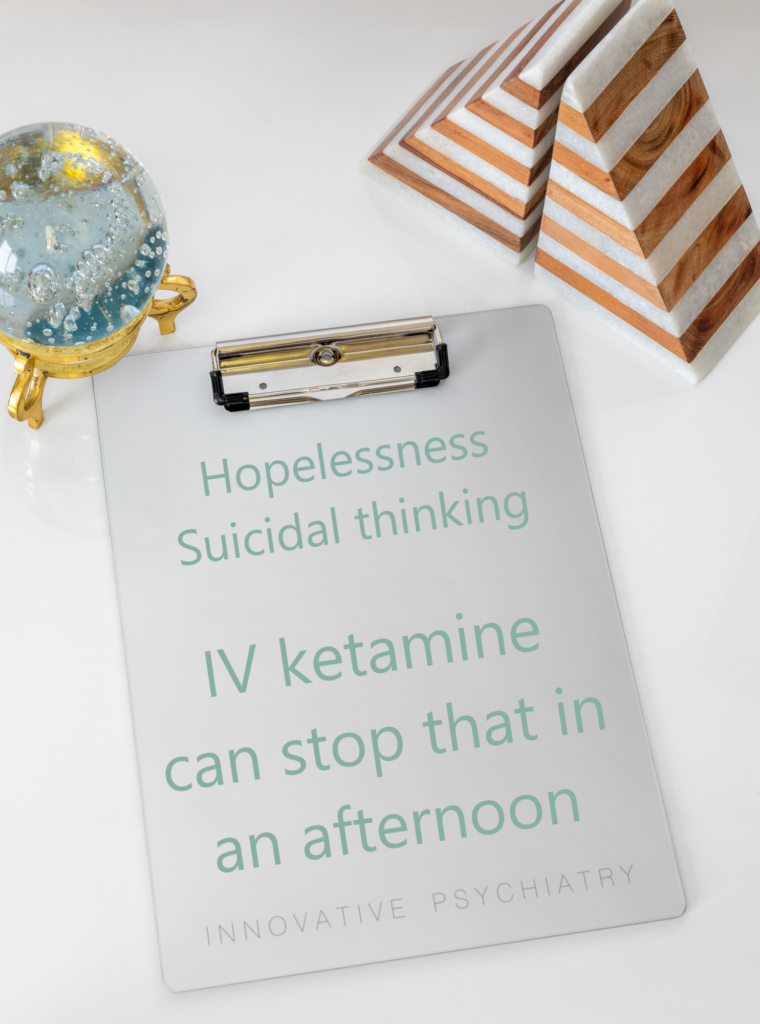
    If you see suicidal thinking in your teen, IV ketamine treatment can stop those thoughts in an afternoon. We conducted a large real-world study in our practice using ketamine in hundreds of patients—including adolescents — with depression and suicidal ideation that shows how incredibly effective it can be.

    Bipolar in teens can lead to suicidal thinking, but ketamine treatment can stop it in a few hours.

    Get help. Seek medical care. Find therapy. For your teen and for you.

    We’re happy to say that IV ketamine treatment has a strong and promising effect on bipolar depression specifically. It’s fast and it’s thorough. It doesn’t work for everyone —because everyone’s brain is unique. But it works for many people who have treatment resistant depression or bipolar depression, even when everything else fails. No other medicine can lay claim to that. Chances are it will work so well for you that you’ll feel transformed.

    Ketamine sees bipolar depression like major depression. It releases mRNA to turn on DNA which triggers release of Brain Derived Neurotrophic Factor (BDNF) which turbo boosts the proliferation of synapses (connections between brain cells). When that happens, signals fly across your brain at rocket speed, which rapidly opens up communication between parts of the brain.

    Creativity turns on. Fear gets turned down. That sad hollow feeling and the inability to enjoy anything pleasurable are kicked to the curb when ketamine hits the lateral habenula to tamp down those restrictors of good emotions. Neuroplasticity flourishes in your brain cells so they become able to change, and you become able to embrace change in your thinking… which can help you get better.

    — Lori Calabrese, MD

    Imagine this for your teen. It could change her life. It could SAVE her life.

    We’ve talked about the difficulties with bipolar disorder. Let’s talk about the blessings of it. When your teen is stable on medications, and symptoms are controlled, she will be one of the most sensitive, caring, affectionate of your children. He’s creative and may write poetry, or music, or lyrics…or may paint or write books.

    Some of the most talented musicians, artists, and poets currently in the world, and throughout history, have struggled with bipolar disorder. The gifting of this beautiful person will hold you in awe. Their capacity for love and giving can be second to none. To watch these abilities expressed is a gift you’ll carry in your heart forever. Don’t give up. There is more help now than ever before.

    At Innovative Psychiatry, we provide IV ketamine in a virus free environment.

    At Innovative Psychiatry, we know that treating both the depression and the mania or hypomania in bipolar disorder is crucial. There isn’t one medicine that treats all the symptoms equally and perfectly for everyone. So you need your doctor’s full attention.

    While IV ketamine treatment often relieves bipolar depression dramatically, it doesn’t work on the manic or hypomanic symptoms. But they’re treatable.

    It may take a collection of meds to treat the manic symptoms. Or…one pill might do it for you. But it’s more likely it will require more than one. For adults and teens with bipolar II disorder—some people call it bipolar 2–if depression is the dominant symptom, IV ketamine treatment can be transformative. So many others — just like you — say that every day.

    If you’re hoping that you or that teen you love might a candidate for IV ketamine treatment — and want to find out — call us and come in for a consult.

    When you begin treatment, you’ll find yourself cozy in a quiet room that feels like a spa so you can fully relax and let the tensions of the day melt away. To make you feel safe here, we’ve installed plasma-cell technology that destroys 99.999% of viruses, bacteria, and molds in the air and on our surfaces…. so you don’t have to worry about delta and mu variants. Our technology was developed by NASA and the Department of Defense — groundbreaking stuff, really, that we’ve invested in to keep you safe. So you can settle in to making the most of your treatment.

    We’re pretty groundbreaking. Always have been. (You don’t get to be a doctor’s doctor without that.)

    If you or your teen (or someone else in your family) suffers with symptoms that treatments and medicines haven’t helped, call us.

    We want to help you discover the freedom available through IV ketamine treatment.

    So you can feel your joy, your hope, your initiative, and motivation restored.

    Lori Calabrese, M.D. is on the front end of the race to stop PTSD in its tracks using IV ketamine treatment.

    To the restoration of your best self,

  • Flavonoids: What they are, Where you get ’em, and Why they’re so Important for your Brain.

    Flavonoids: What they are, Where you get ’em, and Why they’re so Important for your Brain.

    Remember brain fog? Let’s talk about the role diet plays in your mental well-being, cognition, and health. We’ve discussed the microbiome, and nutrients that are good for your outlook. But let’s go deeper.

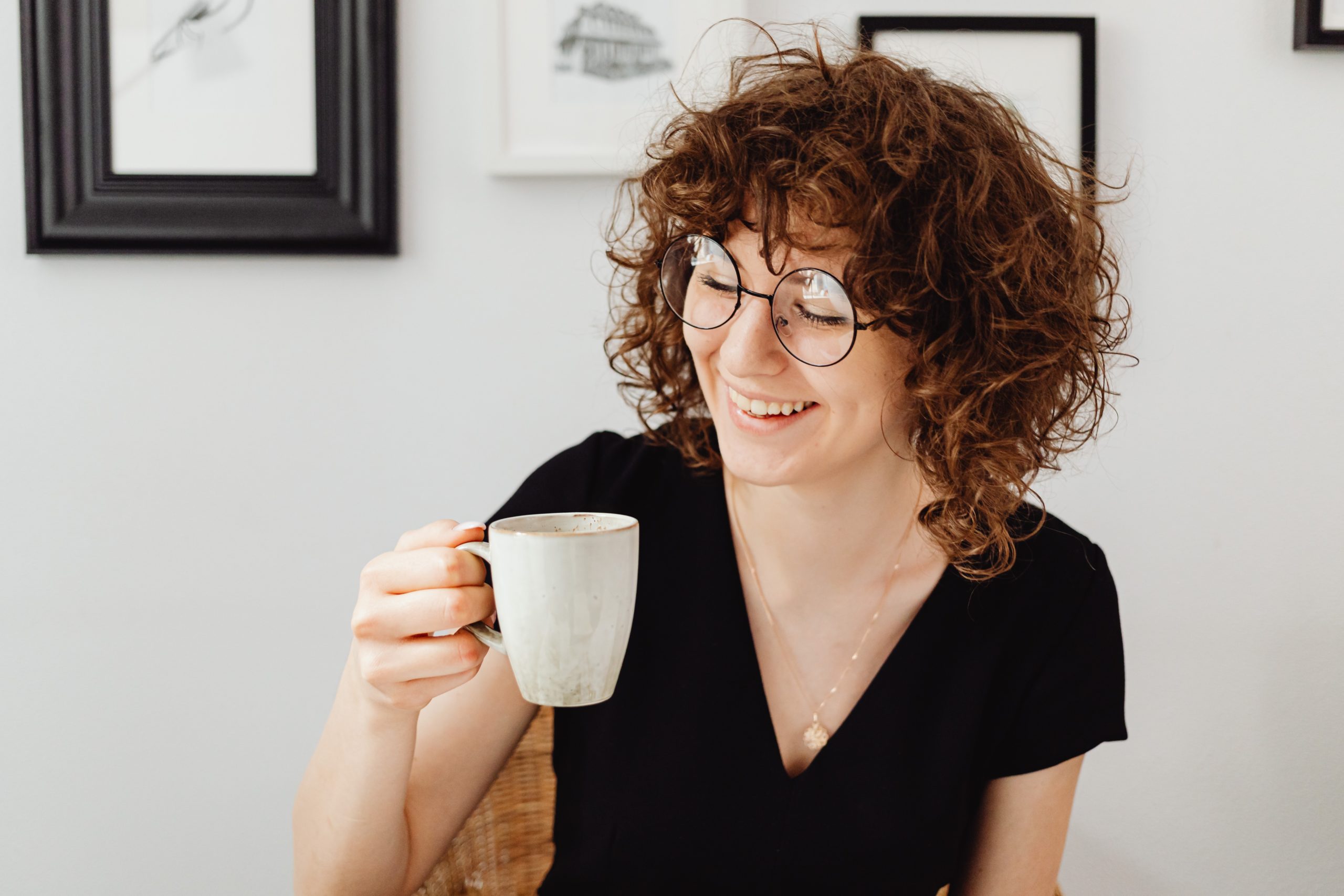
    Lady enjoying flavonoids in her green tea.

    It’s time to talk about flavonoids, since flavonoids impact your vulnerability to serious degenerative brain disorders. Like Alzheimer’s, for instance. Your outlook is important, but avoiding Alzheimer’s is vital. You’ve seen flavonoids in the news (and probably on the cereal box) right..? And you had to wonder about flavonoids: what they are…what they do, are they good or bad..? Let’s talk about them in more general terms today, then next week we can look more closely at the details like how they protect you from neurodegenerative disorders and more.

    Bottom Line — You Need ‘Em! Probably more than you’re getting. So let’s dig in.

    Flavonoids are natural compounds found in plants. They’re made from phenylalanine, and found predominantly in the green pigments in plants. And they have a long history of medical use in treating a variety of ailments. These compounds dominate therapeutic agents because they’re widely disseminated, incredibly diverse, and easy to isolate.

    Researchers who identify and work with flavonoids list over 7000 in medicinal plants, fruits, vegetables, and wines.

    Incredible, right?

    Flavonoids: What They Are… and Can They Be A Way To WARD OFF Dementia..?

    A paper published in 2019 in Frontiers in Aging Neuroscience, by researchers in Chile, Pakistan, Canada, and South Korea, provides a wonderful summary of the sources, chemistry, and importance of flavonoids — not only for improved health, but for protection from debilitating neurological disorders.

    Listen up.

    You’ve probably seen the word on food labels and in articles about diet and nutrition. But what does this word even mean??

    These are naturally occurring compounds that dominate the components in the green pigments of plants. Through the ages, we’ve used them to treat various maladies.

    Why? Because flavonoids are also the major building components for various drugs. (They’re used by people who want plants to be their medicine as well as scientists who develop innovative medicines.)

    Flavonoids have the ability to bind with various proteins in the body and to modify chemical transporters, enzymes, hormones, DNA… chelate heavy metals and scavenge free radicals. (At this point you should be saying, I want some of that!)

    Put another way, they boast strong antioxidant properties.

    In addition to all this, recent research determined that ingesting flavonoids as part of your diet significantly improves cognitive capabilities. It can inhibit the neurodegenerative processes that occur with Alzheimer’s disease (AD).

    Types of Flavonoids – They’re Extensive

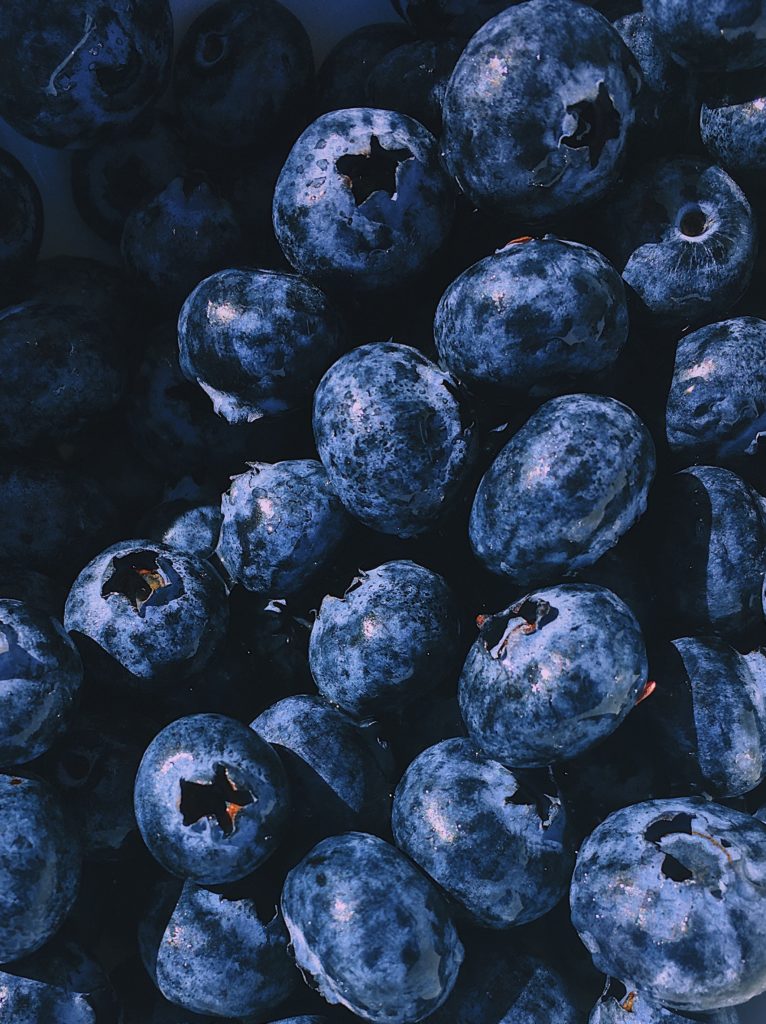
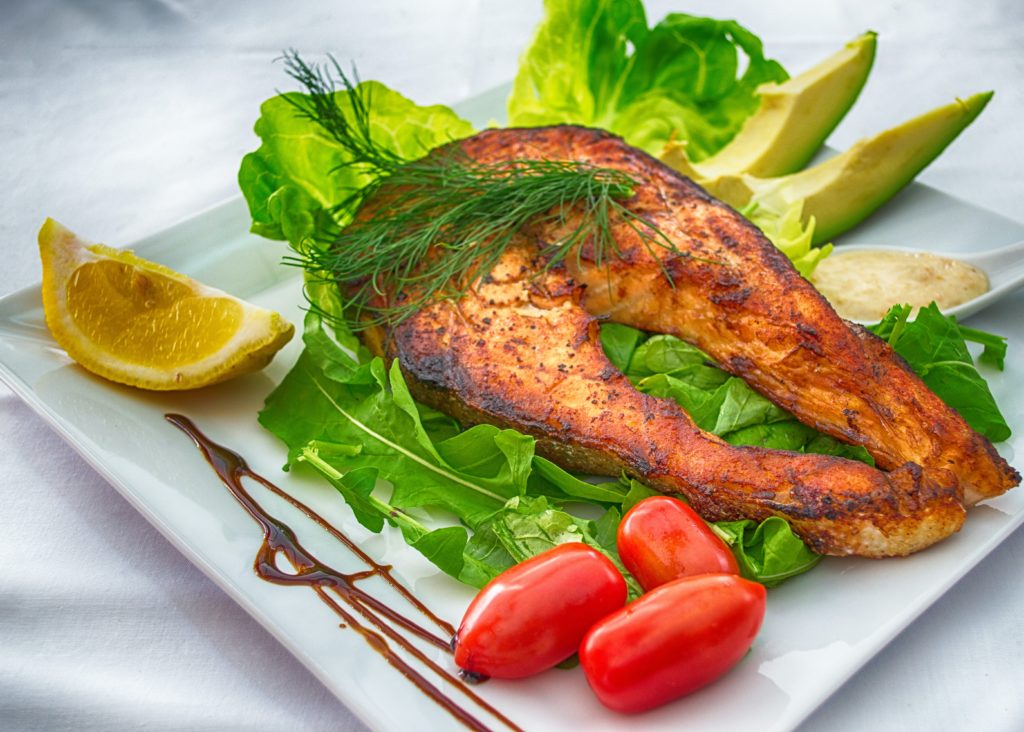
    Now, there is a mountain of biochemistry to explain this, but suffice it to say, these little compounds can be life altering in the best sense. In terms of prevention, flavonoid-rich foods like cocoa, green tea, blueberries, citrus fruits, cereals, and red wine, can launch a multitude of beneficial processes for proteins that protect and manage nerve pathways, as well as multiply and strengthen different types of brain and nerve cells.  More flavonoid-rich foods include onions, leeks, broccoli, celery, parsley, tomatoes and soy products.

    Flavonoids: what they are and what they can do to prevent disease is important to learn.

    There are so many types of flavonoids that the list is too extensive for us here. But the classifications include isoflavones, neoflavonoids, flavones, flavonoids, flavonones, flavanonols, flavanols, anthocyanidins, chalcones — defined by their chemical structure.

    (I really was a Chemistry nerd at Wellesley College!)

    But what is pertinent for me now — and for you — is what happens when neurological development goes awry.

    What Causes Alzheimer’s disease?

    Like in the case of Alzheimer’s disease (AD). Alzheimer’s stands out as a neurodegenerative disorder characterized by gradual, progressive memory loss, cognitive dysfunction, errors and confusion in daily routine activities, and a decrease in intellectual learning. We’re terrified of it. AD affects increasing numbers of adults as they age beyond 65, to 75, 85 and older. Sometimes it starts in people in their 50’s! About 35.6 million people worldwide live with Alzheimer’s today.

    But here’s the rub. 

    We don’t really know what causes Alzheimer’s …yet.

    Still?

    I knowwww…..

    Even so, some important findings have been established — such as deficiency of cholinesterases, deposits of beta-amyloid plaques, hyperphosphorylation of tau proteins, and generation of oxidative stress. They’re all there.

    And there are only 5 drugs on the market approved for use in Alzheimer’s. Four of them are cholinesterase inhibitors. The fifth one is a glutamatergic system modifier called memantine.

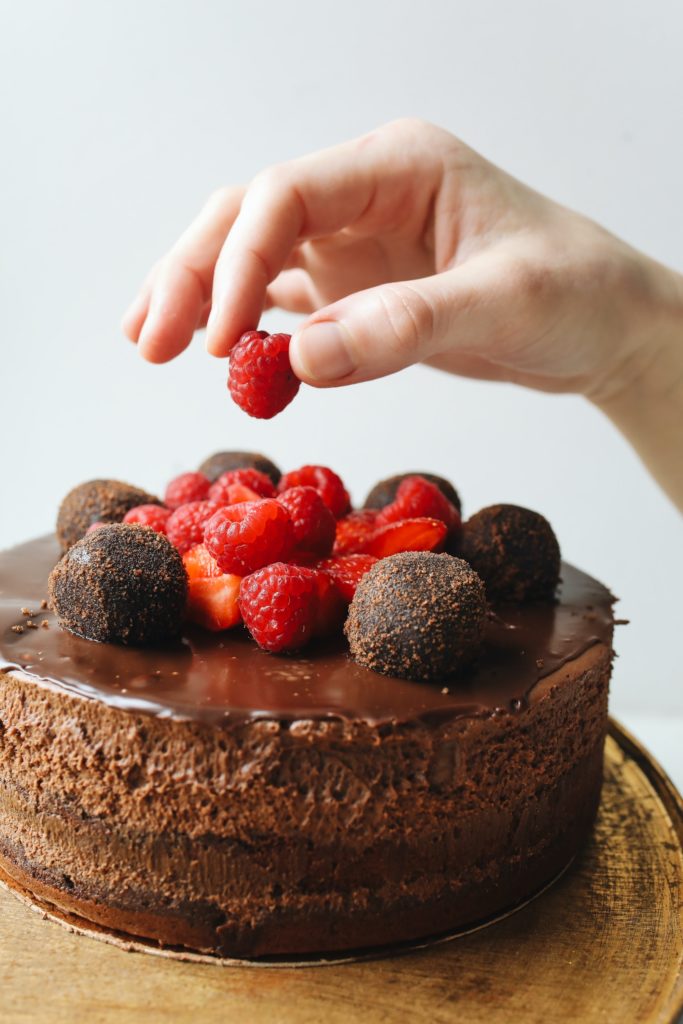
    You ask about flavonoids: what are they...found in tomatoes, citrus, and chocolate, they protect your brain.

    I get that all this might be a bit much. But what I’m getting to is that there are no effective medicines for Alzheimer’s…. the drugs that are out there can maybe help slow the progression of it.

    (But you ask, compared to what? Compared to whom?)

    What about this? Since flavonoids are known to block beta-amyloid from forming plaques and tau clustering… since they scavenge free radicals and sequester metal ions… wouldn’t it be a great idea to use flavonoids in the design and development of anti-AD drugs?

    Because in addition to those who suffer dementia, people like you and me sometimes just need a little relief from brain fog. Maybe flavonoid rich foods can help with that …?

    Why? They not only help get rid of toxins, they also modulate inflammatory actions on neurons.

    Huge!

    It’s inflammatory factors that create dendritic pruning— the pruning that actually prunes you — and makes you lose energy, interests, enthusiasm, drive, resilience.

    We live in concert with our biology, and when our dendrites get pruned, our lives get pruned.

    So…what if we incorporated concentrated forms of flavonoids into our diets every day? 

    When you come for IV ketamine treatment, you'll have a private comfy room.

    At Innovative Psychiatry, we talk to our patients about eating “all the colors” in their diets. The reason is that those rich colors hold treasures for your cognition, balance, focus, and wellbeing. They can also help protect your brain cells from attack by neurodegenerative processes.

    If you find that you’ve lost your sense of mental and emotional balance, perhaps due to anxiety or depression, and you’re not feeling in command of your life, call us.

    Sometimes you need a boost to achieve a level of remission that empowers you to exercise, eat all your colors, and follow all the other guidelines for wellbeing.

    IV ketamine treatment can revitalize your outlook, jumpstart your creativity, and fill in the patience and hope you’ve been needing.

    And when you come for treatment, you’ll find a comfy private room with a zero gravity heated leather recliner to help you truly relax and get the most from your infusion. We have space age technology that destroys viruses and bacteria in the air and on our surfaces, to ensure that no matter what the Delta variant is up to, you’re breathing air that is 99.999% safe. (We LOVE that!)

    You deserve a jump start on reaching your own remission and joy

    And we’re here to help you experience that fresh footing.

    Let’s work together for your fresh start.

    Lori Calabrese, M.D. is on the front end of the race to stop PTSD in its tracks using IV ketamine treatment.

    To the restoration of your best self,

  • Can Cannabis Make You Suicidal?                       It Depends…

    Can Cannabis Make You Suicidal? It Depends…

    There are so many sides to this controversy. Marijuana’s good for what ails you – right? For cancer pain, anxiety, depression…for putting your body back in order… Or is it??

    There has long been a belief that cannabis, another name for marijuana, was associated with suicidality.  Not a popular belief, but one supported by neuroscience. What do I mean by suicidality?  I mean thinking about suicide, planning it, setting it up…and following through. Trying to kill yourself. Or actually killing yourself. Can cannabis make you suicidal? Is cannabis responsible?

    So is it? 

    Is cannabis use directly linked to the process of planning and completing suicide?

    Meet Isaac:

    Isaac walked along the boardwalk, feeling alone. Isolated. Bored. And the more bored he felt the more depressed he felt. He had few friends, and the ones he had he was never able to see. He didn’t have a car to go visit them, and most of them were also without transportation.

    His insides seemed hollow. He felt empty. His mom had died from cancer last summer, and there was nothing left but for him to kill time until his dad got home. But that wasn’t much better. Dad was also hollow and empty, looking for ways to fill the void his mom’s death had left.

    Soon after his mom’s funeral, some friends offered him pot for the pain and heartache. It helped. For a little while. So he got more to keep the heartache from defeating him completely. And it felt good.

    If only the effects lasted longer. He NEEDED it to last longer.

    Within a few months, Isaac was smoking with at least one friend at a time just about every day. He had graduated from high school, but his mom’s illness — then her death, the funeral, and all the grief… he just didn’t have the gumption to drag himself off to a few places to submit applications. Whether for college or even just a part-time job. So he’d sleep late, then get up and meet his friends and share some weed. By the time they were finished, his dad was home from work and in bed…so he’d find some food, then go to bed too. End of another identical day.

    How do you inject meaning into a day..? Can cannabis do it? No..? What can..?

    And if there’s no meaning to be found, can cannabis make you suicidal? Keep reading…

    Time passed. It was meaningless. But he was coping… sort of.

    Still, the days ran together like the colors in an amateur watercolor painting…until the blues, greens, pinks, reds, and oranges of life all puddled together to make a blackness. And the same ol’ same ol’ was no longer tolerable but rather unbearable. 

    Isaac missed his mom. She’d been his best friend. She encouraged him to be more and do more. To have hope for his future. Without her here, life was a vacuum. A void. And smoking weed no longer comforted him…. Instead it seemed to drag him further and further down. He didn’t know when it happened, but at some point he had begun to realize he didn’t want to live anymore. Not feeling like this anyway. 

    And where was a solution? His mom was gone. She’d always been the solution until she got sick. His poor little brother never knew her like that. He wished he could fill in the gaps for his brother, but he couldn’t even keep his own head above water.

    Can cannabis make you suicidal? Can it??

    The bridge over the river that ran through downtown always captured his attention. He could just jump. If he wanted to. He pictured the drop from the bridge … it would be like flying….he pictured the water swooshing and swirling around him as he plunged into it…covering his head…sinking as the sun seemed to pull away…he knew the water would be cold…

    Isaac shook his head to break away from the whole idea.

    Drowning would be a nasty experience… or would it? What if he just inhaled the water…?

    Later that day, he saw his friend Josh on a street corner, ready to cross. 

    “Hey Josh…” They crossed the street together…two young men, bored, empty, hopeless. Depressed.

    “What’s up, Isaac?”

    “A whole lotta nothin’…”

    “I have some medical weed…”

    “Where’d you get it..?”

    “I got a medical card for it. It helps with the pain in my leg from the cancer…”

    “Is it better than pain pills? Why use weed?”

    Josh took a breath, surprised Isaac would ask about something so obvious. “It’s natural, man. It’s organic. Not some chemical that’s created in a laboratory. It’s good for you.”

    “Well, I’m down for it. And I don’t even have any leg pain!” So they headed over to Josh’s car where they could just sit and smoke.

    Where do you go when the meaning runs out?

    What do you do if cannabis makes you suicidal?

    Three days later Josh heard sirens. Didn’t think much of it until he heard on the news that Isaac’s body had been found near the downtown bridge… Josh was sick. Devastated. 

    He had had no idea Isaac was on the verge of suicide. The loss. The waste. Maybe he could have done something for Isaac if he’d known. He knew Isaac’s family and knew they must be heartbroken. It was too tragic, and he’d had no idea. The medical marijuana should have helped soothe him. Baffling. Sickening…

    Let’s take a look at this. As cannabis becomes more widely used — because of legalization for medical and recreational use in more and more states — let’s look at just how good it is for our loved ones …and even ourselves for that matter.

    We’re talking about the use of cannabis, and Cannabis Use Disorder, known as CUD.

    A group of medical researchers from the National Institute on Drug Abuse at the National Institutes of Health set out to learn more about the impact of cannabis use on young adults.

    They chose 281,650 subjects between the ages of 18 and 34 years of age, who had participated in face-to-face National Surveys on Drug Use and Health between 2008 through 2019. These 281,650 people used cannabis daily or almost daily, at least 300 days per year, OR they had a diagnosis of cannabis use disorder plus a major depressive episode.

    The primary focus was to figure out the prevalence of suicidal thinking, planning, and attempts within the last year and whether it was related to cannabis use. More than 281 thousand people. Out of all those people, what did they learn?

    They learned that cannabis use and cannabis use disorder (CUD) were more strongly associated with suicidal thoughts, planning, and attempted suicide and that the risk of suicidality was higher in women than in men. And that was with or without depression.

    Did you know that among people between ages 15 and 54, 60% of first suicide attempts occurred within a year of the first thoughts about it? And get this alarming fact: Suicide attempt is the single most serious clinical predictor of death by suicide.

    Did you know that? When someone makes an attempt, it’s a mistake to claim they’re seeking attention. Never make that deadly mistake. Always take suicide attempts seriously, and offer help and treatment.

    Can cannabis make you suicidal? Yes, if you use it often enough.

    They also found that women with both CUD and depression were more likely to plan and attempt suicide than men with the same circumstances.

    But more importantly, even though women were more likely to think about, plan, and attempt or complete suicide than men if they did use cannabis frequently and had a depressive disorder… they were only equally as likely as men to think about and attempt suicide… if no cannabis was used.

    That’s the shock of it.

    That the more you smoke weed, the more likely you are to think about, plan, and attempt suicide.

    (Data. Fact. Not just me sayin’…..)

    You wonder…was it the increasing amounts of cannabis causing the suicidality, or was it the conditions and circumstances that led to the smoking…?

    We know that a large group of people seeks comfort in cannabis — now more than ever — since cannabis has been legalized in so many states. And the pandemic has increased anxiety in people everywhere.

    But what’s the fallout of that …?

    If you are between 18 and 34 and you use cannabis, you have a greater chance of developing thoughts of suicide, or worse, death by suicide. Regardless of whether or not you have depression. And the chances of becoming suicidal are higher if you’re a woman than if you’re a man. The association is strong and the likelihood seems to be steadily increasing, according to this 11-year study.

    Those are the facts. Those are the risks. And although we need more studies and more information to determine exactly what is causing what, right now today this is information that you should share with everyone you know and love who uses cannabis.

    At Innovative Psychiatry, we hear our patients’ stories of anxiety every day. Depression. Hopelessness. It seems like it’s everywhere. Let us help you with it.

    People have been smoking cannabis, eating it in brownies, including it in their favorite cake recipes for decades, maybe even centuries. But no matter how you introduce it into your body, if you do it often and a lot, suicide is a risk you may not be able to control or talk yourself out of. It’s a serious and severe risk, from what many consider a seemingly harmless plant.

    Can cannabis make you suicidal? Well, cannabis really may be a wolf in sheep’s clothing, if you use it enough to cross the proverbial line into suicidal thinking.

    To more effectively treat depression that medications have not helped, anxiety and trauma, and substance use disorders, IV ketamine treatment may be the best option available. It’s not for everyone, and for reasons that remain elusive, it just doesn’t impact some people in the same remarkable way it does most.

    But those exceptions are in the dwindling minority. More likely than not, it will be the best introduction to peace you’ve ever imagined. From PTSD to social anxiety, and from major depressive disorder to bipolar depression to postpartum depression and even anorexia.

    When you come for treatment, you’ll find a relaxed and beautiful environment, optimized by technology that removes viruses and bacteria from the air and the surfaces. Developed by NASA and the Department of Defense, this plasma cell technology was developed for the space station, and is truly other worldly in its effect. When you come for treatment, you’ll be comfortable and safe. Secure and in privacy. So you can focus on making the most of this IV ketamine treatment.

    If you have suffered PTSD, depression, social anxiety or other conditions we’ve talked about here, call us.

    We’re eager to meet you and work with you to help you rise above the symptoms that have held you back. It’s time to move ahead in your life.

    Lori Calabrese, M.D. is on the front end of the race to stop PTSD in its tracks using IV ketamine treatment.

    To the restoration of your best self,
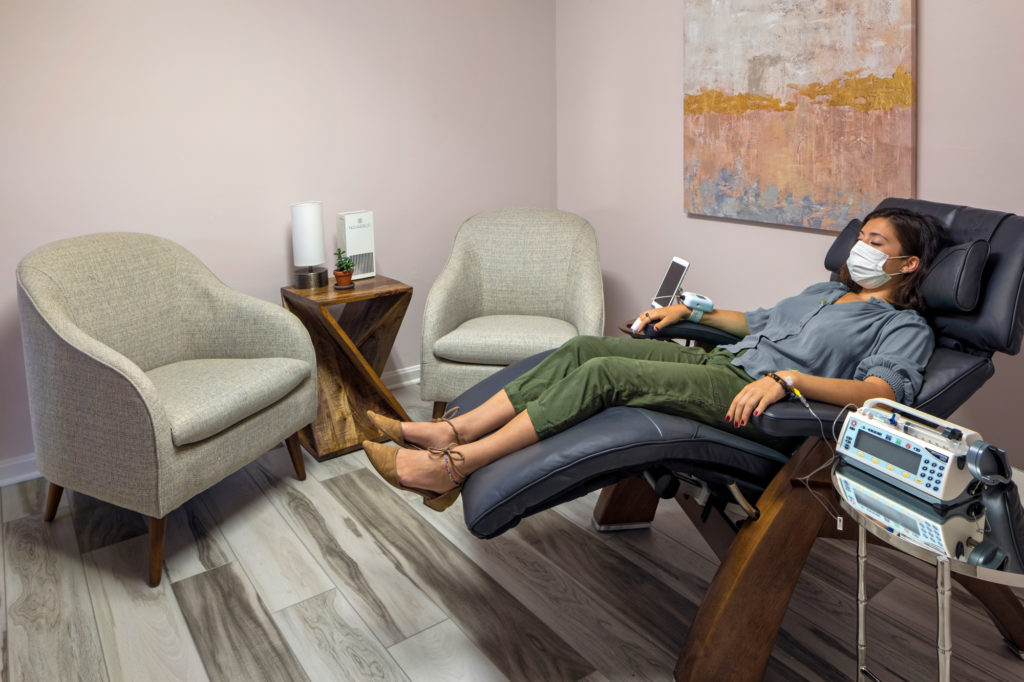
  • Clean Out the Cobwebs in Your Life and Go Forward with Joyful Resilience

    Clean Out the Cobwebs in Your Life and Go Forward with Joyful Resilience

    Engage with family and friends. Exercise and move. Get your juices flowing. Remember to take time for you…snuggle with your cat…play with your dog. Use your brain, exert yourself mentally and physically. Build yourself up to prepare for the world after the Delta variant subsides.

    After all this time with isolation and social distancing, it may have been simplest to just tumble onto the path of least resistance and watch TV, stay alone, play online games. But you need people. You need your pets. Relationships are a function of the human organism and they’re extremely important to your wellbeing. They help you to move forward with joyful resilience.

    We offered a blog about brain fog recently…. You know it’s not that surprising so many have developed brain fog in our current situation where we don’t talk as much about our challenges, seek the support of friends and family, or spend as much time outside as we did before.

    That Delta Variant Just Had to Jump in and Spoil Our Re-Entry 

    Wouldn’t you know it? Just as the pandemic seemed to be subsiding with the advent of so many people vaccinated, here comes the Delta variant stirring up more trouble.

    But let’s take heart. No one expects this variant to last that long. Use fresh air to your advantage. Meet with friends in the fresh air until the virus status shifts. We just need to be patient a little longer, get vaccinated, wear our masks, use hand sanitizer… and hold a steady position against an infection that’s been so widespread that our global response has resulted in changes in our culture like we have never seen before.

    Even though Delta is severe, contagious, and deadly for people without vaccinations, for most vaccinated people who contract it, it’s like a summer cold. So the easy solution? Just get vaccinated. Like we did with polio, we’re conquering this terrible virus and we’re close to getting life as we knew it, back. Or at least something close to it.

    Global Changes Altered What Looks Normal

    So yes, we’ve seen major changes in our lifestyle and surroundings. Social distancing patches on the floor in businesses. A huge part of the workforce has been working remotely (at home) for the last year. Restaurants only serving for drive through and pick up. Changes we never could have imagined, right? We never could have. And now it’s routine.

    And that’s ok, as long as those changes are helpful to us. Like remote working can be good — but don’t let it separate you from human interaction. Whether you meet with others online or behind a mask, do meet. Go forward with joyful resilience.

    Don’t let the changes caused by this pandemic make you forget how to engage. Don’t let your interactions become flippant, superficial, or without connection. 

    Volunteer in person with a mask or online and by phone without one. But do connect.

    You need to connect!

    And others need to connect with you. How do you dig deep and intertwine with others?  How do you get past listening passively, to empathizing, caring, and helping?  It’s interactions on this level that make your life richer and more resilient. 

    Which brings up another discussion. Managing relationships as they bloom again can be a little tricky, if you remember. So think about this:

    Rule of thumb: when their actions infringe on your values that keep you feeling safe, they’ve crossed a boundary.

    Dr. Henry Clout, who wrote the book Boundaries, said it like this:  Boundaries show you where someone else ends and you begin. You may have a parent or sibling or friend who feels they need you to prop them up. But if it happens too often, you begin to feel like you’re in a cell. That you’re controlled by someone other than yourself.

    Those boundaries can exist between you and your parents, you and your children, you and your friends, you and your relatives.

    Relationships, to be meaningful, need to be balanced. You need to know your decisions are yours, that you are not manipulated to make others comfortable. 

    And you need to know that when you feed those relationships, to strengthen your bonds of friendship, each person involved comes away with helpful, supportive, and happy feelings. 

    If your friendships aren’t providing this type of relaxed support, give and take, and respect, maybe you’ll be happier with better friends…you know?

    Because of boundaries, you get to choose what sort of friends you embrace. Then you can go forward with joyful resilience intact, feeling safe, and spreading yourself around to more people.

    So exercise that power.

    And you can push forward with joyful resilience to a life that fulfills you.

    Kick frustration to the curb.

    After 17 months in the throes of the pandemic, complicated by depression, anxiety, trauma, as well as increased alcohol use and substance use…you now can get down to the cobwebs and clean out your life of people and activities that aren’t helping you become stronger or more resilient, and replace them with people and activities that are.

    Move forward with joyful resilience when you exert your emotions and your energy.

    Has your use of alcohol or substances increased during the pandemic? Kick ’em to the curb with IV ketamine treatment.

    Another look at Alcohol and Substance Use

    You might ask yourself whether the incidence of alcohol use and substance use increased for you in the last 17 months.  If they didn’t, that’s great. But for many people, the boredom, the worry, the fear, the loneliness, all contributed to more use of alcohol and substances.

    And if that’s the case, take a close look at whether your friendships contribute to that or not.  Because engagement, fulfilling friendships, family relationships, and having healthy activities includes people who also have healthy lives. People who can do their part in keeping a relationship with you rewarding.

    Consider using this shift in the pandemic to conduct your own house cleaning in your life. Start fresh with a new outlook. You can be free to move forward with joyful resilience after IV ketamine treatment.

    And…if relationships don’t work, or substances get in the way, or depression makes it too hard to exercise, remember that IV ketamine treatment can possibly offer hope for for challenges like these, and help you get a firmer footing for what lies ahead.

    Innovative Psychiatry provides IV ketamine treatment for postpartum PTSD.

    A welcoming place for restoration when you need IV ketamine treatment.

    At Innovative Psychiatry, our patients sometimes express their fears about being able to function well once the pandemic ends. We encourage everyone to exert themselves in their lives… reach out to friends and family online or with masks, use safety protocols but engage with others. Even engage with your pets!

    When you come in for treatment, you’ll be led to a private, comfy room to help you get the most from your treatment. You’ll find the air in the offices is clean and pure, because we’ve installed technology that removes all viruses, bacteria, and mold from the air and surfaces in every room. Plasma cell technology, designed by NASA and the Department of Defense, works around the clock to keep the air and surfaces clean. We want you to relax, settle in for your treatment, and know that you’re safe from infection when you’re here.

    And if you find too many obstacles to your moving forward, like substances, social anxiety, trauma, depression symptoms, and you can’t seem to get around them…then call us.

    Let’s put our heads together and consider IV ketamine treatment and whether you might be a candidate. If so, we can make an appointment for you within just a few days to get your treatment started.

    Meanwhile, practice good relationship skills. And good living skills.

    And expect your life to get better and better and better. Joyful resilience better.

    Lori Calabrese, M.D. is on the front end of the race to stop PTSD in its tracks using IV ketamine treatment.

    To the restoration of your best self,

error: Content is protected !!