Category: Esketamine

Esketamine Nasal Spray from Lori Calabrese, MD | The Ketamine Blog

We provide these articles about esketamine nasal spray, known by the brand name Spravato, to inform… and explain the similarities and differences between esketamine and ketamine, the compound esketamine was derived from. 

Racemic Ketamine and Its Twin Molecules

As a compound made of two mirror-image molecules, racemic ketamine performs with extraordinary and robust antidepressant strength. We call those mirror-image molecules enantiomers. So, the word “racemic” simply means a compound made of right-handed and left-handed molecules.

You probably notice that identical twins look not so much exactly the same, but rather, they look like mirror images of each other. This phenomenon occurs all through nature. And you see it on the cell level, too.

The fact that these molecules are mirror images of each other doesn’t mean they’re identical.  They’re similar…and have similar properties. Sometimes you see this with identical twins. For instance, one twin shows empathy, compassion, and introversion, while the other fills a room with laughter and friendliness.

In the same way, these molecules act differently also, with one showing stronger properties of one kind and the other showing stronger properties of another. It’s the synergy between the two that creates the characteristics of the full racemic compound.

The ketamine compound dynamically illustrates this. Each enantiomer behaves in some ways like the other, and behaves differently from the other in other ways.

We recognize the left enantiomer molecule s-ketamine…”s” being an abbreviation for the latin term for “left.” We recognize the right one r-ketamine, which is much easier to remember, right? So, with this in mind, they created a name that uses the “s” or the “r” phonetically.  So these enantiomers enjoy the nicknames of esketamine and arketamine. Clever-ish…maybe?

Creating a NEW Medicine with an Old Molecule

Researchers hoped that by separating the left mirror-image molecule from the right-side one, they could produce an antidepressant with fewer side effects and less addiction risk. They knew they needed an entirely new compound. Because they needed the financial benefits of a patent to pay for the extensive research and testing that would be required to receive FDA approval.

It turned out that their new medicine required the aide of a newly initiated anti-depressant to perform as an antidepressant effectively. But with that antidepressant added, it showed some promising ability for erasing suicidal thinking and lifting depression. 

Unfortunately, life in the laboratory behaves a lot like life everywhere else. It can be unpredictable. During the trials required for FDA approved, esketamine performed like a champ in some trials, and failed rather miserably in others.

At a time when the suicide rate rises higher and higher, psychiatrists need medicines that erase suicidal thinking. As a result, the FDA approved this new medicine along with its specially designed spray in March 2019. They took precautions, however.

They imposed safeguards. One such safeguard required that doses be restricted to administration in the office under medical supervision. Another one required that the doctor hold the patient for observation in the office for 2 hours after each dose, in case of side effects.

 A Ketamine-Derived Medicine Covered  by Insurance?

Janssen, a company owned by Johnson&Johnson which developed this medicine, promises that esketamine nasal spray will be covered by insurance. So, we’re waiting to hear what the coverage will be.

Will Spravato replace IV ketamine treatment?  Probably not.

While esketamine may not be as effective as ketamine and is more expensive to administer. Does it have a place in treatment of depression and suicidal thinking? We certainly hope so. The fact that insurance companies plan to provide coverage for it will hopefully make it available to patients who find IV ketamine treatment is out of reach financially.

Because of the way the media promoted Spravato (esketamine), most people think that ketamine nasal spray was approved by the FDA.  Esketamine isn’t ketamine, but it IS derived from ketamine. It performs with some of ketamine’s traits, but not others.

At Innovative Psychiatry, we embrace treatments that may help. And we hope esketamine will help some who haven’t been helped by traditional antidepressants or anxiety medicines. As you read these articles about esketamine nasal spray, remember this is a new medication and we’ll know more as we use it to treat the conditions it’s been developed to relieve.
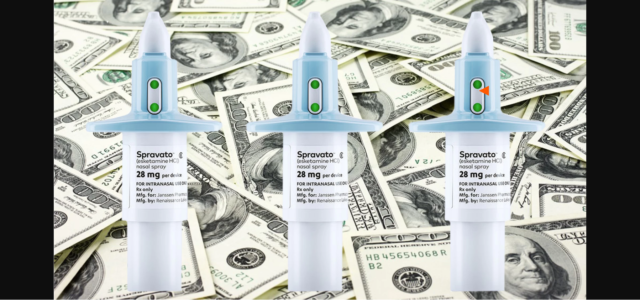
  • Opinion: The New Ketamine-Based Antidepressant Is a Rip-Off

    Opinion: The New Ketamine-Based Antidepressant Is a Rip-Off

    Johnson & Johnson patented a form of the psychedelic with less research and a ridiculous price tag.

    In a popular and public move, the United States’ Federal Drug Administration recently approved intranasal esketamine, one of the components of the psychedelic ketamine, for treatment-resistant depression. The nasal spray costs nearly $900 per dose—or roughly $7,000 for the first month of treatment, and each treatment takes at least two hours in a clinic. (It has yet to be decided how much of the cost insurance plans will cover.)

    Esketamine can be unwieldy to use and carries a number of significant potential side effects. Shockingly, it was no better than placebo in two of the three short-term Phase-III studies submitted to the FDA for approval.

    But the biggest problem at hand is not the drug itself. It’s the fact that instead of representing a revolution in mental health treatment, as it has been touted to do, esketamine is not a breakthrough at all. It’s just a way for pharmaceutical company Johnson & Johnson to make a significant profit off gullible insurance companies and vulnerable patients.

    Generic Ketamine Works

    Generic ketamine is available for a fraction of the price of esketamine, has been shown to work—and work safely—in small-scale single-dose and multidose trials for treatment-resistant depression, can be administered in a variety of ways, and has already been used off-label for decades to treat thousands of patients with depression and suicidality.

    It’s currently difficult, if not impossible, to provide generic ketamine treatment in public clinics, even to patients who need it, because there haven’t been any large-scale, randomized trials, both with and without psychotherapy. Without these trials, and resources, physicians can’t be reimbursed by insurance companies for ketamine treatment like they will be able to do with esketamine.

    Ordinary ketamine is a racemic medication, meaning it is made up of two molecules that are mirror images of each other. Because ordinary ketamine is generic, Johnson & Johnson simply isolated one of the two molecules in regular ketamine so that it qualified as “new.” The reality is that we don’t know whether esketamine is more or less effective than regular ketamine because there have been no head-to-head trials between the two. Johnson & Johnson only tested esketamine against a placebo, likely because they feared esketamine might actually perform worse than the generic version.

    As many critics have pointed out, this strategy has become the bread and butter of drug development in the United States today. Largely because of the influence of pharma on the FDA itself, our drug approval process rewards copycat variation of already-available drugs instead of truly innovative pharmaceutical design.

    When Psychotherapy Is Missing

    The trials for esketamine also reveal a larger issue in the field: they de-emphasized the importance of psychotherapy while focusing solely on its chemical effects. The most effective treatment strategy for treatment-resistant depression is intensive psychotherapy along with the use of medication, but the FDA esketamine trials didn’t include therapy at all.

    Getting insurance companies to pay for psychotherapy is already difficult, and without it as part of the protocol, they will likely offer no reimbursement for patients interested in receiving a psychotherapy session after their esketamine dose in order to process the experience.

    Our colleagues who offer ketamine-assisted psychotherapy say that this is a vital part of the process. One such session can require upwards of three hours of one-on-one treatment in order to prepare patients for the experience, take care of patients while they are under the influence of ketamine, and then integrate the effects afterwards. Ironically, insurance companies would save more money paying for generic ketamine-assisted psychotherapy rather than esketamine treatment alone, as the former is both cheaper than the latter and can lead to long-term remission of symptoms.

    Alternatives

    Private ketamine clinics currently do exist, but they have to fight the stigma of the drug, and sporadic cases of malpractice. Some private clinics do not properly screen patients prior to initiating treatment and often charge outrageous sums of money—one reason that both patients and medical systems have been hesitant to implement it more widely. Those clinics that are providing ketamine responsibly, however, offer a potentially lifesaving treatment for patients living with depression who have exhausted all other available options.

    Although there are no quick fixes for the broken drug-development and approval process that led us to esketamine, it is possible to take concrete steps to address the most glaring problems. Insurance companies and the FDA ought to require head-to-head study designs of clinical trials to investigate generic and patented medications. Additionally, current research on medication-assisted psychotherapy with other psychedelic substances such as MDMA and psilocybincan serve as a model for future research that explores ketamine-assisted psychotherapy, instead of the drug alone.

    While Johnson & Johnson rakes in the profits from esketamine, patients dealing with depression and trying to navigate our struggling mental health system will bear the cost. Fostering the development of mental health treatments that are novel, effective, and affordable will require a critical examination of the undue corporate interests that drive drug approval in American psychiatry today.

    Dr. Michael D. Alpert is a psychiatrist and clinical faculty at Harvard Medical School. He is also a therapist with the MAPS Clinical Study of MDMA-Assisted Psychotherapy for PTSD.

    Dr. J. Wesley Boyd, MD is a psychiatrist and associate professor at the Center for Bioethics at Harvard Medical School.

    Dr. Marco A. Ramos is a psychiatry resident at Yale University.

    [Read the Original Post]

  • Revitalize Psychiatry:  Disrupt – Include – Engage –  Innovate !! – The APA 2019 Conference

    Revitalize Psychiatry: Disrupt – Include – Engage – Innovate !! – The APA 2019 Conference

    Disrupt, Include, Engage, Innovate was the theme of the 2019 APA Conference.

    I just returned from the American Psychiatric Association’s 2019 Conference in San Francisco.

    This is the 175th Anniversary of the APA, and look how far we’ve come. The theme this year was: Revitalize PsychiatryDisrupt – Include – Engage – Innovate. and it certainly provided fodder toward those goals. It was an informative and eye-opening conference with a wide array of talks and poster presentations. Plus, I was privileged to make a presentation, too. More about mine in a bit.

    The attendance at this conference exceeded them all, with thousands of attendees from around the world and new research presentation abstracts which spread out over 800 pages!

    You may not be aware that the APA is the oldest medical organization in the nation. (We’re proud of that.) The venue was enormous and the camaraderie rich, inclusive, and restorative.

    The presentations flowed from every aspect of psychiatry, including geriatric issues as well as issues specifically relevant to children, and adolescents, too. There were talks from ADHD to dementia and addiction to psychosis.

    From Saturday through Wednesday the venue was chock-full of courses, convocations, lectures, symposia, talks, and media presentations by the hundreds. There were more than 360 new research presentations every day in the poster sessions which went up every morning and every afternoon.

    There’s no way I could ever provide a synopsis here of all the findings presented. But there were a couple I do want to mention.

    My own focus was on those presentations specifically related to suicide, depression and other mood disorder treatment, and especially ketamine treatment. I drank up all the information and data I could hold. (That and espresso kept me going.)

    Here we’ll talk about two of the presentations focused on ketamine and the one I presented on suicidal thinking.

    Ketamine’s Effect on OCD

    I was so pleased to see there has been more work focused on ketamine for obsessive-compulsive disorder (OCD). Clinical Psychiatry News featured this article with the title: “Ketamine may help OCD, but much work remains.”

    Young woman suicidal thoughts are gone since her ketamine treatment.

    The author, Carolyn Rodriguez, MD, pointed out that the symptoms of OCD are severe, and 1 in 7 people with OCD attempts suicide at some point in their lives. She said that there is a significant and painful delay between the time of diagnosis and the time when the patient experiences benefits from the medicine — 2-3 months or even longer.

    She talked about her interest in looking at therapies that worked much faster, and were more thorough. This is so important so that patients could feasibly experience more complete eradication of symptoms.

    Since more and more evidence indicates that glutamate seems to contribute to neuron communication as an excitatory chemical messenger, she chose to see what ketamine could do, considering it blocks the glutamate receptor.

    The only study using ketamine with OCD was conducted by Dr. Rodriguez and her team in 2013. Not surprisingly, she’s planning a new one now which will compare ketamine with midazolam, to study the effects of ketamine on the circuits associated with OCD. 

    She Called for More Studies On Ketamine’s Effects on OCD

    She says a larger study is needed to learn more about how long ketamine’s effects on OCD symptoms lasts. It’s also important to see if the effects seen in the 2013 study can be replicated.

    This is exciting work, as we need more information about what ketamine does for OCD so we can help more patients.

    Dr. Rodriguez commented on the FDA approval of esketamine this past March. She made the point that those OCD patients with “contamination OCD” are likely to be unwilling to use a nasal spray. 

    Disrupt – Include – Engage – Innovate …

    Ketamine and Opioid Receptors

    Another talk, presented by Nolan Williams, MD, from Stanford University, discussed ketamine’s mechanism of action. Since there’s wide recognition that stress is directly related to a buildup of glutamate outside the cells which causes unwanted effects, ketamine blocks the NMDA receptors, blocking glutamate, and reverses these unwanted results.

    Dr. Williams made the point that ketamine affects many neurotransmitter systems and has a wide variety of effects, both good and bad, as a result of that.

    Ketamine can eradicate chronic pain like this man on the bus suffers from.
    Researchers know that ketamine’s effect on pain is complex, and an opioid receptor antagonist prevents ketamine from relieving pain. We know that opioids have an antidepressant effect, and Dr. Williams wondered if ketamine’s antidepressant effect depended on the opioid system.

    There were 12 subjects in all who completed the study; 7 had dramatic relief of symptoms. Even more interesting, 6 of the 7 achieved remission. 

    Now, the design of the study included crossing over between 2 groups of subjects. So, to accomplish this, one half received a placebo an hour earlier, then ketamine. The other half received naltrexone an hour beforehand, then ketamine. As you may know, naltrexone blocks opioid receptors, so if ketamine relies on the opioid system, in part, then naltrexone should prevent ketamine from reducing depression symptoms.

    After the ketamine infusion, they allowed the subjects to become depressed again. They became deeply enough depressed to reach the 20% mark on their evaluation tool. Then they were given another infusion of ketamine. If they received placebo with the first infusion, this time they were given naltrexone. If they received naltrexone with the first infusion, this time they were given placebo.

    Opioid Receptor Antagonist Blocks Ketamine’s Effects

    Those who received naltrexone experienced no benefit from the ketamine infusion, whether they received it prior to the first ketamine infusion or the second one. 

    The same is true of suicidal thinking as measured on the tool. Those who received naltrexone experienced no reduction in suicidal thoughts.

    Interesting, right? But, keep in mind, this was a very small study, and much, much more work needs to be done looking at these issues. This is too preliminary, and these numbers are too small, to make sweeping generalizations. Certainly, closer to home, at Yale, patients treated with naltrexone have responded to IV ketamine. So much to learn!

    Disrupt – Include – Engage – Innovate…

    Ketamine Infusions Stop Suicidal Ideation in Outpatients and Avert ER Visits and Hospitalizations

    Finally, my own story. I had the opportunity to present my own data.

    I’m very interested in how IV ketamine can rapidly reverse suicidal thinking in patients with depression. Passionate about it, actually. Taking a long, hard look at my own experience with more 235 adults and adolescents with treatment resistant depression, I presented data which showed that serial, titrated ketamine infusions stopped suicidal thinking in the majority, and prevented ER visits and psychiatric hospitalization.

    We have dozens of case reports, small studies, beautifully written case series, and elegant placebo-controlled trials of ketamine treating depressive episodes — and very fine studies teasing out the effects of ketamine on suicidal thoughts in small numbers of patients.

    APA 2019 poster presentation: Disrupt. Include. Engage. Innovate.

    What’s been missing — for us all — are extensive results from real-world psychiatric treatment with ketamine in large numbers of patients like the ones we see every day–people who are complex, and have more than just one thing going on (like anxiety, OCD, trauma, and histories of substance misuse in addition to their depression or bipolar disorder). People who are medically ill, or in chronic pain. Those who have made numerous trips to the ER for suicidal ideation. So many who have been hospitalized, made suicide attempts, have been failed by ECT, or failed by TMS.

    People like you. Or like people you know.

    When I think about what ketamine can do best, and who it needs to work for first, it’s the patients I see — people like this: Depressed. Sick and tired of it. Sick and tired of treatment not working. With thoughts it would be a relief to not wake up, or with frank thoughts of suicide.

    There were No Suicide Deaths, Suicide Attempts, ER Visits or Hospitalizations in my High Risk Group Treated with IV Ketamine Infusions

    This is the first report from a real-world psychiatry office practice in the community using IV ketamine to treat suicidal thinking in hundreds of adult and adolescent patients with treatment resistant depression.

    The response from attendees to the data was enthusiastic. But we were even more excited with the breadth of new research presented during that same 2 hour poster session. Information that touched on ketamine, suicidality, and treatment resistant depression. It’s extraordinary to see so much energy and thought put into examining these connections. Here are some examples of the new research posters that surrounded me:

    This hand reaches desperately to survive to show how someone suicidal feels.
    • Effect of Ketamine and Esketamine in Suicidal Ideation: Relationship to Depression
    • Patient-Reported Outcomes in Major Depressive Disorder with Suicidal Ideation: A Real-World Data Analysis using Patientslikeme Platform
    • Care Setting Type and Readmission/Subsequent ED Visit Risk Among Patients with Major Depressive Disorder and Suicide Ideation or Suicide Attempt
    • Do the Impact of Risk Factors or Protective Factors for Suicidality
      Change in Response to Effective Treatment? A Case Study
    • Esketamine’s Antisuicidality Effects on Treatment-Resistant Depression: A Role for the Subcutaneous Route
    • The Relationship between the Big Five Personality Traits and the Suicide Crisis Syndrome in an Outpatient Population
    • Resilience Moderates the Relationship between Suicidal Narrative and Suicidal Behaviors
    • Effects of Ketamine and Esketamine on the Levels of Brain-Derived Neurotrophic Factor in Patients with Treatment Resistant Depression
    • Development of a Real-World Ketamine Database Registry: Centers of Psychiatric Excellent (COPE)
    • Managing Esketamine Treatment Frequency Toward Successful Outcomes: Analysis of Phase 3 Data
    • Esketamine’s Antisuicidality Effects on Treatment Resistant Depression: A Role for the Subcutaneous Route

    And the beat goes on.

    Disrupt – Include – Engage -Innovate !!

    So, in fact, we enjoyed a wealth of disruptive information shared through hundreds of studies, new technologies, and new paradigms. We engaged with the information and with each other, included diverse groups who attended and the patients they advocate for and treat. We’re moving forward to innovate in our mindset, our approach, our science, and our treatments.

    Because after all, it’s for you that we attend these conferences. No doctor practices in a vacuum, but our best and most healing practices are born from collaboration within the psychiatric and neuroscience community.

    Ketamine Treatment at Innovative Psychiatry

    So here at home, we focus our energies on you.  Do you have thoughts about suicide that treatment has not been able to stop? Do you suffer from symptoms of depression that recur or persist no matter what you do?

    If so, please call us.

    Young woman is happy with depression lifted by ketamine treatment.

    Let’s determine if you’re a candidate for IV ketamine treatment.

    While it isn’t the right treatment for everyone, (because nothing is) it is remarkably helpful to most. And we’re learning all the time more ways it can help more people.

    We live, study, collaborate, work, and share our findings to help you find the rewarding and fulfilling life you’ve longed for. Together, we can Disrupt -Include – Engage – Innovate …and help transform your life. Give yourself the opportunity to feel well and to enjoy the things in life that mean the most to you. We’re here to help.

    Ketamine KRIYA Conference 2018
  • The Oddities, Charm, and Suffering of Bipolar Disorder

    The Oddities, Charm, and Suffering of Bipolar Disorder

    Suffering of bipolar disorder can include indiscretions in dating and dancing.

    “Though I am often in the depth of misery, there is still calmness, pure harmony, and music inside me.”  —Vincent Van Gogh

    May is Mental Health Awareness Month, and I’ve been thinking about how to disrupt the stigma of “mental illness.” It’s a term I don’t like – but it’s still used throughout the world, unfortunately. To me, “mental illness” is an archaic and stigma-ridden phrase. Because it can isolate people who experience these illnesses in their own dark corner of misery, and surrounds their condition with mystery and skepticism. Yet cardiovascular, pulmonary, or liver disease are all discussed in the light of day and with credibility. There should be no difference. So, let’s talk about the ins and outs of one “brain” illness: the oddities, charm, and suffering of bipolar disorder.

    My patients encounter stigma every day. Family members and friends who are furious with them, and just worn out by it all. Critical. Disgusted. Steeped in stigma.

    And many of my patients are steeped in shame. It’s for them — and their families — that I’m writing today… and for you.

    So let’s talk about what a person can be like who endures the suffering of bipolar disorder. Because the symptoms of a disorder like this one can seem to be intertwined with the person’s personality … for better or for worse. 

    In fact, neuroscience researchers have discovered a genetic connection that influences the personality development of a person with bipolar disorder. We’ll be talking more about the scientific side of bipolar disorder in a future post.

    Emma was diagnosed with bipolar I when she was 15.  She’d stolen her parents’ credit card, and had charged $4700 in a weekend taking friends to nice restaurants, shopping for clothes, and attending concerts. She felt like a million bucks…and tried to spend a million, too.

    Her parents got alarmed, and she got admitted to a mental health crisis unit where she could be evaluated for 72 hours. It was here that she received her diagnosis of bipolar I disorder. The doctors there started medications to help stabilize her mood, and discharged her within a week.

    Shock and awe. Not enough time to see how the medications really worked, or to wade through her questions and fears about this new diagnosis. This wasn’t how it was supposed to go.

    She left confused, a bit shell-shocked, and with no small amount of anxiety as to what life would be like now. The shame she felt gripped her. How could she face anyone? She believed she’d never be able to show her face again anywhere… and the new pills she was taking made her feel weird.

    Bipolar disorder patients seek risky behavior, like this rave party.

    Emma’s next few years were tumultuous, as the medicines didn’t help her stabilize, but even seemed to make her more unstable. Add to that the hormonal changes of adolescence and their affect on symptoms, and the instability…better said, the roller coaster… of her emotions was almost impossible to endure.

    Everywhere she looked, she saw disapproval. Despite regular and frequent visits with her psychiatrist, she felt miserable and her symptoms seemed to get worse and worse.

    Emma and her parents participated in therapy, to become educated about this illness. They also learned how to support structure in her life, as well as methods of helping her decompress when the need arose. 

    Oddities, Charm, Suffering of Bipolar Disorder… So Many Facets

    But her ability to participate with them in counseling got sporadic as her symptoms worsened. During depression she couldn’t get out of bed, and anxiety made leaving the house seem insurmountable.

    But there were also transient periods when she felt a bit more like herself. Her sense of humor had always been spectacular, and often kept her family in stitches. Those light-hearted fun times reminded them of the history they shared, and endeared her to them all the more.

    But…her bedroom floor. Trashed! It was the place clothes and food wrappers went to die. And personal hygiene? …Let’s just say that was a work in progress. She didn’t bother to shower unless she was badgered. But she was feeling better, and creating magnificent, enchanting poetry, so no one wanted to argue with her about hygiene. They had all learned to choose their battles.

    Still, there were also the times when she came home drunk or high.  She told her parents she was sorry, but they feared for her…and wondered what to do.

    She craved the calm, a break from the suffering of bipolar disorder.

    The irony was that when her friends were high, they acted crazy. However, at the same time, when she was high it made her mind feel clear and grounded. She didn’t crave the substance, she craved the clarity. But her parents knew the dangers of addiction.

    She was an odd bird, and she knew it. She figured she’d always feel like the odd one out.

    But, for real, she had to give her parents credit. She could see they were really trying to understand. But it wasn’t a walk in the park.

    At times she felt anxious and angry, and couldn’t tell why. But her parents would react in ways that seemed to her more like an attack. So she responded in kind.

    So Complicated!!

     Through therapy they learned that “pulling rank” and trying to force her to comply only served to escalate her reactions and agitate her when she was manic. They learned to listen patiently when she verbally shot words like bullets in a long tirade. They learned this was a symptom.

    And they learned it was important to treat her with respect, in spite of her outbursts. After all, she wasn’t a spoiled child, she was ill. And… they learned that during times of peace, her talents, empathy, and growing wisdom had a richness they’d never seen in anyone before.

    They had to admit this was new territory, and they couldn’t fall back on their old parenting patterns without making matters worse.

    She was still their Emma, but there were times they didn’t recognize her. The counselor helped them see that all of these behaviors together were part of “their daughter with bipolar disorder.” Good times, bad times, times she amazed, and times she broke hearts.
    Happy young woman having fun in better times.

    Though Emma came home from the crisis center filled with shame, through counseling and the love and acceptance of her parents, along with time, she found she was slowly healing. She and her parents learned together that the mood swings – which were sometimes violent – were not a sign of her contempt for them, but rather a shift in her brain cell function that was involuntary.

    So her parents learned to show her they were standing with her when she found herself in mixed states, exploding with manic energy, rage, and heartbreak.

    Emma had made a friend at the crisis center, and was saddened for her and the awful scenes she described with her parents. Her friend felt so alone and hopeless because her parents viewed her behaviors as threats to their authority, rather than symptoms, and tried to shame her into compliance. Before long, her friend ran away from home.

    Emma knew she was really lucky to have parents who tried so hard to support her and stand with her in this illness.

    At times, she felt upbeat, pleasant, and enjoyed time with her parents, as well as a friend. In those same times, Emma often waxed poetic, writing pages of melodious rhyme, describing her magical wonder of the world as she saw it. Her words carried wisdom far beyond her years, and her creativity resulted in thoughtful and meaningful gifts for those she cared about.

    But as the wonder bubbled up…the bubbles came faster and faster until she felt as though she was all bubbles, like helium…and she was floating, exhilarated, and able to do anything.

    The Suffering of Bipolar Disorder Can Appear To Be Something Else

    People with bipolar disorder seek risky behaviors like climbing this water tower to paint graffiti on it.

    She’d climb a water tower and paint graffiti at the top, or she’d have sex with three different guys in the same night, or shoplift something from Macy’s.  Why?  Because she could do anything. (or at least she thought she could.)

    Was she rebellious? Not intentionally. But she was manic at those times, and her perceptions were distorted, as well as her judgment. And impulsive. Oh myintensely impulsive. Could that be fixed by her parents’ discipline? Ummm…not likely. Impulsivity and distorted perceptions are symptoms of bipolar disorder.

    Unfortunately, there were times the police brought her home, or the store security officer called her parents, or… once…she found out she was pregnant.

    Sadly, she miscarried 6 weeks later. It was all so terribly painful. The grief so suffocating. She really wanted that baby. It didn’t matter that she struggled to care for just herself…she wanted that baby more than she wanted air.

    The grief continues to this day. On bad days, the pain of it rises up fresh and in waves. It’s almost more than she can bear. And the pain never lessens, or heals, but is always fresh and suffocating…because of the disorder in her brain. And the pain she feels when the waves return often push her into another mixed state episode.

    But eventually, with sleep, healthy meals, and medication, she begins to recover each time.

    Then, just about the time she feels a little stable, here come the bubbles again. And she forgets to go home by curfew because of the adventure she’s on. Then the crash… and eventually, the recovery.

    The Suffering of Bipolar Disorder Untreated Leads to Worsening Symptoms

    Sad woman with suicidal thoughts because of suffering of bipolar disorder.

    Years later…?  Emma was 22, and the periods of depression became too frightening. The pressure within her gave way to visions of her death. The pain, then the end. The determination to end the pain rose higher and stronger. The risk of an impulsive act that would remove her hope permanently led her parents to deeply research the options that might be available to help her. 

    They learned about IV ketamine treatment and how it can end suicidal thinking in a few hours. They discussed it with her psychiatrist and made arrangements to see a psychiatrist who offered this treatment and would consult with Emma’s doctor to coordinate her care. 

    All three of them made the trip together, planning to stay for a couple weeks and make it a sort of vacation. They hoped the break and new scenery would do her good. And they believed that saving their daughter was the best investment they could make.

    They’d read of people who had experienced help from bipolar depression with IV ketamine treatment, but their greatest concern was to help her continue to live. 

    They’d also read that people with bipolar disorder have an average life span of 25 years less than those who don’t have this illness. They could see the risk and felt they had to take measures to protect her.

    After the couple of infusions, she didn’t appear to be so deeply and dangerously depressed. Her mom mentioned the suicidal thoughts, asking if there was any change.

    Emma blinked. Oh yeah. As a matter of fact, she realized she hadn’t had any thoughts like that in 2 days. With all that was going on…she forgot that was why she was here. Her parents exchanged a hopeful glance.

    With another infusion, her mom noticed she was picking up after herself. And she got in the shower and shampooed her hairthen blew it dry!  Now this was a moment both parents noticed…but tried to not make an issue of it.

    By the end of the series of treatments,  Emma’s mom saw a light in her eyes that had been gone for months. And Emma suggested a shopping trip and lunch, which never happened when she was depressed.

    Once they arrived back home, Emma was upbeat, and disappeared into her room to organize it and clean. This was no small chore, mind you. She asked her dad to carry out the 3 huge trash bags of trash she picked up from the floor. He jumped at the chance.

    This young woman is happy since ketamine lifted her depression.
    Emma, herself, was surprised about her own motivation and initiative. And she found she enjoyed the sun filtering through the trees…the ducks paddling around the pond at the park, and the aroma of someone’s barbecue cooking outside.

    There was no question about it. She was feeling better. In fact, she felt better every week. She slept better at night, and had more energy for living during the day. A few weeks later, she realized she had a song playing in her head. So she hummed along. Her mom flashed a grin at her. It was so good to see her feeling so much better.

    Emma has had some rough days and weekends since her IV ketamine treatment. Times when she felt exhilarated and knew she might make a bad decision. But she’d learned to call her doctor, report the subtle symptoms, go in and do what she needed to do to avoid sliding into hypomania.

    Overall, her life improved dramatically after ketamine. Every month she sent a note to her ketamine doctor to let her know how she was doing. She missed fewer appointments with her local psychiatrist and her therapist. And somehow she seemed better able to manage herself now.

    While Emma still has challenges, her life is happier and easier to manage. She’s more productive and was able to go to college and actually do the work. What traditional medications couldn’t do for her, IV ketamine treatment could.

    At Innovative Psychiatry, we see patients who suffer from bipolar disorder often. Patients who experience significant improvement through IV ketamine treatment. If the suffering of bipolar disorder, especially bipolar depression, begins to return at some point, we’ll quickly arrange an appointment so you can receive a new infusion to refresh your well being. 

    If you suffer from bipolar disorder or another mood disorder, and you’ve not been helped by the medicines your doctor prescribes up till now, please call us.  We will schedule a consult to determine if you’re a candidate for IV ketamine treatment. And if you are, you can begin your treatments right away.

    Be the best version of yourself with ketamine treatment for the suffering of bipolar disorder.

    We’ll help you connect with the version of the best you that has become hidden, and help you feel and function better, so you can enjoy a rewarding and fulfilling life.

    We’re here to disrupt stigma.

    And innovate— not just with fresh new effective treatments like ketamine, but innovate with understanding

    We don’t just infuse ketamine—we infuse compassion, and we infuse hope We live for that.

    With respect and appreciation for the beauty of your best self,

    Lori Calabrese, MD offers innovative psychiatric treatment like IV Ketamine
    This image has an empty alt attribute; its file name is Angled-dark-blue-Lori-Calabrese-MD.png

    Lori Calabrese, MD

  • When You’re Touched by the Tragedy of Suicide

    When You’re Touched by the Tragedy of Suicide

    We celebrated Mother’s Day yesterday. What was it like for you?

    We truly hope you enjoyed a day of love and hugs as you celebrated with your children. But if you’re a mom who has lost a child, and especially if you’ve lost a child by suicide, this is a day that reminds you of that loss. And we wish you comfort…and hope… as you reflect. We offer these thoughts for solace, along with our warmest wishes.

    The death of someone you love is a terrible event. You’re left with a hole cut through your heart that never closes. Even if you expected the death, and you know that person lived a fulfilling life, you can’t predict how their absence will affect you, or how long it will be before you feel anything close to yourself again.

    After the sudden and unexpected loss of a loved one by the tragedy of suicide, the traumatic experience generates utterly unbearable loss, horror, confusion, shock, and stigma. A tragedy of this magnitude initiates a search for answers that survivors experience that will likely continue the rest of their lives.

    We go through our lives and we don’t remember everyone we’ve known, but we never forget a friend who took his own life. The shock and confusion of the death brands our memories. The questions we asked that couldn’t be answered and the reactions of others around us suffering the same trauma can linger forever.

    Multiply the fallout by a thousand if this person was your child, your spouse, or your parent.

    The BIGGEST Question

    It’s natural for everyone in the inner circle — and the outer one as well — to wonder if something happened that instigated the suicide. Was there a huge disappointment? A terrible argument? Was there something he couldn’t face?

    But underneath all those queries the BIG question lurks: WHY?  “She had everything to live for…” “He’d finally finished school…” “ She was so beautiful and had such a beautiful family…”

    Of course, these questions have no answers. Unless she left a note, or a phone message — and then it might not say why. It might be just a last minute thought for the recipient.

    And here’s an important truth. When someone commits suicide there may not be a clear reason. It could have been an impulsive, spur-of-the-moment act, when something overwhelming makes it seem impossible to go on. 

    Their craving for relief, for release, may have overwhelmed logic and reason.

    The tragedy of suicide can be suffocating, or can fuel your mission.
    Or… if your loved one suffered from from an underlying mood disorder, she may have been having compelling thoughts about death and suicide, about despair and futility, and images of the relief suicide would bring, as well as images that helped her plan this “release.”

    Her reasoning was not your reasoning. Hers may have come from circuitry in her brain that was malfunctioning. So your best intentions in helping her to see “all she has to live for” might have fallen on deaf ears. She may have been incapable of grasping your words.

    When you don’t suffer with suicidal thoughts, it’s hard to imagine what that person’s thinking processes are like. It’s hard to picture how their thoughts can be suffused with distortions that defy logic, and overwhelm consideration.

    You Probably Focus the Most on Your Lost Loved One, But Something Traumatic Is Also Happening To You

    The news of such a tragedy strikes us without warning. We have no time to prepare, to shore up for the devastation that’s sure to follow, like a Category-5 hurricane slamming into a coastal town.

    We instinctively want to tell someone, and we do… whether it’s our spouse, our parent, our best friend…even our child. And when we talk about it, we’re surprised that though there’s a small sense of comfort, the horror of the loss inflated by their absence and the permanence of it, are often far too suffocating to be eased by the sharing of a burden.

    And…it probably seems surreal. Some part of you expects her to walk through the door any minute. You find yourself secretly asking, “Do we really know it was her? Could there be a mistake?”  And you sift through the facts at hand, mentally trace her steps in your mind, to find any inconsistency that would reveal it isn’t really true.

    But eventually, you realize this loved one really is gone. And little by little, perhaps, you begin to notice you’re able to accept it in tiny bites at a time.

    Be Assured: KNOW You’re Not Alone When You Collide With the Tragedy of Suicide

    Like any traumatic event, the pain of this can be isolating. You can feel like no one knows what you’re the going through, and that no one notices your pain, or understands it.

    The tragedy of suicide leaves you heartbroken, so you need time to heal.

    At the same time, you may find you experience “triggers” — locations, tokens, sights, sounds that remind you of your loved one’s suicide. Or it may remind you of where you were when you heard about it.

    And the tragedy of suicide comes crashing down upon you again.

    Bottom line, this has been one of the most traumatic events of your life. Reminders of it can create their own version of PTSD. Trembling, suddenly bursting into tears, lashing out in anger, or hiding in a dark corner, can all happen with you when these reminders trigger the memories.

    Those moments may also cause you embarrassment. It can even make it hard to leave the house. You can feel so vulnerable to these reactions occurring out of nowhere. And you may fear it happening without warning. Just another fallout of this terrible loss.

    When you’re touched by the tragedy of suicide it can seem that you’re often swept away with waves of grief and disbelief.

    Grief is Hard on Your Relationship

    You and your partner or spouse may both be experiencing these symptoms of grief. The energy you each expend to navigate this terrible time reduces the energy you have for each other. What’s more, it’s natural to withdraw to some degree as you sort out these emotions, thoughts, fears, confusion, anger… loss, sadness, maybe even guilt… and the combination of it all can cause a certain distance between you.

    This is a time when you need each other the most. But, circumstances may make it terribly difficult to lean, share, or support.

    Again, be assured you’re not alone. Thousands upon thousands of others are experiencing the same things you are at this same moment. And there is support, kindness, and empathy nearby if you’ll allow yourself to seek it out.

    Take Healing Step by Step After You’re Touched by the Tragedy of Suicide

    LIke this girl, you must take care of yourself after a loved one commits suicide. Spend time in a peaceful setting, and let your heart heal.

    First, take care of yourself. There’s a wonderful book by Michael Myers, M.D. and Carla Fine, called Touched by Suicide — Hope and Healing After Loss. As you navigate your way through the days, weeks, months, and years, this book may be a great help in the process.

    Next, take care of your relationship. As soon as you’re able, listen to each other. Your emotions are probably ragged. But, trusting the most important relationship in your life can help you land on more secure footing as you get through your days. When you’re able to open your heart to your spouse, listen to your spouse’s heart, too. You can begin to knit together a greater intimacy than you’ve had before… from the fiber of this tragedy.

    Third, take care of your family and allow them to take care of you. This is the place where you can be nurtured, even while you nurture them. This is your safe place, and you need each other, and will continue to.

    And when you’re ready, look for others who who need the support only you can give, and give it freely. When you have the opportunity to generously give support out of the well of your own walk with the tragedy of suicide and the recovering process, you may find you can triumph in that tragedy. Your most terrible wound can become your strength.

    Intense Stress Can Lead to Depression, So Keep a Watchful Eye

    Sorrow comes in waves when you're touched by the tragedy of suicide.
    And do keep in mind, that the loss of a loved one is an extreme stressor. The fact that the loss you mourn was caused by suicide only makes it greater. 

    If you’ve been reading with us for at least a little while, you know that stress can cause depression. Watch your loved ones as the weeks and months go by, for signs of depression… and encourage them to watch you, too.

    Grief is normal, and sadness is part of grief. There’s no time table for determining an “appropriate length of time” to grieve the loss of your loved one by the tragedy of suicide. But if you find yourself stuck in a spot, and not moving forward, at some point you may want to consider treatment.

    If sadness gives way to despair and despondency, seek help.

    Our hearts are with you, and hope for your joy and resilience to return soon. Remember, while the hole left by your loved one will not really close, over time you’ll learn to live around it, to grieve when it’s time, and to rejoice in life when it’s not.

    And if you already suffer from a mood or anxiety disorder that’s not getting better, and have been plunged into grief and loss, it may be important for you to seek treatment now. Call us and let us help you restore the resilience that can help you navigate the sadness, and in your own time, recover and move forward.

    To the rejuvenation of your best self, 

    Lori Calabrese, MD offers innovative psychiatric treatment like IV Ketamine
    This image has an empty alt attribute; its file name is Angled-dark-blue-Lori-Calabrese-MD.png

    Lori Calabrese, M.D.

  • Misinformation about Esketamine (Spravato) and IV Ketamine

    Misinformation about Esketamine (Spravato) and IV Ketamine

    Misinformation about esketamine (Spravato) discourages patients from receiving treatment.

    They’re different, but each can bring relief to those who suffer.

    As word gets out that esketamine intranasal spray has been approved by the FDA, the internet is rippling with articles, posts, interviews, newsclips and press releases about ketamine — IV ketamine, esketamine, and ketamine nasal spray. And — online forums and meeting places are awash with misinformation on all counts. 

    We published a couple of articles here to lay the groundwork about the composition of esketamine compared to its relative ketamine — and about the requirements for esketamine use — to help to dispel misunderstanding.

    But not everyone has read our posts, of course! And… some medical professionals have also stepped up to the mic to shed what we’ll call a tainted light on these medicines. It’s only been a couple weeks since the news broke, but things have already gotten a bit muddy in social media…

    So let’s clean the windshield, and clear up some misunderstandings surrounding the news about these novel treatments, and the ground they stand on. Sound good?

    Esketamine intranasal spray

    First of all, esketamine intranasal spray (Spravato) is not ketamine intranasal spray. Esketamine is the left-facing enantiomer in the ketamine racemic moleduce, and as such possesses some of ketamine’s beneficial characteristics, but not nearly all.

    (There’s a right-facing enantiomer, arketamine, that we’ll ignore for today. Together, both esketamine and arketamine make up what we refer to as “ketamine”–which we also refer to as racemic ketamine.)

    The neuroscientists who developed esketamine for the pharmaceutical company Janssen (owned by Johnson & Johnson) worked with engineers to create a remarkable nasal sprayer to dispense it that gives a specific and controlled dose of esketamine with each spray. 

    Each dose of esketamine nasal spray comes in a box about the size of an iphone. The beginning dose is 56 mg, divided into two 28 mg sprayers. Each sprayer dispenses 2 sprays, one for each nostril to equal 28 mg. Then you open the second sprayer box 5 minutes later and use another sprayer that holds another 2 doses: one for each nostril.

    So: one spray in each nostril, wait 5 minutes, and do it again. In your doctor’s office. With monitoring. For 2 hours. And then you can go home.

    That’s for the starting dose of 56 mg.

    If the dose is increased to 84 mg, you use 3 sprayers instead of 2.

    While we all hope that esketamine intranasal spray is effective we won’t really know just how much it can do to relieve stuck depression until it’s been in use awhile and data emerges about the full extent of its effectiveness. Fingers crossed.

    Insurance Coverage for the First FDA-Approved Novel and Advanced Depression Treatment

    Misinformation about esketamine (Spravato) can discourage someone who needs treatment when treatment can remit her symptoms.

    But here’s the thing. Insurance companies are scrambling to determine their own company’s coverage position.

    They’re waiting to announce if they will cover esketamine (Spravato) right away, how much of the cost they will pay for, and if and how much they will pay for two hours of administration, clinical care and medical monitoring time. The sooner we know the answers to these questions for this FDA-approved medicine, the better.

    So while we’re waiting, as confusing as it may seem to all of us, we can’t accurately refer to esketamine intranasal spray and ketamine intranasal spray interchangeably. They’re different. 

    Ketamine nasal spray has been around for a long time. (Bet you didn’t know that.) It was and is still the full racemic compound, and it has to be made up or “compounded” specially for individual patients by specialty compounding pharmacies.

    A doctor can’t just write a simple prescription for it.

    But there’s been no standardization in the compounding of it. The doses are individual and patient-specific, the dilutions can all be different, and there are literally dozens of sprayers a compounding pharmacy can choose to put it in. Testing to make sure that the exact dose needed is actually what is sprayed is, well, ….. ?

    Racemic ketamine (the left and right molecules together) as a nasal spray can be less effective than IV ketamine because the nasal route isn’t as reliable as IV access, and the medication is not as bioavailable as it is when given IV.

    One of the first psychiatrists who used ketamine intranasal spray in children is Dr. Demitri Papolos who has worked with children afflicted with the Fear of Harm phenotype of bipolar disorder.  He reports striking results in these children consumed by fear when they are treated with ketamine nasal spray.

    Racemic ketamine nasal spray has been offered by some doctors instead of IV ketamine, in addition to IV ketamine, after IV ketamine. And racemic ketamine has been used IM (intramuscularly) as an injection instead of IV ketamine, when IV access isn’t available, and for ketamine-assisted psychotherapy.

    How to make sense of all of it?

    IV Ketamine Treatment and its Side Effects

    In general terms, IV ketamine treatment is a robust and rapid-acting antidepressant that can lift depressive symptoms even when all else has failed, and often helps patients achieve remission from their symptoms. Even if they’ve been symptomatic for years.

    If you talk to an expert neuroscientist or physician who administers it to patients, you’ll often hear this medicine is the most extraordinary, remarkable medicine they’ve ever seen in psychiatry.

    It just needs to be administered so its best benefits are maximized.

    Of course, we’re learning more every day — and every week — about how to achieve the very best outcomes and help patients achieve remission. 

    And yet, there are times when it doesn’t seem to be effective in some people. We can’t explain that, but keep trying to learn more about why.

    But it’s remarkably transforming in most people whose ketamine treatment is administered with wisdom, insight, and skill.

    Woman twirling in relief from remission of depression.
    We can say that in recent years as we learn, our ability to work with ketamine and finely tune our patients’ responses has been growing, and more and more patients are achieving full remission.

    Esketamine is the New Kid on the Block

    This is one reason why it’s important that esketamine and ketamine mustn’t be considered interchangeable. Because esketamine intranasal spray has not had time to demonstrate what it can do. At least not yet.

    Since esketamine (Spravato) has just been released, time is needed for psychiatrists to provide it to their patients, just as they provide IV ketamine, and compare the two. They need real life experience with both treatments to adequately speak about them from experience.

    There has been no study published –yet– that compares racemic IV ketamine and esketamine intranasal spray head to head. So we’re hopeful … but we have to wait and see how well esketamine performs.

    As far as IV ketamine treatment, the IV route gives us a very broad dose range, the ability to adjust the dose from moment to moment, to slow it or stop it immediately if a patient is fearful, to micromanage side effects like nausea, to extend the dissociative experience if necessary.  It is completely customizable.

    Nasal esketamine is not. It will be available in a very controlled, directed way without that type of flexibility, and only as a 28 mg 2-dose sprayer; you would use 2 or 3 spayers to equal 56 or 84 mg.  No matter what you weigh. That means your dose is a standard, 2 sizes fit all. NOT calculated according to your weight.

    The Issue of “Side Effects”

    Misinformation about esketamine (Spravato) and IV ketamine's side effects cause confusion.

    There are some side effects that have been reported with ketamine treatment, though they’re not widespread. Things like dizzyness, nausea, and blood pressure as well as heart rate elevations. All of these can be managed to keep you safe and comfortable during an infusion.

    When the infusion ends, these transient effects tend to dissipate.

    But there’s another effect that’s important to the work ketamine accomplishes, and rather than treating it, we want it to have full freedom to express itself.

    That effect is dissociation.

    Because the intensity of dissociation during an infusion is directly related to the improvement and remission of symptoms.

    So write that down. When you see medical authorities who don’t know ketamine first-hand make statements about dissociation being a side effect to be avoided, remember that we not only don’t want to avoid it, but rather, we do give it the full stage. Because it’s associated with response.

    Another case of misinformation about esketamine (Spravato) and IV ketamine.

    Dissociation is one sign that ketamine is at work restoring those delicate brain systems that make you who you are.

    And…the Naysayers

    As surprising as it is at this point, there are still plenty of professors, psychiatrists, and other physicians who have read some negative reports about ketamine and stopped there. Those reports have turned out to be anomalies, rather than true evaluations of ketamine’s abilities to restore and transform.

    Misinformation about esketamine (Spravato) and IV ketamine has been rampant the last few weeks.

    So, surprising as it is, there are still those medical professionals who stand up and speak of their perception of ketamine, and declare it’s effects “patchy, spotty, or unreliable” when they don’t necessarily have the hands-on experience to understand what they’re referring to.

    And so, with due respect intended, I encourage those who make statements like this to learn with us what we’ve learned in the last several years…

    Because nothing could be further from the truth.

    Each of those professionals who proclaim ketamine’s “placebo effect at best” need to shore up their courage, and interview the thousands who have been far more than relieved of severe symptoms.

    Man with guitar soaking up peace after IV ketamine treatment.

    So many have found themselves transformed, living in joy, and utterly free of the depression symptoms that have held them back for so many years.

    People who think these treatments are bogus really should make the effort to talk to the thousands whose lives are working again.

    Esketamine is building its track record now.

    Since esketamine intranasal spray is new on the market, we’ll have to wait and see what it can do. We’re hoping it will be transforming, too. But when we speak of IV ketamine treatment, we’re not also referring to esketamine… at least not yet.

    But so much has emerged about racemic ketamine treatment in the last few years. While we use it primarily at Innovative Psychiatry in a series of IV infusions to achieve remission, it’s being widely used in IM injections by psychiatric professionals across the country and internationally for ketamine-assisted psychotherapy with outstanding results, and as a compounded intranasal spray, and a compounded oral lozenge (or troche).

    Are the effects temporary?  Those who are lucky enough to find a doctor who understands the goals (remission) in ketamine treatment, may go for very long period without a maintenance treatment. Others find they need one or two at the 3-4 month and maybe the 7-8 month points …or at some other interval.

    So no, when the treatment is administered properly, we’re not looking for temporary results. Some patients achieve remission easily, and others require a little more effort, or a few more infusions, to get there. But remission is remission. And the difference between depression and remission is…well everything.

    Everyone is different. There is a wide variety of responses to ketamine, and some seem to need a maintenance or booster infusions every couple of months. And in their cases, they’re thankful that with those infusions they’re living again.

    Not EVERYONE Responds to IV Ketamine Treatment the Same Way

    It doesn’t work the same for everyone, because every brain is different and every life is different. Some lives are more laden with daily stress.

    But it does result in remission for most. And you should hope and expect it to go the best way for you. And then you work to make it last.

    Work on your infrastructure. Maintaining remission for the long term may require that you adjust and improve your personal infrastructure. Learn how to cope with major stressors and nurture peace in your life.

    Is it possible the ones who go for extended periods in remission will reach a point they need a maintenance dose?  Well sure… we can’t know until each person finds that the need arises down the road.  Did their treatment fail??

    NO!  A thousand times no. Ask those patients how THEY feel about it. A full 18 months without a ketamine booster, living in joy, creativity, and hope…?  Then a death in the family or a lost job or a divorce comes along, and they feel the need for another treatment. Because they want to maintain the solid creative life they’ve been enjoying.

    Wonderful!  Isn’t that wonderful???

    And those very patients will likely move forward for another 2-3 years – or more – till they need another infusion. If ever.

    Misinformation About Esketamine (Spravato) and IV Ketamine… And Moving Forward in the Latest Administration Methods is a Responsibility of The Physician in This Grassroots Field
    We’re learning in this “ketamine for depression field” together. We don’t have the luxury of simply reading the pamphlet compiled by the pharmaceutical company who provides a medicine. Nor do we get to be lazy. We must keep learning, moving forward, exchanging data and experiences, and improving this treatment for our patients.

    So you see, the method of administration matters. 

    The 0.5mg/kg doses we began with turns out to possibly be on the low end of average for therapeutic dosage. In our real-world practices, we must keep learning better ways to use IV ketamine treatment to help our patients achieve remission, one patient at a time.

    Ketamine Dosage Just Can’t Be One-Size-Fits-All

    This man is grateful for hope after esketamine (Spravato) and IV ketamine infusion.

    Turns out there is no one-size-fits-all dose. It was a good place to start, but that was only the beginning. And doctors who are administering ketamine using that original set dosage, without watching for signs of dissociation then titrating the dose according to the patient’s response, may not be giving their patients the best chance for remission.

    You may find someone in your town who can administer IV ketamine treatment in such an effective way that you enjoy remission for a long, long time.  And when you do, you also want to send your friends to that doctor. The one that gets it.

    The one that goes to the effort to titrate the dose, the rate, and the duration of the infusion. Who gets you scheduled for appointments no more than a few days apart. 

    With that doctor you achieved remission. You know you experienced deep and intense dissociation during every infusion. And now you know you’re better than you’ve been in a long, long time.

    That’s the doctor you want to send your friends to,…right?

    And you should.

    Is Antidepressant Therapy Necessary During IV Ketamine Treatment?

    That’s a good question, and another point of confusion these days. Antidepressant use while undergoing IV ketamine treatment is not necessary but is acceptable and in no way interferes with IV ketamine’s effectiveness. One of the beautiful things about ketamine (this doesn’t apply to esketamine…because it’s a different medicine, right?)  is that it has its own actions.

    If you’ve been taking an antidepressant, that’s no problem at all.  Continue on your familiar medication, and move forward with a consult about IV ketamine treatment. Your medication and ketamine have different actions and won’t get in each other’s way.

    At the same time, if you’ve stopped taking antidepressants because they didn’t help you at all, there is no need to start on a new one when you go for IV ketamine treatment.

    Ketamine’s action is independent of traditional antidepressants and doesn’t require their actions to do its job. It’s a fast-acting, robust treatment that can restore and transform on its own.

    This is unlike esketamine. Esketamine was FDA-approved with the condition that it be administered along with a new antidepressant that you have to start at the same time. Again, two different medicines.

    Ketamine’s actions in the BDNF, prolific synapse formation, synaptic plasticity, the lateral habenula, and G cells on the lipid rafts of cell membranes, are fast and thorough.

    This is no placebo, as some “experts” on the internet would have you believe. It’s transformative reconstruction in the brain.

    One professional came forward and was interviewed. His knowledge about ketamine treatment was not first hand. He expressed that only 1 out of 9 subjects who were treated with ketamine for depression experienced any positive effects. And it was a very mild positive result. From his perspective, this was proof that ketamine had a placebo effect, at best.

    To the untrained reader, it sounds like a dud, right?

    Passing Judgment On a New Treatment Without Studying Its Use

    There is more to this story we don’t know. Things like possibly improper administration of ketamine, or a poor understanding of medicines that interfere with its effects. Benzodiazepines or other medications, for example. Something was preventing those 9 patients from receiving ketamine’s benefits, and it could have been “user error,” as my computer says when I goof.

    Bottom line, there is still so much we don’t know – but want to know – about IV ketamine treatment. But we do know a lot more than we did ten years ago.

    And, authoritative comments made by people who aren’t themselves in the trenches with psychiatric patients and using ketamine as a psychiatric treatment, only create confusion for those seeking information.

    We look forward to all we’ll learn about esketamine intranasal spray as we use it in the years to come, and watch what it can do for the lives of our patients and their families.

    Misinformation about esketamine (Spravato) and IV ketamine can confuse patients who suffer.

    We’ve entered a new world in psychiatry — and with the help of ketamine and its derivatives, we’re closing the gap on the suffering from ineffective treatment of these disorders. We’re seeing patients who’ve been hopeless all their lives enjoy resilience and true remission.

    This is amazing to see. We never take it for granted.

    Innovative Psychiatry is pleased to provide esketamine (Spravato) intranasal spray and IV ketamine treatment for depression, suicidal thoughts, and other disorders.

    If you suffer from symptoms that haven’t responded to treatment, call us. We can help you get the best treatment for your needs. There is hope ahead.

    To the blooming of your best self this Spring,

    Lori Calabrese, MD offers innovative psychiatric treatment like IV Ketamine
    Lori Calabrese, M.D.
  • Ketamine: Dissociation Quality Determines Remission

    Ketamine: Dissociation Quality Determines Remission

    Dissociation quality determines remission for this man.

    Transformative remission is inextricably linked to the quality, depth, and degree of dissociation during ketamine infusions.

    Christopher trudged through the day, listless. He felt dead inside. Just couldn’t work up a care about what happened at the job interview. But practicality — the bills were piling up — drove him to go anyway.

    He did his best in the interview, then got in the car to hurry home where he could retreat into his dark bedroom and sleep. He thought about death…about ways of ending his life… of making a plan that would work, before he could be interrupted. He knew he wouldn’t do it. But he’d been living with these thoughts all his life, and in the bad times it was the only way he could calm his mind and maybe fall asleep.

    After months of research with studies she found online, his wife had been talking to him about ketamine treatment, and how it could not only wash away the suicidal thoughts but could help him feel good again, and find the energy to live. To care.

    He wasn’t buying it. Just another antidepressant. They don’t work and never have. One more way to throw away money. A waste.

    Still, she insisted, and he resigned himself to be a “guinea pig.”

    How Dissociation Quality Determines Remission Lasting Power

    The first two infusions were pleasant. Relaxing. Sort of “billowy.” But once each one ended he was back in the real world –, irritable, edgy, resigned. He thought to himself that surely his wife will now accept there’s nothing that will work, and leave him alone about it.

    Dissociation is key to transformative remission so be like this woman, and get treatment.

    His wife, however, was determined. If ketamine could help others achieve remission, then it could help her husband.

    When the doctor came in, she told him in no uncertain terms that nothing good was happening to Chris that she could see. She pressed the doctor to change something so this would not be a waste of money…and hope… Because his hope was gone. He needed success.

    Increasing the Dose and Duration

    The doctor agreed and increased the dose and extended the duration of the infusion to try to find that sweet spot between relaxation and overstimulation. Christopher’s “relaxing” experience was quite different this time.

    Little by little, he lost his awareness of his chair, his presence in the room, and of his wife sitting nearby. He felt himself floating into another room…then another place…and then he lost awareness of himself and just let his mind float, and fly, and feel freedom. He didn’t care what was happening. Christopher thoroughly enjoyed the respite and relief of this vacation from his pain.

    After his treatment ended, Chris felt a tinge of renewal. Of refreshing. Just a tinge…but it was unmistakable from the previous infusions where he soon returned to the same despair.

    Now I get it, he thought. I see where this is trying to go. He set about googling and reading to find out how to prepare himself for the next infusion, to give it its best chance. He also picked back up a low stress hobby he’d enjoyed in the past and found he was enjoying it again. Did he feel happy?  No. But there was something different.

    Just a tinge of hope.

    Christopher talked to the doctor about the first two infusions, who suggested that they keep doing infusions for awhile to make up for the lost ones. The doctor was willing to see where it took Chris, since he admitted he was learning what ketamine could do, too…

    Dissociation quality determines remission power, like with this man singing in a field.

    The 4th, 5th, 6th, 7th, and 8th infusions each enfolded Christopher in a deeper, more intense, and longer lasting dissociative experience then the one before.

    By the end of the 8th infusion and for the weeks that followed, Christopher discovered life with a fresh new perspective.

    He saw everything through more hopeful, optimistic goggles, and found more energy to create wondrous software programs in his work, enjoyed his wife like he never had before, and took up painting sunsets in a quest to truly capture the intensity of colors he saw.

    Christopher has been enjoying his life and living it with gusto for the last 13 months since his ketamine treatment. He still looks back with gratitude on that day when his wife pressed him to let the doctor raise the dose, and the transformation with ketamine began…

    In another blog, we discussed the role dissociation plays in remission from depression symptoms.

    Let’s talk more about what that dissociation can be like.

    Dissociation Quality Determines Remission Power

    Since this last article about dissociation was written last fall, the field of ketamine for treatment resistant depression and other psychiatric disorders has grown by leaps and bounds. You can sample some of the reasons why here, here, and here.

    Physicians, researchers, pharmacologists, and biochemists are in high gear exploring, testing, adapting, and learning at such a clip it’s hard to keep up.

    But with so many brilliant neuroscientists constantly studying ketamine treatment — and so many dedicated physicians learning more and applying the new information to their patients’ treatments — growth was bound to happen.

    So in the six months since our last blog on dissociation, we’ve learned that the standard dose of 0.5 mg/kg of ketamine is on the low end of average in effective antidepressant treatment. In our practice, a higher dose is needed in most patients before they experience deeper dissociation and remission of their hopelessness and depressive symptoms.

    We’ve also learned that by clinging to the originally tested 0.5mg/kg for the full series of six or more infusions, many patients fall short of remission. So we’ve adopted flexible dosing and adapted infusions to the individual.

    Wife helps her husband find out that dissociation quality determines remission power.

    Because remember, as we keep saying, in a private real-world practice (as opposed to a research laboratory) our goal is to help each patient achieve remission from their symptoms. That means we remain open-minded to those things that may help our patients reach their goals.

    We do what it takes.

    And we’ve just submitted a paper for peer review describing this.

    How Does Dose, Rate, and Duration of the Infusion Affect Remission?

    So with that in mind, we seek to administer the ketamine infusions with remission as the target goal, and therefore adapt dosage, rate, and duration of the infusion based on each patient’s response to this medicine in each infusion.

    Remember… 15 years ago, remission from treatment resistant disorders was pretty much unheard of. We’re exploring this frontier to find the best results for each patient.

    This is the most personalized form of medical treatment available, and it’s vital for taking a long term illness from debilitation to remission.

    So let’s go a little deeper.

    What is dissociation and what isn’t..?  Does it matter what happens in a patient’s brain during the infusion, as long as ketamine is infused into his or her body?  Isn’t this medicine delivered through the IV based on the person’s weight, like most medicines?

    These are great questions, so let’s take them one by one. The answer to the last question is NO.

    Apparently, according to some studies between 2015 and 2018, the dissociative experience is explicitly connected to reduction in depressive symptoms. Which means dissociation helps you get well.
    Dissociation determines remission quality and endurance.

    So it turns out that just infusing the body with ketamine isn’t enough. Something more is needed. Intense dissociation gives your brain what it needs to reboot… and feel joy.

    In addition, that dissociative experience is not triggered by ketamine delivered in a standard dose based on body weight. It varies between individuals and needs to be titrated according to that individual’s response.

    We see this first hand, every day. We know it.

    Now, as far as dissociation, it’s the sense of being detached from yourself, or your body. We’re not talking about a disorder here, but rather a sense, or feeling, that occurs during the ketamine infusion.

    Dissociation may includes feelings of waves splashing around you.

    You may experience a lovely floaty dreamy feeling, one where it’s like you’re daydreaming and relaxed. You may feel as if waves are splashing around you, but more in a metaphorical sense. But at the same time, you’re aware you’re sitting peacefully relaxed in a chair or recliner, but you’re not focusing on that. If someone speaks to you, you can easily respond. You’re aware of yourself, but not focused on yourself.

    This isn’t dissociation, though it may be leading to it.

    So What IS Dissociation?

    Dissociation may be hard to describe but you’ll know it when you experience it. For lack of a better term, it’s a feeling of being separate from your body or yourself while still feeling relaxed. It may seem as though you’ve left your body and are floating above it, or in another place. It’s not an unpleasant or frightening feeling, but rather a relaxed sense of freedom… and it’s often accompanied by billowing relief.

    In other cases, it may be a deep dive into your “inner workings,” your outlook and motives, your biases and self-imposed limitations… all in a flexible atmosphere where you can change the attitudes you want to change.

    In still others, it may be more spiritual in nature, a transformative, almost metaphysical experience, focused on your spiritual self.

    Remember, this is your brain. And your experience during dissociation will be uniquely yours.

    No matter what the format of your dissociation, the importance of this is that it’s a direct sign that ketamine is at work in that moment repairing the signaling structures in your brain and all the damage that stress and depression have done. It doesn’t all happen at once, but the process does start right then.

    For this reason, when you feel that “floating above your body” feeling or however it happens with you, we know it’s important that what you’re experiencing is sustained awhile.

    This crucial time sees the repair work initiated and carried out and you may begin to feel a bit better within the hour. You may even find that you feel better and better through the next day and the day after that.

    When your brain is functioning at full capacity, all the neurons are happily buzzing along carrying billions of signals all around your brain as you think about things, feel emotions, make decisions, sort through offenses, and figure out solutions.

    Each neuron brandishes branches of buds that burst into connections with other neurons forming a dense and complex network.

    You think the internet is complex? Ha! It’s a child’s toy compared to this. Every thought you form requires signals dashing around your brain pulling memory and feelings from the hippocampus and amygdala, managing impulses in the prefrontal cortex, and around and around it goes until your thought is formed.

    And the beauty of it is that it can do that at the speed of light, while you memorize volumes of scientific theory, write a speech for a women’s conference, and compose music for your recital.

    But when trauma or overwhelming stressors shove you into depression,  those signaling pathways slow down, break apart, and thin out. Then, you find yourself left with something about as sophisticated as a string suspended between two tin cans. Remember those “telephones” when you were a child? Primitive. Impaired. Ineffective.

    (You can hear some buzzing when someone talks to you but it’s hard to make sense of it. You can say something simple and try to make it heard by your friend in the tree house, but it won’t likely be the Gettysburg address.)

    Your energy to try drains away. Your ability to think complex thoughts seems to all but disappear. The ability to perform becomes so “last year.”
    Dissociation during ketamine infusions may cause strange visual images, like this melting building.

    You need a way to overcome this, but all the things they tell you to do just don’t help much at all.

    It all seems futile, and you’re too weighed down to even try much anymore.

    And then you hear about ketamine treatment and you go for your first infusion… (as in…how soon can you see me??)

    What Happens During Your Ketamine Treatment

    There is something significant that happened when Chris moved past the relaxed floaty feeling and advanced to “another room then another place…” and “let his mind float, and fly, and feel freedom.”  That sensation is the outward signal that ketamine is repairing and restoring. 

    It triggers massive production of turbo-boosted brain-derived-neurotrophic-factor (BDNF) which causes the synapses to explode into branching and proliferating connections that spread across the brain in a sort of fast motion animation.

    It happens at high speed and results in these sensations and impressions like floating then flying and swirling around.

    Dissociation quality determines remission durability. And you want your remission to last and to be resilient, right? So be sure your doctor helps you experience intense and extended dissociation.

    It seems possible – even likely – that some of those who are receiving the flat dosage of 0.5mg/kg without titration aren’t achieving sustained remission… Could it be this is why some of those are needing to return for maintenance doses every month or two?

    We have studies that show that dosing below 0.5mg/kg doesn’t work well to decrease depression symptoms. And it might be that this dose decreases depression symptoms, but is not enough to bring on actual remission.

    Is there a magic dose that always results in remission for everyone? Unfortunately, no …(wouldn’t that make things simpler?)

    Is it possible that by titrating the dose, raising it a bit higher — according to a patient’s response — it could help a patient achieve remission? Well, it’s safe to say his or her chances are much better. What do you think? I’d love to read your comments!

    With the new esketamine intranasal spray approved by the FDA, and with ketamine treatment becoming increasingly effective as we learn what it’s teaching us, hope is growing. People are getting well.

    Dissociation quality detemines remission strength, like tulips rising to the sun.

    We’re learning. All of us are learning together. The field of ketamine for psychiatric disorders didn’t come with a manual, but we’re reading, and comparing notes, exchanging experiences, and watching our patients respond. And the more we learn, the more people get well.

    Options are improving.

    Watch for word from your own insurance company in coming months about their stance with esketamine. We expect to see more and more insurers get on board with esketamine intranasal spray.

    But if you want treatment now, and you seriously seek remission, call us. And let’s work together to help you experience full and deep dissociation to the end that you may achieve remission. So you can build your life and your relationships. And work toward your dreams.

    To the joy of life as your best self,

    Lori Calabrese, MD offers innovative psychiatric treatment like IV Ketamine
    Lori Calabrese, M.D.
  • Esketamine FDA Approval Marks a New Era in Psychiatric Medicine

    Esketamine FDA Approval Marks a New Era in Psychiatric Medicine

    Esketamine FDA approval ushers in a new era in psychiatric medicine.

    Have you heard? In the “ketamine for depression” world we’re all a-buzz.

    Esketamine nasal spray’s been added to our arsenal to fight refractory depression.

    This is the first psychiatric medicine of its kind to win FDA approval. A medicine developed in a new brand new direction — glutamate modulation — to stimulate production of BDNF and to proliferate neurosynaptic branching and connection. It doesn’t just do some trivial thing. It repairs, and improves…and enriches.

    Esketamine is the left-sided mirror image molecule — which in addition to the right-sided one makes up ketamine — and it may provide many of the same remarkable benefits of its parent, ketamine.

    So why work with something that isn’t ketamine?

    History of Esketamine’s Father

    Because ketamine was approved by the FDA 50 years ago as a dissociative anesthetic, it’s generic, and not likely to be re-approved by the FDA for any other indication — like treatment resistant depression.

    There was just no one to put the money into the expensive trials it takes to show efficacy and safety, despite the hundreds of scientific papers published about using ketamine for depression and other psychiatric conditions.

    In 2006 (yes, 2006!), an important study revealed that ketamine was effective in treating depression.

    And since then, a grass-roots movement by researchers and psychiatrists around the world swelled to study ketamine’s significant impact on depression, bipolar depression, PTSD, suicidal thoughts, social anxiety, OCD, and addiction.

    Then, a few years ago, further research revealed that the temporary nature of ketamine’s antidepressant benefits could be extended by providing additional infusions.

    And there were some doctors who began working with that data, and offered short series IV ketamine infusions over 2-3 weeks to help patients achieve, maintain, and extend their response and remission to ketamine. I was one of them.

    Fast and Strong Antidepressant Medication

    Esketamine FDA approval means you can enjoy things you used to enjoy.

    As revelations of IV ketamine’s rapid and robust antidepressant properties spread through journals, news outlets, and face-to -face discussions, a number of pharmaceutical companies set out to develop medicines that could act like ketamine and bring relief to more people… as well as win FDA approval. 

    Esketamine is the first medicine to accomplish this.

    And there will be more to follow, for sure.

    The days of relying on a monoamine hypothesis, and selective serotonin reuptake inhibitors (SRIs) and selective norepinephrine reuptake inhibitors (SNRIs) are behind us.

    This is not to say these medicines are obsolete. Roughly 30-60% of people who suffer from depression are effectively treated by the oral antidepressants that are already available.

    But for the rest who haven’t been helped –many of whom have become increasingly hopeless or suicidal — a medicine has been needed that does work. One that’s covered by insurance to help more people.

    So researchers in pharmaceutical companies got to work to find compounds that would fit the bill.

    There are several medicines that continue to be tested, but esketamine nasal spray (Spravato) is the first out of the gate.

    Esketamine FDA Approval Will Lead to More Effective Medicines for Mood Relief

    Instead, we’re enjoying the widespread, rapid, and robust effectiveness glutamate modulators can give. You know, the ones that dampen activity in the lateral habenula, dramatically proliferate signaling structures, and move G proteins off their lipid rafts in cell membranes to enhance communication across the brain.

    Esketamine FDA approval means more people can be treated for depression with the help of insurance.
    Janssen Pharmaceuticals
    The happy news is that esketamine is expected to be covered by insurance, and insurance companies have already begun negotiating with Janssen to provide this coverage.

    Here’s what this means for you: the medicine will be covered by insurance, and the doctor’s office visit to provide it should also be covered by insurance. Given that it’s a 2 hour office visit, we expect the insurance reimbursement for that will make a dramatic difference for people and allow more people to come in for treatment.

    Considering Aetna provided some of the funding for esketamine (Spravato) FDA trials, it seems likely they’ll be one of the companies that provides coverage for esketamine treatment. (Aetna, are you listening?) Blue Cross and Blue Shield as well as United Healthcare seem to be already involved and negotiating coverage, too.

    We think all of them should get on board, and quickly and generously cover the drug and the physician expertise required for the office administration and monitoring.

    Treatment resistant depression is extensive, leads to disability and life years lost, and can lead to suicide. Insurance companies need to step up quickly.

    They can and should do better for you and for your family.

    Since esketamine FDA approval only took place less than a week ago, it’ll take few weeks for us to get it — Janssen and their partners are working to produce, package and ship it, working out the certification, registration, and patient safety monitoring details.

    And it may take up to 6 months for some insurance companies to decide what and how much of the cost of the drug and the office visit they’ll cover.

    So we’re in a holding pattern.  Watching, waiting, and preparing.

    The Particulars of Esketamine FDA Approval

    Now — let’s talk about what esketamine is, and what it isn’t.

    The popular belief that esketamine nasal spray is ketamine runs rampant. It’s a relative of ketamine, but it isn’t ketamine.

    As we’ve talked about before, ketamine is a racemic compound consisting of 2 mirror image molecules, like holding your two palms together: one on the right and one on the left. R-ketamine. And S-ketamine. In the world of science, many terms have Latin origins.  The word for “left” in Latin is sinistra. Hence, the left-side mirror image molecule is called S-ketamine.

    Esketamine FDA approval means you can get relief from depression with insurance support.

    So these molecules are now often called by the phonetic spelling of their prefix: arketamine (R-ketamine) and esketamine (S-ketamine.)

    This is important in understanding a little bit about this treatment. Each molecule in the ketamine compound contains different properties, and they share some as well. For instance, we think the left is the more psychoactive molecule — and many think it is a better antidepressant than the right; other researchers disagree or say they don’t know.

    We know how robust the combination is, because we see it in IV ketamine treatment.

    But we’ll all learn together what esketamine nasal spray will be like in the real world with real patients.

    Esketamine nasal spray has not yet undergone a head-to-head comparison with IV ketamine in any published study. But with time, we’ll see how it performs to help you get better.

    Esketamine FDA Approval: Requirements For Treatment 

    You need to know that you can’t just be prescribed esketamine.

    When esketamine nasal spray is prescribed for you for treatment resistant depression, you need to show you’ve taken two antidepressants that have failed. In both cases, you must have taken the medicine for an adequate time at an adequate dose. And you will have start taking a new antidepressant when you start esketamine. (No ifs, ands, or buts about it. )

    First, your doctor will register you with a special patient safety monitoring program.

    Second, esketamine must stay in your doctor’s office. You’ll have to have your treatment in your doctor’s office, biweekly at first, then weekly, and then every 1-2 weeks for maintenance treatment.

    Third, plan to stay in the office for 2 hours following treatment — for monitoring, and to ensure the side effects have subsided. In addition, you won’t be permitted to drive until the next day after a full and restful sleep.

    Esketamine Side Effects

    The FDA warns us about the side effects possible with esketamine. While they’re concerned with seeing proof that a medicine works, their greater concern is safety.

    Esketamine FDA approval can help you enjoy life again.

    So, even though we don’t anticipate a serious safety hazard with esketamine, to protect your safety, the FDA warns of the potential for short-term cognitive impairment, and stresses that you not drive a car or operate machinery the day of your treatment, and also that you avoid making major decisions. They say the side effects may impair your attention, judgment, thinking, reaction speed, and motor skills. So — be cautious.

    Esketamine nasal spray is not for pregnant and nursing women.

    There’s been no testing at this point for esketamine’s effects on fetuses in the womb or infants.

    The esketamine FDA approval has ushered in a new era of depression and anxiety medicines. Watch for updates about other ketamine-related medicines. We’ll be talking about them more as they begin to emerge.

    To learn more about receiving esketamine (Spravato) treatment, please contact us here, and we’ll add you to our waiting list. We’ll contact you to come in for a consult to see if this is for you as soon as we’re able to begin ordering it from our specialty pharmacy, and we’ll work with your current doctors and therapist to ensure you get the most out of your treatment.

    We’re on the cutting edge of treatment, to give you an edge over depression and suicidal thoughts. 

    We offer both IV ketamine treatment and esketamine nasal spray. And that means there’s help ahead for you.

    Lori Calabrese, MD explains esketamine  FDA approval and what it involves.

    To the emerging of your very best self,

    Lori Calabrese, M.D.

  • Ketamine Treatment and the Science of Joy

    Ketamine Treatment and the Science of Joy

    Science of joy resonates with your remission.

    Do you trudge or dance ?

    Trudging through life isn’t reserved for only the sick, the suffering, and the poverty-stricken.  On some level, trudging is part of the routine of daily living for many. Certainly, it isn’t the sentence for every human. But why? Could the reason be hidden in the science of joy…?

    Or is it because those privileged with wealth and fame are spared the drudgery of a mundane routine, bad weather, or a car that won’t start?

    Let’s talk about the differences between those who trudge and those who dance through life. Is joy the result of near-perfect surroundings?  Is it an abundance of happiness? 

    Beautiful flowers blooming.

    Or is joy the result of nurturing a garden in your psyche and soul that pays off in dividends of fragrance, beauty, patience, and the aromatic blossoming of inner joy?

    For the last 4 weeks, we talked about ways to remodel the infrastructure of your mindset, your outlook, and your attitude. Our purpose has been to show you the potential for developing an atmosphere in your thought life that nurtures your remission after ketamine treatment, and gives you the rich soil you need to grow a healthy and peace-cultivating way of thinking.

    Letting Go, Then Facing Your Truth, Sets You Free

    When you let go of those things that you’ve held onto that have been obstacles to your wellbeing, you give yourself the gift of freedom from addictions, freedom from bitterness, freedom from rage that drives reactions inside you that can enslave you. You give yourself the gift of new options as you move forward in life.

    Sometimes in the process of letting go of those things that have been destructive to your wellbeing, you find yourself against a wall that you don’t know how to penetrate. We talked about facing the truth about situations you haven’t wanted to face. You may have been defending yourself in your mind, and running active arguments through your mind to defend that thing you haven’t faced.  

    A beautiful bloom like this one is fragrant and  amazing.
    Then you can open yourself to the possibility that maybe you were actually wrong, or that you share the responsibility, and you can face and accept that. Telling that person you’ve been in conflict with that you know you were wrong, and asking forgiveness, can lift such a burden of shame and blame off you, and let you enjoy peace within yourself, and with others. 

    It doesn’t matter that you know their actions were terribly wrong and caused damage. That’s their responsibility. But you’ve evicted that guilt, resentment, and denial from your mind and heart. And the place it occupied is now filled with peace.

    “Persisting” Leads to a Life of Peace and Kindness

    Once you know you have nothing to prove, and you enjoy the relief and freedom that brings, you’re equipped to face the next item in your life that surfaces and go through that same process to find peace, once again.

    You then learn that this is a way of life, and you can grow in peace and freedom by persisting in this process with each issue that arises within you. 

    You’re on a mission to set yourself free. And it’s working.

    Then LOVE follows. Your process, your system for recovery, leads you to treat yourself with love, and that flows to others in kindness. Your former short-tempered, impatient, self-focused self becomes more focused on others and helping them find peace, too. And your personality begins to mold around the kindness that dominates in your interactions with others.

    This process repeated over and over, reduces  your stress and strengthens your resilience … and all those gut knots that had been your constant companions in life relax and dissipate…  

    The Science of joy shows you how to make your heart explode with hope.

    And you begin to notice that joy bubbles up from within. 

    So let’s talk about the anatomy of that joy.

    What Is the Science of Joy?

    Is it about happiness? Well, joy can make you smile like happiness can, but it’s based on different things. 

    Happiness is centered on “happenstance” …or basically when circumstances align with what you want. Maybe you’ve worked hard for that job, and maybe you got the promotion. Or maybe you were able to buy a car, after having to rely on the bus for the last 3 years.  And just maybe… that gorgeous woman you met online finally agreed to meet you for coffee.

    Science of joy helps you to be stable through tough times.

    All of these things are good. And they present themselves as solutions to one problem or another. But the problem with happiness is that it is limited to your circumstances being a certain way that pleases you.

    Now, the problem with life is that circumstances may line up with your desires from time to time, but then they change, don’t they? Happenstance, as such, is fickle. One day everything is just like you want it, and the next, well your world has been turned upside down. 

    You got passed up for the promotion after all. Someone ran a stop sign and your new car is wrecked. That gorgeous woman turned out to be a liar and a witch.

    If that upsets your happy outlook, then you’re only happy when things go your way.

    So there has to be something that comes from a deeper place—something that remains stable no matter which way the wind blows or the direction your boat floats.

    It needs to be something that emerges from deep inside you, even when times are hard, and tells you everything is going to be alright. Something that fuels optimism in a storm.

    It’s joy. Joy transcends circumstances. And it’s not based on you getting what you want.

    Hmmm……you’re saying. What’s this?

    Joy In Your Heart In Tough Times

    Remember how we talked about giving of ourselves and the kindness that naturally follows? Well, this is also where joy comes in. While happiness is based on circumstances, joy flourishes as a product of transcending those circumstances. 

    Let’s say that again:

    The Science of Joy teaches you that joy flourishes as a product of transcending your circumstances.

    In fact, joy comes from giving to someone to the point of your own personal sacrifice, and from seeing that person gain freedom and joy, too.  

    Joy also arises from your gratitude. 

    Researchers have found that humans tend to focus more on negative experiences than positive ones. Even though we may have many times more positive experiences in a given 24 hour period, it’s the negative one that can ruin our day. That is, if we let it.

    One thing people tend to do is to miss the chance to focus on the things that are good in their lives. And … after awhile … they don’t notice them at all.  

    The science of joy helps people find meaning in their lives.

    This is where the attitude of gratitude comes in. A compelling component in the science of joy. One study showed that people who make a list each morning of all the things they’re grateful for, are healthier physically and psychologically, more successful, and happier. They’re less materialistic and envious, and more generous in giving to others.

    Happiness vs. Joy

    What is the opposite of happiness?  Unhappiness. 

    Hmmm.

    What is the opposite of joy?  Depression.

    This girl is jumping for joy!

    And what is a telltale sign that you’re in remission after ketamine treatment?  Joy. And HOPE.

    So it stands to reason that to maintain a joyous heart is to build a sort of insurance policy against depression. To rise in your aspirations higher than material gain, personal pleasure, or the attention that comes from achievement…well, it’s liberating. Then, to transcend your own desires, and rather reach beyond yourself to help someone else find fulfillment — that results in joy.

    And because that joy is not dependent on you having what you want, it lasts. 

    And fuels your mind and heart with passion that motivates you to make the world a better place, one person at a time.

    Mother Teresa and Your Family

    Science of Joy fills you with light as you care for others who need help.

    Mother Teresa knew all about joy. She said, “Help one person at a time and start with the person nearest you…”  and “..If you want to change the world, go home and love your family.”

    For the most part, it’s safe to say that what you need is to be freed from making yourself  happy. The science of joy, in a nutshell.

    It might be interesting to write down all the things you think you want, and the stressors subtly associated with each one. 

    Like, the car payment you’d have to make every month, keeping it clean, paying for gasoline, changing the oil, paying for new tires, and the list goes on…

    Then, think about the needs you see around you. Your parents? Maybe your spouse? Certainly your children…and maybe your neighbor or co-worker. Sometimes your presence is the greatest gift of all.

    The science of joy includes simplifying your life. To free up your time and resources for a more rewarding way to live.

    Sharing Your Joy

    A researcher at Brigham Young University, Nathaniel Lambert, conducted a recent study that showed that when you share your positive experiences and the things you’re grateful for, it leads to heightened wellbeing, more energy, and better overall satisfaction in life.

    Isn’t that amazing?? Practicing the very thing that supercharges your joy makes your life BETTER!!

    The science of joy is the outpouring from rebuilding your personal infrastructure.

    When you take a step back and really think about all these aspects of joy, you gotta start to wonder if we all just need to make a major shift in what motivates us.  Because when you’re motivated to please yourself, it leads to all sorts of obstacles to your peace.

    But when you follow the path of joy, everything seems to fall into place.

    And that’s the science of joy.

    These are the keys to building an infrastructure to help your remission thrive…  but if you haven’t received ketamine treatment yet, you may want to talk about it with us.

    Ketamine treatment is particularly effective if you’ve had depression but haven’t been helped by at least two different medications. Ketamine is effective even with the most severe cases of depression, bipolar depression, suicidal thinking, and PTSD. There is new and exciting work on its effectiveness with addictions, OCD, and social anxiety. There is early work that studied it in eating disorders.

    But the most exciting work with ketamine centers on using it to stop suicidal ideation. To stop suicidal thinking. And to avoid going to the ER. To avoid getting hospitalized. Put simply, to stop the suffering.

    What a game changer.

    And the remarkable thing about suicidal thinking is that ketamine can erase those thoughts fast – in less than an hour.

    The science of joy teaches us to focus on helping others to cultivate joy in ourselves.

    Reach out to us, or have your doctor get in touch with us. We love working with the doctors who already know you and take care of you so that we can create your best outcome.

    If you think ketamine treatment might be right for you, call us.  Let’s talk about whether you’re a candidate for ketamine treatment.

    No other medication has offered such extraordinary outcomes to so many people. Our joy is helping you get better…  really better. 

    Lori Calabrese, MD offers innovative psychiatric treatment like IV Ketamine

    To the healing and restoration of your best self,

    Lori Calabrese, MD

  • Advances in Psychiatric Treatment: 2018 in Review

    Advances in Psychiatric Treatment: 2018 in Review

    Happy New Year!!  The big silver ball falls tonight to celebrate the birth of 2019.

    Advances in psychiatric treatment help this man find joy again.

    Let’s celebrate the unprecedented, transforming, and ever-accelerating advances in psychiatric treatment this year and the neuroscience that backs it up.

    Celebrate is the word. Because we’re so grateful to the courageous researchers around the beginning of the 21st century who dared to test new ideas and compounds to treat psychiatric disorders.

    This testing, and subsequent investigation, snowballed into a field of life-changing breakthroughs and developments like ketamine treatment, transcranial magnetic stimulation (TMS), and other “outside the box” novel treatments.

    We’ve watched TMS press forward from an almost incredulous idea to its more prestigious position as a very effective non-drug treatment for patients with major depression and OCD who have not responded to traditional treatments.

    True advancement risks misunderstanding, distrust, and adjustment before it’s accepted, and the breakthroughs in psychiatry are no different. There have been skeptics and naysayers, and those who prefer to “wait and see.” But tireless researchers press on.

    Psychiatric Treatments Are Improving

    Ketamine treatment has, in a relatively short time, emerged from being a who? kid on the block to a blockbuster this year. We know it as possibly the most rapid, robust, and effective treatment for patients with treatment-resistant depression and for depressed patients with suicidal thoughts.

    The discovery of its hidden talents and the explosion of research publications testing at its effectiveness for PTSD, OCD, addictions, and anorexia (actually one of the first published studies on IV ketamine!) has inspired numerous investigations into other rapid-acting medicines by demonstrating its widespread and neuroplastic actions in the brain.

    Across the fields of psychiatry and neuroscience, 2018 has been a very good year, with breakthrough research published all year long.

    Let’s look at some of the 21st century discoveries that have been rising to new heights in 2018.

    Outside The Box

    Schizophrenia and Autism Spectrum Disorder

    In 2018, the ballooning mental health crisis drove researchers to find more biological causes for these illnesses, and more ways to treat them effectively.

    For instance, researchers identified master keys (neat name!) in terms of genetic markers that identify complex disorders like schizophrenia and autism spectrum disorder (ASD).

    And after studying the genetic connections, they found that too much of a specific master key: MIR-137, can result in symptoms of schizophrenia … and too little of it can result in symptoms of ASD. 

    How’s that for a startling connection?

    Just knowing this can potentially pave the way for development of treatments for these disorders — using MIR-137, for example.

    Better Therapy for PTSD

    Since treatment for PTSD has traditionally been burdensome for both therapist and patient, treatments are being sought that are effective but more practical. Research supported by NIMH produced a new psychotherapy approach, called written exposure therapy, or WET.

    Advances in Psychiatric Treatment make getting well available to more people.
    By writing about the specific traumatic event, patients were found to improve as much in only 5 sessions as they improved in 12 sessions with cognitive processing therapy, or CPT.

    5 sessions are better than 12, wouldn’t you say?  For patients tormented by severe PTSD symptoms, 5 sessions are far better than 12. Just ask them.

    Better Suicide Prevention..?

    Since there are 45,000 suicides in the U.S. every year, it’s essential to develop ways to predict and prevent suicide in individuals that don’t rely on that individual telling someone. Because, many of those who succeed in ending their lives never tell anyone, so it behooves us to find more effective ways of predicting … and preventing.

    Researchers tackled electronic medical records and found that half of those who commit suicide and 2/3 of those who try but fail, have had a mental health evaluation in the last year.

    Using these records, they leverage things like diagnosis, substance abuse, use of mental health emergency treatment and in-patient hospitalizations, self harm, and scores on Patient Health Evaluations, to predict those patients at risk for suicidal intent and death.

    By better predicting those most likely to attempt suicide, we hope to provide adequate treatment in time… and help restore the lives of those who have lost hope.

    It’s not enough … but it’s just one more way to try to reach and help some people before it’s too late.

    Social Media Surprise

    We think of social media in the “fun” category, don’t we? Or do we?  If you’re like me, you know more people than you want to admit who have sworn off social media. But why? Isn’t it all about the fun? …or is it?

    The first study ever to examine the link between social media usage and mental health issues found that there’s an undeniable link between the amount of time you use social media and the intensity of the loneliness you feel.

    Or, put another way, if you’re depressed to start with, the less time you spend on social media the less depressed and lonely you’ll feel.

    These researchers only included Facebook, Instagram, and Snapchat in the study.

    Now… finally…

    Ketamine Treatment Continues to Demonstrate Its Prowess

    There are so many more breakthroughs and advancements we could talk about that they would fill a book…and it’s just too much for one blog.

    Advances in psychiatric treatment  cause those who suffer to reach for hope that's emerging about ketamine's healing.

    But it’s an exciting time in the world of mental health disorders as neuroscience researchers continue to delve into and investigate the causes, mechanisms, treatments, and prevention of these disorders. 

    Your hope for recovery… and remission… is more warranted than it’s ever been. You really can get better…even well.

    During 2018, physicians and researchers have collaborated, exchanged, and built upon the information that’s accumulating to support the rapid and robust antidepressant treatment of more and more disorders. 

    We’re Learning about Doses

    A study published in October 2018, led by Massachusetts General Hospital researchers, tested four ketamine infusion doses against each other to determine the more effective dose.

    Their trial tested 0.1mg/kg, 0.2mg/kg, 0.5mg/kg, and 1.0mg/kg of ketamine in a single 40 minute infusion. The results showed that the two smallest doses weren’t very effective at all for depression, but the two largest were.

    And that’s the range that we usually use at Innovative Psychiatry. It’s a very small dose…smaller than the dose typically used for anesthesia. 

    More study is needed, testing these two against some slightly higher doses.  And also more testing with these two doses measuring the most effective dose against bipolar disorder, social anxiety, PTSD, OCD, general anxiety, panic attacks, addictions, and eating disorders

    The more we learn, the more we need to know!

    And We’re Learning What Doses Halt Suicidal Thinking in Outpatients

    I presented my work using ketamine infusions on an outpatient basis with suicidal patients, and reported how quickly it works to halt suicidal thinking, and the doses required in Oxford, England at the First International Conference on Ketamine and Related Compounds and again at KRIYA Conference 2018 in San Francisco.

    Ketamine’s Impact on G Proteins Transforms Depression Treatment

    Extensive work on ketamine’s antidepressant actions with G proteins shows these actions are independent of the NMDA receptors… and that it relieves depression faster than SSRIs can by quickly sliding the G proteins off the lipid rafts. Plus…and this is a big plus…it also lasts longer than the half life of ketamine itself because the Gs are much slower to return to the rafts.

    A November 2018 study demonstrated that removal of G proteins from the lipid rafts was not only rapid…beginning within 15 minutes…but that returning to the lipid rafts was much slower after ketamine treatment than after SSRI’s. 
    Advances in psychiatric treatment have taught us about ketamine's rapid relief for depression is caused by its blocking cell bursts in the lateral habenula.

    All of this knowledge lights the path to more research as well as customizing personalized treatment for major depression … and soon, for other psychiatric disorders.

    Advances in Psychiatry Treatment

    Ketamine treatment is quickly becoming more sophisticated. The more we learn, the more effective your treatments will become. 

    Those naysayers who scoffed in the early years of ketamine development, who said ketamine will never see the light of day, have reason to rethink their stance now about this tide-turning treatment for those afflicted with disorders like major depression or anxiety.

    The snowball is rolling down the hill and is quickly becoming gargantuan. It’s exciting to consider…at this rate… the wonders we’ll learn about ketamine and all the other new insights into psychiatric treatment this coming year in 2019. 

    It just keeps getting better.  And more hopeful. 

    Restoration is Available for You

    So before you look forward, take a quick look back. If you face your own daily battle with symptoms of mood disorders. If you have sought treatment for severe depression, bipolar depression, social anxiety, PTSD, OCD, substance use disorder, and even suicidal thinking… and if that treatment hasn’t relieved your symptoms, perhaps you should consider ketamine treatment. 

    We encourage you or your doctor to contact us and discuss this extraordinary treatment that’s taking psychiatry by storm.

    Not for any other reason than the hope of getting you better and getting your life back. Reclaiming your joy, your relationships, your work satisfaction, and overall fulfillment in life.

    We love collaborating with your healthcare team to help you reach the best health and wellbeing you possibly can.

    Ketamine treatment won’t make you someone you’re not. But it can restore you to the very best version of yourself. A version you may not remember right now, but the one who’s buried inside you underneath the difficult symptoms that can seem to dominate everything.

    Ketamine, like any other medicine, isn’t for everyone…but if you’ve suffered without relief from numerous other medicines, it may be just right for you. Ketamine struts its best stuff in those who are the most severely ill. 

    This treatment has nothing to do with the world of “getting high…”  It just works in your brain in interesting ways to get a lot done fast. It works on your mRNA, your BDNF, your lateral habenula, in your synapses and signaling systems, and in your cell walls with the G proteins and lipid rafts.  So much happens so fast. And day by day, the symptoms of disorders fade away.

    Advances in psychiatry turn sullen despair to laughter.

    You can be vibrant, creative, motivated, patient, and engaged. You can enjoy the little things again, build your relationships again…put thoughts together and excel again.

    Start your New Year 2019 on the path to wellbeing and feeling whole. Call us.

    We’re eager to help you find the life you were meant to live without symptoms blocking the way.

    To the restoration of your best self in 2019, 

    Lori Calabrese, M.D.
    Lori Calabrese, MD offers innovative psychiatric treatment like IV Ketamine
  • 2018 Innovative Psychiatry: Ketamine Developments

    2018 Innovative Psychiatry: Ketamine Developments

    2018 Innovative Psychiatry ketamine developments show 80% response in treatment-resistant disorders.

    What a year it’s been!!

    As this busy year creeps toward its end, it’s fun to look back on all we’ve accomplished in our hard work to help find more effective treatment for those who suffer with symptoms that don’t respond to traditional treatment.

    Since the early beginnings in my work as a psychiatrist, I’ve been devoted to staying on the leading edge, and to finding solutions for those whose symptoms persist despite their best efforts.

    2018 Innovative Psychiatry ketamine developments demonstrated 80% response in patients with treatment resistant disorders.
    As I’ve added innovative and advanced treatments to my practice to extend our effectiveness. And I’ve discovered that IV ketamine treatment in a series of infusions given closely together, is the most exciting, effective treatment for depression that just won’t lift.

    So, we’ve invested time, money, and staff to help us learn more about this treatment for those who need it, and about what it can do.

    Interventions and Adjustments

    At the beginning of the year, we explored a variety of schedules and extended hours. We’ve continued to adjust them all year.  It’s always a moving target as we try to offer an opportunity for everyone to be seen and treated.

    Since I began providing ketamine treatment 3 years ago, we’ve been compiling data to learn more about the outcomes with our own patients here, as well as with those who come to us from outside Innovative Psychiatry.

    And we’ve consistently been amazed at what we see. But more about that in a bit.

    Then, in March, I had the opportunity to attend the International Conference on Ketamine and Related Compounds for Psychiatric Disorders 2018, in Oxford, England.

    2018 Innovative Psychiatry ketamine developments included attendance at the Oxford Conference.

    This conference was the first gathering globally of neuroscience researchers, psychiatrists, and psychopharmacologists specializing in ketamine research for psychiatric use.

    This momentous academic gathering explored the rapidly emerging data on the history, development, and use of ketamine, and related compounds in psychiatric treatment — in basic neuroscience, neuroimaging, and clinical studies. How does it work? Why does it work? How can we know? What does neuroimaging tell us about ketamine and the default mode network (DMN)? What’s in the pipeline with esketamine and related compounds? These are some of the questions research has been answering about ketamine. We’re gaining confidence in it as a viable and extremely useful treatment, as opposed to just an experimental treatment that would soon dissipate (as naysayers claimed). 

    I presented some of my data on treatment of suicidal thinking, and what ketamine can do to erase it in a poster session.  

    Next, came the first annual American Society of Ketamine Physicians (ASKP) Conference in September, where I saw a number of the same professionals I’d seen in Oxford…again meeting to share insights and experiences with the use of ketamine treatment in psychiatry and in pain management.

    Again, we talked about the broad applications of ketamine.  And the openness among us sharing information and insights helped to broaden the horizon for all present regarding what ketamine can do to relieve suffering in our patients.

    Suffering that, for far too many, had remained unrelieved before ketamine.

    Friendships were building at both of these conferences as we learned from each other, asked questions, and exchanged information. I took notes as fast as I could type. The information was compelling, exciting, and clinically useful.

    Then, in November, along came KRIYA Conference 2018. Many of the same medical professionals gathered along with a host of others, and something magical happened.

    These celebrated and deeply experienced experts in the field of ketamine treatment for psychiatric disorders left any pretense (they might have justifiably possessed) at the door.

    Deep connection happened. And a light bulb turned on. 

    2018 Innovative Psychiatry ketamine developments included a well-received presentation at the Kriya conference in San Francisco.

    We took notes voraciously, exchanged ideas generously, talked intensively, asked questions of each other, and utilized every second we were together.

    We gathered for coffee before the speakers began. Chatted on the steps. Talked on the way in and out, and everywhere in between. And lingered even after we were ushered from the building at the end of the day … then met at restaurants and continued far into the night. 

    I presented from the podium this time, and appreciated the enthusiastic response my data received. But I have to say, when it comes to the feats of ketamine, it’s hard to not be excited.

    In fact, Raquel Bennett Ph.D., the founder of KRIYA, declared in her opening remarks that we’re witnessing, and are also players in, the birth of a new field: ketamine for psychiatric disorders. And that this time will go down in history as a renaissance of psychiatric treatment.

    As the year has progressed, those of us in this new field are collaborating and continually refining and improving our methods of treatment as we probe more deeply into the potential of this extraordinary treatment.

    The Birth of a New Field

    If you or someone you love suffers from depression that has not responded to treatment, this collection of researchers and doctors understands, and we’re all working tirelessly to find answers for you.  

    You really aren’t alone.

    We’re also watching research for more evidence about new areas of ketamine research to show us more ways to apply it.

    2018 Innovative Psychiatry ketamine developments include ongoing research and collaboration globally.

    At the same time, ketamine’s actions inspire more research into why it’s so effective, and pharmaceutical companies are developing new and related medications with the advances in this frontier.

    Ketamine treatment consistently shows a strong response rate for treatment-resistant depression and bipolar depression; plus there is exciting emerging data for those with disorders like OCD, social anxiety, and substance use disorders that haven’t responded to other medications. 

    2018 Innovative Psychiatry ketamine developments include research opportunities.

    We continue to collaborate and follow research to find ways to increase those numbers. To make a rewarding life available to more people.

    I’ve been busy behind the scenes reviewing new research for upcoming new treatments– like esketamine, rapastinel infusions, and brexanolone infusions for post-partum depression and the exciting work done by the scientists at Neuro-Rx.

    Our Experiences at Innovative Psychiatry with You Provides Useful Aid to Other Patients in Other Practices

    My experiences with my patients in the last few years inspired me to respond to a Request of Information from the NIH/NIMH on the use of ketamine for suicidal patients — hopefully to help shape future research directions. And … to write an article that we plan to publish in a scientific journal. More information about this should be coming in the weeks ahead.

    As a result of all these new connections, I’ve had the opportunity to collaborate on an international level. 
    2018 Innovative Psychiatry ketamine developments include ongoing research in my practice to allow new drug trials.

    Over the summer, we began exploring how to serve as a potential study site so we could offer patients the opportunity to participate in clinical research trials with new medications — more on that to come. 

    This would give people an opportunity to get treatment with a new agent long before it’s available to the general public.

    Exciting, isn’t it?

    As you know, we’re all about educating our patients.

    In addition to our Ketamine Blog, we offer The Ketamine Library for our patients. (Who does that? I can tell you, from my trips around the country and into Europe … no one we know.)

    Extraordinary efforts at education. It’s one of the things we’re known for. 

    2018 Innovative Psychiatry

    And we’ve also added Instagram to reach more of our readers. We’re getting the word out about new breakthroughs in treatment.

    And have you noticed the facelift to our website menu bar

    You’ll notice a new menu along the top emphasizing our Ketamine Blog.  (It should really be called the Ketamine and So Many Other New Things Blog –but that didn’t fit very well!)  Seriously, we’ve been busy writing all year. 

    If you haven’t explored the blog much, jump in — we write about everything from science to heartache, from fear to gratitude, from children to aging gracefully, from friendships to loneliness, from narcissism (STILL such a hot topic!) to ketamine wannabees.

    And… we also offer advice, recommendations, and insights on the topics that are hard to find anywhere else — from how to screen a ketamine clinic to why your doctor might not yet be offering ketamine treatment. Check it out!

    We write about stories, successes and failures.

    I look forward to telling you more about all that and about other new initiatives we have planned, coming up in the new year ahead.

    This has been such an exciting year in the advancement of better and more effective treatment for our patients. The ground is rumbling with new breakthroughs for 2019.

    Enjoy your holiday season as it unfolds, and remember to take a moment to show kindness to those around you. It’s one of the most important things we can do for each another.

    Ketamine Inspires Hope

    Lots of inspiring news here. The purpose in all we do is to help you get better. And with the hundreds of medicines at our disposal, only about 2/3 of people psychiatrists treat with all those medicines actually improve. 

    Ask your psychiatrist to help you get better. But if you’ve tried a couple of medications…or even if you’ve tried 30!…and you don’t feel better, ketamine may really help you. 

    Ketamine treatment is amazing. It can smash depression, relieve social anxiety, dismantle PTSD, break addiction, and erase suicidal thinking within a couple hours. That’s why we’re celebrating the 2018 Innovative Psychiatry ketamine developments that are saving and restoring lives. 

    Ketamine treatment seems to demonstrate its greatest power with those who are the most ill, who’ve had the least amount of hope.

    If this sounds like you, or someone you love, call us. 

    2018 Innovative Psychiatry ketamine developments help more people achieve a fulfilling life.

    We are most thrilled by the opportunity to help you get better, really truly better, and to feel well and able to build the life of meaning you’ve always wished for.

    To find the motivation and initiative to pursue, and invest in, those things that are important to you. To build relationships that have the depth and longevity to add strength to your life. Basically, to have the energy to live well, rather than endure.

    Give yourself your best hope.  Call for an appointment to see if ketamine treatment is right for you.

    To the release and restoration of your best self, 

    Lori Calabrese, MD offers innovative psychiatric treatment like IV Ketamine
    Lori Calabrese, M.D.

error: Content is protected !!