
Category: Postpartum

Articles About Postpartum Depression and Anxiety by Lori Calabrese, M.D.

After the birth of a baby, a woman’s hormones take a dramatic dip, while she is adapting to the reaction of her newborn’s introduction to life outside the womb. Babies are individuals, just like their parents, and some adapt more easily, while others experience some amount of pain and shock.  

They may sleep well, or they may not. Sleep deprivation is a common factor that can contribute to a new mother’s overall condition. Parents and child can struggle to get through those early weeks. And that’s when all things are normal. But in some cases, the impact on the mother can be so daunting, that she may experience some level of depression. 

Baby Blues 

The adjustment that feels like an uphill battle for a few weeks, then resolves, is known as the “baby blues,” and is not uncommon. As baby learns to sleep, and mom learns to nap when baby naps, and hormones begin to stabilize, those difficult first weeks can settle into a routine. The joys of having a new baby return. This happens with 50 – 75% of new moms. 

Postpartum Depression Symptoms 

However, sometimes, those problems don’t resolve for a longer period of time. And they become much more severe. When symptoms of depression arise, like feelings of sadness, hopelessness, worthlessness, or guilt occur, intense irritability, crying for no reason, or crying often, loss of interest in things you once enjoyed, Overwhelming tiredness, difficulty sleeping or sleeping too much, changes in your appetite, difficulty bonding with your baby – or a lack of interest in your baby – or even wanting to hurt him, as well as loss of motivation and even thoughts of dying become part of your daily experience, you need to seek treatment. 

Postpartum depression can be caused by hormonal changes, a history of depression, lack of support, extreme stress during pregnancy and/or delivery, and other factors. First, it is not your fault, just as any other illness is not your fault. Second, you need treatment to reduce or eradicate your symptoms, so you can move forward and enjoy a rewarding life with your child. 

Sometimes Dads Suffer from Postpartum Depression, Too 

Postpartum depression is not limited to mothers. Sometimes dads suffer the symptoms of depression, caused by stress in the home, increased responsibility, sleep deprivation, and inability to soothe a baby who doesn’t stop crying. There is also a drop in testosterone levels in some men after the birth of a baby. Just like moms, some dads feel inadequate as fathers and self doubt creeps in.  

But the good news is that postpartum depression in both parents can be treated very successfully, restoring your enjoyment in your baby and your confidence in yourself. 

Keep reading to learn more. 


  • Birth Trauma? Ketamine Treatment Can Help Heal PTSD

    Birth Trauma? Ketamine Treatment Can Help Heal PTSD

    Madison took a deep breath, then let it out slowly. Trying to calm herself, she knew her reaction wasn’t rational. Her husband had gently stroked her arm, but she’d been asleep. That touch triggered panic. She was flailing her arms and kicking before she knew what she was doing. As wakefulness turned on the lights in her mind, she saw it was dark, and she was in bed with Zach. Her slow steady breaths were an effort to calm herself, but she was shaking. Finally, she began to cry. And cry. Her birth trauma had crushed and terrorized her, and she didn’t know ketamine treatment can help heal trauma. Zachary sat up in bed, unsure what to do. His affection had triggered terror in his wife. Why?

    Their 4 month-old baby made some squeaking noises in the bedside crib next to his wife, but thankfully seemed to go back to sleep.

    Trauma Kicks Back

    He whispered, “Mads, what happened? Are you ok?”

    She sighed, desperately trying to calm herself. “I think it was when you touched my arm. I’m sorry… I don’t know what’s wrong with me… But it startled me and I was engulfed in terror. I feel so foolish.” 

    Her hands still shaking, she got up and went to the kitchen for a drink of water. When she returned to the bedroom, her husband was waiting, but unsure what to say. 

    “Do you think you had a bad dream?”

    Madison was still shaking… why couldn’t she calm down?

    I don’t know…I don’t remember. This has never happened to me before. But, ever since Jack’s birth, being out of town with a strange doctor like that, and the horror of all that happened, I’ve been on edge. The healing has been prolonged, and there’s been more pain than I had with the other two. I’m just not snapping back like I did with the first two babies.

    Her birth trauma was deep, and she didn’t know ketamine treatment could help her heal.

    “But what happened, the way the doctor let me labor so long, cut an episiotomy, then changed his mind and did a C-section. It was terrible!  He went about the epidural wrong, or didn’t give it enough time or something, and I felt it! I felt the C-section!! I just feel so angry about it!” 

    By now, Madison was screaming.

    Sometimes during the day…I haven’t known how to tell you this…but sometimes while you’re at work, I feel so vulnerable. Like someone’s casing our house…feeling like they’ll break in! Zach, I know this sounds ridiculous, but it feels so real

    “I feel so threatened a lot of the time. All day, I watch the yard and front porch, and keep all the doors and windows locked, but I start shaking and sometimes I cry, really hard, and can’t stop.

    “Other times, I can get up, dress the kids, and go to the park or the grocery store with them just fine. This seems to come and go. I just don’t understand what’s wrong with me!”

    “When you touched my arm, I honestly felt like I was about to be raped. I don’t get it! I know you weren’t trying to hurt me, but I couldn’t figure that out at the time. I just can’t describe how threatening it felt. Tonight I couldn’t separate who I know you to be, and the terror I felt.”

    “Mads, you’ve been through so much. Let’s try to find ways to help you rest, feel soothed, lighten the pressure…”

    “HOW!!!?? I have two preschoolers and a newborn! How am I supposed to relax?”

    “You’re right. That was a silly thing for me to say. Would it help if we asked your mom to come for awhile and pitch in? Or would that make it worse?”

    “It would not help. I’d be on edge. In fact, I’m already on edge. Let’s don’t make it worse.”

    “Ok, honey. I’m going to take a few days off work. With the weekend maybe it will give us several days to try to reset.”

    Helpful Ideas Rise with the Dawn

    As the sunrise filled the kitchen with a golden glow, they were drinking coffee. Madison told Zach that she found it hard to hug the children…like she was living in a prison of fear and aloneness. She felt — detached — and worried she was no longer able to be a good mother. 

    She felt no affection for anyone. Just sort of frozen. Stiff.

    Zach suggested they call her doctor and see if he had any suggestions. He felt like an utterly helpless husband. So they did, and left a message for him to call.

    The doctor called during lunch. They described what Madison had been going through, and he seemed to understand.

    He said, “You’ve suffered significant birth trauma, Madison. It’s not surprising that you’re still suffering from it all. It sounds like you may be experiencing some PTSD, or post-traumatic stress disorder. It would explain your hyper vigilance, the fear of someone breaking in, terror when you’re touched in your sleep.

    “You were wounded, physically and emotionally. You don’t feel safe. So of course, you feel threatened. After birth trauma like yours, ketamine treatment is a treatment that can help you heal.

    “This is a disorder that happens sometimes to people who experience a severe trauma and can’t seem to recover. I can imagine how terribly distressing this is.

    Her Doctor Offers Hope

    “I want to suggest you call a colleague of mine, who specializes in treating conditions like this. I’ll text you her name and number.

    “Try not to worry. Take it easy, as much as you can. You really can recover from all you’ve been through. Why don’t you come see me in a few weeks? We can see how you’re progressing at that point.”

    Immediately after they ended the call, she received his text message about the doctor he mentioned, and her phone number.

    Turning to Ketamine Treatment

    They promptly called her and made an appointment for the next day.

    The doctor was kind, compassionate, and extremely knowledgeable, which was reassuring. She talked with Madison for an hour, typing notes and filling out forms. Then she closed her laptop, and smiled.
    “Madison, I’m so sorry for all you’ve been through, with the birth of your baby, and ever since in your life. Birth trauma like this can cause your symptoms of PTSD, but we have seen such remarkable recovery from these symptoms with ketamine treatment.

    “It involves an infusion a couple times a week for a few weeks. We’ll evaluate as we go, to see how many infusions you’ll need to feel like your best self again. And that’s our goal. For you to feel like the best you, you can be. Would you like to start today?”

    Ketamine Treatment Begins

    Zach and Mads looked at each other with hope in their eyes, and nodded at the same time.

    “Yes, I would.”

    After the first infusion, Madison felt a strange lightness in her chest…sort of? Was it physical…? Or was it hope..?

    On the way home, Zach suggested that they call her mom and ask if their two preschoolers, Charlotte and Adelaide, could come see Mimi for a week or so. They would love it, and she and Zach could keep little Jack with them and still have opportunities for rest. Just to lower the stress during her ketamine treatment.

    Madison agreed it was a good idea, so they called her mom and made arrangements.  Her mom arrived before bed time to pack bags for the girls and take them home for baths and bedtime snacks.

    Just reducing their household numbers from 5 to 3 seemed to make things a little less stressful. Zach encouraged her to enjoy a bubble bath and candles, while he diapered and rocked Jack.

    2nd Infusion

    Two days later, they went back for her second infusion. Afterward, she didn’t feel much more relaxed, but sudden noises didn’t make her jump as badly. Since Jack was born, when something startled her, it felt like she’d been kicked in the kidneys. Extremely jarring and painful.

    But now it was milder. She also noticed she was upset by certain things, but not so extremely outraged. Something was changing…slowly.

    After the third, and then the fourth infusions, she began to realize she was coping a little better. Not a lot…but at least it was some.

    6th Through 9th Infusions

    By the 5th and 6th infusions, her kids were home again and she found she was enjoying them. Her negative feelings were milder, and there were moments when she thought there was a little bit of joy bubbling up. Just a little, but something she hadn’t felt since Jack was born.

    After the 8th infusion, her heart was swelling with love for Jack, Charlotte, and Addy, She noticed it. She was feeling like a mom again. She felt close to her children. And she realized she was enjoying Zach, too.

    Madison had 9 infusions in all, and she continued feeling better and better over the next 2-3 weeks. 

    She experienced first hand, over several weeks, that PTSD caused by birth trauma could actually heal from IV ketamine treatment. She was living proof!

    Traumatic Birth Memories Heal with IV Ketamine

    She called and made an appointment to see her doctor. In the office, she told him she just wanted to thank him in person for referring her to this psychiatrist and ketamine treatment. She was feeling good, enjoying her family, and felt affectionate and stable again. It felt like a miracle, and she was so grateful.

    She had had no idea that she was suffering from PTSD before she called him. But even more, she had no idea there was such effective treatment.

    She thanked him again for helping her get her life back. Where she really felt like herself again.

    He, in turn, thanked her for showing him how effective this treatment could be!

    PTSD can result from a variety of traumatic experiences, but there’s hope.

    If the trauma Madison endured sounds familiar, and her symptoms that followed afterwards plague you too, call us.

    You’re in good company with so many others who have suffered trauma, followed by a host of distressing symptoms, but then found out what ketamine treatment could do.

    You, too, can enjoy peace again…and joy.

    And get back to living your best life. That’s why we’re here.

    Lori Calabrese, M.D. is on the front end of the race to stop PTSD in its tracks using IV ketamine treatment.

    To the restoration of your best self,

  • Mothers of Babies, Teens, and Mothers of Senior Citizens… We Honor You!

    Mothers of Babies, Teens, and Mothers of Senior Citizens… We Honor You!

    Whether you’re expecting your first child or your kids are senior citizens themselves, your heart has been on your sleeve for the duration. Is there anything like being a mother? Whether you’re a. mother of a baby, a teen, or a mother of senior citizens, the worry never dissipates. They’re always on your mind.

    Here in the US, we celebrated Mother’s Day last weekend. But everyday is a celebration of this most wonderful – and sometimes not so wonderful – relationship. The rearing and loving of a human, who pops out of the womb with his own ideas, plans, intents, and decisions compares with nothing else in this world.

    But on the other end of mothering, when children are grown, is when the tables turn in a long, slow process as grown children come to face their mother is a human being, rather than the self sacrificing superhero she’s always been. And that’s a rich opportunity to really learn to know her. Some mothers live long enough to nurture as mothers of senior citizens… and sometimes their senior citizen children are focused on caring for their elderly mother. Turn about is fair play when it comes to your mom.

    Adam is 40…and says his mom really WAS a super hero. The things she accomplished, the things she did for him as a child. No one could ever keep up. But when she was diagnosed with cancer, she became weak and frail. Then she didn’t recognize him at one point, and he says her mortality confronted him like a fist to his midsection. And that’s no joke.

    Marcie Anne talks about how she herself was a realist.  Always was. So her mom’s romantic and poetic views of life seemed to hit her cross ways from the time she was very young…as in three. Now in her mid thirties, her realistic mind set is even stronger. She says if she had to name a time when she was really seeing her mother as she was, it was when Marcie Anne was between 20 and 22…during her mom’s painful divorce.

    She made the point that there’s nothing like watching a parent torn to their core during a crisis like that. 

    What about you?  Do you remember when you realized your mother wasn’t just someone in your life to serve you, but rather a feeling, vulnerable human being in her own right and that there are needs of hers you can meet?

    Perhaps your mother wasn’t healthy enough to be there for you, but rather caused you to suffer by imposing her needs and desires upon you. There are some mothers like that, and if yours is I’m sorry.

    That said, there are no mothers who are perfect, right? None who are never selfish, or who never make mistakes or disappoint you.

    If you’re a mother, you know the deep exhaustion and creativity that life requires of you…and at the same time the reward of watching these young humans grow is beyond description.

    If you, like me, have children by natural birth, adoption, fostering, or just serendipity, you know that the greatest rewards come when we give the most. And few occupations…or rather callings…can require the investment mothering does, or brings the returns.

    But we all know that sometimes mothers become ill and can’t give to their children as they wish to. It can be a catastrophic illness like cancer… or a psychiatric one like severe treatment resistant depression, PTSD, bipolar depression, substance use disorder, or suicidal thoughts that won’t stop.

    In situations like that, the best Mother’s Day gift just might be ketamine treatment. As much as you love and appreciate your mom, she may love and appreciate you even more. To help her get back her heart, her clear mind, her cognition, and to help her get the treatment that restores her hope, and relieves the symptoms of the disorder, lets her live and love again like her heart aches to do.

    At Innovative Psychiatry, we’re set up and equipped to help you receive the treatment you need to function well without depression, social anxiety, or alcohol misuse.

    So you’re free to enjoy your family and your life, and you have the energy to invest yourself in things that matter to you. Your life is to be lived, and ketamine treatment can help you live it.

    To Mothers Everywhere, Happy Mother’s Day–every day!

    Lori Calabrese, M.D. is on the front end of the race to stop PTSD in its tracks using IV ketamine treatment.

    To the restoration of your best self,

  • Indicators for Postpartum Depression May Protect Moms and Babes

    Indicators for Postpartum Depression May Protect Moms and Babes

    In addition to the suffering a new mother experiences from postpartum depression, the baby is at risk for lower IQ, increased likelihood of ADHD, slower language development, and increased risk of behavior problems and other psychiatric disorders.

    Indicators for postpartum depression — or risk factors, as we might call them — can be identified and treated to possibly prevent this illness. Psychiatric history before pregnancy, psychiatric illness in the family, depression during pregnancy, along with environmental causes including a pandemic, adverse life events like trauma in a family member, or death in the family, and obstetrical outcomes, including baby’s health at birth, can all increase the risk that a mom could develop post-partum depression (PPD).

    Jill tried to enjoy her pregnancy during the early months of the COVID-19 pandemic. While she had many joyful moments, she also worried deeply about the impact of the pandemic on her baby, and whether she, her husband, or her baby would be infected with COVID. Fear that the coronavirus would cause some sort of damage to her unborn child if it invaded her womb.

    This was her first pregnancy, and she had no idea when she found out she was pregnant that a pandemic was coming. She was 3 months along when read about the pandemic. The news filled Jill with terror.

    Her husband, Jason, wasn’t himself. He was painfully fearful about the pandemic and vented about it all the time. Quite honestly, she wished she had a calm home and calm marriage while she was pregnant.  She’d had a tendency to get anxious for years, and little frustrations at work could really set her off with shortness of breath, sweaty palms, neck, and forehead. Her hands would tremble, and her knees would give way.  

    After a cool drink of water, and the calm reassuring chat with a friend, she could calm down. But until that happened, it was embarrassing.

    So when she started showing these same symptoms during pregnancy, she worried. Jill knew it wasn’t good for babies in utero to feel mom’s panic and tension. She worried her anxiety would impact her baby.

    Unfortunately, as the months went by, her anxiety and panic attacks grew worse. She just tried to keep her nose above water….  Then finally the baby was born.  

    Her doctor admitted her to the hospital to induce labor, and after hours of labor, she became more and more anxious. After she entered the transition phase of labor, the monitor revealed the baby was in distress. The nurse and doctor wheeled her to the delivery area. Their baby was born but was not breathing properly. 

    Jill and Jason felt panic and terror. The respiratory emergency team worked on the baby for 45 minutes then finally took him to the NICU. 

    After 24 hours, the baby was functioning well, and was pink all over. But it was such a traumatic experience for Jill and Jason, and they worried about the long term effect on their baby.

    When they got home it started. The baby cried hard all the time. Exhaustion prevented Jill from enjoying the baby. She was in what seemed a constant state of breastfeeding…without sleep, without peace… and though Jason would walk the baby for hours, Jill still couldn’t fall asleep.

    A visit to the doctor when the baby was nine months old resulted in the doctor explaining that her anxiety was sky high and so was her baby’s.

    The OBGYN referred them to a group therapy directed by a pediatrician. He encouraged a special schedule to retrain the baby to nurse longer and sleep longer.  Within a month the baby was sleeping at night. 

    Jason and Jill began to sleep.  They started to wake refreshed. They were both deeply shaken by the nine months they’d spent with a hysterical baby, and were only cautiously optimistic that it would last.

    Jill continued seeing her therapist by telepsychiatry sessions, and trauma from her childhood began to emerge.

    Jill is continuing in therapy, and learning more and more about the damage she incurred as an abused child

    Over time, she realized that the postpartum anxiety and depression emerged in the presence of stress, and when the stress eased, she found she had access to old wounds and could get help and heal. She learned a great deal during these sessions, and often deeply wept. Jason felt so enlightened, and was so grateful to see his wife healing. It’s a long process, and while she is steadily learning and healing, more continues to emerge.

    Authors of the PPD biomarkers study found that focusing on maternal mental health to treat and relieve illness resulted in mental and physical outcomes for everyone in the family.

    Indicators for postpartum depression present a useful method for noting a pregnant woman at high risk for PPD, and treating her symptoms proactively.

    To prevent PPD, it’s most effective if it is identified before symptoms emerge. That requires identifying the factors that can contribute to the onset of illness.

    Think about the fact that out of every 100 pregnant women, 10-15 will develop postpartum depression. Out of that group, if any of them have risk factors for postpartum depression — such as a history of psychiatric disorder, and are not taking medications — the risk of developing PPD is even higher. In addition, if there is a family history of psychiatric illness, as well as depression during pregnancy, there is a higher risk of PPD.

    Add to that environmental risk factors like socioeconomic status, adverse life events — including the impact of a pandemic, and obstetrical outcomes (like a baby not breathing at birth) or a preterm birth.

    Notice that we spoke of one indicator for postpartum depression being psychiatric illness without medication. One of the most effective treatments for depression and PPD is IV ketamine treatment. With its action to increase brain derived neurotrophic factor (BDNF) to rapidly trigger dendrites and dendritic spines to grow and flourish, and remodel synapses in the brain, ketamine can bring transformation, emotional energy, motivation and initiative, as well as joy to your life. With the renewed joy, you can find you enjoy your baby, and bonding can replace the exhausted, detached feeling you may have had with your baby.

    We must mention here that ketamine isn’t for everyone. It’s a treatment that helps some people dramatically, but not all — and like with so many treatments in medicine, we don’t yet understand why. IV ketamine treatment can bring many people with treatment resistant depression, including postpartum depression, into rapid and extraordinary remission. Chances are it can be transformative in your life.

    At Innovative Psychiatry, we often see women with indicators for postpartum depression achieve remission with IV ketamine treatment. It’s a joyous, hope-filled, new outlook on life and relationships that can give you the energy you need for your husband and children, and your baby. The ‘funny’ thing about ketamine is that it really seems to be most effective with those whose illness is the most severe. It seems to love to show its power in full transformations.

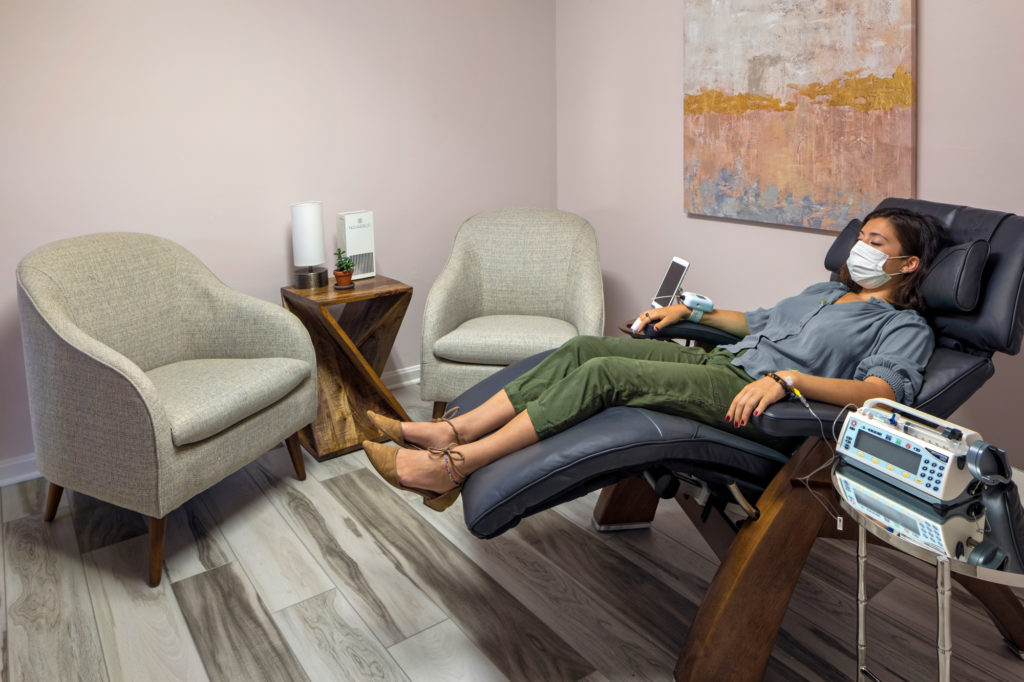
    When you come for ketamine infusions, we’ll meet you at the door and show you to your private treatment room where you can settle in and get comfortable on your recliner designed to help you relax most completely. You may bring your favorite relaxing music and a sweater to stay warm.

    When you come for ketamine treatment, you'll have a comfortable, quiet room to get the most from your treatment.

    You’ll notice an elegant white box inscribed with the word Novaerus sitting on the table. This technology is at work in every room of our practice to protect you from infection of any kind while you’re here. Using plasma cell technology, this process was developed by the Department of Defense and NASA for the Space Station to prevent infection there. It destroys all viruses — including COVID delta, lambda and mu — bacteria, and fungi in the air. (It can even lift Staph aureus from hard surfaces. Amazing!) And our plasma cell technology can keep you safe while you undergo treatment, even during this pandemic.

    This safety allows you to relax, not worry, and focus on your treatment, to get the most out of it.

    We’ve gone the extra mile to ensure you feel safe and free of risk regarding infection.

    Because you need to get better now…and not wait till the COVID pandemic finally comes to an end.

    If you recognize the indicators of postpartum depression in yourself, and you think they might have led to the way you’re feeling now, you can get better, feel like yourself again, and enjoy your new baby.

    Give yourself the extra boost you need to feel joy.

    Lori Calabrese, M.D. is on the front end of the race to stop PTSD in its tracks using IV ketamine treatment.

    To the restoration of your best self,

  • Suffer from Postpartum PTSD?        Ketamine Can Bring Back Your Joy

    Suffer from Postpartum PTSD? Ketamine Can Bring Back Your Joy

    We say that childbirth is utterly natural. But the experience of giving birth doesn’t always go as planned. Sometimes there are surprises, disappointments, unexpected changes, fears, and excessive pain.

    A terribly painful labor or delivery can become a traumatic memory for a postpartum mom. Loss of the baby during the process can also create an unbearable trauma for the mom. Especially in situations where the infant doesn’t survive, the mom can be so deeply affected that the smell of baby powder or lotion can trigger a cascade of PTSD symptoms. Or the cry of a newborn baby. Mothers who suffer from postpartum PTSD can have severe reactions to triggers for months after delivery.

    Leanne has five children.  The first four of her deliveries were increasingly traumatic. In one case, the baby’s head was lodged at the side of the pelvis and after hours of pushing with no progress, she was moved to surgery for a C- section. This was the fourth delivery.  More about that one in a bit.

    With the first, she labored for 38 hours and when the baby was finally born, she tore through her rectum. Bonding with her baby didn’t go well, because she was in so much pain. Plus, she felt beat up, traumatized, exhausted, and unable to find any warm feelings for her newborn. (And too ashamed of this to say it out loud.) Eventually, over months, she began to improve.

    But within 7 months of that birth, she found out she was expecting again. She sat down and cried. She didn’t feel ready. The pain in her rectum had only recently subsided.

    Then, the circumstances of her second baby’s birth were also excessively painful. (We’ll leave out the details.) She began to feel like she just had terrible luck… or just wasn’t supposed to be a mother.

    From that time, she cried anytime her husband tried to touch her.  She couldn’t separate the suffering of the two births from amorous times with her husband. Leanne couldn’t face the risk of another childbirth. One day she was so angry, she slammed the dishwasher door hard over and over, then sat down and cried.

    Leanne’s husband quietly slipped out of the house and bought a new set of dishes.

    Leanne talked with her doctor, and he said that she suffered from Postpartum PTSD.

    Then, one day Leanne and her husband went to visit friends for a backyard cookout. They took the babies with them and really had a wonderful day. That night, they were both relaxed, and enjoyed cuddling. One thing led to another…

    And soon enough, Leanne was pregnant with her third child. She’d been in therapy for 2 years at that point, so she was guardedly optimistic…but on shaky ground.

    This time, unfortunately, the crisis was placenta previa… specifically the placenta was overlapping the opening of the womb to the birth canal.  Once she began to dilate, portions of the placenta broke free, causing a rush of blood loss. She started to hemorrhage.  She panicked, called her husband, called her doctor, called her mom. ( If only she had called 911…but she was too shaken to think clearly.)  Of course, her husband was on his way, and told her to call 911 NOW.  She called 911 then called a neighbor to come stay with her little toddlers. She was rushed to the hospital, unconscious when she arrived. Doctors went to work hoping beyond hope they could save both mother and child.

    Thankfully both mother and child survived, but again, Leanne was exhausted, shaken, and shut down. She just couldn’t relate to the baby.  She was overwhelmed with guilt that her mistakes had come so close to causing the baby’s death. 

    Even though Leanne and her husband were committed to living a natural lifestyle, and had never used birth control, she just felt she couldn’t go through this again.  But he stood strong about not using birth control. So she used the best form of preventing pregnancy she could think of. Anytime her husband touched her or was affectionate, she pushed him away…or sometimes she just fell to the floor in a heap, weeping her heart out.

    She had times when she just began to tremble and couldn’t stop. One day she dropped a jug of milk that spilled and splattered all over the kitchen. Then she had to pull herself together to clean it up. Who else would?

    By this point, she tried to be a good mom to her innocent babies, but so much of the time she felt vacant. Other times she felt angry. Then, there were times when she had such anxiety that she didn’t dare drive, even to the grocery store.

    If you suffer from postpartum PTSD, ketamine treatment can help.

    She managed to avoid pregnancy for two years. Her marriage had become volatile. She just couldn’t be calm to communicate with her husband. Everything was falling apart.

    Her husband suggested they let the 3 kids stay with Grandma and Grandpa, so they could take vacation to somewhere peaceful. They took a week in Jamaica. It was wonderful with swimming, great food, walks on the beach, and local music. (And those drinks with umbrellas! She loved them!) So many sites, smells, and friendly people. They both believed this was just what the doctor ordered.

    On their 5th night, they danced to local music, and drank more umbrella drinks than they realized…  They found their way to their room and collapsed in bed. The next day neither of them remembered how they got there. In their inebriated state, their celebration led to baby-producing activity. So rare for them, at this point.

    You guessed it…baby #4 was on the way.

    Leanne home-schooled her children, so by now she was doing lessons with babies #1 and #2.

    At least on the days she was functioning. But her anxiety was pretty high.  How could she take care of these children when she was so shaky?  A few times during the pregnancy she experienced a panic attack. Her therapist was working with her to help her work through the anxiety.

    Bless her heart. This was the delivery we mentioned earlier. The baby’s head seemed to be stuck to the side in her pelvis and they couldn’t get the baby to move into the birth canal. It was the last straw for Leanne. She had a full out panic attack during the latter portion of her labor. She was standing up in her bed and screaming and crying. No one could calm her. She just wasn’t rational. She was terrified. So they did an emergency C-section after putting her sleep.

    When she emerged from the anesthetic, she was disoriented, surprised to learn her 4th baby was born and doing well in the nursery.  Her doctor encouraged her to rest before they brought the baby to see her. But she just withdrew.

    Leanne had had dreams of being such a natural “earth mom” …she’d started out wanting to give birth to her children at home. But each childbirth had been too risky to continue at home. She felt cheated. Angry. Beaten. Each labor and delivery was a nightmare.

    All her plans for meaningful home births had been vanquished. She knew she suffered not just from postpartum depression but from postpartum PTSD … and she just didn’t know what to do about it.

    Her doctor had advised Leanne and her husband to consider a tubal ligation during this C-section but she had been far too distraught for a decision like that. So he encouraged them to consider it later, to give her a chance to  recover.

    While they were “thinking” about it, she got pregnant once again. She told her doctor she definitely wanted the tubal ligation done during her final C-section. As it happened, this 5th birth went smoothly as a C-section, and the tubal ligation was completed in the same procedure.

    She was able to bond with her new baby peacefully, and she enjoyed him so much. 

    A wonderful, simple, easy, planned C-section — with no crash carts, hemorrhages, horrible images, horrible fears, horrible pain. Why couldn’t it replace all those awful memories? Why did they shake her up during the day, and infiltrate her dreams at night? And why did every little thing seem to be a trigger? The kids were healthy, right? They were OK, right? She was OK, right? Well on that one, no…she was really not ok. She still suffered from postpartum PTSD symptoms — and all the treatment she had had over the years hadn’t made a dent in it.

    So when a friend encouraged her to consider IV ketamine treatment, Leanne grabbed her phone, and started trying to learn what ketamine can do for postpartum depression and postpartum PTSD. She made the call.

    Scheduled her appointment. And left the children with a babysitter. 

    After the first infusion, she felt no different. Same after the second. After the third she decided to cook a new recipe for supper. Such a little thing, right? But it was such a big deal—she hadn’t done that for months. (Ketamine can restore initiative and motivation.) After the fourth, she could feel rays of hope inside her. Almost like rays of sunshine, she said.  By the time she went for the 5th infusion, she was calmer. No longer shaking. And although there was still anxiety, she was becoming hopeful. She had good days and bad days. But there was improvement. She could feel it. She just wasn’t there yet.

    So she went for a 7th infusion…and then an 8th. By this time she went for her 8th infusion, she had joy. She felt free of the fear and anxiety.  And as the days passed, she felt more resilient all the time.

    She became her old self over the next several weeks — felt happy, calm, fun-loving. (Oh wow, when was the last she she’d felt that?) She had patience with her children, she had creativity in home schooling them, she enjoyed socializing. She also had the initiative and motivation to clean up the house and invite another couple with kids over for dinner — outside, on the patio. 

    Leanne hadn’t felt this good since her first baby was born.  

    If you suffer from postpartum PTSD, try ketamine treatment. This mom found her joy again after she did.

    She also found the patience, wisdom, and determination to work with her children in family therapy in hopes of improving their security with her and building the bonds that suffered with these pregnancies and deliveries. 

    And she was thankful that her husband was still at home so they could work together with a marriage counselor to strengthen their relationship.

    IV ketamine treatment has developed a track record for helping women who suffer from postpartum PTSD to achieve remission. Choosing to seek out this treatment was a wise move for Leanne to make. At the same time, it’s important that you understand that ketamine is not for everyone. (There isn’t anything that works for 100% of people 100% of the time.) But ketamine can be transformative for most people who are suffering from severe postpartum PTSD, depression, social anxiety, bipolar depression, postpartum depression, and more.

    Innovative Psychiatry provides IV ketamine treatment for postpartum PTSD.

    At Innovative Psychiatry, we’re experts in psychiatry, in postpartum disorders, and in all the treatments available for them—including IV ketamine—and we work with you to map out the best course of treatment for you. We have the protocols and — incredibly important — the technology to protect you from viruses including COVID-19, bacteria, and molds, so you can come for your treatment with peace of mind. You can breathe easy…even if you haven’t for months.

    If you suffer from postpartum PTSD, don’t keep toughing it out. Call us.

    We’ll set up an appointment to talk about your history and current symptoms and all the things we need to know to determine if you’re a candidate for IV ketamine treatment. You deserve the care of a specialist.

    Don’t hesitate to call. Get your hope back. And the power to enjoy your family.

    We want to help.

    Lori Calabrese, M.D. is on the front end of the race to stop PTSD in its tracks using IV ketamine treatment.

    To the restoration of your best self,

  • Postpartum Stress Is Vicious: Reach Out for Support…It Takes a Village

    Postpartum Stress Is Vicious: Reach Out for Support…It Takes a Village

    Do you have a COVID baby?  If so, you’ve had compounded stress.

    Most moms are familiar with the exhaustion (and the overwhelm!) that often takes over when your newborn comes home from the hospital. It isn’t as though you were sleeping great before you went into labor.  Then contractions started and progressed to active serious labor. Then the hard pushing. Bottom line, giving birth is hard, hard work. You think you just can’t wait till the baby is OUT of your body so you can finally sleep.  WAKE UP CALL!!! Actually, once baby is outside your body, she’s adjusting too.  So she cries.  And cries. What can you do but nurse her till she drops off to sleep… until 30 mins later she wakes up in your arms crying again. So you put her back on the breast. And then it starts. And a challenging pattern emerges. Baby feels warm, secure, and happy when she’s nursing. Then, bereaved when the nursing stops. And you? Stressed to the max. Postpartum stress can be persistent if you’ve had a COVID baby…and even if your baby was born before COVID.

    The trouble with that is that anxiety can shoot up when baby nurses, wakes, and nurses some more. Because you want some sleep… you NEED sleep.

    And when anxiety rises, it’s hard to go to sleep. Your mind just keeps racing.

    So what do you do?  You call your mom, your sister, or your best friend to come and walk baby while you get some rest. And that’s not all it’s cracked up to be either, because you lay on the bed, wide awake….staring at the ceiling…worrying about the baby. 

    This is especially true for first time moms who so want to be perfect moms in every way but hadn’t counted on exhaustion and stress making you miserable. In fact, postpartum stress can be especially brutal for moms who try to be perfect.

    Try to relax and let go. Perfect moms don’t exist. Cut yourself lots of slack and call in help when you feel like you’re at the end of your rope. Don’t keep pushing. Because you just have to break the stress cycle periodically.

    And kick guilt to the curb!

    This is also true for moms with a baby/toddler and other children…. it can be so hard to cover all the bases of everyone’s needs. Plus laundry, cooking, baths, keeping the house picked up after you’ve been up all night with the baby.

    And You Wonder…Where Can You Find Postpartum Stress SOLUTIONS?

    Parenting books are full of advice about how to manage your baby AND your other children when there’s no one to help. (Ha! is what I said when I read them, on baby #4.) But, when you try to put their advice to work…well it’s not as easy as it sounds.

    Postpartum stress is that midlevel and escalating stress that occurs after the baby blues but before postpartum depression takes over.

    If relief isn’t found, postpartum depression can settle in.

    FAST FOWARD 10 months…

    You finally got the baby into a schedule where she sleeps several hours each night and you depend on that chance to rest.  Then you go on vacation. (Ha! they say it’s a vacation….) The changed vacation schedule disrupts baby’s schedule and she starts wanting to find comfort in constant nursing again.

    By the time you get home from your trip, you’re exhausted again. And not sleeping. And you’re crying more than baby. Sound familiar?

    Stress plus exhaustion is a devastating combination.

    First, understand that babies are individuals with temperaments unique to them. Some are easy going, relatively relaxed, and honestly, some seem almost self contained. Moms with babies like this have no idea why you’re so stressed. So ignore what those moms say. Right??

    Some babies are “high need” and may require lots of patience.  This type of baby may also be colicky, and as the saying goes, it takes a village. To walk her, to soothe her, and to give you a break to rest and breathe.

    You always hear that childbirth is a natural part of life…and it is. But it’s still a huge strain on your body and emotions. If you don’t have support, it can be difficult to recover.

    And women who don’t receive support during childbirth have a harder time recovering from it. They can continue to struggle for weeks or longer. In fact, a study by researchers led by CT Beck found 18% of American moms reported symptoms of PTSD. We call that postpartum post-traumatic-stress-disorder –really!–and we’ll be talking about that, soon.

    What is postpartum stress anyway?

    It’s like this…when something goes on that sets you on edge, but it doesn’t happen just once…or twice. It happens all the time, all the time. Like a baby crying incessantly…or children screaming because they’re mad, The longer this cacophony goes on the more it strips your patience…your ability to cope…to endure. And it goes on and on, day and night, week after week after month. It goes from acute stress to chronic stress… postpartum stress.

    When this happens, think of it as wearing down the synapses — those connection between neurons in the brain that help messages go from one part of the brain to the other. Those synapses can break down. The dendrites and dendritic spines also break away. You can think of it as pruning, like you do to a tree. But in terms of synapses, this is not a good thing. As those synapses break down, the connections between neurons are lost. And what’s left is a depressed mood. Anxiety. Misery.

    Postpartum Stress Needs to be Relieved

    Whether by natural means of relief and support, or by a remarkable treatment. Because left untreated it can easily advance to postpartum depression, a more dangerous condition.

    What it comes down to is that you need all the synapses you can get in the right parts of your brain so you can be resilient and not defeated. So you can embrace challenges as they arise.

    This is why it takes a village. Because you must have support from grandparents, friends, family, and as your baby grows older and is easier to manage, you can help another young mom.  

    But what if postpartum stress has resulted in damage too extensive for you to find the relief and resilience you need just by taking a nap, or walking and relaxing while someone else cares for baby?

    Well maybe that’s where IV ketamine treatment comes in.

    Nothing restores resilience like IV ketamine treatment. Nothing restores those synapses as thoroughly or as fast as IV ketamine treatment. For so many. Because ketamine restores resilience by restoring those synapses, by causing mRNA to flip on DNA to turbo boost brain-derived-neurotrophic-factors. By moving those G proteins off the lipid rafts to get those neurotransmitters revved up to do their job. By stopping the cell bursting in the lateral habenula… all these things working together to help you feel up to the tasks before you… Full of initiative, the motivation to do what needs to be done, and the hope for making your life rewarding again.

    Postpartum Stress Disorder can be overwhelming so reach out for help.

    At Innovative Psychiatry we’re in place to meet you here when you arrive for ketamine treatment. Because if you want to rise above the hopeless and dark listlessness that is overshadowing your time with your baby, we’re here to help. And for the safety of you and your baby, and the confidence it brings, we’ve outfitted our offices with a space station technology developed by NASA to remove 99.99% of the viruses, bacteria, mold, and pollen from the air and surfaces in our office.

    We keep the door locked so that only those who have been scheduled to be there will be there. You can feel safe here.

    We’re here to help you get better, feel better, and have the power to enjoy your baby, and your family. To have the power to face the challenges with resilience.

    Take affirmative steps to find out if you’re a candidate for IV ketamine treatment. Call us.

    We’re here to help.

    Lori Calabrese, M.D. is on the front end of the race to stop PTSD in its tracks using IV ketamine treatment.

    To the restoration of your best self,

  • Depression in Pregnant Mom Can Affect Baby Before and After Birth

    Depression in Pregnant Mom Can Affect Baby Before and After Birth

    Depression in pregnant mom can affect her baby's brain development.

    Sarah Driscoll had looked forward to her first pregnancy for years.

    She had to complete her graduate degree first, so she could relax and enjoy every moment. Now she was pregnant, and it was going well. Every visit to the doctor revealed more growth in her baby. It was an exciting time. But as her delivery date approached, something seemed off. She’d heard of depression in pregnant moms but she had no reason to be depressed!

    Still, rather than feeling excited about her baby’s birth, she found herself with mixed feelings. The idea of the work ahead, the sleepless nights, the exhaustion… began to weigh on her. Each day she felt more nervous about it than the day before.

    She mentioned her fears to her husband who reassured her that it would probably all fall into place once she saw her beautiful baby’s face. She secretly hoped so, but was skeptical.

    One day she asked her mom if she felt the same way before her first baby, and her mom told her no, she was so excited about having the baby in her arms, she didn’t care what it required of her.

    That just made her feel more selfish and guilty.

    Her best friend chimed in with a similar perspective, except admitted she was worried whether she would be able to handle everything after her third baby was born. But she reassured Sarah that it turned out to not be a problem. Caring for her 3 children was not so hard to take in stride.

    Sarah’s anxiety rose higher and higher, and by the time she began having labor contractions, she felt exhausted about the whole thing.

    After 9 hours of labor, her baby boy was born healthy, looking around the room with big bright eyes. And he quickly began to nurse when the doctor placed him on her chest.

    Postpartum isn’t always a fairy tale

    Sarah felt she should feel happier. Pangs of guilt shot through her that she felt so little for this beautiful baby boy. Her lack of emotion seemed to confirm she just wasn’t fit to be a mother.  And now this poor child was stuck with her.  What should she do?

    The first 2 weeks after he was born seemed like a test of endurance. How long can you live without sleep, she wondered. She went through the motions of changing diapers, feeding, and holding this baby. But she felt like a robot. And she was consumed with guilt.

    Help Arrived: Her Sister Came to Visit

    When her sister came to visit, Sarah tried to be a hostess in her exhausted, bedraggled state. Her sister sensed she wasn’t doing well and finally asked. 

    “How are you feeling emotionally..?”

    Sarah’s chin quivered. “I feel like a terrible mom. I love my baby but I don’t feel it. I’m so tired. I thought this would be a happy time….”

    Her sister arrives to help new mom with depression.

    Her sister wrapped her arms around her. 

    “Sarah. You’re NOT a terrible mom. But you do need some rest and a chance to see the doctor.  Tell you what.  Go to bed.  Let me take over with Jake.  I’ll love every minute of it and you need rest. Then we can talk more.”

    No surprise, the nap helped Sarah feel revived, but it didn’t help the empty, blank, nervous feeling go away. So she Said that to her sister… who told her she had a friend who was diagnosed with postpartum depression and had described feelings kind of like Sarah did.

    She suggested they make an appointment to see the doctor, who then referred Sarah to his trusted psychiatrist friend. That psychiatrist explained that depression in pregnant moms happens sometimes. She recommended a special treatment that could give Sarah rejuvenation in her emotions, her bond with little Jake, and hope for the future.

    She called it IV ketamine treatment.  Sarah had never heard of it, and her only concern was whether it would hurt her baby through her breastmilk.

    The doctor explained how it worked, how quickly it’s eliminated, and how infusions are usually scheduled, but if she liked she could pump her breast milk for the next 2-3 weeks then resume breastfeeding afterwards. Sarah was fine with that, and frankly was game to try anything at that point…

    We don’t talk about depression in pregnant moms very often, do we? 

    In fact, at this point it’s been nearly 2 years since the last time. But treating depression is important. And when it comes to bringing a child into the world, that depression may have a reach beyond just you.  It may impact your baby as well.

    A study published in the American Journal of Psychiatry this past September authored by Zou, Tiemeier, et al, showed that maternal depressive symptoms during the time before and after childbirth actually can affect the development of the baby’s brain. 

    For the study, researchers collected data from 3469 mothers and their babies related to whether the mother experienced depression symptoms during pregnancy and afterward, through the baby’s childhood up to age 10. They measured behavioral and emotional problems in these children, at the end when the children were ten years old. 

    Children were assessed at age 2 months, 3 years, and 10 years. The timing of the mother’s depressive symptoms were charted as they pertained to these age points.

    What they found out was that at the age of 2 months, babies whose mothers had been depressed had less gray matter — meaning the volume of their brain was smaller. They also had less white matter, which is the areas of the brain where brain cell connections happen. The color is the result of the myelin that covers and protects these circuits. 

    This was not the case in older children, but was significant at the 2 month mark after birth.

    However, those children who had these changes at two months were more likely to have attention deficit problems at 10 years. Depression in pregnant moms can have a lasting effect in their children.

    Preparing for Your Child’s Best Future

    Seems pretty important, doesn’t it?

    Especially as you plan and prepare for conception. If you’ve been depressed, and medicines haven’t helped, consider IV ketamine treatment before you get pregnant. 

    On the other hand, we all know that not all pregnancies are carefully planned. So what happens if you find out you’re pregnant and you’re also depressed?

    The FDA classifies ketamine as a Category B drug, meaning it is believed to be relatively safe during pregnancy, but it really hasn’t been adequately studied during pregnancy yet.

    You Have Options

    The good news is that you can wait until the baby is born, then receive ketamine treatment to hopefully relieve the depression symptoms right after your baby is born. 

    As always, remember that ketamine isn’t for everyone. But those who’ve been severely depressed and not helped by traditional medications are usually dramatically improved with IV ketamine treatment, even to achieving remission.

    With that said, the best hope for you to have the well-being to bond with your baby, and to enjoy your life and motherhood, may lie in ketamine treatment.

    And just as important as your wellbeing, is your baby’s brain health and development during infancy and childhood. If your wellbeing could protect your baby from attention deficit problems later.. well, that’s a no-brainer. Right??

    We think about prenatal vitamins, exercise, and childbirth classes. But the idea of IV ketamine treatment before pregnancy hasn’t really been on the list, you know? 

    That’s because we didn’t have the info we have now about the effect of depression in pregnant moms on the developing baby.

    The more we learn, the more we can do to give our babies the best possible start in life. And the beauty of it is, taking care of baby this way will help you enjoy life, too.

    Moms, Dads, and Babies All Live Better

    At Innovative Psychiatry, we like to see moms come in for IV ketamine treatment because they deserve to feel good, to have the joy, energy, and initiative to give their families what they need, while enjoying their lives themselves. 

    This mom's depression is in remission and she's enjoying her baby and her life.

    But we’re especially happy for women who’d like to achieve remission from their life-long depression before they start their family.

    What a wonderful beginning. But you know what?  It’s not just about moms, either.  It’s also about dads.

    And when a dad realizes he wants a child but is depressed, this may be the ideal time to reach out for treatment and the potential of remission. Because if he hasn’t benefitted from other medicines, he may be a great candidate for IV ketamine treatment. It can help him be the best dad he can be…and enjoy his life and family to the fullest.

    Wouldn’t you love to have the zest for life to enjoy your children, camping with the family, coaching your kids’ soccer team …dancing with your spouse? IV ketamine treatment can give you your life back, and give you the freedom and stamina to do things you love to do, the initiative to invest in your career and hobbies, and to build strong, lasting relationships. 

    If you’ve suffered from symptoms of disorders that hold you back from moving forward in your life, call us.

    We want to help you plug in to a life that really matters to you.  

    Lori Calabrese, M.D. is on the front end of the race to stop PTSD in its tracks using IV ketamine treatment.

    To the restoration of your best self,

  • Antepartum and Postpartum Anxiety: Moms Who Suffer Without Feeling Sad

    Antepartum and Postpartum Anxiety: Moms Who Suffer Without Feeling Sad

    Ketamine treatment helped this mom restore from antepartum and postpartum anxiety.

    Treatment can help anxious moms relax and enjoy their babies.

    Jill was so excited to be pregnant.  She’d waited for 4 years after she and Joe were married to start trying.  She was just elated three months later when a home pregnancy test showed those two little lines.  She was pregnant! Even the slightest thought of antepartum and postpartum anxiety never crossed her mind.

    In spite of waves of nausea off and on the first couple months, by the time she got through her first trimester, she was feeling better.  Her excitement to see and hold her precious baby was bubbling up like crazy. How could she wait six more months??

    But as she moved through the 4th month, she began to feel… uneasy.  

    Just this vague sense that something bad could really happen… maybe something about her pregnancy wasn’t going as it should? She worried that something was going wrong with the baby. What if there was something wrong that they couldn’t see? Or a problem with his development?  What if he was in that 3%? What if something went really wrong during delivery?How would she take care of him?  

    Day by day the dread grew worse. She asked her doctor about her concern, and she assured her that everything looked good. Told her that she should enjoy her pregnancy.

    That was the problem. She couldn’t. She was worried sick.

    Then, when she reached her third trimester, the dreams started with a vengeance. Night after night she’d dream she gave birth … to an alien.  Or a forest creature.  Or a monstrous murderous demon. She was so ashamed that these were her nightmares that she couldn’t tell anyone. No one.

    When something is so terrible, who can you tell? Who can you trust?

    The nightmares were so cruel, so vivid, that she’d wake up in the wee hours sweating, heart pounding, and screaming. Her husband would try to comfort her, then she’d go back to sleep. And the nightmare would continue. It was as if she couldn’t escape. 

    By the time the baby was born, her joy was gone, and in its place loomed a terrible dread. She feared for the baby, and what he would grow to be.  Not who…but what.  She tried to nurse him in the hospital but would break down and cry and ask the nurses to take him for awhile to give her a break.

    Going Home From the Hospital Didn’t Help

    It wasn’t supposed to be like this!  What was happening to her?  Why couldn’t she enjoy her newborn son?

    The first 6 weeks or so she tried. She really tried. She was exhausted, and wondered if she’d ever get enough sleep to feel better. Waking every hour or two around the clock took a toll she didn’t anticipate. Her thoughts about her baby seemed irrational, even to her. She couldn’t imagine why she ever thought she wanted a baby.  Now here she was, stuck in a permanent nightmare. She felt cheated.

    Then her worries about what she might do to him if she let her guard down overwhelmed her.  She mentioned her concerns to her pediatrician during a routine visit, and he explained that this could be postpartum anxiety and gave her a card to see someone he trusted.

    Within a few months after her treatment began, she was beginning to see life, her son, and herself in a new light. She could sort of imagine now that it was possible she could have a good and loving relationship with him. 

    It helped enormously to know all this was a condition her hormonal imbalances and stress created. To fully realize that neither she nor her infant son were to blame. She read all she could find on antepartum and postpartum anxiety.

    There wasn’t much.

    But where, oh where, did it come from?

    We’re all familiar with postpartum depression, but you rarely hear people talk about postpartum anxiety. While the two often join forces, they’re actually individual disorders.  Since postpartum depression is often associated with sadness and anxiety, postpartum anxiety is sometimes overlooked.

    It’s actually possible to feel overwhelmed, severely stressed, and have thoughts of harming your baby or… of ending your own lifewithout feeling sad.

    When a woman gives birth, several changes go into high gear in her body. Pregnancy hormones drop, lactating hormones kick in, and the sudden changes in her brain give way to mood swings.  

    This woman suffers from antepartum and postpartum anxiety and needs treatment to feel relief and to bond with her baby.
    Add to that the painful engorgement in her breasts as milk comes in, lack of sleep from her baby’s waking every hour or two to eat, the soreness in her perineum from stitches, (or in her abdomen from a C-section) and cramping of her uterus as it recovers from pregnancy and childbirth, and this new mother is enduring substantial stress.

    Stress + Fear = Anxiety

    Even though many people are more familiar with postpartum depression, roughly 6% of all pregnant women and about 10% of those who are postpartum develop anxiety that’s severe enough to need treatment.

    It’s natural for a new mother to have mild worries or nervousness about whether her baby is eating enough, whether the baby’s stool is like it’s supposed to be…and wonder if she’ll ever feel rested again.

    But when mild worries become more intense, concern becomes a constant dread that something bad is going to happen, or intrusive thoughts begin of harming the baby or yourself, it’s time to seek help.

    So why do some mothers seem to adapt to the new addition to the family, along with hormone changes, the lack of sleep, and the new routine, while others feel and think things they don’t want to feel or think, struggle to bond with the baby or enjoy her, and wish for a way to escape … either temporarily or permanently…?

    There are a number of factors. And none of them are the anxious mother’s fault. 

    Risk Factors for Antepartum and Postpartum Anxiety

    First, mothers who have relatives with anxiety disorders –or have had anxiety disorders themselves in the past — are at higher risk for postpartum anxiety than woman with no family history of anxiety at all. In addition, women with thyroid imbalance are at higher risk, also. 

    Most of the time when we refer to postpartum anxiety, we’re talking about a generalized anxiety disorder that develops during or after pregnancy. Symptoms like nervousness, constant worry, difficulty sleeping, racing thoughts, tension…

    But there are a couple more types of postpartum anxiety that are important to highlight.

    Postpartum Panic Disorder

    Panic disorder doesn’t mean being panicky, or having anxiety that escalates easily until you feel wound up. It means having frank, out of the blue, and unprovoked panic attacks. You’re not just worried all the time about whether the baby is eating enough, whether you’re capable of being a good mother, or whether the baby will get sick, you begin to get random episodes of sheer panic.

    Sometimes multiple times a day.

    Shortness of breath, fast heart rate, chest pain, dizziness, and tingling along with feeling confined or like you’re suffocating can make it extremely difficult for you to take care of your baby, yourself, or the rest of the family. These sensations can come and go, but you may need professional help to cope with them and reduce their impact on you and your new family. 

    Postpartum Obsessive Compulsive Disorder (POCD)

    Symptoms of OCD can emerge during or after pregnancy, too. They’re similar to general symptoms of OCD but tend to be focused on the baby. Intrusive thoughts  about harm coming to your baby can crowd your mind, and even shock you.

    The next thing you know, you find yourself checking things over and over and repeating things over and over to try to avoid a circumstance that would allow your thought to come true. 

    And…you’re probably horrified at the thoughts that pop into your mind. But this is why we call them “intrusive” thoughts. They intrude into your thoughts without you inviting them.

    They’re a result of disordered circuitry, and misfiring signals, in your brain as the result of relentless and overwhelming stress, shock, and genetics.

    Of all of the antepartum and postpartum anxiety disorders, this may be the most difficult and the most upsetting of all. Even though you probably know in your head you would never follow through on the thoughts, and you also know that the repetitions and cycles of checking don’t really help, you probably feel powerless to stop. But treatment can do what you can’t by yourself.

    Because this condition is treatable, and you need to not endure these symptoms alone. Seek help and treatment so you can get your life and your relationship with your child back on track and in a healthier, brighter place.

    Postpartum anxiety disorders are not your fault.

    You’re not to blame for the intrusive thoughts, the fears, the compulsive reactions. These are a result of your genetics, your circumstances, your stress, and your family history. But treatment is not only available to you, it also can return your world back to its right and rewarding function.

    Antepartum and postpartum anxiety disorders come in various forms with a variety of faces.  But it’s vital that you not confront this alone. Rather, seek treatment. And please know that this is not your fault. Even so, you may not get better without help outside yourself. 

    Treatment for antepartum and postpartum anxiety is vital so mom and baby can bond and enjoy each other.

    If you’re pregnant and feeling feelings and thinking thoughts that aren’t what you wish you they were, there is help available. If your baby has been born, and those feelings are just starting or are getting worse, call us. We can help you feel better, or refer you to someone who can.

    Don’t face postpartum anxiety disorders alone.  

    You and your baby deserve a loving and happy relationship together. 

    Can we stop suicide? Yes, with a series of IV ketamine infusions.
  • Treating Postpartum Depression Requires Fast-Acting Medicine: Ketamine Treatment Restores

    Treating Postpartum Depression Requires Fast-Acting Medicine: Ketamine Treatment Restores

    Treating postpartum depression is vital for both mom and baby.Postpartum Depression and Paternal Postpartum Depression

    Mental Health Awareness Month is also

    Maternal Depression Awareness Month

    #BreaktheSilence

    So let’s stamp out the stigma and talk about mothers and Postpartum Depression. Treating postpartum depression requires fast-acting treatments because there’s so much at stake. Pregnant and breastfeeding moms are targets for anxiety and depression for so many reasons — and are more vulnerable to developing anxiety and depression than at any other time in their lives.

    Brain and Behavior Research published a study in the November 7, 2017 issue of Brain, Behavior, and Immunity about pregnancy.

    They discovered that pregnancy and the postpartum period actually reduce the immune response in the brain. Which may explain why some women are more susceptible to anxiety and depression during this time.

    Women with postpartum depression carry shame and anxiety about being a “good enough” mom to their babies.

    Brain and Behavior Research displays this hashtag for May and I like it:  #BreaktheSilence

    So we’re going to break the silence about postpartum depression and continue to celebrate mothers today by talking about something too many moms go through.

    Think about this for a moment:

    Your friend is pregnant — which is a glorious time of joy for a mother … or is it?

    You want to talk about her baby, shop for baby clothes with her, plan her shower. But she doesn’t Treating postpartum depression is vital for mom and baby.seem to be responding like you thought she would. In the first few months, she’s noncommittal and has nothing much to say. In case something goes wrong. You hope it’s because she’s just tired and nauseous. Maybe her excitement will build when she feels the baby’s movement.

    But the second trimester is anything but exciting for her.  As her baby grows, you begin to see a vacancy of sorts in her eyes. She becomes more and more listless.

    Your friend’s once bright and sparkling personality has dulled. She seems to just trudge through the days. Then, late one evening, you get a call from her husband. He says she’s screaming and crying that she can’t be a good mother … she’s terrified of going into labor. 

    Postpartum Depression, Panic Attacks, and Anxiety

    In less than 20 minutes you arrive at her house and try to help her calm down.  You listen, you reassure her…though she seems inconsolable…then finally sobs and sobs.  The next morning she tells you she’s sorry for her outburst. But you know there’s more to this than “normal” pregnancy.

    When her baby is born you’re sure the cloud over her will dissipate as she looks into the face of her beautiful child, and enjoys the wonder of this miracle.

    But unfortunately, she hardly wants to even see the baby in the first few days.  And finally, when she does, she holds the baby and stares vacantly into space. What can you do..?

    What IS Postpartum Depression..?

    Women with postpartum depression experience the symptoms of depression anyone with depression experiences. Symptoms such as listlessness, feelings of emptiness, loss of interest, muscular and skeletal aches and pains, reduced energy, hopelessness, and withdrawal, for starters.

    But, the new mom also experiences other symptoms that are unique to her situation. She focusesTreating postpartum depression helps mom and baby bond. on her baby, her ability (or feared inability) to care for him, or financially support him.

    Women with postpartum depression can suffer with feelings of anxiety, panic attacks, feelings of extreme inadequacy, and overwhelming sadness.

    Postpartum depression doesn’t always follow depression during pregnancy. But the likelihood a woman will experience postpartum depression is much higher if she was depressed during pregnancy.

    In fact, 1 in 7 women are affected by postpartum depression, and fully 25% of cases of postpartum depression began during pregnancy.

    But what about the other 75% of cases?  What sets those off postpartum?

    More Causes of Postpartum Depression

    There’s quite a variety of things that contribute to postpartum depression. Things like severe financial distress or multiple births can be behind it. Family problems such as separation or abandonment by the baby’s father, which can include heartbreak and  financial crisis together. 

    There’s also a sudden drop in estrogen and progesterone that can trigger it for some women. When the baby is in the NICU for a prolonged period of time, that can interfere with maternal-child bonding, and can result in depression in the mom.

    But for many moms–moms with support, with resources, with help… it’s so frustrating. There’s nothing that seems to precipitate it and no one to blame. The depression comes out of nowhere.

    Serious Consequences of Untreated Postpartum Depression

    It’s during this early period after birth that mothers and babies bond. When that Treating postpartum depression is vital for maternal child bonding.period is interrupted, it can cause a cascade of suffering in both mother and child. The cooing and cuddling a mother does with her newborn stimulates the growth of neurons and synapses in the brain.

    When the newborn misses this opportunity, neurocognitive deficits can be the result.

    Or in straight English, it can interfere with the baby’s memory, ability to think and process, and make decisions as she gets older. Because of this, it can reduce her academic performance, too.

    If a mother is depressed during pregnancy, we believe this has a direct impact on the wellbeing of her baby. Researchers report these babies are sometimes born irritable, lethargic, and have sleeping and eating problems. They can grow to be slow learners who are underweight and emotionally unresponsive. And later in life show behavior problems like aggression.

    The same is true of babies of moms with postpartum depression. These babies are more likely to have excessive crying, behavioral and emotional problems, and later Attention Deficit Hyperactive Disorder, or ADHD.

    This Mom is Suffering

    For the mother, if depression takes hold, not only does she miss the rewarding connection with her infant, and the hormones that help her “feel” like a “good mom” but she often tends to blame herself as a “bad mother.” More than likely she’ll think about all the ways she believes she’s failing her child, or causing damage.  Sometime to the point of developing recurrent, intrusive, and unwanted thoughts about this — obsessive thoughts.

    And those obsessive thoughts are fueled to be even more intense by depression.

    Dads Get Postpartum Depression, Too

    Then, there’s the dad. He can also be heavily affected by her postpartum depression. It’s common Treating postpartum depression is important in men also. Father and infant bonding is very important.enough for the father to become depressed also that they have a name for that too: Paternal Postpartum Depression. In fact, new fathers are at increased risk of postpartum depression due to the immense changes they experience with the birth of a baby.

    And if the new father has a history of mood disorder, his risks are even higher. Newborns and infants depend on the loving interaction with both parents to thrive. When that interaction is absent, the baby suffers.

    Mom’s Depression Is Tough on Baby

    A study was conducted where mothers of 3-month-old infants were told to imitate depression symptoms for 3 minutes. They did this by speaking in a monotone, maintaining an expressionless face, and avoiding touching the baby.

    In only 3 minutes, the infants reacted to this change in their mother’s mood.

    They turned away from their mothers, became irritable and distressed. Even after the 3 minutes of exposure to this change, when the mothers returned to their normal, nurturing demeanor, the babies remained upset for awhile, difficult to console.

    Infants are extremely sensitive to their mom’s sadness, silence, and inattentiveness.

    Sometime postpartum depression can spiral dangerously out of control — beyond depressive symptoms into mixed symptoms with agitation, or symptoms of psychosis with delusional beliefs or hallucinations. This is especially dangerous when delusional beliefs or auditory hallucinations are centered on the baby.

    Treating Postpartum Depression

    For all these reasons, it’s vital that the mom with postpartum depression be treated and relieved as soon as possible. If the mom is given oral antidepressants, it can be weeks or months before she experiences relief. And that critical period for bonding and nurturing for mom and baby can be interrupted while they wait for relief.

    Ketamine treatment for depression, when administered according to best protocols, can bring relief in as little as a few hours, or within a couple of treatments. 

    It doesn’t take weeks to work.

    This is a psychiatric treatment that’s been used very effectively for the most difficult-to-treat cases of depression, bipolar depression and anxiety. It’s often a treatment “AFTER everything else has failed.”

    With postpartum moms and newborn babies, it can be a treatment “BEFORE everything else has failed.”

    It can save you weeks … or months. It can prevent a missed-bonding opportunity for you and your baby. Quickly. Immediately. Hopefully this will minimize the damage that can arise from that, before it becomes established and fixed.

    Has it been studied extensively in postpartum depression? No. Not yet.

    But neither has anything else. The latest Cochrane Database review shows an impressive lack of significant new studies of antidepressants in postpartum depression over the past decade, despite all of the available antidepressants on the market.  No real news, no new findings, no new recommendations.

    Geez.

    We have several postpartum moms who came to us for ketamine treatment after weeks of failed treatment with antidepressants and psychotherapy, and who responded strikingly to IV ketamine. Sometime, we add 1-2 more infusions or use a larger or smaller dosage at a faster or slower rate to get symptoms to remit entirely

    Double Blind Study Shows Safety and Effectiveness of Ketamine

    What’s more, researchers conducted a double-blind study published in the Journal of Treating postpartum depression with ketamine helps mom and baby bond.Clinical and Diagnostic Research. They included 92 women scheduled for caesarean section, to determine the safety and effectiveness of using a combination of ketamine and propofol to manage pain after surgery. Researchers hoped to address the problem of pain that delayed initial breastfeeding after caesarean section. (Stay with me here — it’s relevant.)

    In addition to pain, the nausea, vomiting, and shivering that occurs in more than half of women following C-section also interferes with breastfeeding, walking, and caring for the newborn.

    Researchers divided the women into 4 groups, and treated each group with either propofol, ketamine, ketofol (a combination of ketamine and propofol) or a placebo. 

    Those who were treated for pain with the placebo required an average of 58 minutes before they were stable enough to breastfeed.

    Those whose pain was treated with propofol alone required 42 minutes before they could breastfeed.

    Ketamine was most effective for pain and required only 31 minutes. But there were some surgery-focused issues that propofol could resolve and ketamine couldn’t.

    So, those who were treated with ketofol (a combination of propofol and ketamine) required only 25 minutes after surgery to breastfeed.

    This study determined that the ketofol combination was most effective. And it also found ketamine and propofol are safe for infants through breastfeeding.

    Ketamine is Safe – Plus – Postpartum Depression Puts Mother and Child at Risk

    Ketamine has shown its safety in treating people from infants to adults as well as the elderly for 50 years. One of the greatest risks to a baby born to a mother with depression is the mom’s untreated depression. Other medications are beingTreating postpartum depression with ketamine ensures future happiness for the family. tested to find more medicines that act quickly like ketamine does. In the future, we may find that they can be used postpartum to bring a mom to remission quickly so she can bond with her baby.

    At this point, ketamine is the safest and fastest-acting depression-smasher for women, or men, suffering from postpartum depression.

    If you’re pregnant or postpartum and are finding no joy in your pregnancy or in your life with your baby, know that you can feel better

    Call us, and let’s talk about what can be done to help you find joy again in your baby’s, and your own, future.

    And if you suffer from depression, anxiety, panic disorder, social anxiety, bipolar disorder, PTSD, OCD, suicidal thinking, or other feelings of hopelessness and despair, you can have hope again.

    At Innovative Psychiatry, ketamine treatment is administered with state-of-the-art infusion pumps, protocols, and expertise with dosage and rate to result in the best outcome for you.

    We’re here to help you find your life again. To enjoy your family and relationships, your new baby and your most enjoyable interests.

    Lori Calabrese, MD offers innovative psychiatric treatment like IV KetamineTo the revealing of your best self,

    Lori Calabrese, MD

  • Reaching Out to Sad Dads: Can Men Suffer Postpartum Depression, Too?

    Reaching Out to Sad Dads: Can Men Suffer Postpartum Depression, Too?

    Can men suffer postpartum depression? This dad is overwhelmed with his newborn, work, and worry about parenting skills.Paternal Postpartum Depression

    In the last ten years, we’ve heard more and more about postpartum depression. Celebrities like Brooke Shields, Drew Barrymore, and Gwyneth Paltrow have stepped up to speak out about their own struggles with it.

    But, as much as we talk about postpartum depression in mothers, very little is mentioned about the same illness in fathers. Can men suffer postpartum depression, too?

    Dads fall prey to the pain, shame, and isolation of this illness only slightly less than moms. How great it would be if some celebrity fathers would grab the mic and talk about their own depression, wouldn’t it? 

    As tough as it is for moms to admit they have any feelings other than the blissful joy they expected after the birth of their babies, it’s probably tougher for men. But, when you stop to think about the massive adjustments men go through with the birth of a child, it might not be so surprising.

    The overwhelming sense of responsibility, sleep deprivation, difficulty in soothing a baby who continues to cry … all are familiar to Sad dejected dad: can men suffer postpartum depression, too?mothers, but can be just as suffocating to fathers. And as lack of sleep continues to interfere with normal functioning, shame, darkness, dread…and despair replace the joy and elation of a new baby. 

    Can Men Suffer Postpartum Depression?

    When a parent can’t feel affection, whether it’s dad or mom, that parent can be bombarded by self-critical judgment that she – or he – is a bad parent, not cut out for parenting … and with fear of ruining their child and a host of other fears.

    Society has believed that postpartum depression was the result of hormonal changes in the mother after giving birth. And that since the father doesn’t give birth, he can’t possibly be afflicted with the same type of condition.

    But it turns out it’s not quite that simple. About 12 percent of women experience postpartum depression after the birth of a child, and somewhere between 7-10% of men do, also. A study at the University of Southern California found that depression in men following the birth of a baby seemed to be linked to reduced testosterone levels. To make it more complicated, they found that higher testosterone levels in men seemed to protect them from depression, but sadly, it seemed to correlate to more depression in their wives. 

    One reason may be that testosterone gives a big boost for hunting venison and feeding the family, but is not as helpful with sensitivity to the feelings and needs of wife and children. Testosterone may even interfere with husband-wife and father-child relationships on some level.

    Testosterone’s More Useful for Conquering Dragons than for Nurturing Relationships

    And here’s another tidbit about these dads. One more study, published in the American Journal of Human Biology, discovered that men who have children have lower testosterone than those who don’t.

    Plus, those whose testosterone dropped when the baby was born seemed to also be more tuned in to their infant’s cues, and show more affectionate attention to them… and cuddle more.

    So, men whose testosterone drops when a child is born, tend to be more sensitive to their wives or partners, also. And in these close relationships, researchers found that if one spouse’s hormones drop, the other spouse’s often do, too. Researchers didn’t understand why, but speculated there was a sort of interdependence between the couple that translated into these changes.

    Fathers Get Depressed, Too

    So back to postpartum depression. The fact is that women aren’t the only ones who have hormonal fluctuations with pregnancy and after childbirth. For some men, being in a relationship that’s producing a child, combined with sleep deprivation, tips the scale on hormone balances, anxiety, and feeling overwhelmed.

    And just like their wives sometimes do, men suffer from the negative self-talk that accompanies these negative feelings and fears. And, it’s not enough that they trudge through the exhaustion, anxieties, and overload of fatherhood. The shame is just cruel.

    Shame creeps in telling them they’re not cut out to be fathers… Of course, it’s a lie. But it sounds true to their impaired thinking

    In the vast majority of cases, these guys turn out to be wonderful dads and husbands.  They just need treatment and rest to restore and find the energy to care for, protect, and enjoy their families..

    So… can men suffer postpartum depression…?  Apparently they can.

    What To Do About Paternal Postpartum Depression…?

    So what can men with paternal postpartum depression do?

    Seek treatment.
    I’ll say it again. You can seek treatment.

    The combination of the major life changes, added responsibility, money worries, and sleep deprivation create a huge obstacle to conquer by yourself. 

    Your manhood may tell you to not be “vulnerable.” That you must be strong and not “cave.”  But, to get better, enjoy your new baby and your wife, you need a little help.

    Dads aren’t likely to get better as long as they continue to rehearse their terrible self-criticisms over and over in their minds. Or ferment those thoughts through sleepless nights. But anxiety can be hard to control singlehandedly.

    In many cases, an antidepressant can be very helpful, as well as talk therapy. Learning how to cut yourself some slack. Talking with your wife about how you really feel. Letting down your guard.

    Still, antidepressants help only roughly two-thirds of depressed people. But if antidepressants don’t help, Can men suffer postpartum depression? This dad would feel more like playing with his son if he had treatment for paternal postpartum depression.don’t give up.

    Ketamine treatment rapidly and robustly restores you to your real self.  That’s been true in 75-80% of cases, and it’s highly likely it will help you, too. 

    And I mean it not only helps you feel less terrible. It doesn’t just take the edge off the shame…

    But rather, it helps you feel alive again. So alive you feel your love for your wife and child. You truly enjoy them again. And that helps you become the best dad and husband you you can be. 

    There’s no place for shame in parenting. To your child, you’re a hero. Let us help you enjoy it.

    You’re going to feel good again.  You’ll see.

    To the strengthening of your best self,

    Lori Calabrese, M.D.

    Lori Calabrese, MD offers innovative psychiatric treatment like IV Ketamine

  • Ketamine's Healing: Does Depression Run in Families?

    Ketamine's Healing: Does Depression Run in Families?

    • Depressed girl is unresponsive to nagging father -does depression runs families.

    Does depression run families?

    I didn’t ask if it runs in families. Does it run your family?

    Well, let me ask you this. Do you love someone who’s depressed … ?

    I mean really depressed.  Someone who’s been withdrawn, listless, drained, and nervous for months — or years… Maybe you hear how they wish they could die.  Maybe you hear that often.

    Have you helped your son, daughter, or spouse get to the doctor for treatment?  It was hard for them to even just get out of bed, I bet. Really hard.

    They grumbled … maybe slung harsh words at the obstacle of waking up, of getting out of bed. If they did, you probably felt annoyed with the abusive language, but you also knew their struggle was gargantuan. And you knew better than to say anything.

    At the doctor, maybe you listened as they described how they felt. If they even let you in. They probably didn’t have much to say. Too shut down … or too angry.

    When Treatment Doesn’t Help

    After years of doctor visits, years of trying new medications one after the other … then 2 or 3 in combination … maybe none helped very much or for very long. Years of watching her — or him — stop taking meds because “they don’t work anyway.” You’ve likely fought your own despair about ever finding any real help for them.

    You’ve probably wondered just how long one person can endure such hopelessness. And, if you’re human, you may have even secretly wished there was somewhere you could go for a vacation from it just to get away for a little while. But you put that secret thought aside, because what’s most important is finding relief for your son or your daughter or your spouse … or your sister … or your Mom.

    Depression is a Problem of the Family – Not Just the Patient

    You’ve watched phobias take over. Fear of answering the phone. Of going outside. Fear of driving and fear of crowded places. Even fear of eating.

    It’s one thing to watch someone you love in pain for a day or a week.  But when the years come and go and you’d give Father tries to comfort his daughter. He knows that depression is a family problem.anything to see her enjoy herself, even for a little while … it becomes terribly hard to bear. Or to take her to dinner for her birthday and see that frozen look of dread in her face.

    Searching the World for Someone Who Can Help

    So you’ve researched, asked doctors and friends, read articles, scanned the internet, to find that one program, residential treatment, or miracle drug that could lift the lead blanket from the life of this one you love so much.

    But…after a while, they all seem the same.  Nothing seems to make a difference.

    Then, you dig deeper.  You see her desperation, and you worry about suicide risk, so you pull out the stops.  She doesn’t want to hear about any more promises, so you subtly take sugar out of her diet…and dyes… plus salt…  and add a plethora of nutrients like folate, vitamins, and anything else you read on the web. 

    Breakthrough Possibilities

    You learn about new medications that are creating breakthroughs for others.  But she says, “NO.” She’s jaded, has lost her confidence in treatment. She’s sullen and disillusioned. She’s tired.

    Then one day, you’re sitting in the doctor’s waiting room with her, and you pick up a magazine. It says something about ketamine…for depression

    Hmmmm. Ketamine.  Why does that ring a bell…?  You think you’ve heard about it in the context of surgery. What was that? Something that helped a patient breathe…?  No… You read the article…and your head explodes.

    An anesthetic…?  A street drug…?  What on earth.

    You get online and find out there have been all sorts of articles and studies written about this for years but you never noticed them. But now with determination, you start Googling.

    Researching the Breakthrough

    The scientific articles are too hard to understand, but you discover articles written about the science. In everyday language. You read and take notes.  Read and take notes. Read more and take more notes.

    And it dawns on you this is something you haven’t tried. And instead of just a third of patients finding some sort of help, you’re reading about 75-80% of patients not just getting help, but getting better.  Symptom free. Really better.

    (***If you’re reading this, and you haven’t shared the yoke with a beloved spouse or child who’s, this all may sound ludicrous to you. “…Hey, aren’t you just a little over-invested there…?”)

    Depression is a problem of the family…

    A serious chronic disease impacts the entire family. It’s not only the ill person who suffers. The symptoms affect Little boy hugs his depressed dad. Does depression run families?everyone. Family gatherings are overshadowed by your family member’s reluctance to enter in, or to leave the house. Everyone carries the ache of this one’s suffering sadness. Everyone feels helpless — powerless — to offer relief.

    Mood Disorders – Serious, Crippling Illnesses

    Depression, specifically Major Depressive Disorder, is not a bad attitude, or laziness. It’s an illness caused by changes in brain structures and function. And depression is just one mood disorder. There are so many others just as crippling. OCD, PTSD, bipolar disorder, other anxiety disorders

    About 1/3 of depressed people are successfully treated by traditional antidepressants. For them, depression is treatable, and they’re able to live their lives in a meaningful way.

    For another 1/3 who weren’t helped by their first round of antidepressants, a new medication or a combination “cocktail” of meds turns out to be effective.

    But what about that other one-third? 

    The World Health Organization estimates 350  million people worldwide are depressed. That means 116 million people in the world are suffering all the pain of depression along with the anxiety that accompanies it, without help or relief. That’s more than 3 times the population of Tokyo, the largest city on earth. And for every person in that list, a family suffers with him.

    Their loved one remains weighted by the lead blanket of depression and anxiety.  Phobias, withdrawl, poor functioning socially and professionally, and despair.  And their risk for suicide grows with every month, every year, they continue to suffer.

    Until now.

    Ketamine Relieves the Family by Making the Patient Better

    Now there is, for the first time in the history of psychiatry, a medication that can stop suicidal thoughts within hours.  Since suicidal thinking — and planning — often create an emergent situation needing life-saving intervention, time is of the essence. 

    And it’s safe.

    Ketamine  hydrochloride is a compound that was FDA-approved for anesthesia in 1964. It’s proven itself to be an Child sits alone listless, depressed.effective and useful anesthesia medication for surgery and for managing pain in emergency situations for 50 years. Ketamine has also demonstrated its safety when used in appropriate doses for children, adolescents, and adults.

    It was even included in the List of Essential Medications by the World Health Organization.

    It’s demonstrated its safety as an anesthetic in all age groups for 50 years. In the last 15 years it has also emerged as an extraordinary drug for stopping suicidal thinking, and in treating many forms of depression and anxiety.  Specifically, treatment-resistant mood disorders.

    Ketamine has been proving itself in laboratories, studies, and private practices across the US and around the world as a rapid and robust antidepressant, when used in the tiny doses required for treatment of mood disorders.

    WARNING: Use of Ketamine to Self-Medicate is DANGEROUS

    While it’s true that ketamine, known on the street as Special K, has been abused and passed on the street as a hallucinogenic way to get high, the doses people in the drug scene use for tripping are much, much higher than the dose administered by psychiatrists in precise therapeutic infusions. 

    And those who abuse ketamine on the street use large doses, massive doses…and way, way too often. And…they can suffer serious side effects in the form of damage to their bodies that are irreversible. Like bleeding ulcers inside the bladder, kidney failure. Death.

    Depression is a problem of the family, not just the patient.

    We know that families need relief along with their loved one who suffers.

    If you and your family have been prisoners in the war against major depression and anxiety, ketamine treatment for your family member can restore the rest of your family.

    Ketamine Relieves Stress in the Family Caused by Psychiatric Mood Disorders

    At Innovative Psychiatry, we’re dedicated to finding treatment for the sickest of the sick. Those who’ve trudged andDad playing with kids after ketamine treatment. Does depression run families? bowed under the tyranny of psychiatric mood disorders. While we can’t accept more patients who need general psychiatric care, (we’re full!), we do want to talk to you if you’ve tried two or more medications or treatment combinations without success.

    If treatment has been failing you up till now, call us. Helping people like you is our specialty.

    Let’s schedule an appointment to determine whether you’re a good candidate for ketamine. While ketamine isn’t for everyone, it’s remarkably effective for 80% of people who have been failed by other traditional treatments.

    And chances are it could be just what you need to restore your life — so you can enjoy meaning, productivity, and relationships you haven’t been able to for a long time.

    To the emergence of your best self,

    Lori Calabrese, M.D.

    Lori Calabrese, MD offers innovative psychiatric treatment like IV Ketamine


error: Content is protected !!