Category: Suicidal Thoughts

Articles About Suicidal Thoughts by Lori Calabrese, MD | The Ketamine Blog

We offer the following articles about suicidal thoughts to reduce the hype and stigma that seem to accompany the tragedy of suicide and those who consider it. We hope to show how changes in brain circuitry and structures lead to the torment of these thoughts, and as a result an individual can make attempts on his own life because he succumbs to those painful images and thought patterns.

Suicidal Thoughts Are Caused by a Variety of Disorders and Reactions

Suicide is not selfish, as some claim, any more than kidney failure is selfish. It’s part of a disease process that creates a cycle the individual is trapped within.

Suicidal thoughts can accompany a variety of psychiatric disorders. In fact, they can torment people who have never been diagnosed with a disorder at all. Sometimes changes can happen slowly over time in response to a significant life event that takes the joy out of life for an individual.  And that state can progress to thoughts of death.

The loss of someone near and dear, or other types of losses can also contribute. Sometimes a personal failure is behind the action.

In other cases, a person may suffer for a prolonged period of time from a diagnosis, or multiple disorders, that bring feelings of depression, despair, and despondency.  When this happens, in some cases mental images of death, or thoughts of dying, or even plans for dying can begin.

Of all of those who admit to thinking about death and dying, and those who think those thoughts but don’t talk about them, there is a smaller percentage of people who actually follow through.

But that’s not to say that there aren’t far too many suicides.

Suicide is the Second Leading Cause of Death in 15-29 Year Olds

And it doesn’t just happen in developed countries. Globally, 79% of suicides occur in lower and middle income countries.

And think about this: The greatest risk factor for suicide is a previous attempt.

The archaic idea that an unsuccessful suicide attempt is just a cry for attention is an idea that can eventually lead to tragedy.

Here’s the point.

Talk of suicide should always be taken seriously. We don’t know for sure who among this group will follow through and who won’t. But these thoughts put any person at risk who experiences them.

Suicidal Thoughts and Actions Are a Product of a Mind Out of Order

Unfortunately there are far too many who end their lives. But thanks to IV ketamine treatment, that number is decreasing.

What I’ve seen in my own practice is that IV ketamine can end those thoughts in an afternoon. That buys time for the individual to safely participate in therapy and build a more solid personal infrastructure for remission.

In fact, the use of IV ketamine for suicidal thoughts can prevent trips to the ER for suicidal attempts and prevent hospitalizations, as well.

It’s for this reason I offer IV ketamine to stop suicidal thoughts and save lives. Lives of people who can go on to enjoy love, productivity, and fulfillment.

As you read these articles about suicidal thoughts, I hope they’ll broaden your perspective about how widely thoughts like this are experienced, and how important it is to stop them so your loved one can heal.

  • How Stress Takes Down the Best People…and What To Do About It

    How Stress Takes Down the Best People…and What To Do About It

    Stress takes down the best people, but ketamine treatment restores them.Heather was 38, and had had a series of extreme stressors over a period of several years. She was a giver at heart, always looking for ways to help — always trying to make the lives of people she knew easier or more fun.

    But then her husband left her. It was the same old, tired story — an affair with her closest and dearest friend.  But still … she was left with two enormous losses, and a crippling sense of betrayal about both of them.

    She tried to function for the sake her of two children, Katie and Noah. One foot in front of the other. One day at a time.

    Another Devastating Crisis

    Three years later, Noah was hit by a school bus and rushed to the hospital. He had a Stress takes down the best people, but ketamine treatment puts them back in working order.concussion and his pelvis and femur were broken in so many places they gave her minimal hope he’d walk again.  Weeks in the hospital, then months of rehab. Asking neighbors and family members to pick her daughter up at school, get her to piano lessons, grab dinner.

    She was exhausted. And Noah was beginning to walk with a walker and just starting back to school when she got a phone call from her mother.

    Another Overwhelming Tragedy

    Her dad had died when she was 25 and her mom lived alone. Mom just found out she had an aggressive form of breast cancer. She’d been told to expect a year minimum of treatment then re-evaluation. But when her mom got so tired she couldn’t drive back and forth to chemo, there was nothing to do but have her mom stay with her. She’d probably be there through radiation, too. Heather asked her mom’s neighbors to look in on her house.

    So a household of three greatly stressed people became a household of four extremely stressed people. Heather just held her chin up and set out to get through this, too.  The idea of losing her mom when she was so young was terrifying.

    She cooked, cleaned, ran the kids around. Made dinner. Went to work. Drove her mom to chemo. Did everything.

    Stress Takes Down the Best People

    Finally, 6 months later, her mom had to be admitted to the hospital. Her next door neighbor Stress takes down the best people, but they can restore with ketamine treatment.offered to take care of Katie and Noah for a few days. Thank goodness.  But then … Heather didn’t get out of bed or out of her pj’s for three days … and she felt less and less like getting out of bed after that. She went through the motions of getting her kids to school and back home again … and feeding them when they were hungry.  But she was numb. She was barely functioning.

    Finally, darkness wrapped around her like a cold box, and she felt hollow. Numb. Adrift.

    Someone from the church came to see her. When they saw how she looked, they could see she’d been through too much for too long. They went to work to take over the care of her mom, and took her to the hospital. Heather was admitted with severe Major Depressive Disorder.

    Heather’s a giving, kind, and generous person. But chronic and repeating stress can take down the best people, and Heather was no exception. It brought her to her knees.

    How Stress Brings Someone Like Heather to Her Knees

    We’ve talked and talked about what stress does to your brain, and how it contributes to depression.

    But let’s talk about why that happens.

    Thanks to recent studies sponsored by Brain and Behavior Research Foundation, we’ve learned some things lately.

    And I’m excited to share them with you.

    It all makes so much sense when you get a peek inside the brain to see what happens.

    MIcroglia Unwittingly Launch a Destructive Attack

    There are immune cells in the brain, called microglia, that are responsible for defending against infection, among other things. One of the other things they do is help build and change the construction of neural connections in the brain.

    Huge. And hugely important.

    In this study, the research team, led by Ronald S. Duman, periodically caused laboratory mice to undergo stress-inducing conditions over a period of weeks. Then they evaluated the effects of this chronic stress on their brains.

    It’s not surprising that the mice displayed symptoms of depression and anxiety. The team demonstrated that the neurons in the prefrontal cortex — which control your abilities to make decisions and function socially — react to the stressors.

    Specifically, these brain cells signal the microglia to begin “remodeling” pyramidal neuronal circuits … which basically WEAKENS them. The outcome is that the synaptic connections between the neurons in the prefrontal cortex begin to break down. And too many of them are lost.

    Sounds like Heather. Broken down.  Lost.

    Maybe that sounds like you.

    How to Stop the Damage?

    Then the team carried it another step.

    When they blocked the neurons from signaling the Stress takes down the best people, but ketamine treatment can put them back on their feet again.microglia, the chronic stress the mice were subjected to did not affect their synapses in their prefrontal cortex so they did not become depressed.

    The research team concluded that finding a way to block the neurons from signaling the microglia could be a way to treat anxiety and depression. 

    (It seems to me this could be a fantastic way to prevent anxiety and depression in those subjected to long term chronic stress, such as first responders, those with chronic illnesses, and more.)

    You can imagine that if you undergo extreme stress over an extended period of time, that more and more of these connections will be lost due to microglia activity. And depression and its accompanying anxiety become more and more severe.

    So what can be done about this deconstruction… these massive losses of synapses?

    Restoration through an Extraordinary Medicine

    Enter IV ketamine treatment, which has been shown to rapidly rebuild and proliferate these synapse connections that have been broken down by depression and anxiety … which are caused by stress and which create more stress of their own.

    Remember that tiny doses of ketamine, administered properly, turns on mRNA to switch on Stress takes down the best people, but ketamine restores synapses and restores peace.DNA which turbo charges the brain-derived-neurotrophic-factors (BDNF) so the synapses grow, branch out, and proliferate creating a dense forestation of neuron connections.

    And when all these neurons in the prefrontal cortex are tied together with a dense network of synapses, you come alive. Joy returns. Creativity blooms. Initiative and motivation billow.

    This is what we can do about those lost synaptic connections.

    Innovative Psychiatry Offers Expertly Administered Ketamine Infusions

    We know that stress takes down the best people. You probably know someone like Heather who tries to help everyone, but eventually she’s the one who breaks down and needs help.

    At Innovative Psychiatry, we see extraordinary, positive outcomes in treatment-resistant depression and bipolar depression, as well as in PTSD, OCD, social anxiety and suicidal thinking. That means that very ill people can get really, truly better. As in happy, upbeat, full of energy, initiative, and hope for the future.

    You can feel like yourself again. With the energy to embrace each day, the hope to look forward to the future. You can enjoy an afternoon breeze, a beautiful ocean view, or the fragrance of a summer rose.

    When was the last time that happened?

    If you suffer from depression, anxiety, bipolar disorder, PTSD, OCD, social anxiety or suicidal thoughts, and medications haven’t helped, call us. We can help you leave psychiatric disorders behind, and live a fulfilling life.

    Live as the best you you can be.

    Lori Calabrese, MD offers innovative psychiatric treatment like IV KetamineTo the emerging of your very best self,

    Lori Calabrese, M.D.

  • International Conference on Ketamine for Psychiatric Disorders 2018

    International Conference on Ketamine for Psychiatric Disorders 2018

    Ketamine for Psychiatric Disorders breakfast.Can you say PHENOMENAL???

    Let’s hear it for Ketamine Treatment and Oxford!!

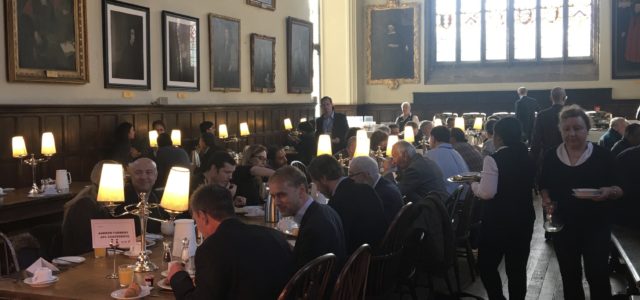
    I just returned from a history-making global conference focused on research and clinical evidence for ketamine for psychiatric disorders. Experts from nearly every continent spoke of their own data and evidence from this emerging field of the the science behind ketamine and the extraordinary help ketamine treatment provides. The entire room was held spellbound for three days, from the first word spoken until the final applause Friday afternoon. It was an unforgettable event in the most beautiful and historic venue at Wadham College, Oxford, UK.  

    A 400-Year-Old Chandelier in a 400-Year-Old Room

    In the 1650’s, a group of individuals including such celebrated thought leaders as Robert Hooke, Robert Boyle, Christopher Wren, and Thomas Willis began an “Experimental Philosophy” club where the fundamental premise required that orthodox thought was rejected and the world was viewed through the “broadened lens of experimental scrutiny.”

    Well, this club became the Royal Society when members of the family of King Charles II got Ketamine for Psychiatric Disorders International Conference 2018involved. When that happened, the revolutionary became the norm.

    It seems only fitting that this international conference on the revolutionary breakthroughs for treating psychiatric disorders should be held in this same building, and on these same grounds.

    Rupert McShane chaired this ground-breaking event. Hats off to him for beginning what we hope will become an annual international conference.

    Luminaries in the Ketamine Adventure

    Gerard Sanacora, a frontline researcher for ketamine treatment in psychiatry, spoke first. He previously served as the lead researcher of the American Psychiatric Association Counsel of Research Taskforce for Novel Biomarkers and Treatments which published a consensus statement about ketamine for this purpose in mid-2017.

    Dr. Sanacora kicked off the conference with an overview of the literature and key studies that have explored ketamine’s mechanism of action in treating psychiatric disorders. It was brilliant!

    We’ve been keeping you informed about some of those in recent times … but there was so much more that was discussed.

    Luminaries all around!  We were graced with Peter Somogyi and David Lodge whose seminal work on NMDA and axoaxonic cells paved the way. Many of the top ketamine researchers and clinicians in the world presented their findings: Colleen Loo, Jennifer Southgate, Nuri Farber, Steve Levine, David Feifel, Declan McLoughlin, Haggai Sharon, Alison McInnes, Samuel Wilkinson, Michael Grunebaum, Elias Dakwar, Rupert McShane, Raquel Bennett, Karen Lascelles, Jeffrey Becker, Ian Anderson, Gordon Fernie, James Stone, Meng Lei, and Dan Iosifescu. Jose Miyar covered regulatory issues. Jonn Donello and Suresh Durgam discussed new breakthrough findings for the mechanism of action of Rapastine, and Jaz Singh presented new data about the safety and efficacy of esketamine.

    And of course, the extraordinary international collaborative teams involved in all of this work … the freshness of perspective emerging across the field — from doe-eyed young researchers to seasoned principal investigators … the breadth and energy of molecular, cellular, neuroimaging, and clinical work represented in the posters.

    Breathtaking doesn’t do it justice.

    We talked about everything ketamine from mice to men … and from chandelier cells (just as gorgeous as the chandeliers King George IV gifted to Wadham College for the Holywell Music Room) to psychotherapy.

    How fitting that we heard about paradigm shifts in the very room where Handel and Haydn first played! Raquel Bennet, Founder of KRIYA Institute, explored the importance of the dissociative experience as transformative, and the many ways ketamine has been used in clinical practice.

    Biologically to induce neuronal plasticity (we talked about this before), as a sort of lubricant  to enhance psychotherapy, and to deliberately induce dissociation … which can be transformative for the patient.

    Jeffrey Becker offered us an elegant unifying hypothesis for ketamine in clinical practice, exploring the GABAergic interneurons and Jungian archetypes in treating people with depression. 

    The depth and breadth of this conference was amazing. The sheer richness of talents in the room, the knowledge and experience gathered into this one place from all over the world. Everyone talked about how much more we need to learn, and the questions that still need to be answered.

    Ketamine for Psychiatric Disorders – Global Conference! Stunning.

    These were basic scientists, principle investigators, neurimaging experts, clinical researchers, psychiatrists, anesthesiologists, Ketamine for Psychiatric Disorders International Conference illuminated ketamine's many therapies.psychologists … it’s astonishing to realize the scope of interest and exploration there is in perfecting this most remarkable treatment to help you get better.

    When you feel depressed, deeply and severely … or when your vigilance and terror from PTSD is tearing apart your family … or when bipolar disorder rips you apart … It can feel like you’re all alone and no one out there cares. You know you don’t know the solutions. So you feel like you’re relying on scientists to figure out the solutions … but … is anyone really trying to help you?

    This is why I tell you about this conference.  This sharing of data, preliminary findings, hypotheses, results… just to show you there are people all around the world who explore the solutions to your pain, and work on solutions for you … and others like you … as feverishly as they can. They care. And they’re dedicated to learning more and more. All to help you.

    As for me, I presented data from my clinical practice. It demonstrates that ketamine can be used to stop suicidal thoughts. And it happens often in a real-world outpatient clinical practice. What’s more, it provides an alternative to hospitalization.

    Someone recently mentioned to me that he predicts the excitement over ketamine will fade away.

    Of course, he’d probably read negative media accounts and had probably missed the science … and all the studies. But I have to say, I wish he and others who share that “doom and gloom” outlook could have been present to hear all the extraordinary work going on with ketamine and related compounds.

    It seems pretty clear to me: ketamine treatment is going to be with us a good while.

    Ketamine Can Make Antidepressants Work Better for Hospitalized Patients

    Declan McLoughlin spoke of his study in Dublin using ketamine to try to prolong remission after ECT. He also explained his work using ketamine as an additional treatment combined with antidepressants for hospitalized patients in Dublin.

    These are just examples. But they don’t even scratch the surface of all the topics covered these three days last week.

    There’s no question that ketamine treatment has a long way to go to reach “mainstream status.” Everyone in the upper echelons of research and practice seems to agree we need to know so much more. The more we learn the more questions arise that we need answers to. But we know so much more than we did even two years ago.

    This is the breakthrough we’ve wished for … depressed and anxious people, suicidal people, Ketamine for Psychiatric Disorders international Conference 2018people wracked with PTSD, or torn by bipolar disorder, trapped by OCD. This is what you’ve yearned for. So have I. Many say this is the greatest breakthrough in fifty years in psychiatry. But we can go further than that.

    This is the best, life-changing breakthrough for people who suffer with psychiatric mood disorders EVER.

    There is so much more to learn…so much! Ketamine is the new frontier in psychiatry and the treatment of psychiatric mood disorders and more.

    Ketamine for Psychiatric Disorders like Substance Use Disorders

    One more story I have to tell you about. Elias Dakwar (we’ve talked about his work) discussed his research with ketamine in treating substance use disorders. You might remember our post on crack cocaine use in February.

    We talked about how Dakwar and his team studied responses of crack cocaine users. Those who were currently using and had no intention of stopping.  When they had been given ketamine infusions the day before being offered either crack or money, they had the motivation to turn and choose money, and their craving was so diminished that they also had the power to turn down crack.

    That brings up something we’ve talked about here: that ketamine restores initiative and motivation.

    All in all, this conference gathering of great scientific minds, young researchers, and brilliant clinicians was a huge step forward for the needs of depressed and anxious people. A huge step forward for the use of ketamine in the treatment of psychiatric disorders.

    Research is ongoing to test ketamine’s use with psychotherapy, ECT, TMS, and traditional antidepressants. Plus, its effectiveness intravenously, intramuscularly, subcutaneously, orally, and intranasally.

    Now we’ve all gone back to our home offices, and our work will continue. And this time next year I hope we’ll see that ketamine’s advantages have taken another big step forward.

    Meanwhile, at Innovative Psychiatry, we’re still here providing IV ketamine treatment. And we see life-changing results with it for people with treatment-resistant depression, bipolar depressionsocial anxiety, bipolar disorderPTSD, OCD, and suicidal thoughts. 

    If you’re suffering from a mood or anxiety disorder, treatment hasn’t helped, I’m sure you’re far more concerned about your desire to feel better and function again, than about a conference. And that’s why we’re here and want to help. We try to offer you the best that the world has to offer. This time from the first International Conference for Ketamine and Related Compounds.

    Call us or schedule an appointment here to be evaluated.

    There is hope. You can feel truly better. 

    So don’t judge your next treatment by the ones you’ve had before. This time, chances are, you’ll see a difference. And you’ll remember how to live again.

    Lori Calabrese, MD offers innovative psychiatric treatment like IV Ketamine

    To your life and the emerging of your best self,

    Lori Calabrese, MD

  • When Your Loved One Plans to Die: How to Prevent Imminent Suicide

    When Your Loved One Plans to Die: How to Prevent Imminent Suicide

    Depressed lady floating in water needs to know ketamine treatment erases suicidal thoughts.

    Suicidal Thoughts…?

    “Nah, she’s not going to kill herself. She’s too afraid of pain.”

    “He’ll never follow through…he just keeps threatening… he’s just looking for attention…”

    …“I’m so shocked he did this.  I had no idea he was thinking about suicide… I feel so bad…”

    If you’re depressed, or you know someone who is, your heart may break when you hear people say things like this. Or…maybe you say these things yourself. 

    Let’s talk about how depression leads to thinking about suicide… and how thinking about suicide may lead to attempting it – or worse dying.

    If you ever think about suicide yourself, I hope this discussion will give you new hope and you’ll reach out for help.

    And if you love someone who thinks about suicide, I hope we can help you help them.

    Suicide is the 10th leading cause of death, according to the National Center for Health Statistics, and it’s rising.  If you love someone who’s depressed, and has spoken of death or wanting to not live, you and your loved one have both suffered from this epidemic.

    The higher the statistics climb, the greater urgency we all feel to find ways to stop these tragedies. But to do it, we must understand how to recognize the signs and help those caught in suicide’s web to break free, and live… really live.

    Clearly this is a multi-faceted quest for everyone in healthcare, as well as families and friends of people at risk.

    So, how do we know that someone near us is at risk..? 

    That in itself is complicated.  Because there are those with suicidal ideation, and there are those who progress from ideation, or thinking about suicide …toWoman in despair needs treatment because ketamine treatment erases suicidal thoughts. doing it. 

    How can we know when someone is thinking about death and suicide…and how can we tell if they’ve moved on to planning to take action…?

    How can you even know who’s really at risk?

    Risk Factors for Depression that Lead to Suicidal Ideation

    If someone has these risk factors in place, you can know they’re at risk for eventually thinking about suicide unless something changes.

    So risk factors signal a possibility of danger for this person within the coming months or years. The danger to their life isn’t imminent at this point. 

    Risk factors for suicidal thoughts include depression, hopelessness, the presence of nearly any psychiatric disorder, and impulsiveness.

    These risk factors certainly herald the likelihood of someone thinking about death and suicide. However, they’re no help in differentiating between someone who just thinks about it, and the person who will follow through. Of course, it’s possible that any person who thinks about death and suicide, who wishes for an escape from their pain, may advance beyond the thinking stage to taking action…tragic action.

    So how do we identify that person?  How can we get them help before it’s too late…?

    Suicidal Ideation vs. Intent

    What’s suicidal ideation? “Ideation” is a weird word, and no one really uses it, to speak of. Except in psychiatry. It means the “formation of ideas or concepts.” So it means that thoughts about suicide begin to form where they didn’t exist before. And over time those thoughts may continue to evolve.

    As they unfold, sometimes they progress to more dangerous ideas and concepts, like how to commit suicide… and even when.  So it’s vital to learn to recognize the difference between when someone you love has passive thoughts of death as a relief (like if I didn’t wake up … was killed in an accident…or had a heart attack, it wouldn’t be a relief), or active and intrusive thoughts about suicide, or has active, increasingly frequent, intrusive thoughts about suicide with a detailed plan or date. Someone who has added purpose and decision to those thoughts.

    As a friend or family member, hearing someone you care about talk about such terrible things can be unsettling… shocking… alarming. But it’s important to recognize these signs, pay attention to them. Give them the credibility they deserve, because shocking or not, they’re real.

    E. David Klonsky and his research team published a review of the recent research about warning signs for someone likely to attempt suicide soon.  These are warning signs in someone who has the risk factors we talked about. Depression, other psychiatric disorders, hopelessness, and impulsiveness.

    This focus is to go a step – or maybe two – deeper. And it’s laid out like this. Does he or she:

    1. Think about death and suicide, or about hurting himself

    2. Seem isolated, withdrawn, disconnected from important relationships

    3. See no purpose or meaning for his life

    4. Seem obsessed with death, and writes about it 

    5. Display sudden changes in his personality, his sleeping patterns, his eating patterns

    6. Use an increased amount of substances

    7. Struggle with guilt feelings

    8. Show loss of interest in academics or work

    9. Exhibit paranoia and irritability

    10. Feel trapped

    Capability for Suicidal Action

    Klonsky makes an important distinction about determining if the suicidal person is in imminent danger of taking deadly action. In addition to the warning signs above, does this person have the capability to take a decisive action to end his life or to end her life, such as: 
    • High tolerance for pain

    • Diminished fear of pain

    • Increased fearlessness about pain

    • Persistence through pain and distress

    • Knowledge of and access to a lethal means of committing suicide

    • Experience with self-inflicted injury

    Pay attention, because this is huge. These traits and features, when paired with all the other risk factors we’ve talked about, indicate not only the serious warning of imminent deadly action, but also the capability to follow through. This is the person who sees no reason to live and is equipped to end his life when he decides to. Within minutes. Or hours. Or possibly days.

    Now is the time to intervene.

    But…how?

    Start with calling 911 if the situation calls for it.

    If calling 911 seems like an over reaction, think about the items on the lists above. If he seems isolated, withdrawn, if she seems disconnected from important relationships, step up and engage them in conversation. Look for ways to connect with him, show him he’s loved and that he matters.

    If he has access to a method for ending his life, find ways to remove items that he might think of using. Reduce his capability.

    At the very least, encourage him to get help. Immediately. And encourage him to not give up. If needed, encourage him to allow himself to be treated through admission to a psychiatric hospital unit to help him stay safe and stabilize on treatment.

    As long as he stays alive there is hope.

    So let’s talk more about that hope.

    But first… there’s another element you might need to consider.

    Rethink Your Trite Empty Words

    What do you say to him once you intervene?  What hope can you offer?  If she’s been depressed, tormented, troubled…even agitated…for a long time, you’ve probably told her before that this situation will pass.  That their symptoms will eventually subside. That life is worth living.

    He may not believe that at all anymore. At this point he may have become resigned to the belief that there is just no hope.This young man contemplates jumping and needs to know IV Ketamine treatment erases suicidal thoughts.

    And quite honestly…for some there really was NO HOPE. They couldn’t see it.

    But the horizon for people who battle severe depression, intractable bipolar disorder, crippling PTSD, and terrifying panic disorder… has changed.  There is new hope now.

    IV Ketamine Prevents Imminent Suicide

    IV ketamine treatment erases suicidal thoughts. Now that’s some HOPE for you!  It’s a 50-year-old anesthesia medicine that has all kinds of history in operating rooms, war zones, and emergency rooms around the world. This remarkable medication still hasn’t tapped all its talents.

    In the last 15 years it’s been at the center of great victories and outstanding therapy for treating psychiatric mood and anxiety disorders in all ages. By applying different actions in the brain, it rejuvenates and restores synapse connections throughout the brain and helps rebuild the very structure of brain cells themselves — called dendrites and dendritic spines — prolifically branching a dense communication system between nerve cells to turbo boost the signals that make the brain function and come alive.

    For children with the Fear of Harm form of Bipolar Disorder, ketamine treatment has dramatically reduced symptoms and allowed these children to feel joy, happiness, love. To have the ability to do their homework and contribute at school without torment. Some of these children feel happiness and joy for the first time with the help of ketamine. It’s like a child who’s been blind seeing for the first time.

    In men and women with PTSD, it has calmed the fear, restored peace, balance, and in enjoyment in life.

    For those deeply depressed, it has restored their energy, creativity, initiative, and hope.

    And for those with suicidal thoughts or imminent suicidal plans, it has erased suicidal thinking fast. In minutes or a few short hours. Once those thoughts disappear, treatment can proceed to relieve depression.

    No medication has been shown to erase suicidal ideation in less than 4 hours.  Well, nothing except IV ketamine. IV ketamine prevents imminent suicide so you can pause, catch your breath, and work on treatment and recovery.

    IV ketamine stops suicidal thoughts.

    When you help your loved one stop suicidal thoughts, there’s hope for relieving the depression, too. If he’s been taking ketamine erases suicidal thoughtsantidepressants that haven’t helped, he’s likely a candidate for IV ketamine treatment.

    No longer do you have to say, “It’s going to get better someday, I promise…somehow…”

    You can say, “Dr. Calabrese has advanced treatment options. You’re going to feel so much better very soon.

    And what about you?

    Suicidal Thoughts vs. Intent to Act

    Do you have thoughts about death…suicidal thoughts… or even a strong plan for suicide?

    Do you think about death, or about yourself dying…?

    These thoughts…these images… are a sign of severe depression and your need for treatment.

    IV ketamine treatment provides relief, restoration, and relaxation for 80% of patients with treatment-resistant depression at Innovative Psychiatry. We see it every day.

    We know that the literature speaks of 70-75% positive outcomes with IV ketamine treatment. But keep in mind those are studies conducted to learn about ketamine using strict protocols. Research protocols don’t allow for the many adjustments we make to fit your need like we can as your doctor.

    Our goal is to achieve the best outcome for each patient — taking into account all of the complexity that comes with your history, your biology, and your previous treatments. And we’ve learned that some patients need varied adjustments in dose, or perhaps a slightly longer infusion time or longer infusion series in order to achieve remission. For these reasons, some private practices are able to achieve better outcomes than larger published studies. We consistently see excellent outcomes, relief, restoration, and enjoyment of life in 80% of our patients, even when nothing else has worked.

    There are the naysayers.

    Who believe IV ketamine treatment is a “passing fad” or has too many “side effects.” (There is no weight gain, no sexual problems — or other side effects antidepressants are known for.) That we should wait. That it hasn’t been studied enough. And some who say that using it is premature.

    Here’s what’s premature: dying before your time.This happy lady in the snow knows that ketamine treatment erases suicidal thoughts.

    IV Ketamine Treatment – A New Frontier

    IV ketamine treatment is a new frontier in psychiatric treatment.

    We’re also learning that some of the 20% who aren’t helped immediately by ketamine treatment can get better over time. Weeks or months later, ketamine seems to take hold and they emerge better than ever.  We have some theories working as to why that happens.

    So there’s still so much to learn, and that’s why it’s important that you communicate with us during and long after your infusion treatments are over, so we know how you’re doing. It helps us learn more about how IV ketamine treatment works for you. We offer state-of-the-art daily mood monitoring tools to make it easy. To keep you well. So you feel safe. And connected. 

    If you experience visual images of death or of yourself dying, if you think about it, if you find yourself planning it…there is hope, and a way out without harming yourself. Hang on. Find safety. And call us.

    IV ketamine treatment can give you relief and erase those thoughts from your mind. You can have an opportunity to redirect your life and your treatment.

    We offer innovative treatment options for those with treatment-resistant mood and anxiety disorders like depression, panic disorder, bipolar disorder, PTSD, social anxiety, and OCD. If you’d like to see if IV ketamine treatment can pull you up out of despair, schedule an appointment and let’s work together to help you get better.

    We’re eager to work with you and your doctors to help you achieve a healthy, balanced, restored life, and the desire to live it. 

    To the healing of your best self in 2018,

    Lori Calabrese, MD offers innovative psychiatric treatment like IV Ketamine


    signature of Lori Calabrese, M.D.


    Lori Calabrese, M.D.

  • IV Ketamine Treatment for the Saddest Day of the Year…?   Maybe so, if it’s SAD – Seasonal Affective Disorder Treatment

    IV Ketamine Treatment for the Saddest Day of the Year…? Maybe so, if it’s SAD – Seasonal Affective Disorder Treatment

    Seasonal Affective Disorder Treatment is available in IV ketamine treatment.So maybe you’ve heard of Blue Monday…?  January 15, the saddest day of the year. This 13 year old hoax needs a little straightening out. See if you agree. Blue Monday? What does that have to do with psychiatry?

    Pretty much nothing … but let me explain.

    In 2005, a guy named Dr. Cliff Arnall in Wales devised a formula for determining the single saddest, most depressing day of the year.

    Was he a neurologist? No. A psychiatrist? Not even close.

    He was actually working to help a travel agency determine the most likely day that people would book a tropical holiday. The “psychology” behind it measured up to this: When you feel the worst, you want to escape. Get away. So what’s the next best thing…? A vacation on the beach! Once you’ve set up the get-away, you have something to look forward to, and you feel excited about it, and life gets easier. At least that’s the theory.

    The “Gloominess” Calculation

    And what did he base his calculations on to determine when you’ll feel the worst?

    Of course, it had to land on a Monday…who likes Mondays..?  Plus, it had to be after the long stretch of holiday excitement from Thanksgiving, Christmas, and New Years was past.

    And it needed to be far enough past Christmas shopping that you’d have received the bills and wish you’d spent less. And far enough past January 1st to have broken your New Year’s resolutions.

    Then…add to that the gloomy winter weather, the overcast skies… remember he didn’t live in Southern California, but in Wales…the cold and snow and rain, and the short days and long nights at that time of year.

    seasonal affective disorder treatment

    So in Arnall’s equation to the right, W=weather, D=debt, d=monthly salary, T=time since Christmas, Q=time since failing new year’s resolutions, M=low motivational levels and Na=the feeling for a need to take action.

    Now, rather than taking the time to disprove his equation, let’s just be real. Arnall was quite pleased that he was paid for his clever equation, which earned him 1650 British Pounds, or about $2265.93 in US dollars. A drop in the bucket compared to the revenue gained by the travel agency who hired him. For them, it was a great ROI.

    Internet Advertising … Is It Always True?

    But the fact is, there is no truth to the idea that January 15 is the saddest day of the year. Just as there is no truth to Audi’s “Truth in Engineering” slogan, since we all know they cheated on the emissions tests with about half a million cars. Not as truthful as they claim, are they?

    Audi’s slogan is part of a PR marketing campaign intended to sell cars, and Arnall’s formula was part of a PR campaign intended to drive business to a travel agency. Neither one was a scam, but rather a marketing gimmick.

    And the fact remains, he just made it up!

    There is NO saddest day of the year. And if this time of the year is hard for you, that may be a seasonal problem. And we can help with treatment, if you need it.

    So, my suggestion is that social media participants stop aiding and abetting this 2005 advertising gimmick, so that we can talk about things like sadness, moodiness, and depression in real and helpful ways.

    Sound good?

    SAD – Seasonal Affective Disorder Treatment

    This time of year can be difficult for those who are sensitive to light, or the lack of it. While some are unaffected by these short, overcast days, you may be one who is deeply affected by the cloud cover, the cold, the gloominess…SAD Seasonal Affective Disorder Treatment IV ketamine treatment beats SAD.

    And if that happens, it’s great to do something to brighten your mood. Go to a movie, or get your hair done, maybe shop for a new shirt. If that helps you feel a lighter mood, then you’ve accomplished a worthwhile goal.

    Some people know that this mood slide begins early in the fall, every year. And you might find that light therapy helps. The idea is to use a 10,000 LUX light box or lamp for about 30 minutes very early in the morning to replace the light you’re missing in your environment. There are some variables to this depending on you, related to how far the light is placed from your eyes, and how much you can tolerate the brightness.

    One of the ways around this to to use a visor with a 10K lux light on the inner brim.  They are so versatile and easy to wear that you can walk around, make a cup of coffee, make the bed, get ready for your day, all while wearing the visor.  You’re not stuck sitting still in front of a light on a table.

    For some people this can really help. For others with seasonal affective disorder (SAD), even light therapy might not be enough. SAD is also called winter depression and it can occur episodically, just when fall strikes, and last through spring. Sometimes, people who have depression chronically or who have frequent episodes always seem to have a seasonal exacerbation — a winter worsening. And an antidepressant along with light therapy may bring you relief.

    However, some people suffer so severely from depression when it occurs as seasonal affective disorder, winter after winter, that they have periods when they can’t function at all.  And just like any form of severe depression, seasonal affective disorder can be crippling, even devastating.

    Where you’re too sluggish to function, and you feel hopeless, helpless, fatigued, and gloomy. And gloominess advances to despondency… Despondency may even progress to thoughts of ending your life.

    If this sounds familiar…if you’re feeling this way and having thoughts you haven’t admitted to anyone yet, there is hope.

    In fact, there’s more than HOPE. There’s a SOLUTION.

    IV Ketamine Treatment Beats SAD – Seasonal Affective Disorder

    Until the last several years, only a third of depressed patients were helped by antidepressants. Which has been wonderful for those patients, but what about those who didn’t improve?

    Well for those, another 1/3 felt some improvement with a second try using another antidepressant, or a combination of medications.

    And for those who did find help, life had hope again. They could return to work, resume their lives and relationships.

    But what about the 1/3 who were left in the pits of depression and despair…?  What about them?Woman relaxed by fire due to IV ketamine treatment beats SAD seasonal affective disorder.

    There’s now another form of treatment for severe depression, and it is as effective for severe seasonal affective disorder, or severe winter depression, as it is for depression any time of the year. It’s called IV ketamine treatment, and it’s not just 33% effective. IV ketamine treatment is effective in treating 80% of treatment-resistant cases of depression at Innovative Psychiatry in South Windsor, CT.

    That means that if you’ve tried medications and treatments that haven’t helped, you may be a good candidate for IV ketamine treatment.

    IV Ketamine Treatment Operates Like a S.W.A.T. Team Against Depression

    Ketamine acts on different aspects of the brain than traditional antidepressants. Rather than affecting serotonin or dopamine receptors, it works on rebuilding the synapse branches that connect nerve cells in the brain to each other. 

    Let’s pretend you’re in the old west. And you need to get a message to your family in Boston that you’ve arrived safely in San Francisco. You want to send a message by telegraph. So you go to the telegraph office, and they tell you that the lines have gone down between San Francisco and Boston due to tornadoes and fires. There’s no connection.

    And you can’t reach anyone until all those lines are repaired.

    IV Ketamine Treatment at Work

    The synapse connections from signaling cells to more signaling cells in your brain have been broken down, weakened, or destroyed by the stress of depression. This is what depression does to your brain, and these connections have to be repaired and restored so you can get the information signals moving fast around your brain. When that happens, you’ll feel upbeat again.

    IV ketamine treatment helps clear away the old broken branches, called dendrites and dendritic spines, to make way for new ones. Then it goes to work fast to rebuild new healthy, resilient connections that proliferate throughout your brain. 

    The result? Your sad, dark, depressed brain comes alive and lights up like Times Square on New Year’s Eve!

    All that activity and signaling lightens your mood brighter and brighter, restores your motivation, your hope, your energy, and your IV Ketamine treatment beats SAD seasonal affective disorder.creativity…and you feel better.  So much better, it may be the best you ever remember feeling.

    IV ketamine treatment also stimulates mRNA to switch on DNA to turbo boost brain-derived-neurotrophic-factors (BDNA). BDNA is like a rich compost in the brain that helps to stimulate prolific and rampant growth of dendrites and dendritic spines in the synapse connections.

    Another of ketamine’s talents involves moving lazy G proteins off their lipid rafts and back to work to enhance the signaling communication.

    Now let’s be clear…IV ketamine treatment isn’t for everyone. But more than likely, it’s just what you need to recover, to find your best self again, and to revel in your life.

    So don’t let the gloominess of the skies at this time of year drain your hope. At Innovative Psychiatry, we’re innovative and we offer solutions — even more than we’ve talked about here.

    If your winters are too hard to bear, call us. Let’s talk about options that just may be available for you.  And you can dance on your way to work, and twinkle about the joy of building a warm fire to sit by when you get home at the end of the day.

    Winter can be about popcorn, hot chocolate, fuzzy sweaters, and crackling fires. Discover how you can enjoy the beauty of winter through advanced treatment options like IV ketamine treatment

    There’s hope for your winters.

    Lori Calabrese, MD offers innovative psychiatric treatment like IV KetamineTo the liberation of your best self,

    Lori Calabrese, MD

  • 2018: Neuroscience Breakthroughs like IV Ketamine Treatment Mean Breakthroughs for YOU

    2018: Neuroscience Breakthroughs like IV Ketamine Treatment Mean Breakthroughs for YOU

    Neuroscience breakthroughs with IV ketamine treatment make the future look bright. Neuroscience breakthroughs like…IV ketamine treatment..?

    Exactly.

    2018 lies before us, like a valley that spreads to the horizon. And while it’s impossible to access the future, you can move forward knowing that each “today” you live has promise that was unheard of until recently.

    Especially if you suffer from untreated or treatment-resistant depression, anxiety, bipolar disorder, PTSD, or anxietysocial anxietyOCD or phobias.

    Neuroscience researchers have been discovering more and more about treating psychiatric mood disorders that has transformed our approach to treatment — and the outcomes, as well. 

    The 21st century breakthrough of IV ketamine treatment for depression is transforming psychiatric medicine. Studying the effects of this treatment has revealed that depression and other mood disorders wear away at the signaling structures in the brain, leaving synapses, dendrites and dendritic spines broken, weakened, and sparse.

    Neuroscience breakthroughs like IV ketamine treatment can bring breakthroughs to you … to your life.

    The clearing away of those broken down structures, and the rebuilding of new ones in a denser, more prolific, forestation turns out to be key to treating depression. The old theory that depression was caused by levels of serotonin or dopamine that were too low … well they’re ancient history now.

    Neuroscience Breakthroughs like IV Ketamine Treatment means Breakthroughs for You

    Actually, so far we know of four ways ketamine clears away depression and erases suicidal thinking so quickly. And we’re watching Neuroscience breakthroughs with IV ketamine treatment mean breakthroughs for you.with anticipation to see if research this year will reveal even more.

    So another intervention ketamine performs is related to the G proteins that are piled on lipid rafts in the cell membranes of the neuron cells in the brain.  Depressed people have these G proteins piled up on lipid rafts, where they can’t do their job to enhance signaling from synapse to synapse.

    For those who are helped by traditional antidepressants, it takes several hours for those G proteins to slide off the rafts and become productive.

    This is one reason it takes so long for traditional antidepressants to work for those they help. But when ketamine is given, they slide off the rafts within minutes. Remarkable. 

    Yet another healing action of ketamine is its effect on DNA. Turns out it also switches on mRNA which in turn flips the DNA switch to “ON” and that fire hoses BDNF across the synapse network.

    BDNF is a growth factor like the richest of composts, and it empowers the dendrites and dendritic spines to burst into blooming branches like a giant oak tree.  When the BDNF is fueled by ketamine, it turbo boosts that prolific branching of synapse structures, and your brain lights up like New York City. Unprecedented.

    A well-lit brain is a happy brain.

    Quoting from our earlier post entitled, “Breaking News: Another Way IV Ketamine Smashes Depression,”Neuroscience breakthroughs like IV ketamine treatment mean breakthroughs for you.

    As new synaptic connections are built, and greater communication between brain cells develops, the brain gains the ability to see things in a different perspective, and your outlook becomes brighter and healthier.

    IV ketamine can jump start that process. Wait. No. It can turbo-charge it.

    Extraordinary.

    And the fourth action IV ketamine treatment performs is increasing glutamate levels to equip synapses to send more and faster signals across the brain, which traditional antidepressants don’t touch. Brilliant.

    APA Task Force Issued a Consensus Statement in May 2017

    What a year it’s been!

    Four actions of ketamine we know about so far. The outcome is so extraordinary, so successful in such a large number of treatment-resistant cases, the American Psychiatry Association assigned a task force to issue a statement about the use of ketamine, this anesthesia medicine, off-label for treating depression.

    Their statement was one of the most momentous and widely read articles of the year. In fact, it’s listed as #3 on JAMA Psychiatry’s “Most Talked About Articles of 2017.” Suffice it to say that those who were on the task force are true experts in our field. They’d seen ketamine’s power to lift depression right out of the water.

    So they offered guidelines and cautions, and expressed theirNeuroscience breakthroughs like IV ketamine mean breakthroughs for you. elation when interviewed that such a thing has happened in their lifetime.

    They also specify that ketamine should be administered under a psychiatrist’s supervision.

    TheHealthSite.com featured a list of the 6 best medical achievements of 2017 that everyone should know about…. Ketamine for depression stood strong on that list.

    Of course, we know ketamine’s discovery didn’t happen this year.  Many years of studies and clinical trials laid the groundwork for ketamine’s popularity now.

    Thousands of patients have experienced the relief, the return of joy, initiative, creativity, and energy without side effects that ketamine provides.

    Never before has there been such a medicine that treats so many disorders in such a huge percentage of the population as ketamine.

    Ketamine has delivered HOPE.

    At Innovative Psychiatry, we see 80% of patients who’ve suffered for years with treatment-resistant depression, crippling panic attacks, suicidal thoughts that won’t stop, severe bipolar disorder, PTSD, social anxiety, and OCD experience relief, restoration, and relaxation after treatment.

    Another neuroscience breakthrough that means breakthroughs for you is Transcranial Magnetic Stimulation or TMS. It uses a coil to create a focused magnetic field over the front left side of your head. Specifically the left dorsolateral prefrontal cortex region.

    Then it sends tiny repetitive pulses deep into the brain to the emotion-regulation region. This stimulates the nerve cells and wakes them up. When they wake up, they begin to function again and give you better emotional regulation and function.

    With TMS treatment, you sit quietly for anywhere from 16 to 37 minutes, five days a week for 6-8 weeks. About halfway through the series of treatments, depression begins to lift, and you begin to feel better and better. Again, faster than Neuroscience breakthroughs like IV ketamine treatment mean breakthroughs for you.traditional antidepressants, and without any of the weight gain, sexual dysfunction, fatigue, or GI side effects they can cause.

    The sophisticated technology of TMS continues to develop. Even 5 years ago TMS seemed experimental and wasn’t widely available. But, like ketamine,TMS built a strong reputation for effectiveness. 

    In general terms, clinicians and hospitals report 60-75% success with TMS around the US. We see 75% of our patients consistently respond — and often remit — at Innovative Psychiatry. 

    Again, HOPE.

    Curcumin has gained an ever stronger reputation for its use as an adjunct in treating depression. Plus the connection between the brain, mood, and the strengthening of the microbiome is growing and gives us more and more opportunities to work with your diet and lifestyle to improve your mood.

    No known treatment lifts depression, anxiety, bipolar disorder, PTSD, or OCD in 100% of cases at this point. But these innovative treatment options prove successful for 75 – 80% of people who suffer in spite of traditional treatments. Obviously, hope soars for you if suffer with depression.

    If you suffer from suicidal thoughtsdepression, bipolar disorder, PTSD, social anxiety, OCD, you can feel better. The age of despair for sufferers is quickly dissipating. This has never been the case before. You really can feel better….lots better….as in really good.

    If you’d like to start 2018 on a brighter, fuller, more functional, and happy path, call us. We live one day at a time, because “now” is all we really have. But live well. Live as the best you you can be.

    Lori Calabrese, MD offers innovative psychiatric treatment like IV KetamineTo your very best self in 2018,

    Lori Calabrese, MD

  • Can Inflammation Cause Suicide? What Can We Do to Stop It?

    Can Inflammation Cause Suicide? What Can We Do to Stop It?

    Can inflammation cause suicide?

    Really?? Can Inflammation Cause Suicide…?  Or Suicidal Thoughts?

    Maybe you’ve just reached the end of your rope. The long dark days, the despair of watching everything always go wrong, the deterioration of your relationships, the exhaustion and inability to think well enough to do your job…and that feeling that you despise yourself. Loss of self-respect was the final straw.

    It all culminates in a dark, rumbling thunder cloud in your mind. And every day you wake up you feel angry that you’re still alive. You prayed last night that you wouldn’t wake up, that you’d finally be released from this horrid existence.

    Depression can come for lots of reasons, or it can come for no reason at all.  If you’ve endured the long dark halls of major depression, tried one medication after another and have never gotten better … if you’ve worked with more than one psychiatrist without any benefit…

    Maybe you’ve just reached the end of your rope.

    Where Does Suicidal Thinking Come From?

    Do you ever wonder why you sometimes feel like you want to stop living when you’re depressed?  Why some people never have a thought like that…but you do?  What causes suicidal thinking anyway? 
    Can inflammation cause suicide? Young man sits on train tracks.

    We’ve all assumed it was just the way one person responds to terrible, heart-breaking depression versus another. That people are different and respond to things differently.

    New Discovery About Suicidal Thinking

    But, there’s some new information about major depression, and especially the suicidal thinking that sometimes goes with it. Researchers in the UK have discovered a link between inflammation in the brain and the presence of suicidal thinking and intent.

    Dr. Peter Talbot and his team at the University of Manchester found that there is a marker that’s increased in the brain of depressed patients who were contemplating suicide. It turns out this microglial activation marker is a sign of inflammation, and was only elevated  in depressed patients with suicidal thoughts — not in depressed patients who weren’t suicidal.

    They found the most dramatic elevation in the anterior cingulate cortex through brain imaging. This part of the brain is where mood regulation happens, and many of us think it could be the focal point where depression starts.

    In the past, the closest researchers had come to detecting this connection was by studying tissue samples from deceased patients. But this is Can inflammation cause suicide?the first time that elevations of this microglial marker have been identified in severely depressed patients who were alive and able to talk about the severity and the torment of their suicidal thoughts.  And this inflammatory marker is specifically a marker for suicidal thinking in depression — not for depression itself.

    So Now What?

    Now, you may wonder … so what? What we can do with this information??

    Well, for one thing it helps a lot to think that in some cases, specifically those depressed patients who are thinking about suicide, we might be able to find anti-inflammatory treatments that may actually help their suicidal thinking.

    Does this mean we’ll start prescribing two Advil for suicidal patients, with instructions to call us in the morning….?

    No. Of course not.

    Still, this is a first step along the path of research to help us provide more individualized and personalized care for our patients.

    … It may turn out that … targeting inflammatory pathways and the release of inflammatory factors in the brain — on the other side of the blood-brain barrier — may help to manage suicidal thoughts in depressed patients … It may turn out that bioavailable curcumin, a potent natural anti-inflammatory that easily crosses into the brain, will become an even more critical supplement for us to study and to offer to our patients who are depressed … and suicidal.

    Long story short, the human brain is medicine’s last frontier.

    The complexities of the neurons, their connections, the vast array of chemical reactions that lead to signals that zoom around to create your feelings of love, joy, anger, sorrow – and depression – and the physical structures that determine your cognition and your mood, are the focus of extensive research among neuroscientists around the world.

    The more we learn through the research of neuroscientists, the clearer our path can become treating certain patients. Because it all comes down to the fact that no two brains are alike. We’re each unique, and the response of our brains and personalities to our individual circumstances and genetic makeup varies.

    So, for those patients who are deeply depressed and are thinking about ending their lives … following the path of investigating their level of brain cell Can inflammation cause suicide? Standing on ledge about to jump.inflammation may soon be a viable part of an overall treatment plan.

    At the same time, as a result of explosive research, we’ve found that ketamine treatment has an extraordinary effect on suicidal thinking. And… we can treat that in those with treatment-resistant depression right now.

    We know, and have seen in hundreds of cases, that IV ketamine stops suicidal thinking in 80% of treatment-resistant suicidal patients. And it can do it within 4 hours — and often in just the first hour. For most people who suffer from severe depression and torturous suicidal thinking, IV ketamine is a treatment that can give them emergency relief. It will allow them to just go home … have dinner … go to bed like anyone else … and wake up refreshed. And alive.

    And for many, it will continue to help them feel better, think more clearly, and process their emotions. In fact, process them so well that they can invest in therapy to change the way they respond to life’s events and build a healthy, better life for the long term.

    For that 20% who aren’t helped by ketamine, it’s great news that research is breaking through more mysteries. Because treating suicidal struggles in depressed patients is a life or death matter.

    If you can relate to this concept of suicidal thinking, and if your thoughts head in this direction at times, call us. We can arrange an appointment to discuss whether you’re a candidate for ketamine treatment.

    We can help you get your life on the path you want it to be.

    To the restoration and health of your best self,

    Lori Calabrese, M.D.

    Lori Calabrese, MD offers innovative psychiatric treatment like IV Ketamine

  • Suicidal Thoughts Children Have – What Can Parents Do?

    Suicidal Thoughts Children Have – What Can Parents Do?

    Depressed boy may just seem bored to parents. Suicidal thoughts children have can be addressed and treated.The Beauty of a Fresh Young Mind

    Your child is born beautiful, both fragile and strong at the same time, with all your hopes and dreams for her waiting to be fulfilled.

    She bursts through infancy, preschool, then her first few grades, and you discover she’s not an empty canvas waiting for you to paint…she’s an individual. Her views catch you by surprise, her reactions are different than yours would be.  And little by little it dawns on you she’s actually a separate and unique person in her own right… And you learn to observe, support, and guide. 

    But then, along the way, you notice traits that also trouble you. She’s your precious child, and you want her to enjoy her childhood, her school activities, her friends. But, she seems less and less like the toddler and Mom enjoying newborn can't predict the suicidal thoughts children have, but by nurturing her as she grows she'll be there to help.preschooler you knew her to be. 

    She’s sad, irritable, agitated at times.

    By the time she’s 13, she’s talking about wanting to die. (And you think, this isn’t typical… is it?) Thirteen years old… and mentions death not just once… but often. She is treated with correction at school much more than she used to, and seems to swing from glee to sorrow to desperation… the correction from teachers baffles and grieves her. Your daughter feels persecuted, and doesn’t understand. She cries that she wants to die… You wonder what on earth is going on…? What are these suicidal thoughts she has?

    Why Would a Child Want to Die…?

    A 10 year-old-boy reaches out to his parents, weeping, crying out that he wants to die. When they tell him things will get better, he says that they always say that.  That he’s given up hope…  at 10.

    This wasn’t the impulsive thought of a pubescent teenager, but a child who can’t remember a time he wasn’t suffering in emotional pain. That boy later attempts suicide the first time at 14. Again, not impulsively…he’s been suffering for years…  Suicidal thoughts in children. Heartbreaking… and dangerous.

    Suicide in children under 12 is rare….about 4 per 500,000 a year… at least that’s what statistics say. That figure’s doubled since 1979, and recently was listed as the 14th leading cause of death in children under 12. Just under meningitis and anemia.

    If kids under 12 struggle with depression and other mood disorders, and even think about wanting to die, why is the rate of suicide so low among this age?

    It’s not because it doesn’t happen. No… it’s because it happens differently.

    For instance, one reason is supervision. This age is typically supervised by a parent or teacher. So they’re more often interrupted. And most parents are reluctant to report these cases.

    Children are Spontaneous

    Another point is that traditional suicide in teenagers and adults starts with a thought, then grows into a plan, then Worried dad... suicidal thoughts in children - what can parents do?proceeds to action. On the other hand, suicide in children is typically spontaneous, rather than planned. Like a child overwhelmed from school might jump in front of traffic, and it’s labeled an accident. Or a frustrated third grader “falls” from an apartment window after wrestling with his brother. Again, it looks like an accident. Or a 5 year-old jumps in a pool…then inhaleson purpose. Again, an accident.

    Bottom line, adults often miss depression or anxiety disorders in a young child. Exceptionally tuned-in parents may notice the changes in their child, but may not know what to do to help. It’s a phase… they think. He’s a child.  He’ll snap out of it.   

    But years go by. And “wanting to die” just keeps coming up.

    Persistent Sorrow May Be a Sign

    An 11-year -old cries herself to sleep night after night…praying she’ll die before she wakes in the morning. But Suicidal thoughts in children, -what can parents do?morning after morning, she wakes up as usual. And each time she’s disappointed, because life is so full of pain for her. She can’t remember when she wasn’t drowning in sorrow, emptiness, isolation.

    She always dove into her school work to distract herself from the constant inner ache. The sense of futility. But eventually, she just got tired.  Tired of trying so hard, tired of fighting constantly for relief. It all seemed so hopeless. Pointless.

    One night, her mom walks into her room to kiss her goodnight, and finds her with a bottle of Tylenol dumped in front of her on the bed, and a tall glass of water in her hand.

    Her mom had no idea she felt suicidal…

    When you’re faced with suicidal thoughts in children what do you do…?

    You Feel So Helpless…

    Turns out teenaged girls are twice as likely to be diagnosed with a mood disorder as boys. And boys are also far too often affected by the pain and listlessness that saps their desire to live. The agitation some depressed kids feel often leads to disruption in class, and the child is punished. Which further reduces their hope as well as their self respect.

    What do you do? Tighten the discipline…?  Then tighten the structure…? Plus, tighten her accountability…?? Unfortunately, all too often what appears to be a discipline problem in a child at school is more accurately a psychiatric mood problem. Not that discipline and structure aren’t good for children. They are. But an ill child may not have the energy to respond as you’d wish…

    If the child is depressed, correction and punishment can just drive him further into himself, reducing anySuicidal thoughts in children - What can parents do? hope or self-respect he might have had. If he has another behavior disorder, he likely doesn’t understand what drives him, and just may feel baffled by the punishment, and more hopeless.

    Parents Try So Hard to Help

    The most well-meaning parents can be completely caught off-guard by a psychiatric mood disorder in their child. Their best efforts to help by encouraging new interests and social activities can be misdirected if the child is depressed, or suffering from an anxiety disorder, that drains her energy.

    No matter how closely they may work with the psychiatrist to try new medications, therapies, hospitalizations, exercise and diet changes, if the problem in the child’s brain is not related so much to school and friends and junk food but rather to structural changes in certain parts of the brain, traditional efforts aren’t going to help.  And everyone becomes discouraged…and exhausted.

    For parents, to know your child is wishing to die… month after month, year after year… and that all your best efforts make no difference… can leave you feeling defeated, but never willing to give up the fight.

    And, if you’ve fought for your child’s life for years, and you hear about a treatment that’s bringing relief to others within hours, your instincts leap at the opportunity to save your child.

    So you learn all you can about this treatment.

    Suicidal Thoughts Children Have – What Can Parents Do?

    Suicidal thoughts in children What can parents do? Your research shows you there are skeptics, professors and scientists who say there are reasons to wait and see if this remarkable treatment is safe, but you learn of those who have been almost miraculously released from their symptoms, you want to try it.  You reach for hope.

    You say to yourself, the risks of unknown potential side effects that might show up decades later, compared to saving my child’s life right now, is a no-brainer. Our child may not live till next month… !

    We’ll take this as it comes, and help her to get her life back now.

    If you’ve ever lived with a suicidal loved one, you know how very real this comparison is. Your instinct says, “Ok, so what if we wait 20 years when researchers know more…?  She won’t be alive when that time comes. Let’s give her the time we can.”

    That’s the story of those who’ve desperately needed a remedy for their child’s psychiatric mood disorder.  Who have almost resigned to accepting their child will die from suicide.

    WHAT can be done?

    The New Story of Ketamine Treatment

    Ketamine treatment is presenting itself as the psychiatric hero for mood disorders. A drug that’s been used in anesthesia for humans and animals for 50 years is showing itself to remarkably restore the lives of those disabled by mood disorders.

    A drug that’s been heavily abused on the streets, under the name Special K.  Like so many medications that are a Suicidal thoughts in children - what can parents do?great help to those who need them, and receive them under medically-supervised conditions, ketamine is abused by people “just looking for a good time.”

    Sadly, there are rare and serious long-term side effects that have occurred with illegal, heavy ketamine abuse on the street. Things like severe bladder pain that have sometimes required the removal of the bladder, for instance. But, keep in mind the doses that people have used illegally to get to this point are massive … each one on the order of 10 times or more the dosage used in anesthesia, over years.  And the dose used in psychiatry is miniscule in comparison.  We call it a fairy dust fraction. 

    Ketamine Treatment – To Be Provided Only Under Close Medical Supervision

    Under medically-supervised conditions, ketamine treatment has proven to be a safe medication for decades in children and adults. Children and adults have responded well to it in ERs and ORs throughout the country for decades.

    The uncertainty lies in the fact that, as an anesthetic, it’s not been used repeatedly in many patients over a period of years, so there is limited information about whether there might be long-term negative side effects.

    But, as a psychiatric treatment for depression, anxiety, and other mood disorders, IV ketamine treatment is being used now with wonderful results. While it’s true that a single dose of ketamine may not last very long, a short series of infusions often brings about a complete remission of symptoms. In our practice, with our customized treatment protocols, fewer than 20% of our patients need to return for follow-up or maintenance infusions.

    And while these carefully supervised infusions are rather expensive, most parents say that the investment is less than the cost of antidepressants over years…that haven’t worked…not to mention the value of watching their child bloom.

    Suicidal Thoughts Children Have Can Be Dissipated by Ketamine Treatment …in Minutes

    Plus, a remarkable and separate action of IV ketamine, is that it erases suicidal thinking within 4 hours, and often Suicidal thoughts children have leave parents baffled about what to do.in minutes.

    So it not only removes the danger of suicide, but also gives your child back her joy for life. The power to enjoy experiences. Plus, initiative to work through therapy to strengthen her thinking patterns for productive living. And, the hope to plan for and work toward the future.

    Yale Psychiatrist Touts Ketamine Treatment in Children

    Jack Turban MD, a child and adolescent resident psychiatrist at MGH/Harvard Medical School, recently published an article where he shared his observations of a group of adolescents during and after their IV ketamine infusions for psychiatric mood disorders. After their infusions, he remarked:

    “I could see the weight of depression lifted from these patients within hours. Adolescents who were previously ready to end theirTeen girl relaxed and at ease after IV ketamine. Suicidal thoughts children have can be quickly stopped by IV ketamine.. own lives became bright and hopeful. Psychiatry has never seen a drug intervention so powerful and fast acting. While most anti-depressants take weeks to work and offer modest improvement, ketamine offers dramatic improvement in less than a day.”

    Dr. Turban went on to express his concern that some doctors are using less discretion with ketamine treatment —  in fact, he questioned their ethics. He described doctors who were sending large amounts of the drug home with patients, to give themselves injections at home. This puts the patient in jeopardy of side effects or a situation that can’t be handled at home. He also spoke of lollipops for children, and the danger of addiction under such uncontrolled use.

    Dr. Turban quoted Jennifer Dwyer, MD PhD at the the Child Study Center at Yale, who said,

    “Ketamine should only be given under careful physician supervision with appropriate monitoring.”

    We agree.

    IV Ketamine Treatment – Innovative Remedy for Psychiatric Mood Disorders

    With that understanding, we at Innovative Psychiatry are consistently encouraged by the hope and promise that IV Suicidal Thoughts Children have can be healed by IV ketamine.ketamine is providing for recovery and remission of psychiatric mood disorders in children and adolescents, as well as adults. We operate with integrity and with excellence, and use only the best practices in providing IV ketamine treatment for treatment-resistant mood disorders.

    So, we proceed with great care, following the results of clinical studies and data across the country to watch new advances unfold.

    We’re on the edge of our seats because suicide is the second leading cause of death in adolescents, and 40% of depressed teens aren’t helped by traditional treatment. And as mentioned above, many of those suicides are the end result of suffering that began in early in childhood. IV ketamine treatment is the greatest hope for treating pediatric mood disorders… ever.

    It’s worth the caution, the studies, the gathering of data, and the meeting of the brightest and best psychiatric minds, to find the safest way to make this treatment available and save those lives.  Beyond saving them; to restore, rejuvenate, and revive them.

    If you or your child have suffered from the effects of depression, anxiety, painful memories… and you’ve not found a treatment that brings you relief, and you feel yourself losing hope, please call me. Let’s arrange an appointment and talk about your options.

    To the discovery of your child’s very best self,

    Lori Calabrese, M.D.

    Lori Calabrese, MD offers innovative psychiatric treatment like IV Ketamine


  • Breaking News: Another Way IV Ketamine SMASHES Depression

    Breaking News: Another Way IV Ketamine SMASHES Depression

    Another way IV ketamine smashes depression is by moving g proteins off lipid rafts in cell membrane.Another way IV Ketamine SMASHES depression

    Sometimes news is so hot it sizzles.

    It lures you away from whatever you’re into.  It captivates you.  And then — just face it — you think to yourself, with admiration, OMG.  You say to yourself … whoever came up with that is brilliant. They nailed it.

    Well, Mark Rasenik and his group from the University of Illinois Chicago College of Medicine nailed it.  They presented absolutely breathtaking work in May at the SBP meeting — the Society of Biological Psychiatry.  It’s the meeting where research is presented that is just so brilliantly conceived and executed that it’s mind-blowing.

    Rasenik’s work is like that.

    He and his group came in from left field with their brilliant discovery of a new way ketamine works which just might explain how and why it can begin to lift depressive symptoms in minutes.

    Understand ketamine’s talents, then get creative

    The goal was to learn what happens on a molecular level that causes IV ketamine’s fast depression relief.  Because, of course, someone wants to design a drug just as effective as ketamine but without its side effects. This is the ever-loving quest for new drugs that wannabe like ketamine.  

    Now, we’ve talked before about how IV ketamine acts on synapses to stimulate them to grow, branch out, and flourish — multiplying the numbers of connections between neurons that send signals deep into the brain. We’ve also talked about neuroplasticity, and how it’s key to this process that causes the brain to change.

    As new synaptic connections are built, and greater communication between brain cells develops, the brain gains the ability to see things in a different perspective, and your outlook becomes brighter and healthier. IV ketamine can jump start that process. Wait. No. It can turbo-charge it.

    How to Get Those G’s Back to Work

    So Rasenik and his team found that “g proteins” were packed on “lipid rafts” in the cell membrane with people G proteins on lipid rafts are moved off the raft shows another way IV ketamine smashes depression.who are depressed. In addition, their brain cell signaling is stifled, which may be the cause of that numbness depressed people experience.

    If this is you, listen up.  Numbness is no joke.

    They’ve demonstrated that when SSRI antidepressants are used, they move g proteins from lipid rafts (I love that visual…like the G’s are languidly floating on a raft in the pool…taking time off being lazy) very gradually, and back into WORK mode. Which is how SSRI’s help some people who are depressed — but it takes weeks or months for relief.

    You see, G proteins produce cyclic AMP, which is vital for the nerve cells to properly send their signals.

    And, Rasenick and his team noted that the movement of the G proteins under the influence of SSRI antidepressants, was gradual … over a period of several days.

    So, let’s take a breath here.

    The Many Talents of IV Ketamine

    We’ve talked about how IV ketamine stimulates neurons to flourish, grow branches, and become prolific with healthy connections for sending signals throughout the brain, especially into the deep brain structures like the hippocampus.

    Now, Dr. Rasenick and his team have discovered that IV ketamine also gathers up the tools the nerve cells need so they actually can send signals throughout this new and bountiful network of connections, or synapses.

    Those unemployed g proteins that were hanging out on the rafts, are pulled off the rafts and put to work to equip the brain cells to do their job.

    And they work fast.

    Remember how it takes several days for the g proteins to move off the rafts with an SSRI? Well, with IV ketamine, it happens in 15 minutes!!

    So … do you see why ketamine acts so fast to remove suicidal thinking and depression?Young man is relaxed as he benefits from yet another way IV ketamine smashes depression.

    I’m telling you, the more we know about IV ketamine, the more hope explodes with all of its potential.

    Letting Go of OLD Ideas

    There’s been a belief for years that ketamine’s one action was to block NMDA receptors.  (Boy, does that seem like the dark ages now!) But ketamine is the only drug that blocks NMDA receptors AND moves g proteins off lipid rafts. It’s a double whammy, a one-two punch!

    Once again, ketamine shows its highly targeted prowess in its assault on depression and its potential for assault on other psychiatric disorders.

    In addition, ketamine and other compounds like it, improve glutamate levels, which SSRIs really don’t touch. When the processing of glutamate doesn’t function properly, that also contributes to depression.

    So…wait a minute…that’s three actions ketamine uses to turn depression on its ear!

    Oh, and the fourth:  it turns on mRNA … to turn on DNA … to make more BDNF (Brain Derived Neurotrophic Factor) so that neurons grow new branches.

    The Four Ways.  Four different ways that ketamine smashes depression.  This has brought a level of excitement into psychiatry like nothing else.

    Someone should write a book.

    A full 80% of those who are treated with IV ketamine infusions in our Relieved and relaxed lady shows another way IV ketamine smashes depression.office respond, and many of those achieve complete remission of their symptoms. But, I’ve said before that it isn’t for everyone.  If it’s not for you, we have other treatments like TMS to help you get better.

    If you have symptoms of depression (chronic, recurrent, bipolar, postpartum),  PTSD, and treatment-resistant OCD and have not been helped by anti-depressants, call or email us to arrange an appointment for a consultation. We’ll thoroughly check you out, and analyze what we learn, to determine the treatment most likely to truly help you feel better. I don’t mean to reduce your current symptoms, but to actually get well.

    We’re Innovative Psychiatry.  (Um, you’d have to be to translate lipid rafts and g proteins into treatment that works in your office … )  And we’ll work with you to find the best steps that will help you get well and live the life you want to live.

    To the discovery of your best self,

    Lori Calabrese, M.D.

    Lori Calabrese, MD offers innovative psychiatric treatment like IV Ketamine

  • Does Your Teen Exhibit Signs of Bipolar Disorder?

    Does Your Teen Exhibit Signs of Bipolar Disorder?

    Teen playing in surf after treatment because teen exhibit signs of bipolar disorder.Can You See It?

    Teenagers can be so unbelievably moody.  Well … a far more palatable word for it is reactive. 

    Overreactive (like yelling that brings the house down), intensely reactive (meltdowns that go on for hours, leave a hole in the drywall, or tear the room apart), egregiously reactive (with threats to jump off the roof, open a vein, down some pills), and . . . insufferably nonplussed. Apathetic. Unmotivated. Just downright bored.  

    Is this what kids are like now? Is this what your kid is like?  (or Is this what you were like?)  Is this what everybody else’s kid is like?

    How do you know if what you’re seeing at home falls within the norm . . . or points to something bigger?  

    Like bipolar disorder.  Does your teen exhibit signs of bipolar disorder? Signs that should point you in the direction of help.  How can you tell the difference between adolescent drama and an agitated mania or mixed episode?

    If you’ve never seen it before, how will you know?

    Bipolar disorder isn’t diagnosed on the basis of a single symptom.  Or a single episode of rage.  Or an impulsive (regretful) moment.

    Not ever.

    But if you wonder about the changes you’ve seen in your teen’s behavior and state of mind — and what parent doesn’t wonder what’s normal anymore? — then sit up straight, because this is probably the most important reading you will ever do.  It could save her life. 

    At first, it isn’t that easy to differentiate between a teen who’s reacting to frustration and a teen experiencing a bipolar manic episode.

    This distraught teen exhibits signs of bipolar disorder.

    Both are intense.

    But are unpleasant.

    And helping a teen grow up through the volatile reactions of adolescence, the moments of intimidation from challenging responsibilities, the sorrow of a spurned young love … can seem to mimic parenting a teen through bipolar disorder.

    However, they bear no resemblance, as surprising at that sounds.

    But if you’re the parent, how do you know?

    Does Your Teen Exhibit Signs of Bipolar Disorder?

    There are specific symptoms of bipolar disorder that go beyond your teen’s angry outburst. Symptoms that together paint a picture of an overall debilitating condition.

    To make it easier to put this picture together… to see if there are symptoms compelling enough for your child to be evaluated by a psychiatrist … there are some helpful and well-known mnemonics that can help you know what to look for. (A mnemonic is just a way to remember something that’s really important.) 

    First, the manic symptoms to watch for… DIG FAST.

    There’s just about nothing else that can dig you into a hole faster than being a little, or a lot, manic. That means having intensely happy, angry or wildly swinging moods with several of the following at the same time:

    Distractibility —

    jumping from one thing to another to another, without getting anything done, and just leaving a mess

    Injudiciousness —

    poor judgement with reckless behavior

    Grandiosity —

    that can start with feeling that you are just surrounded by idiots, that nobody really gets you or your vision, and it gets worse from there

    Fast thoughts —

    thoughts that fly through your head so fast it’s dizzying, sometimes with speech so fast it’s hard to interrupt

    Appetite for risk —

    fun, food, alcohol, gambling, drugs, sex, spending — it seems like whatever you do, you want more of, and risks you might never take are now opportunities you can’t wait to jump right into

    Sleep needs diminish —

    you can get by with very little sleep over days or weeks

    Thoughts become increasingly disorganized —

    and you can become hard to follow

    Next, the depression symptoms that emerge in very low and incredibly empty states…SIG:E CAPS

    Sleep changes:

    with difficulty falling asleep or staying asleep, waking up too early, or wanting to sleep all day — or a mix of these

    Interest loss:

    loss of interest in things that used to interest you

    Guilt /worthlessness:

    brooding about all the mistakes you’ve made, how you’ve messed up, feeling ashamed of yourself, feeling worthless

    Energy loss:

    lack of energy, fatigue, listlessness

    Cognition / Concentration:

    poor concentration, cloudy thinking, inability to make decisions, forgetfulness
    Teen exhibits signs of bipolar disorder.

    Appetite loss:

    a loss of appetite for life, pleasure, food, and the things you used to enjoy

    Psychomotor changes:

    variable agitation when anxiety is high, or just dragging when lethargy is pervasive

    Suicidal/death preoccupation

    passive thoughts of death as a relief, intrusive thoughts of killing yourself, deliberate planning for suicide, impulsive suicide attempts

    If you’re wondering what SIG:E CAPS means, it comes from the prescription pad your doctor uses. The term SIG: is printed on the pad and that’s where he writes the directions for taking the prescription.

    It stands for a Latin word, signetur, which means “write on the label.” Since lethargy, or loss of energy, is such a strong symptom in the diagnosis of depression, E stands for energy, or the need to write a prescription for Energy in the form of an antidepressant. And CAPS refers to those capsules that will help the patient feel better.  We used to think that antidepressants could be energy capsules — or should be energy capsules — and although we’re more sophisticated in our thinking of what antidepressants do and how they act, SIG: E CAPS sticks.

    Sort of silly, isn’t it?  But like all mnemonics, using relevant letters like this helps us, and the patient, remember the most prominent symptoms of depression and the depression in bipolar disorder.

    So, does your teen exhibit signs that could indicate bipolar disorder? These tools, DIG FAST and SIG:E CAPS will give you a starting place to examine your teen’s frame of mind and behavior. And the earlier this potentially devastating illness is diagnosed, the earlier treatment can begin, and the more likely your son or daughter can feel better, function better, and live a more rewarding life.

    Of course, psychiatric diagnosis and formulation is much more complex than simple observation, tallying checklists or counting up checkboxes. There’s a host of other symptoms, syndromes, disorders, developmental issues, and character traits that make teasing this apart an art as well as a science. That’s where we come in.

    The Danger of Untreated Bipolar Disorder

    Here’s something else to consider. When an adult over 30 is diagnosed with depression, they often have a frame of reference as to what life can be like. They have a compass, so to speak, from their memories of happier, healthier times.

    On the other hand, when young teens are diagnosed, they quickly lose sight of happier times, of what it’s like to feel good. To be fully functional. That shortened perspective can be so dangerous as it feeds their despondency, and suffocates their hope when asking themselves, “why live?”

    The pressure to find rapid and effective treatments for depression in teenagers continues to rise. Pressure to reduce the negative changes in their brains that will impact who they become as they mature. And also, the pressure to find treatments to ease the hopelessness during the years when impulsivity is strong, and most dangerous.

    IV Ketamine for Teen Depression

    One study at the University of Minnesota is currently accepting candidates to test the effectiveness of ketamine in adolescents who’ve suffered from treatment-resistant depression. The 3-year study began in 2014, and takes a look at the neurobiological mechanisms that make ketamine work — at an age where getting well can change the whole trajectory of your life for the better.

    This is extraordinary.

    They’re studying teens and how low doses of ketamine affect their depression. Change the course of their lives.  Save their lives.Teen girl can enjoy the beauty and quiet peace of a quiet evening because of IV ketamine

    So it’s exciting to think that IV ketamine for unipolar and bipolar depression doesn’t have to be reserved just for adults.

    The study will be completed this year, so conclusions are pending. But we’re hoping the conclusions will reveal ketamine is an effective drug that provides fast, safe relief for treatment-resistant depression and bipolar disorder, as well as other mood disorders in teenagers, too.

    This is critically important because for many people who suffer with unipolar and bipolar depression, their symptoms began during adolescence … somewhere between the ages of 12 and 20.

    Suicide-Driven Thinking

    What’s more, during the teen years, the outcomes of serious major depressive disorder or bipolar depression can be devastating … even deadly. Suicidal ideation is sometimes the only trigger needed for a teen to make an irreversible decision.

    And here’s why.

    During the years before the prefrontal cortex has completed its development – usually in the mid-twenties – the risk of impulsive Manic girl fights with friend so this teen exhibits signs of bipolar disorder.reactions to emotional pain are very high.

    So to find a way to stop the suicidal drive that causes so many lives to be cut short is simply but profoundly life-saving.

    And IV ketamine’s specialty is to erase suicidal thinking and hopelessness … fast. We’re talking in less than 4 hours.

    There’s more to be learned about treating adolescents with IV ketamine.

    But consider this. With everything that teens face in terms of the risk of life-long depression or bipolar disorder, as well as their elevated risk of acting on suicidal impulses, the sooner we aggressively study and support widespread adolescent treatment, the better.

    Ok, that was a mouthful. I’m just saying that we need dramatically improved treatments for depressed teens and those with bipolar disorder. Their developing brains make rash decisions at times. Their susceptibility to treatment is at its peak when they’re young. And their risk of suicide makes this a terribly urgent need.

    Meanwhile, we continue to seek every possible  treatment to achieve the greatest possible relief for our adolescent and adult patients at Innovative Psychiatry. We evaluate each patient with a proverbial “fine tooth comb” to design the most effective and customized treatment possible.

    Contact us for an appointment so we can learn more about you and provide the help so you, or your teen, can be restored to your very best self.

    When you’re at ease, balanced, and resilient, you can perform at your best, love at your best, and achieve at your best. In short, you can enjoy your life and look forward to your future. What a beautiful thing.

    To the restoration of your best self,

    Lori Calabrese, M.D.

    Lori Calabrese, MD offers innovative psychiatric treatment like IV Ketamine

  • IV Ketamine + Neuroplasticity = Relief, Relaxation, and Relishing Life

    IV Ketamine + Neuroplasticity = Relief, Relaxation, and Relishing Life

    Woman relishes a spring day after IV ketamine for her treatment resistant depression.I could use some of that.  We hear that all the time. Relief, relaxation and relishing your life can sound so far away … but it doesn’t have to be. As word gets out about IV ketamine treatment for depression and other psychiatric mood disorders, more and more studies are emerging.

    New information is surfacing about the effectiveness of this medication. And it’s inspiring more discussion, more research, and deeper understanding of the causes of depression.

    And there’s more.

    As evidence grows through research and clinical data, it seems clear that depression interferes with the neuroplasticity in the brain. Including diminished neurogenesis in the hippocampus and diminished synaptogenesis in the prefrontal cortex. In other words, depression messes with the growing neurons or brain cells and the synapses or connections that allow the neurons to communicate with each other.

    A big factor in this is that stress reduces an important growth factor called BDNF, or Brain Derived Neurotrophic Factor. Sort of a “compost” for neurons. Without BDNF, your neurons become tattered and sparse.

    They diminish in size and number … and thin out.

    When you’re depressed, these measly neurons with their poor synaptic connections just have a much tougher time communicating with each other … so there is less creative thought, if any. Well-being tanks. And your world becomes darker, less hopeful, and without future. It’s a bad place to be in.

    A brain that is well-connected is a brain that experiences creative thought and well-being. A brain in the dark is a depressed brain.

    IV Ketamine + Neuroplasticity

    Here’s where neuroplasticity comes in.  (Don’t let the word shut you down.)

    In this context, plasticity refers to the brain’s ability to change at any age … whether for better or for worse. So the term “neuroplasticity” refers to the ability of your neurons to adapt and remodel themselves. In the past 10 years or so, neuroscientists have come to understand that your brain is constantly remodeling itself throughout your life.  And when it remodels itself, it remodels its networks,  And because of that, it remodels how it works.

    So, to put it briefly, when you think dark and despairing thoughts, or angry and vindictive thoughts, day after day after month after year, this thinking actually reshapes and remodels your brain. It’s kind of shocking, really.

    The brain remodels itself.  Your brain remodels itself.

    This spectacular image of a neuron shows the rich prolific regeneration of neurons and synapses with IV ketamine + neuroplasticity.

    Dark, negative and hopeless thoughts have a detrimental impact on your brain’s structure and on how it functions. Your brain changes to fit your thought processes … to respond to your stressors.  By the same token, if you read inspiring and creative books, spend time with joyful people, and create joyful experiences, your brain can change over time for the better.

    The very structure of your neurons can change — in a lush way. Richly. For the better.  For your good.

    Wow.  

    This is where people say, “I want some of that.”

    Well, this is an oversimplification, of course.  It doesn’t account for all of the different factors, illnesses, and environmental influences that shape the way your neurons look and act — grow and function — but it IS an illustration of one way the brain can change. At any rate, It appears that one reason IV ketamine treatment is so effective for so many different psychiatric symptoms is because of the way it enhances neuroplasticity in the brain.

    Growing Your Brain Structure Garden

    For example, when you take the time to learn a new language as an adult, you’re putting parts of your brain to work that respond by growing to accommodate.

    A study of taxi drivers in London revealed that through the process of memorizing the streets of London to pass certification, that a specific structure in the brain enlarges to manage that information. The hippocampus is the memory center in the brain, and this study revealed that drivers who’d been driving taxis for decades had the largest hippocampi of the group.

    Just an example to show how the brain changes with the right type of stimulation.

    By the same token, the amygdala is the fear center in the brain, and it’s been studied extensively in childhood trauma, and in adult anxiety, depression, and bipolar disorder.  The newest research shows that the size of the amygdala can change rapidly in response to recent stressors — even in people who’ve never had any of the these conditions. The left amygdala was smaller in people who’d had a recent stressor — it didn’t even have to be longstanding or chronic. And the shrinkage was enough to be seen on an MRI.

    depressed man needs the relief from treatment with IV ketamine + neuroplasticity

    So here’s the point.

    Ketamine’s Rapid Action

    Ketamine acts rapidly in numerous ways, and its fast action is changing lives, as well as saving them. It stimulates changes in the brain that affect its structure and its function.

    One example is that it quickly matures new neurons so they’re functionally mature and doing their job within 2 hours. Traditional antidepressants just can’t do this.  As more neurons proliferate, mature, and migrate from the hippocampus into far-reaching brain regions, ketamine also stimulates the formation of more synapses, especially in the prefrontal cortex. The greater the communication throughout the brain, the better functioning the brain, and the greater the well-being of the individual.  You.

    The more synapses that are generated, the more neuroplasticity, or ability to change and grow, the brain will enjoy. And a growing, adapting brain provides a higher level of living and learning for you to experience. Plus a greater sense of joy and well-being.

    Let the Sunshine In

    It’s as if the proliferation of neurons – and the synaptic connections that empower them to communicate – opens doors and windows in the brain to let the light and fresh air in. This wonderful circulation of signaling gives the brain new thoughts, new hope, new relief.

    Basically, IV ketamine + neuroplasticity = relief, relaxation, and relishing your life.

    If you’d like to know more about innovative treatments for your psychiatric symptoms, please call for an appointment so we can evaluate what’s going on.

    Innovative Psychiatry is committed to help you find and develop your best self. Let’s work together.

    Joining forces with you to discover your best self,

    Lori Calabrese, M.D.

    Lori Calabrese, MD offers innovative psychiatric treatment like IV Ketamine

error: Content is protected !!