Blog

  • Bipolar Disorder: Why Are You Acting That Way?

    Bipolar Disorder: Why Are You Acting That Way?

    Woman with bipolar disorder appears to be under a veil because she feels veiled from her real self...and that no one can see who she really is.

    “I hope I don’t have bipolar disorder.” 

    “It’s not bipolar, right?” 

    “How do I know if it’s his bipolar disorder or if he’s just being a brat?”

     “Everyone just throws that term around like it’s the menu of the day—bipolar disorder is so overdiagnosed, it’s not funny.” 

    The words are tough to hear.  The phrases can feel ugly.

    And the diagnosis often carries fear and even shame for a lot of people who feel judged, scrutinized, and stigmatized by it.

    But the fact is, bipolar disorder is caused by changes and variations in your brain and how it works …with all its sparks and fire, and all its awful, slow sludge. Changes you couldn’t possibly have prevented. You aren’t to blame. And we’re here to offer you the support and treatment you need.

    So, let’s chat a bit about what those physical causes are. We know that bipolar disorder causes extreme changes in mood, behaviors, and thinking. Your mood changes can happen over a period of months, or weeks, or even hours.

    You may feel happy and energetic. Or you might feel extremely stimulated with feelings of creativity, power, and superiority for a few months. Or…intensely irritable, volatile, and impatient.  It can change on a dime.

    This can last for hours, or days on end, or for months.

    Then your feelings can change…slowly or more abruptly… to a dark melancholy or despairing depression for just as long. Or maybe shorter. Or maybe longer…Yikes.

    Not Easy. But Also Amazing…

    Bipolar disorder is not fun. It’s tough, it’s exhausting, and it can dig you into a hole fast.  Still, there are aspects of this disorder that can actually be amazing. Things like a perception of beauty, and heightened creativity, and exquisite sensitivity that can give you a much more delicious taste of life than the average guy on the street.

    People who find their mood is dark and melancholy for months, then finally begins to brighten for awhile, experience the most common form of bipolar disorder.

    But you know what? Just as the changes may happen over a long period of time, they also may swing over a period of weeks, days, or hours, with happy or agitated periods of energy, then crashing to a pit of despair, then back again… even in the same day.

    The frequency, the intensity, the breadth of the symptoms – and the rate of switching – vary widely across the spectrum of the disorder.

    Meanwhile, it’s important if you have these mood swings over either a short time frame, or a much longer period, that you take the step to get a thorough evaluation.  If your moods and your behaviors change in a way that makes you feel out of control of your life, or like you’re sort of trapped in your emotions, then that’s your signal to reach out for an evaluation.  You don’t have to figure it out all alone.

    Because we’ve been working on figuring it out for centuries.

    Circular Insanity

    Sounds pretty awful. You may know that a generation ago it was known as manic depression. And before that, in 1851, it was called circular insanity. The condition we now call bipolar disorder reaches back to the earliest observations of despair and melancholy in 400 BC.  It’s not new.  It goes way back. Misery has always been easy to spot.

    But early psychiatrists, who were attentive and meticulous observers, recognized that in some people, despair had another face in bipolar disorder.  A person could  suffer from one illness that had two extremes, rather than two separate conditions.  And…the two extreme symptoms were related to each other.

    Medicine has researched bipolar disorder deeply since that time, and it is the most fascinating and possibly the most broadly researched and investigated brain-based health condition.Girl with bipolar disorder feels disheartened and discouraged by her illness.

    That’s right. Bipolar is not just bad behavior, or uncontrollable anger, or a flaw in someone who doesn’t control himself. It’s a brain-based condition that needs treatment.

    The National Institutes of Health says that 2 percent of Americans suffer from this disorder. But of that 2 percent, they say 83 percent are particularly severe.

    Other surveys put the numbers much higher when you take a broader perspective and include more subtle forms of depression and mania—at anywhere from 3 to 10 percent.

    So Many Without Treatment Struggle … And Feel Misunderstood

    Here’s the tragedy, though. Because of the stigma sometimes associated with this diagnosis, as well as misidentification of the symptoms, misunderstandings about the treatments, and financial constraints, not even 40 percent are treated with even minimally adequate treatment.

    That means there’s a huge number of people struggling every day in their work, their relationships, and their homes, unable to understand why everything is so hard. Why they feel so alone and misunderstood.

    Sometimes a person with bipolar disorder feels like he or she’s actually got two different sides: the “wild” one who stirs up problems …. and the “nice” one who has to live with the fallout.

    And that’s what treatment is about — to create stability, to help the “wild” one blend into the nice one so life, work, and relationships are manageable again.

    But What About You?

    What does this mean for you and your family?

    One thing we know is that there’s a tendency to inherit this disorder. So if you see these symptoms in yourself or your child, someone else nearby in the family tree very likely has it, whether they’ve been diagnosed or not.

    If you aren’t the one in your family with bipolar disorder, you may wonder what your role is and how to cope with the ups and downs. Keep reading … we’re going to address relationships with a person who has bipolar disorder in future posts.

    Hopefully, this post will help you gain some understanding of what your loved one goes through, and why.

    Bipolar disorder, like other brain-based disorders, is not a sign of weakness or bad behavior in the person who has it, but rather is a result of changes in the structure and function of certain anatomic elements of the brain.

    The Amygdala in Bipolar Disorder

    One key area that’s a source of symptoms for this disorder is the amygdala, which is located in the temporal portion of the brain. This little lima bean-shaped duo organ is located on each side of the brain, in the temporal lobes. The amygdala alerts us to fear, it responds to things that are rewarding, and is also the seat of aggression. It identifies for us those things in our environment that are emotionally important to us.

    If a fire is ignited near us, we see danger. In a bipolar person that alarm is multiplied. If we see something rewarding, like a bar of chocolate, or a fragrant flower, or the sweet smile of a baby, the amygdala lights up, and we feel a flush of pleasure.

    But if you have bipolar disorder, the response of the amygdala is exaggerated and you may feel that reward with far more intensity.

    Basically, the amygdala activates far more emotion in persons with bipolar disorder than it does in the rest of us.

    So you feel those emotional reactions with more intensity. 

    And understandably, you’re likely to express those emotions with more intensity, too.

    There’s also evidence that the amygdala itself is smaller in children with bipolar disorder, and is assumed to be too small; but it’s been reported as both smaller than it should be… or larger in adults with this disorder. There’s still so much to learn.

    Let’s look, though, at more of the brain structures that explain still more about bipolar disorder.
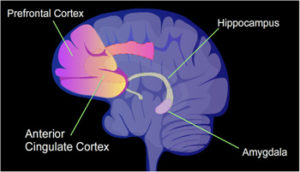
    Illustration shows the location of amygdala in the brain which is intergral to bipolar disorder.The Prefrontal Cortex – Dorsolateral and Ventral

    Another key area in the brain that’s significant for you if you have bipolar disorder is the prefrontal cortex. It helps us consider facts and choose our behavior in response. This area helps with mood regulation, and helps us inhibit behaviors we may feel like doing, but know are not socially advantageous to display.

    There are two key players in the prefrontal cortex for people with this bipolar disorder. They’re the dorsolateral prefrontal cortex, and the ventral prefrontal cortex.

    The ventral prefrontal cortex is securely connected to the amygdala. Like the amygdala, it also responds to what’s rewarding or not rewarding. In people with bipolar disorder, it responds with more intensity than it does in those who don’t have this disorder.

    The dorsolateral prefrontal cortex is the more rational part, and tends to moderate emotional reactions. In people with bipolar disorder, it’s far too inactive.

    Which means that the emotional networks of the brain in bipolar disorder are exceptionally active, and the networks that moderate those emotions are less active or ineffective.

    The result? Highly active emotions in a person who doesn’t have the equipment to regulate them. Plus highly stimulated aggression, again without the inhibitions to control it. This is a brain that just can’t do its job.

    Bipolar Disorder is a Biologic Illness

    All of this is to say that bipolar disorder isn’t an excuse for misbehavior–as sometimes cruel, uninformed individuals might think. It’s the result of altered areas of the brain that heighten emotion when that brain is also lacking the equipment it needs to manage emotional responses.

    For this reason, if you live with bipolar disorder, you can know this is a condition just as real as diabetes or heart disease and just as debilitating.

    And just like other illnesses, if you have bipolar disorder or other mood disorders, you need support and help through treatment.

    We’ll talk more soon about how this disorder affects your life, your work, and your social connections. But for now, let’s just understand that your illness is caused by things in your body that aren’t working properly. Those things need to be treated.

    Some people experience a stable and rewarding life with the right medicine, good therapy, and good structure in their lives. But some need an alternative treatment to enjoy a fulfilling life.

    Experience Improvement

    The only way to determine what might be most helpful for you as an individual requires a thorough evaluation with diagnostic tests.

    That’s why we’re here. We have the expertise it takes to tease apart complex symptoms from the complex life stories that embed them, to rule out other conditions that mimic or masquerade as mood disorders, and to offer sophisticated solutions to get your mood, thinking, and behavior back on track. 

    And we offer an array of treatment options to help you find your best self — including effective ways to stimulate the firing of large neural networks with TMS, and ground-breaking opportunities to stimulate your own neuronal rearborization with IV ketamine

    There have never been more exciting opportunities to get well and stay well.

    Call for an appointment so we can do a full evaluation, and create a plan for you.

    You can experience a more fulfilling and rewarding life, even with a diagnosis like bipolar disorder. You just can’t do it alone.

    Contact me and let’s get started.

    In support of your best self,

    Lori Calabrese, M.D.

    Lori Calabrese, MD offers innovative psychiatric treatment

  • The Doctors: Woman Shares Her Experience Undergoing Ketamine Infusions for Depression

    The Doctors: Woman Shares Her Experience Undergoing Ketamine Infusions for Depression

    Julie, who says she has suffered with clinical depression almost her entire life, recently underwent two ketamine injection treatments to treat her condition. She joins The Doctors to share her experience with the controversial new treatment.

  • There’s No Shame in Shyness

    There’s No Shame in Shyness

    Shy teen feels left out and rejected by peer group. LoriCalabreseMD

    Shyness is a natural reticence to interact with people you don’t know. For those who are shy, it can be very painful and interfere with their social development.

    Introverted ?  …or Shy?

    You may have heard it said that shyness is just introversion. But, this isn’t really true. An introvert may or may not be shy. Introversion is in a person’s makeup causing aloneness to be energizing. Extroversion is a personal state for those who are most energized by interaction with people.

    Shyness, though, is another matter. Some shy people really long for social interaction, but are too inhibited to seek it. It’s an offshoot of social anxiety, where there may be fear of rejection, worries about how you’re seen by others, or negative feelings about yourself.

    As a symptom of social anxiety, shyness can include the belief that everyone is talking about you negatively, or that you’re just not acceptable to others for unknown reasons. A shy person might say to herself, “If they’d just get to know me, they’d see I’m actually a great person.”

    But the shyness can be expressed on the outside by a withdrawn demeanor, or sometimes even a scowl. And those around him may not realize he wants friendship. So a vicious social cycle can form.

    Feeling Shy is Universal

    Most of us feel a little shy at some point in our lives, but when it happens it’s usually transient due to new surroundings or new social settings. But for some, the withdrawal and anxiety is so intense, it prevents interacting with others in situations where it’s really important.

    Add to that the physical symptoms that may show up like deep blushing, profuse perspiration, rapid heartbeat, and upset stomach — and a difficult situation can become unmanageable.

    If you or your child experiences intense shyness, do you find yourself in any of these situations? Do you:

    • Cancel social events at the last minute?
    • Have a small or nonexistent circle of friends?
    • Avoid activities that would otherwise have been pleasurable?
    • Tend to be passive or pessimistic?
    • Have low self-esteem?
    • Use the computer excessively to you avoid face to face contact with others?

    What Causes Such Social Avoidance and Shyness?

    Some people are just born more highly sensitive and emotionally reactive. They show withdrawal and shyness as they grow to be toddlers. If they lack adequate social support, they naturally withdraw.

    Sometimes, their nature is at odds with other family members and they don’t feel they fit in.This beautiful teen girl believes her friends talk about her and ridicule her because of her social anxiety. Her shyness is crippling. LoriCalabreseMD

    Other times, shyness is caused by experiences where they feel shamed or traumatized. This can also happen with a move to another school or city where they have to start over building a supportive group of friends. The vulnerability they feel, or teasing by their new acquaintances, can trigger a shyness and anxiety they never felt before.

    In addition, abrupt changes in family life, or a sudden change like living with a family member, or divorce, can trigger this loss of confidence and withdrawal.

    In both children and adults, negative hurtful interactions or harsh criticism from parents or other family members, or cold family relationships can be damaging and lead to social avoidance, shame, and shyness.

    The same is true of school and work where public embarrassment, and highly competitive, critical or hostile environments can cause the same type of damage to a sensitive person.

    So What Can You Do About Shyness?

    Be kind. Whether to yourself or your loved one, patience and support are the ticket.

    Don’t force social situations … the confidence and stamina to face them will come in time with support.

    Talk with someone you trust, or ask your loved ones about the events of their day and how it all makes them feel.

    Validate for yourself or your child that deep need we all have to belong, and the conflict with the fear of rejection.

    Work on thought patterns, criticism of yourself and others, and develop different ways of thinking about these things.

    Remind yourself and your loved ones that shyness is something everyone feels at some point. With time, patience, and support it will become manageable.

    Over time, you may find you’re ready to set manageable goals for interaction in user-friendly situations.

    Spare Yourself or Your Child Excessively Hostile Situations

    Shyness makes a teen feel her friends are talking behind her back. LoriCalabreseMD

    …until your confidence has improved and you can choose your battles.

    You’re a beautiful person, and there’s no shame in your shyness.

    Loving yourself as you are can help you combat those inner doubts that make your shyness so painful.

    Your sensitivity protects the treasure within you so you can make social decisions that actually enhance your wellbeing.

    If social anxiety holds you back from things you want to experience in life, we can help. Innovative Psychiatry provides treatments that break through tradition and accelerate your progress. Call us today to schedule an appointment for evaluation.

    To your ever blooming best self,

    Lori Calabrese, MD

    Lori Calabrese, MD offers innovative psychiatric treatment

  • Attitude of Gratitude: How to Rise Above Tragedy

    Attitude of Gratitude: How to Rise Above Tragedy

    Grateful woman with arms upraised, overcoming tragedy with attitude of gratitude

    WHAT DOES GRATITUDE HAVE TO DO WITH HAPPINESS?

    We’ve been talking about the science of happiness. The things researchers have been learning about what actually make us happy, as well as what doesn’t make us as happy as we think they will.

    The funny thing about happiness is that it’s sort of counter-intuitive. For instance, if we only think of ourselves and what we want, we begin to sink, and grow less and less happy.

    Even if we get EVERYTHING we want! The richest men in the history of humanity who were focused on accumulating for themselves and got everything they wanted…were usually miserable. The ancient king Nebuchadnezzar, for one. And Howard Hughes might be another example.

    SELFISHNESS HURTS

    Another dramatic example is King Solomon, who lived around 970 BC. He had it all…wealth, fame, and 700 wives. But… he was miserable. The more he gathered for himself, the more miserable he became. (Since building a healthy relationship with one spouse is pretty challenging already, it’s probably not that surprising he was overwhelmed and stressed out trying to do it with 700!)

    Solomon wrote three books in his lifetime, and the final one was about the misery of trying to make yourself happy by getting everything want.

    GIVING FREELY COMPOUNDS JOY

    On the other hand, men who used their wealth and power to improve the lives of people, and make the world a better place, have often been much happier. Men like John D. Rockefeller, who began giving 6% of his paycheck to charity at the age of 16, and lived his life not only building his wealth, but also perfecting systems of giving his money away to improve the lives of others. He has often been called the wealthiest man in the world, but he was also one of the most generous. John enjoyed his wife and family–a strong pillar of happiness.

    But then there was also his contemporary, Andrew Carnegie, who may really have been the wealthiest with the equivalent of $374 billion. In addition to building his massive steel company, he spent the last 20 years of his life traveling to see friends, and helping others. Mr. Carnegie enjoyed his visits with friends like Mark Twain, Teddy Roosevelt, and so many others. He had humility, and valued his friendships.

    These are just two examples of generous wealthy men who found happiness in giving and valuing their relationships. But it’s not hard to think of more from early times to the present. Genghis Kahn for instance (huge surprise!) and of course Bill Gates, among a host of others.

    GENEROSITY AND AN ATTITUDE OF GRATITUDE

    The fact stands that it’s not wealth that brings happiness, but generosity, strong relationships, and a passion for something.

    So…we talked about in our post last week about the science of happiness, we learned that it isn’t getting that brings us joy, but giving. Not taking advantage of someone else to our own ends, but serving and caring for the welfare of others.

    A huge study that included 200,000 people in 136 countries found that being generous had a positive effect on a person’s happiness in 93% of the countries involved. Another study conducted at Notre Dame found that the more people gave of themselves and their money, the happier they were.

    As humans, we need to have something bigger than ourselves to live for.

    We humans actually like to sacrifice for the good of others. How’s that for a surprise…?!

    Another pretty important factor is having an attitude of gratitude.  Rather than taking credit for everything we accomplish, and for all the good in our lives, we’re happier putting humility to work and expressing our gratefulness for the good in our lives and the potential for good even in the toughest situations. 

    Is that because we know we don’t have power to control everything?

    [Because if we think we can, the burden of controlling all things in the world around us to ensure safety, prosperity, friendship, and happiness, is a big truckload to pull around…but let’s save that for a future post.]

    SILVER LININGS

    The beauty of gratitude is that it acknowledges we can’t do it all ourselves. It also says that there’s good to be found in every circumstance of life, no matter what it is. By choosing to be grateful in a difficult circumstance, we open the door to solutions.

    There’s a man who is a world-class expert at finding silver linings. An expert at choosing gratitude.

    His name is Jon Morrow, and if you haven’t learned about him or met him up till now, you may want to connect with him before you forget.

    Jon was born with muscular dystrophy, and is unable to move anything but his lips and his eyes.

    Yes, he’s paralyzed. He can’t move any other part of his body. But he’s not numb. He feels pain just like you do. In fact, pain and struggle is part of every single day of his life.

    And yet, you know what? He’s developed, through decades of suffering, an overcoming approach to every challenge. He looks for the silver lining no matter how bad the circumstances, and he always determines to turn every difficulty into something in his favor.

    GRATITUDE EXPERT

    He’s grateful. Grateful for his life. He admits it’s not been an easy way to live, but he also knows if it had all been easy for him, he might have done nothing with his life.Person holds a beautiful flower in both palms showing that even in darkness gratitude for beauty brings happiness

    Ten years ago he was in poverty, in a hospital bed, and completely dependent on Medicaid to support him and his $120,000/year medical bills. He felt trapped. If he earned more than $700/month, Medicaid would drop him. So he couldn’t build a business…because he needed medical care.

    Jon hadn’t found his flow. Remember how in our science of happiness post we talked about how finding your flow motivates you to live with passion and purpose?  Jon hadn’t found his yet…he felt pretty much stuck.

    But, since the rules of Medicaid had him stuck, he set out to change the rules. It took courage, but the flow was beginning to trickle. He invested two years of his life writing for a successful online publication for free, because he couldn’t make more than $700/month anyway. 

    PUT GRATITUDE ON THE OTHER FOOT

    He told the publisher there was one stipulation…he’d write for them awhile for no pay, but eventually there would come a time he’d need some favors in return.

    Now, Jon is a guy who was accepted into MIT…but he couldn’t afford to go. Jon is no slouch, in fact, he’s a pretty sharp guy. So his writing was received with enthusiasm by this organization. This continued until 2 years later, when he was ready to take the next step.

    He told them it was time, and he needed some favors. He needed to move to Mexico where medical care costs far less. (That $120,000 bill per year in the US only cost $18,000 in Mexico!)

    He told them he needed to start a consulting business and asked for help reaching some people through their mailing list to market his services.

    They happily agreed, and in 30 days, this guy had a full-time consulting business that supported him with $10,000 per month. Now, ten years later, he’s a millionaire, and he can live wherever he wants to.

    Now, let’s talk about what makes happiness in light of Jon’s story.

    It’s human nature to feel sorry for ourselves when things don’t go well. We all know that. But Jon Morrow will quickly tell you he may be tempted to feel sorry for himself…but he can’t afford a single second of it without being defeated.

    JON MORROW’S ATTITUDE OF GRATITUDE

    To overcome whatever he’s faced with, he looks for a way to find benefit in his circumstances – to seek out that silver lining – and he looks for ways to make it better than if it had never happened.

    If you’re angry, bitter, or tied in knots of self-pity, you can’t think that way. When all thoughts are turned inward, it’s tough…really tough…to get them turned outward again.

    And like we said before, happiness relies on counter-intuitive responses. Focusing on ourselves snuffs out the joy. But looking for ways to help others, well, that fills us with power.  And happiness.

    I encourage you to read more of Jon Morrow’s writings. He’s learned some profound lessons about happiness, success, and giving of himself through his 34 years of struggle. He’s started a new blog to give back by teaching the world these principles that have brought him so much richness in life.

    So learn from his story the lessons of gratitude and generosity, of finding your flow, and always finding a way to turn every negative circumstance to your favor. When you do, your garden of happiness will be fertilized, nourished, and will grow so full you’ll have to give some of it away.

    And…if your own struggle makes happiness seem beyond reach, schedule an appointment to see if you’re a candidate for innovative psychiatric treatments like  IV ketamine therapy or transcranial magnetic stimulation. We’ll learn so much after a comprehensive evaluation.

    We’re here to help you live a more fulfilling and rewarding life, and look forward to hearing from you.

    To your increasing happiness within your best self,

    Dr. Lori Calabrese, MD

    Lori Calabrese, MD offers innovative psychiatric treatment

  • Newsweek: Could Ketamine be the Ultimate Cure for Depression?

    Newsweek: Could Ketamine be the Ultimate Cure for Depression?

    Ketamine, or “Special K” as it is commonly known, is a powerful anaesthetic that leaves the user feeling lifeless and physically detached from their senses.

    However, medical experts now believe the popular party drug could be the leading treatment for severe depression and suicidal thinking.

    According to the Washington Post, studies over the past decade have proved Ketamine’s efficacy in mental health patients suffering from severe depression who find traditional antidepressants ineffective.

    [button url=”https://www.newsweek.com/ketamine-can-help-cure-depression-422201″]Read Full Article Here[/button]

  • Newsweek: Ketamine Restores Ability to Experience Pleasure in Depressed Patients within Minutes

    Newsweek: Ketamine Restores Ability to Experience Pleasure in Depressed Patients within Minutes

    There are many faces to depression: sadness, hopelessness, trouble sleeping, lack of motivation, an inability to experience pleasure.

    That last one has a medical name—anhedonia—and people experiencing it often no longer enjoy activities that used to bring happiness. Anhedonia is not found just in depression; it can be an important part of other disorders, including schizophrenia, obsessive-compulsive disorder and addiction.

    [button url=”https://www.newsweek.com/ketamine-restores-ability-experience-pleasure-depressed-patients-within-278943″]Read the Full Article Here[/button]

  • Ketamine Curbs Suicidal Ideation Independent of Antidepressant Effect

    Ketamine Curbs Suicidal Ideation Independent of Antidepressant Effect

    Key clinical point: Ketamine quickly reduces suicidal ideation even in patients whose depressive symptoms are unresponsive.

    Major finding: Ketamine infusions significantly reduced suicidal ideation even in patients whose treatment-resistant depression did not respond to the drug.

    Data source: This ongoing observational study included 27 patients with treatment-resistant depression who received seven intravenous infusions of ketamine over roughly a 3-week period.

    [button url=”https://www.mdedge.com/clinicalpsychiatrynews/article/116353/depression/ketamine-curbs-suicidal-ideation-independent”]Read Full Article Here[/button]

  • What It’s Like to Have Your Severe Depression Treated With a Hallucinogenic Drug

    What It’s Like to Have Your Severe Depression Treated With a Hallucinogenic Drug

    Everyone’s depression is different, but Ted, a 40-year-old resident of Portland, Oregon, describes his as a “continuous dark veil — a foul, dark, awful perspective that informs every moment of your whole life.” He’d tried to treat it with antidepressants, therapy, visits to psychiatrists, “the whole nine,” but although the antidepressants kept him functional, they by no means offered relief. He was getting desperate, so when his sister — an obstetrician who works in New York — mentioned the National Institute of Health was conducting experimental studies using ketamine to treat depression, he gave them a call.

    [button url=”https://nymag.com/scienceofus/2016/03/what-its-like-to-treat-severe-depression-with-a-hallucinogenic-drug.html”]Read the Full Article Here[/button]

  • Street Drug ‘Special K’ May Offer New Hope For People With Treatment-Resistant Depression

    Street Drug ‘Special K’ May Offer New Hope For People With Treatment-Resistant Depression

    A hallucinogenic drug known on the street as “Special K” offers new hope to those suffering from severe, treatment-resistant depression.

    Ketamine, which was originally developed in the 1960s as a milder version of PCP, already has a well-established medical use as a sedative or pain killer. But since 2000, small but high-quality studies have demonstrated its uses as a powerful and fast-acting treatment for major depression.

    [button url=”https://www.huffingtonpost.com/2014/12/12/ketamine-depression_n_6312166.html”]Read the Full Article Here[/button]

  • Symptomatology and Predictors of Antidepressant Efficacy in Extended Responders to a Single Ketamine Infusion

    Symptomatology and Predictors of Antidepressant Efficacy in Extended Responders to a Single Ketamine Infusion

    Abstract

    BACKGROUND:

    Antidepressant response to a single sub-anesthetic dose infusion of the glutamatergic modulator ketamine is transient in most depressed patients; however, a minority continue to experience an extended response. This study examined depressive symptoms and potential clinical predictors of extended response to ketamine in subjects with mood disorders and found that a dissociative response during the infusion and a history of alcohol use in first-degree relatives predicted an extended response to ketamine.

    [button url=”https://www.ncbi.nlm.nih.gov/pubmed/27839782″]Read Full Article Here[/button]

error: Content is protected !!